

You search for your service on Google. A competitor shows up in the map results, in Yelp, in Apple Maps, in Facebook, and in a few directories you forgot existed. Your business appears too, sort of. The phone number is old on one site, the suite number is missing on another, and one listing still points customers to a location you left behind.
That’s usually the moment local citation work stops sounding like “SEO housekeeping” and starts looking like lost revenue.
Most business owners don’t have a visibility problem because they lack effort. They have a data management problem. Their business information has spread across the web over time, and nobody has owned the job of keeping it accurate, complete, and consistent. Local citation services exist to fix that. The useful ones don’t just submit your name to directories. They manage your business identity across platforms that customers and search engines both rely on.
Why Your Competitors Show Up Everywhere, and You Don’t
A familiar pattern shows up in local search. One company seems to be everywhere, while another has a decent website and solid service but barely appears outside its own domain. The difference often comes down to whether the business has built a stable citation footprint.
A local citation is one of the strongest externally visible trust signals a business can control. BrightLocal reports that citations are the sixth most significant ranking factor for local pack visibility and the fourth most important signal for local organic search results in its local SEO and citations guide. That doesn’t mean citations beat everything else. It does mean they’re too influential to leave half-done.
Competitors that show up everywhere usually have a cleaner digital trail. Their Google Business Profile matches their Apple Maps listing. Their Yelp page uses the same address format as their website footer. Their hours are current. Their categories make sense. Search engines can match those signals without guessing.
If you’re already working on ranking higher on Google Maps, citation work is part of the foundation. Maps visibility gets harder when the business data behind it is fragmented.
Practical rule: If a customer can find three versions of your contact details online, search engines can too.
This is why citation services matter even for businesses that don’t care about “directory traffic.” The actual value isn’t a random visit from an obscure listing site. The value is that consistent records across the web help confirm that your business is real, active, and located where you say it is.
What are Local Citations and Why do They Matter
A local citation is an online mention of your business details. In practice, the core data is NAP, which means name, address, and phone number. That mention can live in a structured directory listing, such as Yelp or Bing Places, or in an unstructured mention on a local blog, chamber page, or event site.
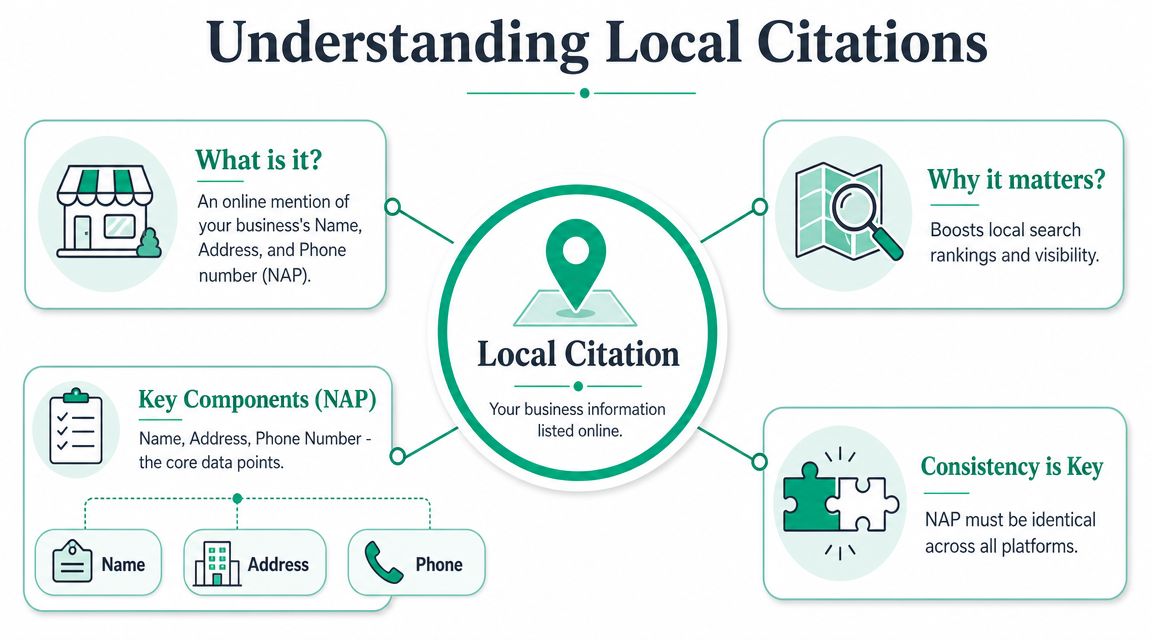
The basic idea behind citation trust
Think of citations as a distributed business record. Search engines compare those records across the web. When the details line up, the business entity becomes easier to validate. When they don’t, the cleanup burden grows.
Whitespark notes in its explanation of what a local citation is for local SEO that a complete citation should include NAP, while partial citations can leave out one or more elements. It also recommends keeping categories aligned across platforms and adding richer fields such as photos and operating hours where the platform supports them.
That last part gets missed all the time. A listing with only a business name and phone number is better than nothing, but it isn’t a finished asset. Categories, hours, photos, social links, and website URLs help platforms understand and present the business correctly.
For a broader walkthrough, this video gives a useful visual overview of local citations and how they fit into local SEO.
Structured listings versus unstructured mentions
The two main citation forms work differently:
- Structured citations live in defined listing fields. Examples include Google Business Profile, Yelp, Apple Maps, and industry directories.
- Unstructured citations appear inside regular content. A local news story, sponsor page, or blog post might mention your business name, address, or phone number without using a directory format.
Both can support local visibility, but citation services usually focus first on the structured side because those listings are easier to standardize, audit, and update.
If you want a practical companion piece, Adwave’s local citation building tips are worth reading because they show the difference between just getting listed and getting listed correctly. That distinction matters more than most business owners expect.
For businesses reviewing their broader listing footprint, this guide to directory listings for SEO connects citation work to the wider local search picture.
The Four Main Types of Local Citation Services
Not all local citation services do the same job. Some build listings from scratch. Some push your data through distribution networks. Others focus on cleanup, which is often the harder and more valuable task. If you buy the wrong service for your situation, you can spend money and still keep the same messy footprint.
Industry guidance described in this local SEO citations overview shows how the workflow changed over time. Citation work used to center on manual directory submissions. Now it’s a combination of listing distribution, auditing, correction, and maintenance. That same guidance recommends starting with major platforms first, then expanding into 10–25 highly relevant local and industry-specific directories.
Manual listing services
This is the hands-on version. A provider claims or creates listings one by one on key platforms.
Manual work is useful when your business has very little existing presence or when certain high-value listings need careful setup. A skilled specialist can choose the right category, write a proper description, upload photos, and verify ownership. The downside is speed. Manual work takes time, and if there’s no audit process behind it, the provider may create new listings without noticing older duplicates.
Aggregator distribution services
These services push your business data to networks, data suppliers, and connected platforms. They’re built for scale.
They can help when you need broad distribution across many endpoints and don’t want to touch every platform individually. The trade-off is control. Aggregator feeds don’t solve every issue, especially when a listing already exists with wrong data or when a platform requires direct claiming and verification.
Citation cleanup services
Cleanup work is where many businesses need help. The provider audits existing mentions, finds duplicates, flags outdated details, and corrects what can be corrected.
This is less glamorous than “we submitted you to lots of directories,” but it usually matters more. An old phone number on a live profile creates friction. A duplicate listing can split reviews or confuse users. Cleanup also tends to expose a business’s history, such as rebrands, moves, call tracking leftovers, or franchise data drift.
Cleanup usually produces more value than blind submission when your business has changed names, locations, or phone numbers.
Ongoing management services
This is the subscription model. Instead of treating citations as a one-time project, the provider monitors and updates listings over time.
That matters because business data changes. Hours shift. Holiday schedules appear. Staff update one platform but forget another. A new location opens. A suite number gets reformatted. Ongoing management keeps those changes from turning into another cleanup project later.
Here’s the practical comparison.
| Service Type | Primary Goal | Best For | Key Benefit |
|---|---|---|---|
| Manual Listings | Build or claim core profiles | New businesses or sparse online presence | Better control over setup quality |
| Aggregator Distribution | Push data broadly at scale | Businesses needing wide coverage | Faster expansion across connected platforms |
| Citation Cleanup | Fix inaccuracies and duplicates | Established businesses with messy records | Reduces confusion and data conflicts |
| Ongoing Management | Maintain listing accuracy over time | Multi-location brands or changing businesses | Prevents drift after initial setup |
What usually works best
Most businesses don’t need just one of these. They need a sequence.
Start with core profiles. Clean up what already exists. Expand selectively into relevant directories. Then maintain the stack. What doesn’t work is paying for bulk submissions before anyone checks whether the business already has conflicting listings scattered across the web.
The Business Case: What is the ROI of Citation Services
The return on citation work isn’t only “better SEO.” That phrase is too vague to help a business owner make a decision. This return shows up in fewer missed customer interactions and a stronger operating base for local search.

Where the value actually comes from
A customer who taps the wrong number doesn’t convert. A customer who drives to an outdated address doesn’t come back in a good mood. A listing with inconsistent hours creates support friction before your team ever speaks to the person.
That’s the first part of ROI. Citation services reduce operational leakage.
The second part is search support. Accurate listings strengthen the business data that platforms use to match your company to local searches. Citation work won’t rescue a weak website or an ignored Google Business Profile, but it gives those channels cleaner inputs.
Citations support more than rankings
When the citation layer is handled well, several business functions get easier:
- Customer access improves because contact details are easier to trust.
- Map discovery gets cleaner when platforms match the right address and category data.
- Brand presentation tightens up because photos, hours, and website links stop varying from one profile to the next.
- Internal marketing work gets simpler since teams aren’t fixing the same listing issues over and over.
A citation service is partly an SEO service and partly a records-management service. Businesses that understand that make better buying decisions.
This is also why cheap packages often disappoint. If the provider’s whole pitch is volume, they’re solving the smallest part of the problem. The long-term value comes from owning the business identity layer online and keeping it stable as the company changes.
How to Evaluate and Choose a Citation Service Provider
A citation vendor should be able to explain their process without hiding behind jargon. If they can’t tell you how they handle duplicates, listing ownership, and update cycles, they probably sell submissions rather than management.
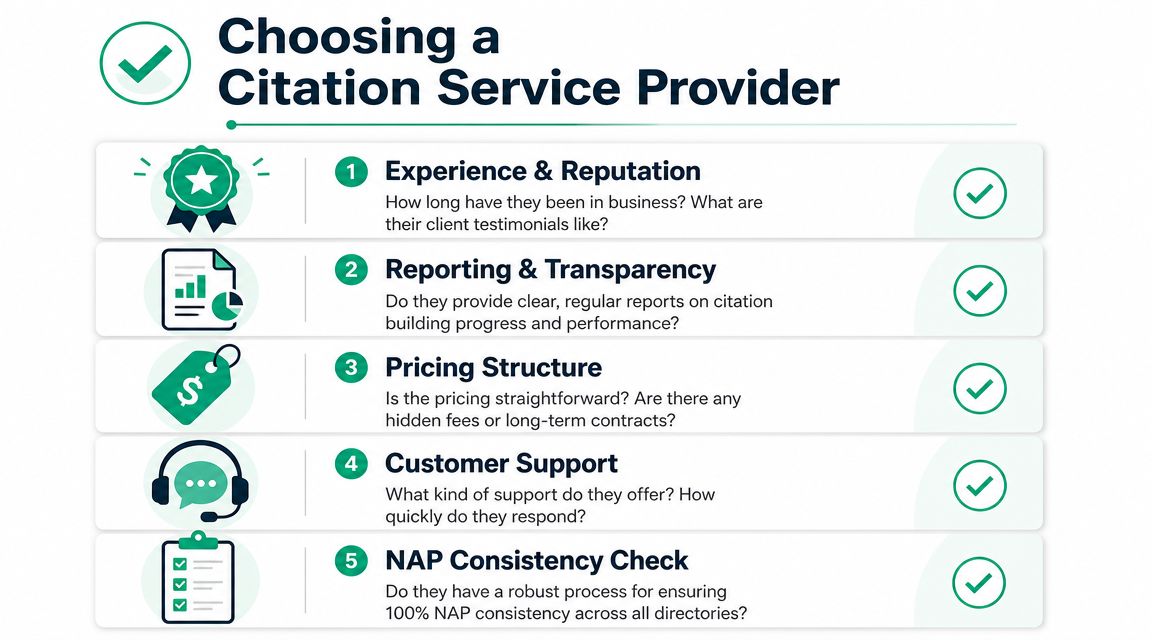
Advice Local explains in its resource on building local citations that effective citation services target a mix of horizontal, vertical, and local-market sources, rather than relying only on high-volume directories. It also notes that providers often use APIs alongside manual submissions to push accurate NAP data at scale. That combination tells you what to listen for in a sales call.
Questions worth asking before you sign
Use these questions to separate real operators from listing mills:
- How do you handle duplicates if the business already has old listings live?
- Which directories do you target first and why those, specifically?
- Do you claim and verify listings or only submit data and hope it sticks?
- Who owns the listings and login access after the work is done?
- How do you report changes so I can see what was fixed, not just what was submitted?
Those answers matter more than a polished dashboard.
What good answers sound like
A solid provider will usually describe a workflow, not a shortcut. They’ll talk about auditing existing records, standardizing the source-of-truth business data, prioritizing major platforms, and then building outward based on industry and geography. They’ll also explain how they update hours, categories, and profile content, not just NAP.
A weak provider tends to focus on quantity. Lots of directories. Fast turnaround. Little detail about claiming, ownership, or maintenance.
Here are a few practical checks:
Source-of-truth process
Ask what document or system they use as the master business record. If there isn’t one, your data will drift again.Directory mix
A provider should mention general platforms, niche industry listings, and local-market sources. That aligns with the mix described above.Review cycle
Ask how often they revisit listings after the initial build. If the answer sounds like “set it and forget it,” that’s a warning sign.Access control
Make sure your business can access or reclaim profiles later. You don’t want your listing footprint locked inside a vendor account.
If you’re comparing providers as part of a broader local search project, this article on selecting the right local SEO services gives a useful framework for judging process depth, not just price. One option in that broader category is Ascendly Marketing, which states that its local SEO work includes NAP consistency and directory auditing as part of citation management.
Common Pitfalls and Advanced Citation Strategies
The biggest citation mistake is thinking more listings automatically mean better results. They don’t. Low-quality submission campaigns can leave a business with more clutter, more duplicates, and less control.
Busy work that looks productive
Some services still sell giant directory blasts. They promise to reach, then push your business into every corner of the web, whether the listing matters or not. That approach creates maintenance debt.
Here’s what usually goes wrong:
- Weak directory selection because the provider prioritizes volume over relevance
- No duplicate suppression, so old listings stay live beside the new ones
- Poor category choices that muddy topical relevance
- Unclaimed profiles that nobody can easily edit later
A useful citation strategy is selective. It favors major platforms, then relevant local and industry sources, then maintenance.
If a vendor talks more about how many listings they create than how they prevent data conflicts, you’re hearing a submission pitch, not a management plan.
The ownership trap
Another problem is listing control. Some providers create assets under their own accounts, so the business can’t easily edit them after the relationship ends. That becomes expensive later, especially if the company moves, rebrands, or changes phone systems.
Ask for clarity on ownership before any work starts. That’s not an administrative detail. That’s future editability.
Multi-location and service-area complexity
Citation work gets harder when a business operates across multiple markets. Page One Power notes in its glossary entry on local SEO citations that multi-location citation management is a critical challenge because businesses must maintain dozens or hundreds of listings across markets, including duplicate suppression, category selection, and localized directory prioritization.
That’s where basic tools often hit a wall. A franchise, regional brand, or healthcare group can’t manage location data casually. Each location needs the right local signals without drifting into cross-location confusion.
Service-area businesses have a different challenge. They may not want to publish a storefront address, but they still need a coherent presence across platforms that support service-area handling differently. A citation plan for that business has to respect platform rules while keeping the public-facing details aligned.
Advanced moves that are worth the effort
Once the basics are under control, stronger citation programs usually include:
- Category alignment across platforms so the business isn’t classified one way in Google and another way elsewhere
- Rich profile completion with hours, photos, website links, and social profiles was supported
- Localized prioritization so each location targets the directories that matter in its own market
- Scheduled review cycles to catch data drift before customers do
That’s the operational reality. Citation work doesn’t stay finished on its own.
Your Questions About Local Citation Services Answered
Can I manage citations myself?
Yes, especially if you have one location and a stable business record. The issue isn’t whether you can submit listings. You can. The issue is whether you’ll keep them synchronized after changes, catch duplicates, and remember which platforms were claimed under which accounts.
Are one-time citation services enough?
Sometimes. A one-time cleanup and build can work for a simple business with one location and very few changes. For businesses that move, add staff-managed listings, open new locations, or update hours often, one-time work usually turns into recurring cleanup later.
How long does citation work take to matter?
Major platforms can be updated relatively quickly, but the broader effect depends on how messy your existing footprint is and how many platforms need direct correction or verification. Cleanup generally takes longer than a fresh submission because old data has to be found and resolved first.
What should a citation service actually deliver?
Look for a defined business record, claimed core profiles, correction of inaccurate listings, duplicate handling, and reporting that shows what changed. A spreadsheet full of submissions isn’t enough if the underlying conflicts remain.
Should I care about niche directories?
Yes, if they’re relevant to your industry or market. A targeted directory footprint tends to be more useful than broad placement on low-value sites.
If your business has inconsistent listings, duplicate profiles, or location data that keeps drifting, Ascendly Marketing can help you audit the footprint, clean up the major platforms, and build a citation process that supports long-term local search visibility.