

TL;DR:
- Most business owners misinterpret content creation as just writing blog posts, which limits their growth potential. Instead, it is a strategic, systematic process that drives revenue, builds authority, and benefits from AI and well-planned distribution. Building scalable systems, focusing on a few core formats, and prioritizing distribution ensures content efforts yield sustainable, measurable results.
Most business owners think content creation means writing blog posts when they have spare time. That framing costs them money. Content marketing generates 3x more leads than traditional outbound marketing at 62% lower cost, yet most companies treat it as an afterthought rather than a core revenue function. What is content creation, really? It is a systematic business discipline, not a creative hobby. This guide breaks down the definition of content creation, the types of content that drive results, proven strategies for building sustainable systems, and how AI is changing what small teams can produce.
Table of Contents
- Key takeaways
- What is content creation, and why does it matter
- Core content creation workflows and frameworks
- Types of content creation formats
- Using AI to optimize your content workflow
- Building a sustainable content marketing engine
- Our take on what actually separates content that works
- Ready to build a content strategy that actually works?
- FAQ
Key takeaways
| Point | Details |
|---|---|
| Content creation drives ROI | A documented content strategy increases success rates by up to 313% compared to no strategy. |
| Format choice matters | Short-form video delivers the highest ROI, but blogs remain top five for planned investment in 2026. |
| AI saves serious time | 86% of marketers say AI saves more than one hour per creative task, compounding output across the year. |
| Systems beat creativity | Small teams fail due to lack of repeatable systems, not lack of ideas or talent. |
| Distribution comes first | Every piece of content needs a distribution plan before production begins, or the work is largely wasted. |
What is content creation, and why does it matter
The definition of content creation is straightforward on the surface: it is the systematic process of planning, producing, and publishing digital materials designed to engage a specific audience. But that definition undersells the strategic weight behind it. Content is how your business shows up in search results, earns trust before a sale, and stays top of mind after one.
The importance of content creation becomes clearest when you look at what it replaces. Cold outreach interrupts. Paid ads disappear the moment your budget does. Content, built correctly, compounds. A well-researched article published today can generate leads two years from now with zero additional spend.
Why content creation is important for business is also a matter of reach. Content creation sits at the foundation of every major digital marketing channel:
- Search engine optimization (SEO): Google ranks pages, not websites. Without content, there is nothing to rank.
- Social media marketing: Every post, reel, and story is a piece of content that either builds your brand or wastes your time.
- Email marketing: Newsletters and campaigns run on content. The words do the work.
- Brand authority: Publishing expert content positions your business as the credible choice in your category.
“Content creation is the engine behind digital marketing. Without it, you are invisible to the audiences who are actively looking for what you sell.” — Ascendly Marketing
Despite this, only 47% of B2B marketers had a documented content strategy in early 2026. That gap is where your competitive advantage lives.
Core content creation workflows and frameworks
Knowing what content creation is only gets you so far. How you create it determines whether your efforts compound or collapse. Professional content production follows six repeatable stages.
- Ideation: Identify topics based on audience search behavior, competitor gaps, and business goals. Keyword research belongs here, not as an afterthought.
- Planning: Map out format, angle, target keyword, word count, and distribution channels before writing a single sentence.
- Production: Write, record, or design the content according to your plan. This is where most teams start. Starting here is why most teams struggle.
- Editing: Review for accuracy, clarity, brand voice, and SEO alignment. Editing is not optional for quality content.
- Publishing: Schedule and publish with proper metadata, internal linking, and calls to action in place.
- Performance tracking: Measure traffic, engagement, conversions, and rankings. Adjust based on what the data tells you.
Two frameworks are worth knowing as you build your system. The 3C’s model covers Creation (original material), Curation (sharing relevant third-party content with your perspective), and Conversation (engaging your audience directly through comments, replies, and discussions). The 5C’s model adds more strategic texture: Clarity, Consistency, Creativity, Connection, and Contribution. Both frameworks point to the same truth. Content creation is not just output. It is a relationship-building system.
One of the most underused practices is building a content calendar before the month begins. Teams that plan publish more consistently, maintain brand voice, and rarely scramble for ideas at the last minute.

Pro Tip: Plan your distribution before you produce. Every piece should have a clear channel strategy covering SEO, social, and email before production begins. Content without a distribution plan is content that does not get read.
Types of content creation formats
Understanding the types of content creation available to you is not just an academic exercise. The format you choose directly affects reach, engagement, and return on investment.
Text-based content
Blog posts, long-form guides, newsletters, and case studies fall here. These formats excel at SEO and building authority. Blogs remain a top-five format for ROI and planned investment heading into 2026, and for good reason. Long-form content ranks, earns backlinks, and converts readers who are deep in the research phase.
Video and audio content
Short-form video delivers the highest ROI among all content formats right now. Platforms like YouTube Shorts, TikTok, and Instagram Reels reward frequency and authenticity over production polish. Podcasts occupy a different lane. They build deep loyalty and work well for B2B brands where the audience commutes or multitasks.
Image and interactive content
Infographics distill complex data into shareable visuals. Interactive content, such as quizzes, assessments, and calculators, generates significantly higher engagement than static posts because it requires participation.
Here is a quick comparison to help you prioritize formats by goal:
| Format | Best for | Time investment | ROI potential |
|---|---|---|---|
| Blog posts | SEO, authority building | Medium | High (long-term) |
| Short-form video | Reach, brand awareness | Low to medium | Very high |
| Podcasts | Loyalty, B2B audiences | High | Medium to high |
| Infographics | Social sharing, link building | Medium | Medium |
| Interactive content | Engagement, lead capture | High | High |
One smart move for lean teams is repurposing. Repurposing content into different formats extends its lifetime and reach without starting from zero. A single 2,000-word guide can become a short-form video script, a newsletter series, a LinkedIn carousel, and a podcast episode. That is five pieces of content from one production effort.
A word on user-generated content (UGC): brands increasingly rely on customer photos, reviews, and testimonials as content. It works well. But public posting does not equal repurposing rights. Always secure permission before using customer content in your marketing materials.
Using AI to optimize your content workflow
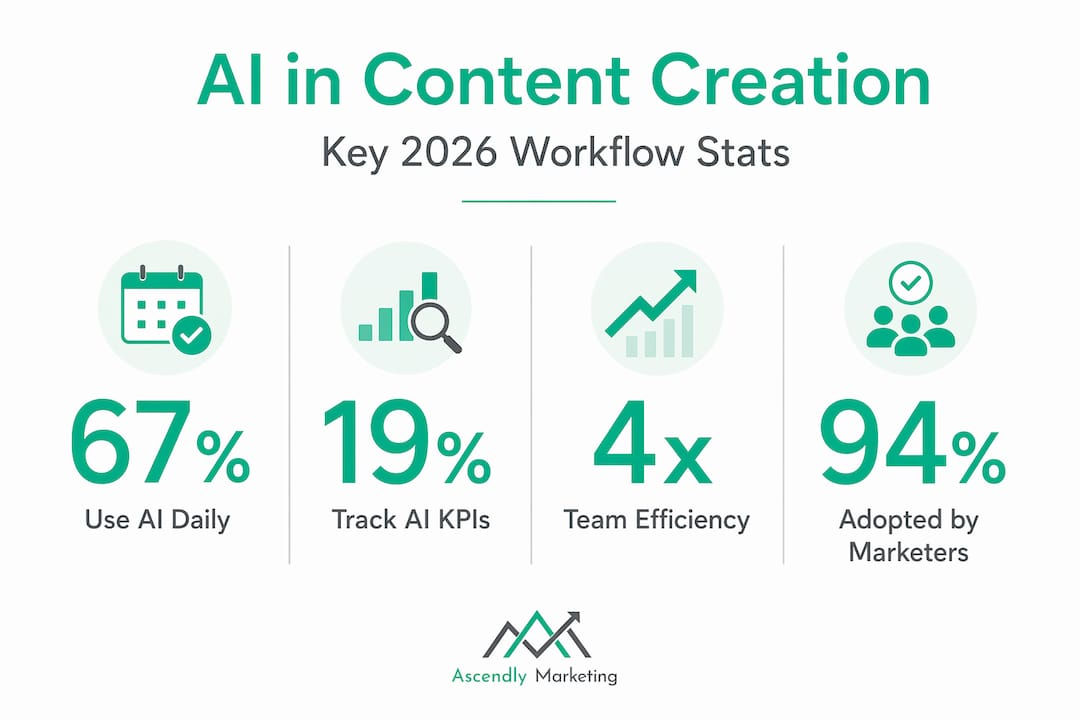
AI has moved from novelty to necessity for content teams. 94% of marketers now use AI in content creation, with 86% reporting it saves more than one hour per creative task. That time savings scales. Across a team of five producing four pieces per week, that is 20-plus hours recovered monthly for strategy, distribution, or business development.
AI is most effective when applied to the right stages of the workflow:
- Research and ideation: AI tools can surface topic clusters, analyze search intent, and identify competitor content gaps in minutes.
- Drafting: AI-generated first drafts give writers a starting point rather than a blank page, cutting production time significantly.
- Optimization: AI tools analyze readability, keyword density, and structure, flagging issues before publishing.
- Content planning: Some platforms generate content calendars based on goals, audience data, and trending topics.
The risk is over-reliance. 67% of marketers use AI daily, but only 19% track AI-specific KPIs. Most teams use AI to produce more without measuring whether that output is actually performing. Volume without accountability is just noise at higher speed.
Pro Tip: Treat AI as your research assistant and first-draft engine, not your editor or strategist. Human judgment on tone, originality, and audience relevance is still what separates content that converts from content that just exists. For a deeper look at AI tools for SMB marketing, there are practical frameworks worth reviewing.
Small teams can use AI to compete with brands that have four times the headcount. The key is using it to eliminate low-skill tasks, not to replace the thinking that makes your content credible and distinctive.
Building a sustainable content marketing engine
Most content programs fail not because the content is bad, but because the system is broken. According to research, small teams fail due to a lack of structured systems, not creativity. The solution is building a content engine that produces compounding results even when bandwidth is limited.
Here is how to build one:
- Audit your existing content. Identify what ranks, what converts, and what does nothing. Pages with low traffic and no backlinks are candidates for pruning or updating, not just leaving to rot.
- Build pillar content first. A pillar piece is a long, authoritative guide on a broad topic. Cluster content, such as shorter supporting articles, links back to the pillar. This structure signals topical authority to search engines and creates an interconnected web of content that drives compounding traffic.
- Document your content process. Every step from ideation to publishing should be written down. When your best writer is sick, the system should still function.
- Align content to business outcomes. Every piece should map to a measurable goal: ranking for a keyword, generating leads, reducing sales cycle length, or building email subscribers.
- Review and prune quarterly. A documented strategy paired with KPI tracking produces 2.4x better content ROI than reactive publishing. Kill what does not work. Double down on what does.
Learning how to scale content marketing without burning out your team requires this kind of intentional infrastructure. The businesses winning with content in 2026 are not the ones publishing most often. They are the ones publishing most strategically.
Our take on what actually separates content that works
I have worked with enough businesses to say this plainly: the ones who struggle with content creation almost always have a creativity problem in their heads and a systems problem in reality.
What I have learned is that the distribution-first mindset is not a nice-to-have. It is the difference between content that reaches people and content that sits quietly on a server. I have seen genuinely brilliant articles with zero traffic because no one thought about promotion before publishing. The content was good. The thinking around it was incomplete.
My honest read on 2026: quality and relevance beat quantity, full stop. The brands publishing three thoughtful, well-distributed pieces per month are outperforming the ones publishing daily without strategy. This is especially true for small teams, where scattered output creates brand confusion and exhausts resources faster than it builds momentum.
The one thing I would tell any business owner starting with content: pick two formats, build a repeatable process for each, and measure everything. Repurposing is your leverage. One great piece of content, distributed well and reformatted smartly, does more than ten mediocre pieces scattered across channels.
AI is a real force multiplier for lean teams. But it works best when a human with real expertise is steering the ship. Use it to go faster. Do not use it to go somewhere you have not decided to go.
— Ascendly Marketing
Ready to build a content strategy that actually works?
Understanding content creation is step one. Building a system that consistently produces results is where most businesses need outside expertise.

At Ascendly Marketing, we specialize in helping businesses move from scattered content efforts to structured marketing engines. Our team handles everything from SEO and content strategy to paid advertising and social media management. We have been doing this since 2013, and we work with businesses that need results, not theory. If you are ready to stop guessing and start growing, Ascendly Marketing is built to be the partner that gets you there.
FAQ
What is content creation in digital marketing?
Content creation is the process of planning, producing, and publishing digital materials, such as articles, videos, podcasts, and social posts, to attract and engage a specific audience. It forms the foundation of SEO, social media, and brand authority strategies.
Why is content creation important for business growth?
Content marketing generates 3x more leads than outbound marketing at 62% lower cost, making it one of the most cost-efficient growth channels available to businesses of any size.
What are the main types of content creation?
The primary types include text-based content (blogs, guides, newsletters), video (short-form and long-form), audio (podcasts), images (infographics), and interactive content (quizzes, calculators). The right format depends on your audience and business goal.
How do I start building a content creation strategy?
Start by auditing existing content, defining two to three core formats, building a content calendar, and aligning each piece to a measurable business outcome. Document your process so your system runs consistently regardless of team changes.
Can AI replace human content creators?
Not effectively. While 94% of marketers use AI in content creation, AI works best as a support tool for drafting, research, and optimization. Human judgment on strategy, originality, and audience relevance remains what makes content credible and distinctive.