

A customer sends you an email that says, “I told a colleague to call you.” That message is small, but the lead usually is not. The prospect arrives warmer, asks better questions, and spends less time doubting whether you can do the job.
This clarifies how do referrals work. A referral takes trust that already exists between two people and transfers part of it to your business. A referral program turns that from a lucky accident into a repeatable system.
Most articles stop at “offer a discount and ask customers to share.” That leaves out the hard parts. Who should receive the ask. What makes someone share. How tracking works once links, codes, cookies, and CRM records get involved. What breaks the program. And what happens when a referred customer has a bad experience.
The Untapped Power of Word-of-Mouth
A lot of businesses already get referrals, but they get them in a messy way. A customer texts a friend. A prospect mentions your name on a call. Someone forgets to ask who sent them. The sale closes, but nobody logs the source, nobody thanks the advocate, and the business learns nothing from it.
A referral program fixes that. It does not replace word-of-mouth. It gives it structure.
Trust changes the starting line
A cold lead starts from skepticism. A referred lead starts from borrowed confidence.
That difference shows up clearly in hiring. In referral hiring, referred candidates are 15 times more likely to get hired, and although referrals make up only 1% of applications across 38 million analyzed, they account for 37% of hires according to Boterview’s referral statistics summary. The context is hiring, not customer acquisition, but the mechanism is the same. A trusted person says, “This one is worth your time,” and the receiver treats the recommendation differently.
For customer referrals, that means fewer trust-building steps at the start. The prospect often arrives already believing three things:
- You are legitimate because someone they trust used you
- You fit the problem because the advocate made a relevant introduction
- You are safer to try because the referrer has already tested you
Word-of-mouth becomes a channel when you can track it
Plenty of owners say, “Most of our business comes from referrals.” Then they cannot tell you which customers refer most often, which offers drive sharing, or where the handoff breaks.
That is not a referral channel. That is anecdotal growth.
A working referral engine has four traits. It is visible, easy to share, easy to attribute, and easy to reward.
Once those pieces exist, referrals stop being random praise and start becoming an acquisition system you can improve.
The Anatomy of a Modern Referral Program
A referral program looks simple from the outside because the customer should not have to think much. Under the hood, five parts have to work together.
The advocate
The advocate is your current customer, client, user, or member. They are the person making the recommendation.
Not every customer should get the same referral prompt. A buyer who just had a strong result, left positive feedback, renewed a contract, or completed a successful project is a better candidate than someone still waiting on onboarding or support. Timing shapes participation more than many teams anticipate.
An advocate needs three things:
- A clear reason to share
- A simple sharing method
- Confidence that you will not embarrass them
That last part matters most in services and B2B. When someone refers you, they are putting their own judgment on the line.
The friend
The friend is the referred prospect. In B2B, this might be a peer, another owner, a department head, or a procurement contact. In ecommerce, it is often a personal contact who trusts the buyer’s taste.
The friend’s experience should feel direct. They should land on a page that explains the offer plainly, confirms that the recommendation came from someone they know, and removes extra steps. If they have to hunt for the discount or re-explain why they are there, conversion suffers.
The offer
The offer answers the practical question in the advocate’s head: “Why should I do this now?”
The reward can be money, account credit, product credit, a gift, access, or something reputation-based. The strongest offers fit your margin structure and your customer psychology. A generic reward often underperforms a well-matched one.
The tracking mechanism
Many homegrown programs fail at this stage. If you cannot tie the referral action to the eventual conversion, your program turns into a guessing game.
Common tracking methods include:
- Unique referral links with an advocate-specific ID
- Referral codes that the friend enters at signup or checkout
- UTM parameters passed into analytics and CRM workflows
- Platform integrations with systems such as HubSpot or Klaviyo
Each method has trade-offs. Links are easy to share. Codes work when people prefer to mention the offer verbally. CRM integrations reduce manual work, but they need clean setup.
The redemption process
A reward should not depend on someone checking a spreadsheet every Friday.
Define the event that triggers the reward. That might be a purchase, a signed agreement, a completed first invoice, or another verified milestone. Then decide how the reward gets delivered and how the participant sees its status.
A solid redemption flow answers these questions up front:
| Program Part | What it does | Failure point if missing |
|---|---|---|
| Advocate setup | Gives the customer a shareable identity in the program | Nobody knows who referred whom |
| Friend offer | Gives the prospect a reason to act | The referral feels vague or unconvincing |
| Tracking | Connects the share to the conversion | Rewards become disputed |
| Validation | Confirms a qualifying action happened | Fraud and accidental payouts increase |
| Reward delivery | Closes the loop with the advocate and friend | Trust drops fast |
If one of these pieces is weak, the whole program feels unreliable even when demand is strong.
The End-to-End Referral Journey
A referral is not one action. It is a sequence. A customer shares. A prospect clicks. Your systems identify the source. Your team validates the conversion. Then the reward gets released.
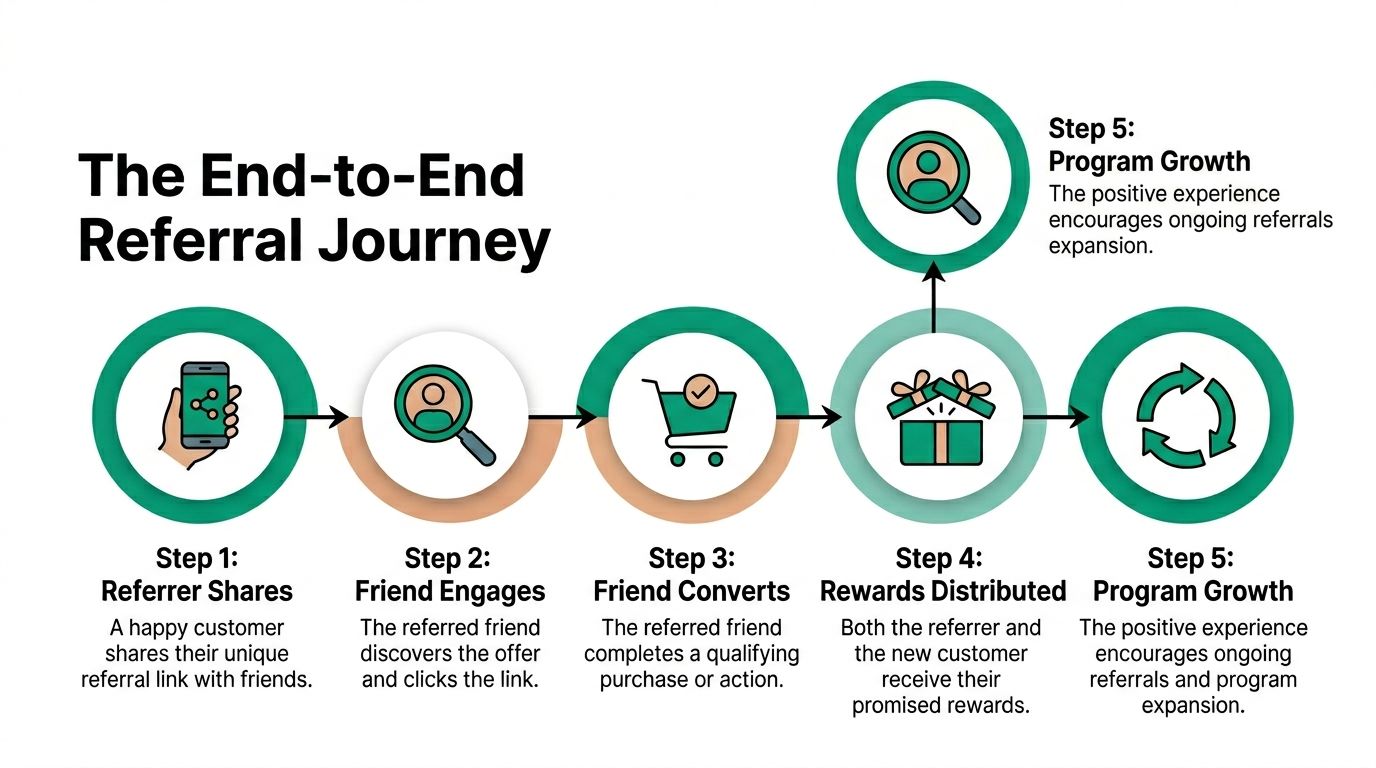
What the advocate experiences
The advocate usually enters the referral flow right after a positive moment. For ecommerce, that can be after delivery or after a strong review. For services, it is often after a successful milestone, a visible result, or a renewal conversation.
The system generates a unique referral link or code for that person. In many setups, software handles this automatically and presents a small dashboard with copy options for email, text, and social sharing. The advocate sends the link with a short personal note. That note matters more than the reward copy because it carries the original trust.
A good prompt sounds like a favor to a friend, not a commission pitch.
What the friend experiences
The friend clicks the referral link and lands on a page built for context. The page should confirm the value quickly. If the business uses email and CRM automation, the click can pass UTM parameters and referral IDs into systems such as HubSpot or Klaviyo, which makes later attribution easier.
The referred prospect often moves faster because the first trust hurdle has already been cleared. In customer referral programs, referred customers show 18% greater loyalty and 16% higher lifetime value, while the trust transfer can cut customer acquisition cost by 50-70% versus paid ads according to Rivo’s overview of how referral programs work.
That does not mean every referred lead closes. It means the lead enters the funnel with less friction than a stranger from an ad click.
For businesses that already run outbound and inbound together, referrals can feed other acquisition systems instead of replacing them. A practical example is using referred contacts to strengthen a broader lead generation process for small business, where warm introductions and direct outreach support each other rather than compete.
What the business has to track
The business side is less glamorous. It is also where the program either scales or becomes a mess.
At minimum, your workflow needs to answer four questions:
- Who shared the referral
- Who clicked or submitted
- What counts as a qualifying conversion
- When the reward should be released
The qualifying event varies by model. In ecommerce, it is usually a completed purchase. In B2B, it may be a booked demo, a signed contract, or a paid first invoice. For local services, it might be a completed job.
Teams often encounter issues at this point. They launch the front-end experience first, then try to patch together attribution later. That creates disputes. A customer says they referred someone. Sales says the lead came from organic search. The CRM record lacks a source field. Finance does not know whether to approve the reward.
Clean referral operations solve that before launch.
A practical backend flow often looks like this:
- Share recorded: the software assigns the advocate’s unique identifier
- Visit captured: the click passes a referral ID or code into analytics
- Lead created: form submission writes the source into the CRM
- Conversion validated: the system checks whether the event meets program rules
- Reward triggered: credit, discount, or gift is released automatically or approved through review
A short visual helps if you need to explain the process to a team member or stakeholder:
Why the loop compounds
The best referral programs create a second effect beyond the initial sale. The referred customer arrives predisposed to trust the business, has a better first experience because expectations are clearer, then becomes another possible advocate.
That is why the full lifecycle matters. If the share step is easy but the reward is late, the loop weakens. If the friend converts but the CRM misses attribution, the advocate loses confidence. If the reward works but the onboarding disappoints, the program produces one sale and no second-order referrals.
Referral growth does not come from the link alone. It comes from a clean chain of events with no weak handoffs.
Designing an Irresistible Incentive Structure
The incentive is not the program. It is the lever that gets people to act. Pick the wrong one and your referral page will sit there untouched. Pick the right one and customers share because the offer feels natural, fair, and easy to explain.
Four incentive models that work differently
Some businesses do well with direct rewards. Others get better traction when the “reward” is social usefulness or professional credibility.
| Model Type | How It Works | Best For | Key Consideration |
|---|---|---|---|
| One-sided reward | Only the advocate receives the benefit after a qualifying referral | Service businesses with loyal repeat customers | Can feel self-serving if the friend gets nothing |
| Dual-sided reward | Both advocate and friend receive a benefit | Ecommerce, subscriptions, consumer offers | Easier for advocates to share because they are giving, not just getting |
| Non-monetary reward | Access, upgrades, exclusives, priority treatment, or added features | Brands with strong loyalty or premium positioning | Must feel valuable, not symbolic |
| Reputation-based referral | Customers or peers refer because your expertise helps them look smart | B2B, agencies, consultants, professional services | Depends on visible proof of specialization |
Why dual-sided offers usually feel easier to share
When both sides benefit, the advocate does not need to justify the message. They can send it as a helpful introduction. That lowers social friction.
A one-sided reward can still work, especially when existing customers have frequent repeat purchases and value credit or perks. But if the advocate feels awkward sending it, participation drops.
For retention-focused brands, the reward should support future value rather than stand apart from it. That is why account credits, service credits, and loyalty benefits often fit better than disconnected gifts. If you already think carefully about improving customer lifetime value, the referral reward should extend that strategy instead of pulling against it.
B2B often runs on reputation more than coupon logic
Professional services and B2B firms should pay attention to a different dynamic. A lot of referral content assumes a consumer discount model. That misses how service buyers behave.
For professional services firms, referrals generated from perceived specialized expertise are 61% more frequent than referrals based on a general “great company” reputation, according to this analysis on referrals and specialized expertise. In practice, that means people refer firms when they can describe exactly what that firm is known for.
A vague reputation sounds like this: “They’re good.”
A useful reputation sounds like this: “They know ecommerce SEO migrations,” or “They handle B2B lead generation for complex sales.”
That difference changes how you build the program.
What works better than a bigger reward
If you sell expertise, referral volume often rises when you improve the shareability of your positioning rather than the size of your incentive. Three methods tend to help:
- Publish narrow proof of expertise so advocates can point to something specific
- Give referrers simple language they can copy into an introduction
- Create referral assets such as short pages, audit offers, or focused explainers that reduce the risk of making the introduction
In B2B, the easiest referral is often not “use this company.” It is “talk to them about this problem.”
That distinction matters because the advocate is protecting their own credibility. A discount might be nice. A clean, specialist recommendation is safer.
Real-World Referral Programs Across Industries
The mechanics stay consistent across industries, but the program should not look identical for every business. The buyer context changes the ask, the reward, and the moment when someone is most likely to share.
Ecommerce brands
An ecommerce referral program usually works best when the reward is simple and immediate. The customer buys, has a good delivery experience, then gets invited to share a personal link with friends.
A strong version of this program keeps the message short. The advocate sees the benefit, copies the link, and sends it in a text or group chat. The friend lands on a page where the offer is already explained and easy to apply. Nothing about the experience should require support.
What fails here is overengineering. If the customer has to create a separate account, remember a code, or explain the program manually, the share rate drops.
A cleaner ecommerce setup often includes:
- Post-purchase timing after the customer is satisfied, not during checkout
- Simple friend benefit that makes the first order easier to justify
- Automatic application of the reward where possible
B2B SaaS companies
SaaS referrals are usually less transactional and more layered. A user may love the product but still hesitate to refer because a bad recommendation reflects on them professionally.
That changes the reward logic. Instead of pushing a generic cash offer, many SaaS teams position the referral around relevance. The message becomes, “Know another team dealing with this workflow problem?” That is easier to send than a broad “refer anyone.”
Tiered rewards can also make sense in SaaS because advocates may know several peers in the same category. The company can reward the first successful introduction one way, then expand value for later successful referrals. The details vary by business model, but the principle is stable: match the reward to a longer sales process and a higher-trust introduction.
Local service businesses
Local service referrals often happen offline first. A homeowner asks a neighbor who did the work. A business owner asks another owner who built the website or handled the campaign. The referral system should support those natural conversations, not force them into a digital script.
That means codes and short links are often more practical than long referral pages. Staff also need a simple way to ask, “Did someone refer you?” when calls come in.
Three details matter more than owners expect:
- Front desk awareness so the source gets logged
- A visible thank-you process so the referrer sees follow-through
- A clean service experience because the referred customer arrives with high expectations
Agencies and consultants
Service firms often make the mistake of copying retail referral tactics. “Give a discount, get a discount” can work in some cases, but it is rarely the strongest lever.
For agencies, consultants, and similar firms, the referral often starts with visible competence. A client forwards a report, shares a result, mentions a process, or points a peer to a useful piece of content. The referral does not feel like a promotion. It feels like problem-solving.
That is why a service firm should build two referral paths, not one:
- A formal program for clients who want a clear incentive and trackable process
- An expertise path where content, case examples, and direct introductions make referrals easier even without a transactional reward
When those two paths run together, the business captures both kinds of advocates. Some want the credit. Others just want to point the right person in the right direction.
Measuring Success and Scaling with Technology
A referral program can produce sales and still be poorly run. You only know whether it is healthy when you can measure the chain from invitation to reward.
What to track first
You do not need a giant dashboard on day one. You do need a short list of metrics that answer practical questions.
Start with these:
Participation rate
How many existing customers join or engage with the program after seeing it?Share activity
Are advocates sending links, codes, or introductions?Referral conversion rate
Of the referred prospects who click or respond, how many complete the qualifying action?Reward fulfillment rate
Are valid rewards getting delivered on time, with no manual confusion?Channel comparison
How does referral acquisition compare with paid and outbound channels on cost and quality?
If you need a structured framework for finance and reporting, this guide on how to measure your referral program's ROI gives a practical way to connect referral revenue, incentive cost, and channel efficiency.
What your stack should do
A referral tool is not useful if it sits apart from the systems your team already uses. The core job is to move referral data into the places where marketing, sales, and support already work.
That usually means connecting referral software to:
| System | Why it matters |
|---|---|
| CRM | Stores referral source, advocate identity, lead status, and conversion outcome |
| Email platform | Triggers invites, reminders, and reward notifications |
| Analytics | Tracks link behavior, landing page performance, and assisted conversions |
| Ecommerce or billing system | Verifies whether a purchase or payment qualifies for reward release |
A lightweight but reliable workflow beats an elaborate one full of edge cases nobody can maintain.
If you want to connect referral data back to broader channel performance, a clear method for how to calculate marketing ROI helps keep referrals in the same reporting language as paid search, SEO, and email.
Where AI changes the program
AI is starting to matter in referral systems for one reason. It helps teams stop treating every advocate the same.
According to Thrive’s referral marketing guide, integrating AI for personalization can lift referral conversions by up to 40%, and AI-driven platforms boost advocate engagement by an average of 37% through personalized sharing suggestions and dynamic rewards. The practical use case is not futuristic. It is basic segmentation done better.
An AI-assisted setup can do things such as:
- Recommend the right prompt based on purchase type or account behavior
- Adjust the reward based on likely value or likelihood to share
- Choose timing so the ask appears after a positive moment instead of at random
- Flag strong advocates who repeatedly influence high-quality leads
The gain from AI usually comes from relevance, not novelty. A referral ask that fits the customer’s context gets shared more often.
That said, AI does not rescue a weak program. If your rules are confusing or rewards arrive late, no personalization layer will fix the trust problem.
Your Launch Checklist and Common Pitfalls
A referral program should launch small, clean, and auditable. Most failed programs do the opposite. They promise too much, rely on manual tracking, and confuse both the customer and the team.
A launch checklist that keeps the program usable
Start with the operating model before the creative.
Define the qualifying action
Decide what counts as a successful referral. A click does not count. A form fill may or may not count. Use an event that your systems can verify consistently.Choose the advocate moment
Pick one or two moments when customers are most likely to share. After a positive outcome works better than a generic newsletter blast.Write the rules in plain English
Customers should know who is eligible, what happens next, and when rewards are issued. If a support rep has to translate the rules, they are too complex.Set up attribution before promotion
Make sure the referral ID, code, or source field flows into your CRM or order data before the first referral goes live.Test reward delivery
Run test referrals internally. Confirm that valid conversions trigger the correct reward and that failed cases do not.Train the team that handles inquiries
Sales, support, front desk, or account staff need to know how the program works. A referred lead should never hear, “We don’t really track that.”Create a small reporting rhythm
Review participation, conversions, disputes, and reward timing regularly. Small operational issues become trust issues fast.
If you want a second tactical checklist to compare against your own rollout plan, this guide on how to start a referral program is useful because it frames setup in operational terms rather than campaign hype.
Risks often overlooked by organizations
The biggest risk is not low participation. It is damage to trust.
A significant danger in referral marketing is reputation damage, because every referral cedes part of your brand’s reputation to the advocate. Industry analysis also indicates that 28% of referral programs fail due to operational issues like unfulfilled rewards, which erodes advocate trust according to Extensiv’s referral marketing analysis.
That risk shows up in several ways.
Poor delivery after the referral
The advocate expects you to take care of the person they sent. If onboarding is sloppy, support is slow, or the sales call feels off, the advocate regrets making the introduction.
Confusing terms
Complex exclusions, unclear timing, and hidden qualification rules make customers feel tricked. Even when the legal terms are technically correct, the social contract is broken.
Manual reward handling
If reward delivery depends on an employee remembering to process it, the program will eventually disappoint someone. That disappointment spreads faster in referrals because the customer already made a personal recommendation.
Compliance blind spots
B2B teams can create trouble when referred leads get pulled into outreach flows without proper handling of consent, disclosures, or communication rules. Referral programs need the same discipline as any other acquisition channel.
Keep the promise narrower than your operations. A program that works every time beats a bigger one that fails in edge cases.
What works better than a broad launch
A tight pilot with a small customer segment usually produces better learning than a full rollout. Pick a segment where the service experience is stable, attribution is easy, and the customer relationship is strong.
That gives you room to answer practical questions:
- Do customers understand the offer without support?
- Does the referred lead land in the right pipeline?
- Are sales and support teams treating referred contacts differently when appropriate?
- Do rewards go out without disputes?
Fix those before scale. A referral engine grows through reliability.
If you want a referral program that is tracked correctly, aligned with your sales process, and tied back to real revenue, Ascendly Marketing can help you design the funnel, connect the systems, and turn word-of-mouth into a channel you can effectively manage.