

B2B companies are spending more on SEO, but the return often falls short because the strategy targets traffic instead of buying visibility.
That’s the problem with most B2B SEO programs. They chase traffic graphs, celebrate impressions, and miss the pages that influence vendor shortlists, internal discussions, and sales conversations. In B2B, revenue usually comes from repeated exposure across a long research process, not from a single blog visit.
The better model is exposure over traffic. Your company needs to show up in the searches that matter during the full buying cycle, using the terms buyers use, on pages that answer commercial questions well enough to move an opportunity closer to pipeline.
Winning the Real Prize in B2B SEO
B2B deals rarely come from one search and one visit. Buyers research, compare options, share pages internally, and return later with a narrower question. If your SEO program only wins broad informational traffic, you can report growth and still miss the searches that shape shortlist decisions.
That gap shows up in pipeline reviews fast.
A lot of small B2B companies invest in content that attracts early curiosity but never supports evaluation. The problem is not SEO itself. The problem is using traffic as the main success metric instead of measuring whether your company keeps showing up during the full research cycle. In practice, the actual prize is exposure to the right accounts, on the right topics, at the right moments.
Traffic can grow without improving pipeline
I see the same pattern across B2B engagements:
- Teams target broad keywords and rank for definitions, trend pieces, and general education topics.
- Organic sessions increase, but the audience has weak purchase intent.
- Sales reports poor lead quality because the pages do not answer vendor-selection questions.
- Marketing gets pressured to publish more when the issue is page intent, not content volume.
The page with 200 visits can produce more revenue than the page with 2,000 if it reaches a buyer comparing solutions, checking integrations, or validating budget.
That is why I treat exposure as the primary goal. Strong B2B SEO makes your company visible across problem-aware, solution-aware, and vendor-aware searches. Those terms usually have lower volume. They also tend to influence real opportunities. If you need a tighter framework for evaluating those terms, this guide on how to choose keywords for search engine optimization is a useful starting point.
What to prioritize instead
Use this filter before approving any SEO work:
| Focus area | Weak approach | Revenue-focused approach |
|---|---|---|
| Keyword targets | Broad industry phrases | Specific pain-point and use-case queries |
| Content success | Traffic volume | Sales conversations and qualified actions |
| Site structure | Blog-heavy sprawl | Clear paths to solution and service pages |
| Reporting | Rankings and sessions | Lead quality and pipeline contribution |
There is a trade-off here. Broad topics can help with awareness and remarketing audiences, but they should not consume most of the budget unless they support commercial pages. For B2B companies with limited resources, SEO usually performs better when the priority is visibility on comparison, use-case, problem, integration, and pricing-adjacent searches.
The same discipline applies outside Google. Teams that sell through marketplaces often study category-level query patterns before they create content or listings, which is why resources on top tools for Amazon growth can be useful for understanding search demand by buyer intent.
B2B SEO isn’t a publishing contest. It is a visibility system built to influence pipeline, not just traffic charts.
Discovering What Your Buyers Actually Search For
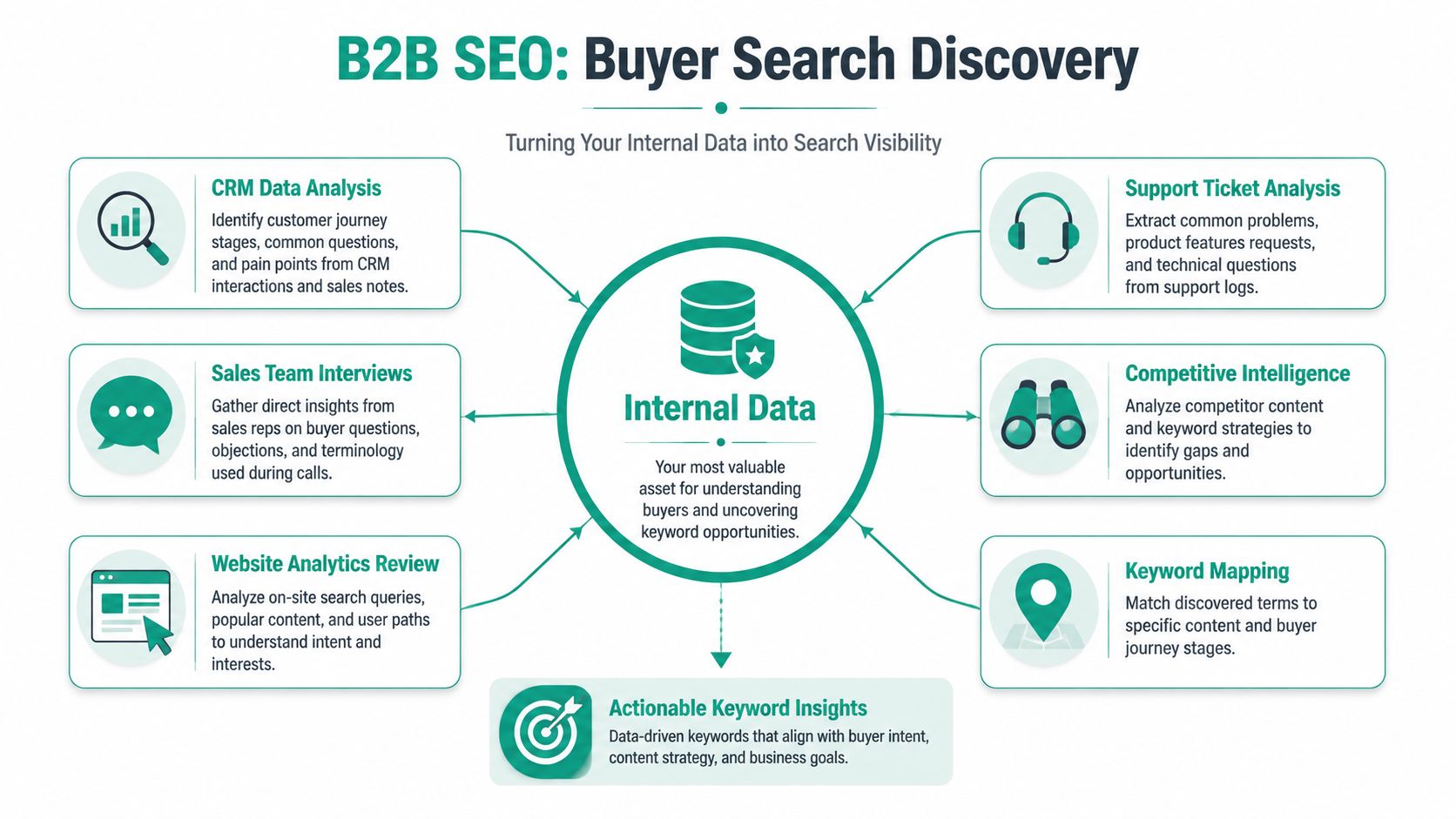
The strongest keyword list usually isn’t sitting in Ahrefs, Semrush, or Google Keyword Planner. It’s sitting in your CRM, support desk, call recordings, and inbox threads.
Evidence shows that 40% of high-intent B2B queries come from exact buyer wording in support tickets and sales call transcripts, based on CXL’s analysis of B2B long-tail SEO strategy. That lines up with what works in practice. Buyers often search with awkward, specific, half-formed phrases that standard keyword tools flatten or miss.
Start with earned insight, not keyword volume
Pull language from places where buyers speak without marketing polish:
Sales call transcripts
Look for repeated questions, buying objections, competitor mentions, budget concerns, and implementation fears.Support tickets
These reveal feature confusion, setup issues, integration gaps, and wording real users use under pressure.CRM notes
Read lost-deal notes and qualified-opportunity notes side by side. The contrast tells you which questions belong on awareness pages and which belong on commercial pages.Site search and chat logs
If visitors search your own site for pricing, setup steps, or comparisons, those topics need dedicated pages.Customer interviews
Ask recent buyers what they typed into Google before booking a call. You’ll get language no tool can infer cleanly.
Buyers rarely search the polished phrase you want them to use. They search the messy phrase they actually said on a call.
Turn messy language into usable keyword clusters
Don’t dump raw phrases into a spreadsheet and call it research. Sort them by intent.
A simple way to do that:
- Problem-aware terms like workflow bottlenecks, reporting gaps, sync issues
- Solution-aware terms tied to software category, service type, or process fix
- Decision-stage terms such as pricing, alternatives, comparisons, implementation, migration
- Post-sale search behavior that can still attract future buyers through support-style content
Here’s the question to ask for each phrase: would a person searching this term be useful to sales if they landed on the right page?
If yes, map it.
Build pages around exact buyer questions
One transcript phrase can produce several assets:
- A detailed blog post for the initial question
- A service or solution page section that handles commercial intent
- An FAQ block for objection handling
- A comparison page if competitors come up repeatedly
- A help article if the phrase reflects implementation friction
For a practical framework on turning terms into targets, use a keyword mapping process like this guide on how to choose keywords for search engine optimization.
If your business also sells through marketplaces or studies how buyers phrase product searches in tight commercial environments, this breakdown of top tools for Amazon growth is useful because it shows how query language changes when purchase intent sharpens.
What usually fails
Teams lose time when they:
- Trust search volume too much and ignore phrases with obvious buying context
- Separate marketing from sales so the keyword set never reflects live objections
- Write one page for several intents, which weakens rankings and confuses visitors
- Hide insight in tools instead of reading the source material directly
In search engine optimization B2B work, the phrase a buyer repeats on a demo call often matters more than the phrase with the bigger chart in a keyword tool.
Building Your Site for Search Engines and Decision Makers
Once you know what buyers search for, your site has to give each important topic a clear home. Many B2B sites don’t have that. They grow page by page, campaign by campaign, until solution pages, blog posts, and old landing pages compete with each other.
This visual captures the structure worth aiming for.

Put the right page in the right place
The simplest technical fix is often architectural. Your commercial pages should sit in obvious sections, use readable URLs, and connect to supporting pages through internal links that make sense to both users and crawlers.
A small B2B site usually needs a structure like this:
- Core solution pages for each service, platform, or offering
- Industry or use-case pages where buyer context changes
- Comparison or alternative pages for active evaluation
- Resource content that supports the commercial pages instead of competing with them
- FAQ and documentation content when technical objections affect sales
If you’re redesigning navigation or page templates, this reference on website design for small business is useful because SEO problems often start as design and structure problems, not copy problems.
On-page placement that actually matters
Some basics still do heavy lifting. B2B landing page optimization mandates placing the primary keyword in the title tag, H1 header, and throughout the content naturally, while ensuring meta descriptions are optimized to influence click-through rates, as outlined by MRS Digital’s B2B SEO best practices.
That means a page targeting a specific service or pain point needs alignment across its main elements. Not forced repetition. Clear consistency.
A quick review checklist:
| Element | What to check |
|---|---|
| Title tag | Primary keyword appears naturally and matches page intent |
| H1 | Reflects the same topic without drifting into generic phrasing |
| Body copy | Uses related language that answers the actual query |
| Meta description | Gives a reason to click, not a vague summary |
| Internal links | Point from relevant pages using descriptive anchor text |
Technical health without the usual jargon
You don't need to become a developer to review the essentials. You need to know what to ask for.
A page won't rank well if search engines can't crawl it cleanly or if users land on a confusing template and leave.
Check these items with your web team or SEO partner:
-
Index control
Make sure important pages can be indexed and duplicate or outdated versions aren't competing. -
Crawl path
Revenue pages shouldn't be buried. They need direct access from navigation, service hubs, and contextual internal links. -
Mobile rendering
Buyers review vendors from phones too. Your forms, pricing blocks, and comparison tables need to work on smaller screens. -
Schema setup
Organization, service, and FAQ schema help search engines understand context more clearly.
A short walkthrough helps if you want to audit your own pages first.
One practical note. FAQ schema has become more useful as teams try to make content easier for AI systems and search engines to extract. That pushes B2B pages toward clearer structure, sharper subheadings, and direct answers instead of vague brand language.
Creating Content for the Complex B2B Buying Cycle
Most B2B content fails because it treats every visitor the same. A first-time researcher doesn't need the same page as a procurement lead comparing vendors. A technical evaluator doesn't need the same language as a founder trying to justify budget.
That's why content planning in search engine optimization B2B work has to follow buying stage, question type, and business risk.
Match content to the question behind the query
B2B SEO success depends on creating content that addresses ROI, KPIs, and data-focused metrics rather than emotional needs, according to Jumpfactor's B2B SEO guidance. That changes how pages should be written.
Instead of broad inspiration or brand storytelling, strong B2B pages answer questions like:
- What does this solve?
- What does implementation involve?
- How is this different from other options?
- What does success look like operationally?
- What objections will finance, operations, or IT raise?
Three content types that move deals
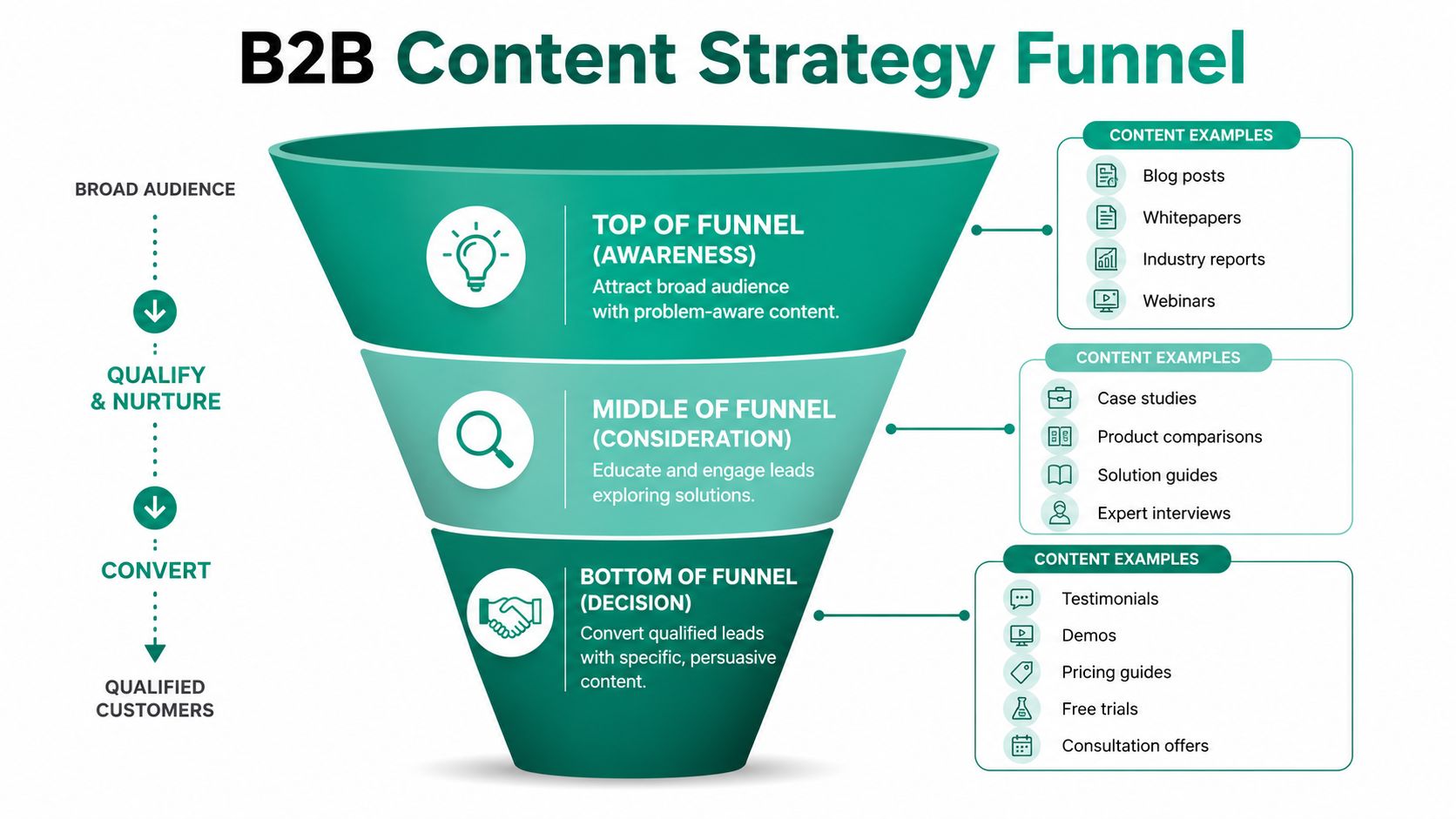
Awareness content
At this stage, buyers define the problem. Good formats include blog posts, whitepapers, industry explainers, and webinars. The mistake is stopping there.
Awareness content should introduce a problem in business terms, then create a path to solution pages and deeper assets. If the post gets traffic but doesn't route visitors anywhere useful, it acts like a dead end.
Consideration content
This layer does the heavy lifting in B2B. Buyers compare approaches, evaluate fit, and ask harder questions.
Useful formats include:
- Comparison pages that explain differences clearly
- Solution guides tied to a use case or role
- Case-style pages if you have verified customer proof to share
- Expert interviews with practical implementation detail
- Integration or workflow pages that reduce technical uncertainty
Field note: Consideration content often produces stronger sales conversations than awareness content because it reaches buyers who already understand the problem.
Decision content
At this stage, commercial friction needs to be removed. Pages here should help a buyer defend the decision internally.
That usually means:
| Decision concern | Content that helps |
|---|---|
| Budget approval | Pricing guide, scope explainer, ROI framing |
| Vendor comparison | Alternatives page, feature comparison, migration page |
| Operational risk | Implementation FAQ, onboarding outline, support documentation |
| Final validation | Demo page, consultation page, technical detail page |
A content engine that doesn't waste effort
One topic can support multiple stages if you build it as a cluster.
A practical example looks like this:
- Start with a broad article on the problem
- Add a solution page for the commercial intent
- Publish an FAQ page from sales objections
- Create a comparison page if competitor names keep coming up
- Build a pricing or process explainer for late-stage questions
That's how content supports a long buying cycle without becoming a pile of disconnected posts. Each asset answers a different question, for a different stakeholder, at a different moment.
Effective Link Building and Outreach Tactics
A lot of link building advice sounds easy because it skips the part where someone has to care. In B2B, random outreach rarely works for long. The strongest links come from relevance, relationships, and material other people can use.
Guest posting still has a place. It just shouldn't be the whole strategy.
Outreach that earns attention
A better approach starts with assets that serve another publisher, partner, or community. Here are the formats that hold up well in B2B:
-
Original commentary from internal experts
Journalists, newsletter writers, and industry podcasters need usable quotes and informed takes. Subject matter specialists often earn stronger links than generic blog contributors. -
Partner webinars and roundtables
A non-competing partner can help you produce a useful event, transcript, recap page, and co-promotion set. That creates links, referral traffic, and brand familiarity at the same time. -
Data-backed resource pages
Even a well-organized internal benchmark, glossary, checklist, or implementation guide can attract links if it saves someone else time. -
Executive interviews
Interview a customer, integration partner, or technical leader and turn it into a page worth citing.
A simple decision test for outreach targets
Before pitching anyone, ask:
- Does this site reach the people you want in your pipeline?
- Would the editor or partner gain something useful from your contribution?
- If Google didn't exist, would this still be worth doing?
If the answer is no, skip it.
Good B2B outreach feels like collaboration. Weak outreach feels like a transaction.
What a workable campaign looks like
Say you run a software company that serves operations teams. Instead of emailing a hundred blogs asking for guest post slots, you could do this:
- Interview your implementation lead about recurring rollout mistakes
- Package those insights into a practical checklist
- Offer the checklist to an industry newsletter as a co-branded resource
- Pitch a webinar with a consulting partner who sees the same issues
- Publish a recap page and link the related service pages internally
That sequence builds authority in a way that matches how B2B buyers research vendors.
If you're a younger company trying to build visibility across directories, startup communities, and launch surfaces, a tool like StartupSubmit for startups can help organize that distribution work without turning it into a manual spreadsheet project.
What to avoid
Three patterns waste time fast:
- Low-relevance guest posts on sites nobody in your market reads
- Template outreach emails that ask for a link before offering value
- Link swaps with no editorial fit which create weak brand associations and weak referral quality
When link building supports search engine optimization B2B properly, it doesn't just improve rankings. It gets your name into the same places buyers already trust.
Measuring SEO Impact on Leads and Revenue
The report that matters in B2B SEO isn't the traffic dashboard. It's the one that shows which organic visits turned into qualified actions, which actions became pipeline, and where those opportunities started.
That's why measurement has to move past sessions and keyword positions. Useful reports tie SEO to form fills, demo requests, consultation requests, content downloads, sales-qualified conversations, and closed revenue where attribution is available.

The numbers that justify the channel
The financial case for SEO in B2B is already strong. Search engine optimization is the highest-performing marketing channel for B2B companies, generating 44.6% of total B2B revenue, and SEO leads convert at 14.6%, which is about 8.6 times higher than the 1.7% conversion rate for traditional outbound strategies, according to GTM 80/20's B2B SEO statistics roundup.
Those numbers matter, but they won't help your business unless your reporting setup shows how organic search contributes inside your own funnel.
Build a report around actions, not visits
A practical SEO measurement stack for B2B should include these categories:
| Metric group | What to track |
|---|---|
| Primary conversions | Demo requests, contact forms, consultation bookings, qualified calls |
| Secondary conversions | Whitepaper downloads, webinar signups, pricing page visits, email captures |
| Sales alignment | Lead source, qualified status, opportunity creation |
| Revenue view | Pipeline created from organic-sourced leads and closed deals where available |
Use Google Search Console and Google Analytics for visibility and behavior. Use your CRM for lead status and pipeline movement. If those systems aren’t connected, SEO will look weaker than it really is because the commercial outcome disappears after the first conversion.
What to review each month
Don’t review every page equally. Focus on pages that should influence pipeline.
A monthly review can be structured like this:
Commercial page performance
Which solution, service, comparison, and pricing-adjacent pages generated qualified actions?Lead quality by landing page
Which pages created leads that sales accepted, not just forms that marketing counted?Assisted conversion paths
Which blog or resource pages appeared earlier in journeys that later produced pipeline?Search result click behavior
Did impressions grow on high-value queries, and did your title and description earn the click?
For teams that need a clearer framework, this guide on what SEO reporting is helps translate ranking data into business-facing reporting.
The metric shift most companies need
A lot of owners still ask, “How much traffic did SEO bring?” The better question is, “Which organic pages influenced buyers who turned into real opportunities?”
That shift changes behavior fast:
- Writers stop chasing loose topics.
- Sales starts feeding objections back into content.
- SEO work gets prioritized by revenue potential.
- Low-value pages get less attention.
If you want another practical angle on tying organic search to inquiries, this resource on how to boost leads with SEO is useful because it keeps the focus on lead generation instead of vanity metrics.
One operational note. If you want outside support, Ascendly Marketing is one option that combines SEO, content, web design, and reporting for B2B lead generation, which is often more useful than treating those functions as separate vendors.
If you want a clearer SEO plan built around qualified leads instead of raw traffic, Ascendly Marketing can help map the right pages, fix the structure, and connect reporting to the actions your sales team cares about.