
TL;DR:
- Aligning SEO and PPC efforts around shared goals and unified data reduces costs and improves search visibility. Regular joint reviews and data-driven attribution help optimize budgets and content strategies for better effectiveness. Most failures occur due to siloed teams focused on separate KPIs rather than collaborative blended metrics.
An SEO and PPC alignment strategy is defined as the deliberate integration of organic and paid search efforts around shared goals, unified data, and coordinated execution. Most marketing teams run SEO and PPC as separate channels with separate budgets, separate KPIs, and separate reporting. That separation costs real money. When both channels share keyword data, attribution models, and landing page messaging, the result is lower customer acquisition cost, stronger total search visibility, and faster feedback loops between content and conversion. Ascendly Marketing has built its search practice on this exact principle: treat organic and paid as one search program, not two competing departments.
What are the key components of an effective SEO and PPC alignment strategy?
The foundation of any working SEO and PPC integration is a shared keyword dataset that combines organic rankings, traffic data, paid spend, impression share, and conversions in one place. Without that query-level view, teams cannot see where they overlap or where gaps exist. Budget decisions become guesswork, and spend goes to the wrong terms.

Attribution is the second pillar. Last-click attribution systematically undervalues organic touchpoints that assist conversions earlier in the funnel. Switching to data-driven or linear attribution models gives a more accurate picture of how each channel contributes to revenue. That accuracy is what makes blended Customer Acquisition Cost (CAC) a reliable metric rather than a rough estimate.
Blended CAC is the total cost of acquiring one customer across both organic and paid channels combined. It replaces the flawed practice of measuring SEO and PPC CAC separately, which hides true efficiency. A unified dashboard that pulls both channels into one view makes blended CAC visible and actionable for any team.
The table below shows the core tools and data types required for alignment:
| Tool or data type | Primary use in alignment |
|---|---|
| Shared keyword dataset | Identifies overlap, gaps, and cannibalization risk |
| Data-driven attribution model | Accurately credits organic and paid touchpoints |
| Unified reporting dashboard | Displays blended CAC and total search performance |
| Conversion path analysis | Maps time from first organic visit to final paid conversion |
| Joint review cadence | Keeps both teams updated as rankings and results shift |
Pro Tip: Set up a single Google Looker Studio dashboard that pulls data from Google Search Console and Google Ads simultaneously. This one view eliminates the back-and-forth between platforms and makes blended CAC visible in real time.
How to build a step-by-step SEO and PPC alignment strategy
Alignment is a process, not a one-time setup. The steps below create a repeatable system that improves over time.
Set shared goals and blended KPIs. Define success at the search program level, not the channel level. Blended KPIs like total revenue per SERP and blended CAC replace siloed metrics and force both teams to optimize for the same outcome.
Build the shared keyword dataset. Pull organic ranking data from Google Search Console and paid data from Google Ads. Merge them by query. Flag every term where you rank organically in positions 1–5 and also run paid ads. Those are your cannibalization candidates.
Establish a search council. A search council is a regular joint meeting between SEO and PPC teams to review unified data, update keyword classifications, and adjust spend. Monthly is the minimum cadence. Weekly works better for high-spend accounts.
Run cannibalization tests. For terms where organic ranks strongly, reduce paid spend by a controlled amount and measure total traffic and conversion impact. Controlled experiments confirm whether PPC spend on those terms is incremental or redundant. Some high-intent commercial queries benefit from both presences. Others do not.
Use PPC to test SEO content priorities. Paid search delivers conversion data in days. Run paid ads on keyword clusters you are considering for organic content investment. High click-through and conversion rates signal that the topic deserves SEO resources. Low performance saves you months of content work on the wrong terms.
Align landing page messaging. Coordinated messaging between PPC ads and organic content reduces bounce rates and improves Quality Scores. A user who clicks a paid ad and lands on a page with a completely different tone or offer will leave. Consistent storytelling across both channels keeps them engaged.
Create iterative feedback loops. PPC data informs SEO content creation. SEO ranking data informs which paid terms to defend or abandon. Run this exchange on the same cadence as your search council meetings.
The table below compares alignment tactics by effort level and expected impact:
| Tactic | Effort level | Expected impact |
|---|---|---|
| Shared keyword dataset | Medium | High: eliminates blind spots |
| Cannibalization testing | Medium | High: redirects wasted spend |
| PPC-to-SEO content testing | Low | High: prioritizes content investment |
| Unified attribution model | High | Very high: accurate budget decisions |
| Landing page message alignment | Medium | Medium: improves conversion rate |
Pro Tip: When you launch a new PPC campaign, share the ad copy with your SEO team before it goes live. The highest-performing ad headlines often become the best title tags and meta descriptions for organic pages.
What are common mistakes in SEO and PPC alignment?
Most alignment failures trace back to the same root causes. Recognizing them early prevents months of wasted effort.
Siloed teams with conflicting KPIs. When the SEO team is measured on organic traffic, and the PPC team is measured on paid ROAS, they have no reason to collaborate. Integrating revenue goals and establishing joint ownership of blended metrics is the structural fix.
Relying on last-click attribution. Last-click gives all credit to the final touchpoint before conversion. Organic content that introduced the customer gets zero credit. This causes teams to underfund SEO and overfund paid retargeting.
Assuming cannibalization without testing. Many teams cut PPC on strong organic terms without running a controlled test first. Some queries genuinely benefit from dual presence. Cutting paid spend without data can reduce total conversions even when organic ranks well.
One-time analysis instead of ongoing review. Ongoing data sharing between teams is what sustains alignment. Rankings shift. Paid competition changes. A one-time audit goes stale within weeks.
Ignoring conversion path timing. Conversion path analysis shows how long it takes a customer to move from a first organic visit to a final paid conversion. That window defines your remarketing duration. Ignoring it means your paid retargeting either fires too early or expires before the customer is ready to buy.
Alignment breaks down when executives measure SEO and PPC teams separately. The fastest fix is a single shared dashboard that shows blended CAC at the top of every weekly review. When leadership sees one number, teams stop competing and start collaborating.
Pro Tip: Assign one person, either a search director or a senior analyst, to own the blended CAC metric. Shared ownership often means no ownership. One accountable person changes that.
What business benefits come from aligning SEO and PPC?
Aligned search programs consistently outperform siloed ones across every measurable dimension. The benefits are concrete and show up in the numbers within one to two quarters of implementation.
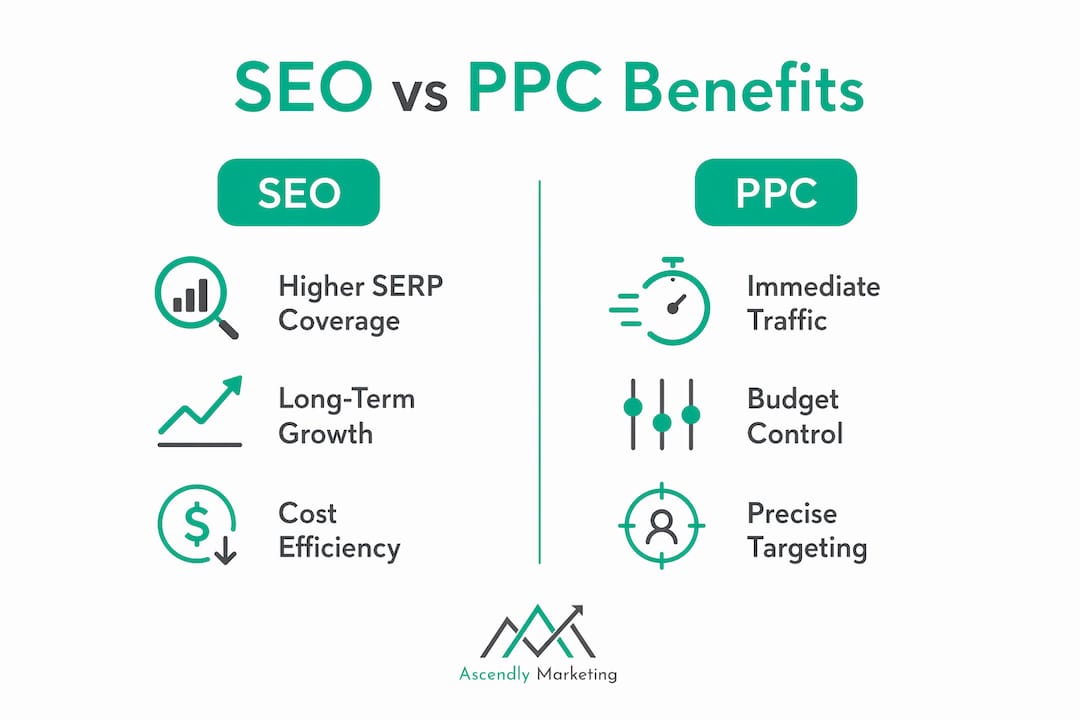
Total search visibility increases because the two channels cover each other’s gaps. SEO builds authority and captures qualified traffic at low cost over time. PPC fills gaps where organic rankings are weak and tests new audiences fast. Together, they cover more of the SERP than either channel can alone.
Blended CAC drops when paid spend shifts away from terms with strong organic coverage. Budget that was funding redundant clicks on owned organic positions moves to competitive gaps where paid presence is genuinely incremental. That reallocation reduces total acquisition cost without reducing total traffic.
Content quality improves because PPC data tells SEO teams which topics actually convert. Without that signal, content teams rely on search volume alone, which is a weak proxy for commercial intent. PPC conversion data is a direct measure of buyer interest.
| Benefit | Mechanism | Timeline |
|---|---|---|
| Higher total SERP coverage | Channels cover each other’s gaps | Immediate |
| Lower blended CAC | Spend shifts from redundant to incremental terms | 1–2 quarters |
| Better content ROI | PPC data prioritizes high-converting topics | 1–3 months |
| Improved Quality Scores | Aligned landing page messaging reduces bounce | 2–4 weeks |
| Faster optimization cycles | Joint reviews accelerate decision making | Ongoing |
Companies using AI-based media mix modeling shift budgets between channels in 15% increments to measure total search revenue impact. That disciplined, incremental approach prevents overcorrection and keeps both channels stable while the team learns what works. You can apply the same logic manually with controlled spend adjustments in your search council meetings. For more on planning campaigns that drive organic growth, the principle of incremental testing applies equally to content investment decisions.
Key Takeaways
A successful SEO and PPC alignment strategy requires shared keyword data, unified attribution, blended CAC measurement, and a regular joint review cadence between both teams.
| Point | Details |
|---|---|
| Shared keyword data is foundational | Merge organic and paid query data to find overlap, gaps, and cannibalization risk. |
| Replace last-click attribution | Use data-driven or linear models to accurately credit organic touchpoints and calculate blended CAC. |
| Run cannibalization tests | Reduce paid spend on strong organic terms in controlled experiments before making permanent cuts. |
| Use PPC to prioritize SEO content | High-converting paid keywords signal which topics deserve organic content investment. |
| Sustain alignment with joint reviews | A regular search council meeting keeps both teams calibrated as rankings and competition shift. |
Why most teams get alignment wrong from the start
The teams at Ascendly Marketing have worked with enough businesses to see a clear pattern. Most alignment efforts fail not because of bad tools or missing data. They fail because the two teams are never actually asked to share a goal.
SEO specialists are rewarded for ranking. PPC managers are rewarded for ROAS. Neither metric requires the other person’s cooperation. So cooperation does not happen. The fix is not a new platform or a bigger dashboard. The fix is an executive decision to hold both teams accountable to blended CAC and total search revenue. That single change makes collaboration the path of least resistance instead of an extra burden.
The second thing I have seen consistently is that alignment is treated as a project with a finish line. Teams merge their data, run one joint review, and declare success. Six weeks later, rankings have shifted, a competitor has entered the paid auction, and nobody has updated the keyword classifications. Alignment is a cadence, not a deliverable. The search council meeting is not optional once things are “set up.” It is the mechanism that keeps the whole system working.
Measurement sophistication matters more than most teams realize. The moment you switch from last-click to data-driven attribution, the entire picture of which channel is performing changes. Organic often looks far more valuable than last-click suggested. That insight alone can shift budget decisions and justify SEO investment that was previously hard to defend.
— Ascendly Marketing
How Ascendly Marketing can unify your search strategy
Ascendly Marketing is a full-service digital marketing agency that has been building integrated search programs since 2013. The team includes SEO specialists, paid search managers, and analytics experts who work from a single blended reporting framework.

If your SEO and PPC teams are running separate playbooks, Ascendly Marketing can audit your current setup, build a shared keyword dataset, and implement the attribution model that gives you an accurate view of blended CAC. The agency’s PPC advertising services are built to work alongside organic strategy, not in competition with it. Explore the full range of digital marketing services or visit Ascendly Marketing to schedule a consultation and get a tailored alignment plan for your business.
FAQ
What is an SEO and PPC alignment strategy?
An SEO and PPC alignment strategy is the integration of organic and paid search efforts around shared goals, unified keyword data, and common attribution models. The goal is to maximize total search visibility and lower blended customer acquisition cost.
How does blended CAC work in search alignment?
Blended CAC measures the total cost of acquiring one customer across both organic and paid channels combined. It replaces separate channel metrics and gives a more accurate view of true marketing efficiency.
What is a search council?
A search council is a regular joint meeting between SEO and PPC teams that uses shared dashboards and unified metrics to review performance, update keyword classifications, and adjust spend as rankings and competition change.
How do you test for keyword cannibalization?
Reduce paid spend on a strong organic term by a controlled amount and measure the impact on total traffic and conversions. If total performance holds, the paid spend was redundant. If it drops, dual presence was adding incremental value.
Why should I replace last-click attribution?
Last-click attribution gives all conversion credit to the final touchpoint and ignores organic content that assisted earlier in the funnel. Data-driven or linear attribution models distribute credit more accurately, which leads to better budget decisions across both channels.