

You open YouTube Studio, see a healthy pile of views, and assume monetization must be close. Then the progress bar barely moves. That gap frustrates a lot of business owners and creators because the number that feels big in analytics often isn’t the number YouTube uses for eligibility.
That’s the central problem with YouTube watch hours. They aren’t just a vanity metric, and they aren’t a rough signal. They’re a filter. YouTube uses them to decide whether people are spending meaningful time with your public content, not just clicking into it and leaving.
That standard matters because the platform is enormous. YouTube users watch over 1 billion hours of video every day, and over 70% of YouTube watch time comes from mobile devices, according to Cross River Therapy’s YouTube statistics roundup. The audience is there. The challenge is holding attention long enough for watch time to count in the way you need it to count.
For brands, consultants, educators, and local businesses, that changes the strategy. A video that attracts curiosity but loses viewers fast won’t help much. A video that keeps the right viewers watching can become an asset. That’s also why the role of video creators keeps expanding inside broader digital programs, especially when companies start treating YouTube as a long-term distribution channel instead of a side project, as discussed in this look at content creators in digital marketing.
The Currency of YouTube Engagement
Views get attention. Watch hours get credit.
That sounds obvious until you look at a real channel. A business posts product explainers, customer questions, and a few event clips. One video pops. The view count looks encouraging. Then the monetization tracker stays flat enough to feel broken. Usually, nothing is broken. The wrong metric got the celebration.
Why watch hours matter more than views
A view is an entry. A watch hour is time someone spent with your content. If you think of YouTube as a store, views are foot traffic and watch hours are time spent browsing the shelves. YouTube rewards the second one more heavily because it signals that the content held attention.
That makes YouTube watch hours a practical measure of audience fit. They tell you whether your topic, hook, pacing, and structure worked together well enough to keep someone in the room.
Practical rule: If a video gets clicks but not watch time, the packaging worked and the content structure failed.
The business owner’s version of the problem
Most business channels don’t struggle because the team has no expertise. They struggle because expertise gets uploaded in the wrong format. The opening rambles. The strongest point arrives late. The video answers questions out of order. The result is familiar. People click, sample, and leave.
When that happens across several uploads, the channel can look active while the monetization path stays slow.
A better approach starts with a simpler question. Are your videos built to earn minutes, or just impressions?
The Two Paths to YouTube Monetization
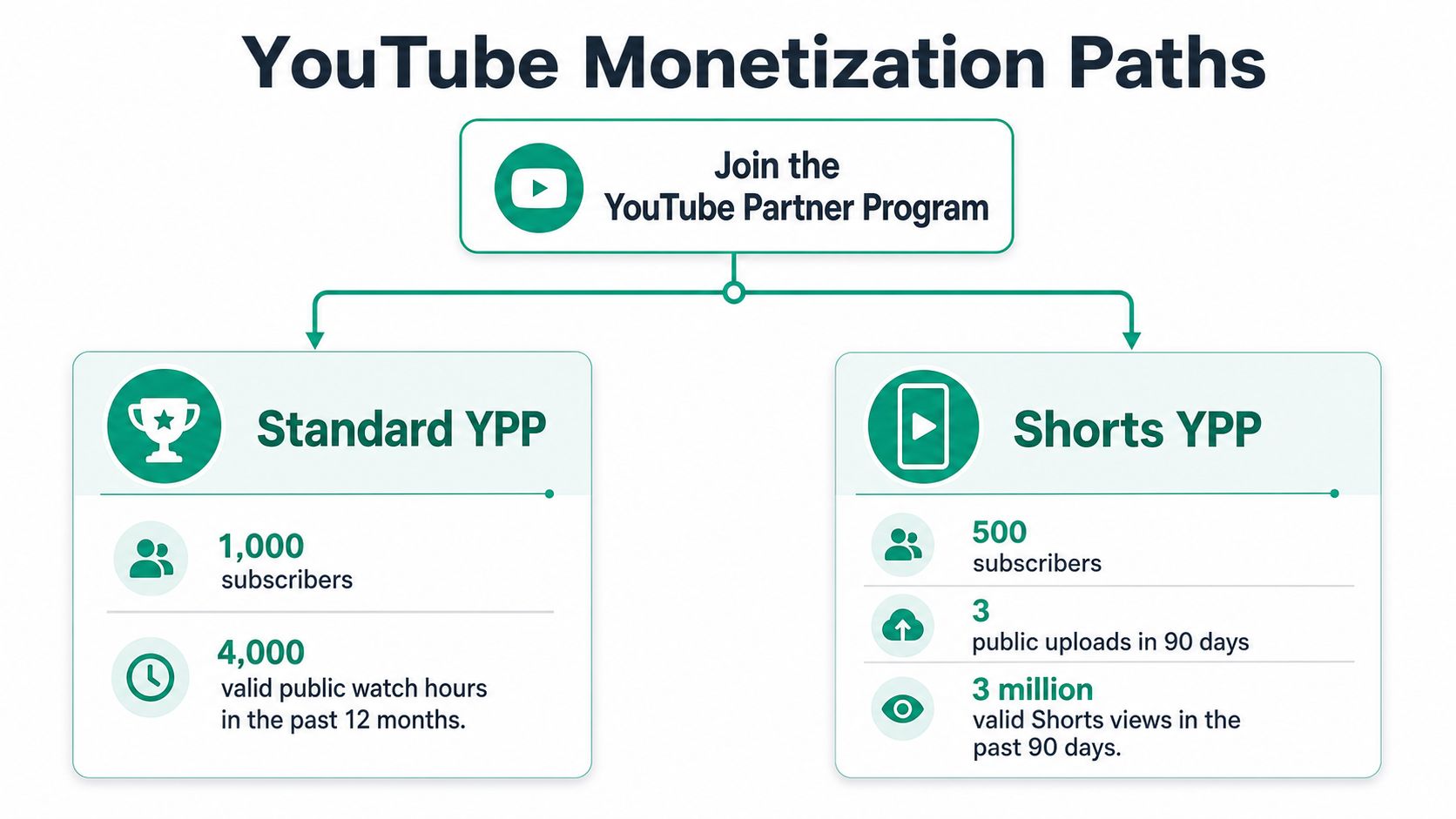
Monetization has two different tracks, and mixing them causes most of the confusion.
The standard path
For full ad revenue access through the YouTube Partner Program, YouTube requires 4,000 valid public watch hours in the past 12 months and 1,000 subscribers, as outlined by TubeBuddy’s breakdown of YouTube monetization requirements.
That rolling window matters more than is commonly recognized. Watch hours older than 365 days don’t count toward that threshold. So this isn’t a lifetime trophy case. It’s a moving scoreboard.
If you publish one strong video, disappear, and come back later, older watch time can fall off. Channels usually grow faster when the team builds a steady publishing rhythm and keeps sending viewers from one useful video to the next.
The shorts-led path
There’s also a Shorts-focused route. The infographic above reflects a lower-entry YPP path built around Shorts activity and upload consistency rather than long-form watch hours. That’s why it helps to treat the two paths like different lanes on the same highway.
One lane is built around accumulated long-form viewing time. The other is built around short-form volume and discovery.
Here’s the trade-off. Shorts can expand reach quickly, but they don’t solve the long-form watch hour problem by themselves. Businesses that want durable YouTube watch hours usually need long-form content architecture, even if Shorts play a supporting role.
What public actually means
“Public” isn’t a loose label. For monetization, visibility controls eligibility. If a video isn’t public, its watch time doesn’t help in the same way.
That’s one reason teams get tripped up when they test content privately, archive underperformers, or use unlisted assets heavily. A video can still exist in your library and still fail to push the monetization tracker forward.
For businesses exploring revenue beyond ads, this is also where sponsorship planning enters the picture. A channel may hit monetization later than expected yet still build commercial value through audience fit, niche authority, and packaging. SponsorRadar has a useful guide to YouTube brand deal strategies that complements this monetization discussion well.
Paid distribution can support awareness too, but monetization strategy and ad delivery strategy aren’t the same thing. Teams that run both often get better results when they separate YouTube content planning from programmatic video advertising strategy.
What Counts as a Valid Public Watch Hour
At this point, most channels misread the scoreboard.
Your analytics can show a strong total watch time number while the monetization page says you’re not close. That isn’t YouTube being inconsistent. It’s YouTube using a narrower definition.
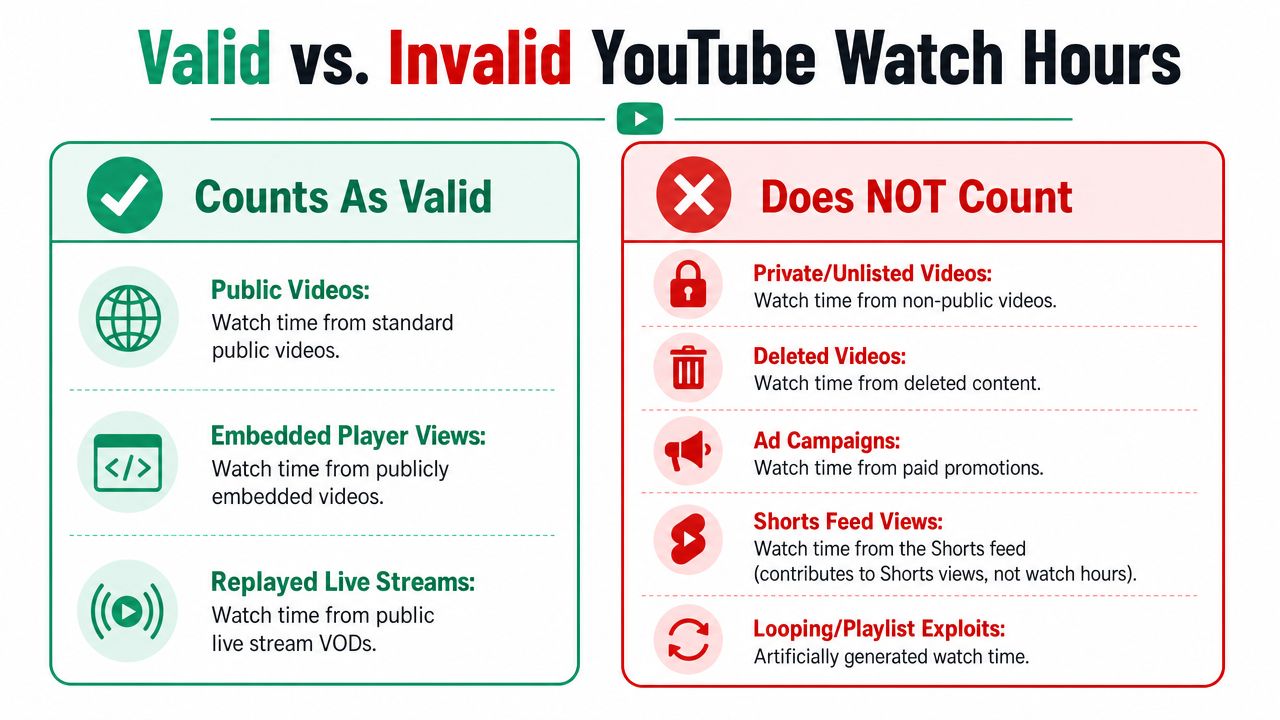
According to NexLev’s explanation of valid public watch hours, many creators assume total analytics watch time equals monetization-eligible hours, but only valid public watch hours from public videos within the last 365 days count. Their write-up also notes exclusions such as private, unlisted, and deleted videos, along with ad views and Premium previews. That’s why some channels see 5,000+ total hours in analytics and still don’t qualify.
What usually counts
The cleanest version is straightforward. Public long-form videos that viewers watch in normal circulation are the foundation. Public replays of live streams can also help when they remain available as public VODs.
Think of these as durable assets. They stay on the shelf, remain publicly accessible, and keep accumulating eligible time while they continue to attract viewers.
What gets excluded
A lot of watch time looks real inside a dashboard but won’t help the YPP threshold.
- Private or unlisted videos count as viewing activity in a broad analytics sense, but they don’t serve the public watch hour requirement.
- Deleted videos can wipe out value you thought you had banked. If the video is gone, the public asset is gone too.
- Paid ad traffic may create exposure, but that kind of viewing doesn’t move you toward the standard watch hour requirement.
- Premium previews and similar non-standard viewing contexts can show up in channel activity without supporting monetization eligibility the way creators expect.
The shorts confusion
Shorts create the biggest misunderstanding.
A lot of businesses publish Shorts, see reach spike, and assume those views are building long-form watch hours. They aren’t interchangeable. Shorts are their own system. Great for discovery, weak as a substitute for standard YouTube watch hours.
That’s why channels can feel busy and still stall. Shorts may help attract subscribers and new viewers, but if the strategy never moves those viewers into public long-form videos, the standard watch hour counter stays sluggish.
When a channel relies on Shorts alone, it often builds momentum in the wrong bucket.
A fast audit you can run today
If your watch time in analytics feels higher than your monetization progress, check these points:
| Question | Why it matters |
|---|---|
| Are your top videos public right now? | Visibility determines whether watch time is eligible |
| Did you delete older videos? | Removed assets can take eligible hours with them |
| Are you relying on Shorts for progress? | Shorts reach and watch hour progress are separate systems |
| Did paid promotion drive a chunk of viewing? | Ad-driven watch time doesn’t count the same way |
That audit usually explains the gap faster than digging through broad analytics tabs.
Finding Your Official Watch Hour Count
Once you know total watch time and valid public watch hours aren't the same thing, the next step is simple. Stop treating the general analytics dashboard as the final answer.
Where to look in YouTube Studio
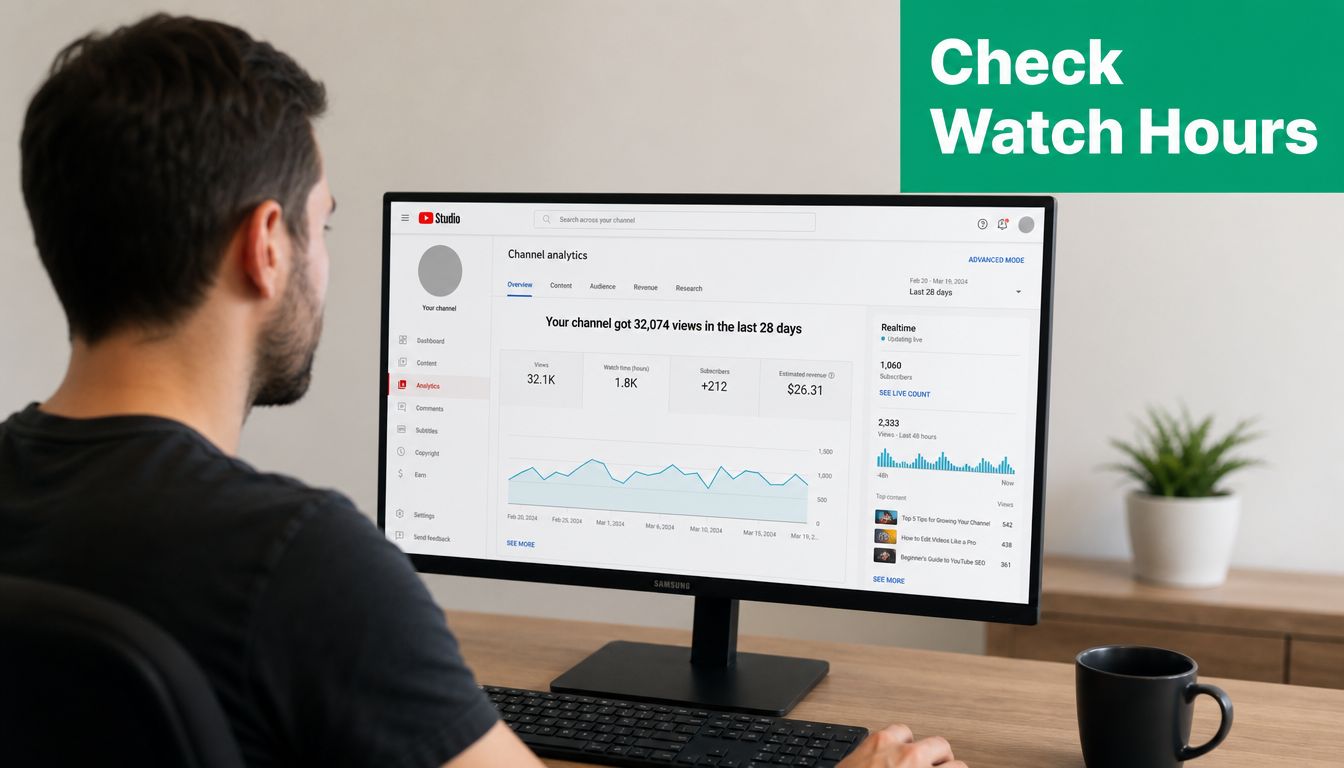
Open YouTube Studio and go to the Earn area. That page is the one that matters for monetization progress because it reflects the official eligibility tracker rather than the broadest version of channel activity.
If you spend all your time in Analytics, you'll keep seeing useful performance data, but you may still misread your position. Analytics tells you how your channel is behaving. Earn tells you whether YouTube accepts that behavior toward monetization.
What to confirm on the page
Check for the monetization progress display tied to the current eligibility period. For the standard path, you want the tracker that reflects your current public watch hour accumulation in the active rolling window.
Use this as your source of truth, then compare it against your content mix. If the number feels lower than expected, the explanation is usually one of three things:
- Visibility mismatch between analytics activity and public eligibility
- Format mismatch where Shorts drive channel activity but not standard hours
- Time-window mismatch where older viewing has already rolled off
That's the practical reason the Earn page matters. It removes guesswork.
Use the dashboard as a control panel, not a trophy shelf
Teams often check monetization only when they think they're close. That's backwards. Check it regularly and use it to guide publishing choices.
If public long-form content is moving the tracker, make more of that format.
If Shorts are lifting reach but not the watch hour line, use them as feeders.
If a public live stream replay keeps adding time after the event ends, keep that format in rotation.
A short walkthrough helps if you want to see the interface in action:
Data-Backed Strategies to Increase Watch Hours
More uploads won't automatically solve a watch hour problem. Structure solves it. Session design solves it. Topic sequencing solves it.
That's the difference between a content library and a watch time engine.
Start with the math
The useful planning formula is this: Monthly Watch Hours = (Average Monthly Views × Average View Duration in Minutes) / 60, based on vidIQ's watch hour planning guide.
That formula changes how you think. It pushes you away from guessing and toward levers.
You can increase watch hours by:
- getting more monthly views,
- increasing average view duration,
- or doing both at the same time.
Most channels obsess over the first lever. Stronger operators work on the second one first because it improves the output of every view you already get.
Fix retention before chasing reach
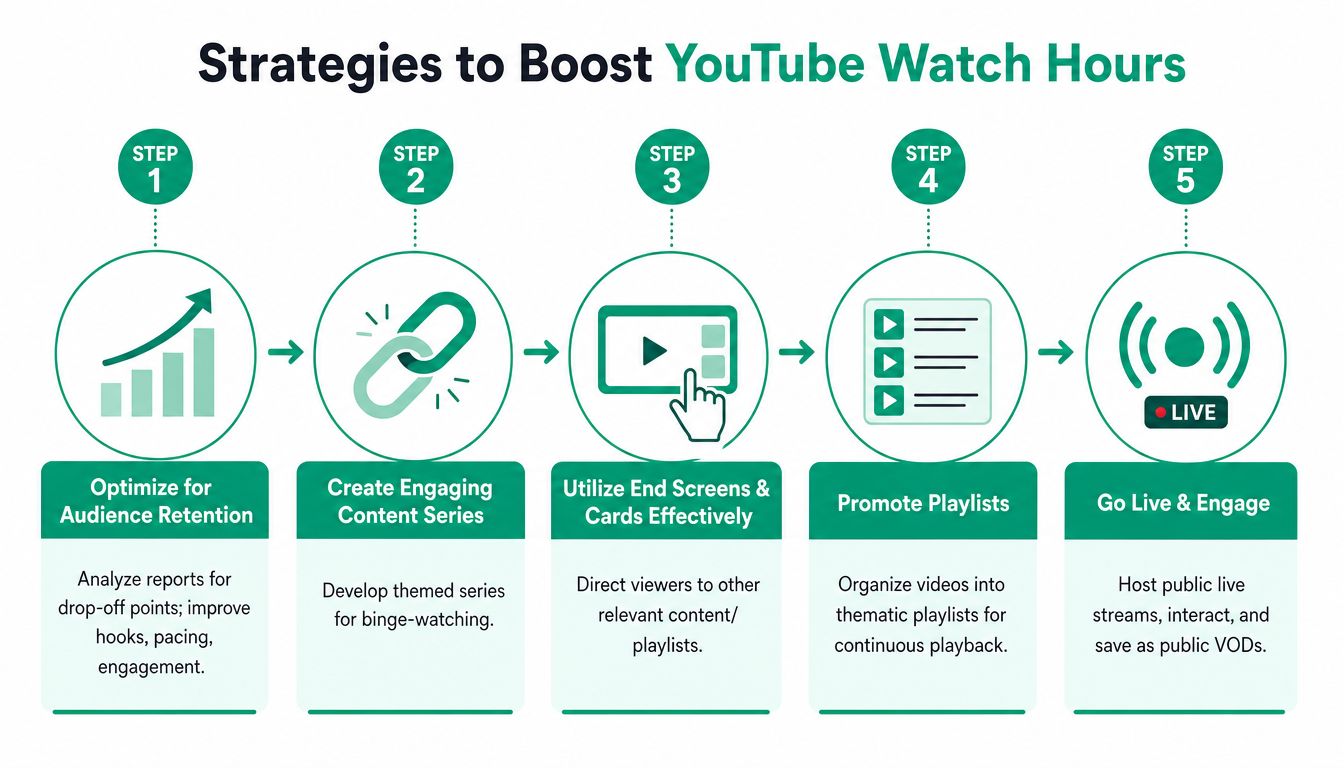
vidIQ's same guide recommends adding a pattern interrupter every 30 to 60 seconds. In practical terms, that means a visual shift, a camera change, a graphic, a cutaway, a new example, a screen share, or a change in pacing.
For business videos, that's especially useful because instructional content drifts easily. The speaker stays on one shot too long. The screen doesn't change. The audience feels the monotony before they consciously decide to leave.
Field note: Retention often drops because the video stayed visually identical for too long, not because the topic was weak.
A pattern interrupter doesn't mean random editing. It means planned resets of attention.
Build videos as chains, not one-offs
A single useful upload can earn watch time. A connected series can multiply it.
If you run a service business, don't publish isolated answers only. Group them by buying stage or by problem type. A tax consultant might connect videos around bookkeeping mistakes, write-off rules, and quarterly planning. A B2B software company might connect onboarding, feature setup, and reporting workflows.
Many teams should also think beyond YouTube in isolation. A broader video marketing strategy for businesses helps connect YouTube content with email, landing pages, sales enablement, and retargeting.
Formats that usually produce stronger watch sessions
- Series-based tutorials give viewers a clear next step.
- Public live streams saved as replays can keep earning time after the live event ends.
- Comparison videos work well when buyers are choosing between methods, tools, or service models.
- FAQ clusters help convert repetitive sales calls into compounding content assets.
End screens need less choice, not more
Many creators treat the end screen like a menu board. They add multiple options and assume more choice means more clicks. Usually the opposite happens. Too many options split attention.
The cleaner play is one strong next video and a subscribe button. That keeps the decision simple. Continue or leave.
If you can move a viewer into a second relevant video, watch hours compound faster because the session extends. The ultimate victory isn't one successful upload. It's one successful upload that pushes viewers into another one.
Playlists are session tools
Playlists often get treated as filing cabinets. That misses the point. A good playlist is a guided sequence.
Arrange videos in an order that matches the viewer's next question. Don't dump loosely related topics into one folder and call it strategy. If someone watches a beginner guide, the next video shouldn't jump to an advanced niche issue unless that's the obvious follow-up.
A clean playlist does three things:
- reduces friction,
- gives YouTube a clearer relationship between videos,
- helps the viewer keep going without deciding from scratch.
Use Shorts as the top of the funnel
Shorts still matter. They just need a job description that matches reality.
Use them to introduce a topic, demonstrate a quick outcome, or spark curiosity. Then point viewers to a related public long-form video where the actual watch hour growth happens. That handoff is where many channels fail. They publish Shorts and never build the bridge.
If you want examples of how creators package content to boost YouTube views and subscribers, this breakdown from quso.ai is useful for studying packaging and distribution decisions, especially when you're trying to turn attention into sustained channel growth.
A practical watch hour system
Here's a working operational loop for most business channels:
| Step | Action | Expected effect |
|---|---|---|
| Plan | Choose topics with follow-up potential | More opportunities for session growth |
| Script | Place the strongest point early | Better early retention |
| Edit | Add pattern interrupters throughout | Higher sustained attention |
| Publish | Link each video to one clear next watch | Longer sessions |
| Review | Compare average view duration across formats | Better future topic decisions |
That system beats brute-force posting because it treats YouTube watch hours as an output of design, not luck.
Answering Your Watch Hour Questions
Do watch hours need to stay above the threshold forever?
The threshold is about qualifying in the active window before entry through the standard route. After that, creators usually worry about what happens if viewing slows. The useful operating mindset is simple. Don't treat monetization as the finish line. Treat it as proof that the channel found a repeatable format.
If the system that got you there stops, the channel can lose momentum even if eligibility was once achieved.
Do paid views help with watch hours?
No, not for the standard public watch hour requirement covered earlier. Paid distribution can still help with awareness, audience testing, and offer validation. It just solves a different problem.
That distinction matters for businesses because paid media and YouTube monetization often sit in the same budget conversation. They shouldn't be measured by the same scoreboard.
Should you focus on Shorts or long-form?
Choose based on the job you need done.
If your channel needs discovery, Shorts can help. They're operating at huge scale, with approximately 2 billion monthly users and 70 to 90 billion views per day, according to Blank Spaces' YouTube screen time statistics. That makes them useful for top-of-funnel exposure.
If your goal is standard YouTube watch hours, long-form public videos need to carry the strategy.
What if your analytics look strong but the Earn tab doesn't?
Assume the gap is structural, not mysterious.
Look at visibility first. Then format. Then time window. Those three checks usually identify the issue quickly. General analytics can tell you your content is getting consumed. The Earn tab tells you whether that consumption qualifies under YouTube's monetization rules.
A healthy channel measures both. One number shows performance. The other shows eligibility.
What kind of business content tends to earn more watch time?
Content with a clear question and a clear sequence. Tutorials, explainers, buyer education, public webinar replays, and tightly scoped comparisons usually outperform vague brand videos because viewers know why they're staying.
The common thread isn't production polish. It's clarity. People watch longer when the next minute feels worth it.
If your business wants a YouTube strategy that supports traffic, lead generation, and stronger content performance, Ascendly Marketing can help you build the system behind the videos, from planning and production through distribution and conversion.