

91% of businesses now use video in their marketing, up from 61% in 2016, and video accounts for 82% of all internet traffic, while 51% of consumers use product videos to make purchase decisions. Those numbers change the standard for how buyers evaluate a company before they ever speak to sales.
For business owners, video is part of demand generation and conversion work. It helps a prospect understand the offer faster, gives sales teams clearer assets to send during follow-up, and improves the odds that paid traffic turns into qualified pipeline instead of bounced sessions. Companies that treat it as a branding extra usually produce disconnected clips with no role in the funnel and no clear way to measure revenue impact.
The stronger approach is simpler and more disciplined.
Use different video formats for different buying stages. Repurpose core assets across channels in ways that fit the platform. Measure what the content contributes to pipeline, sales conversations, and closed revenue, not just views.
Why Video Marketing is a Business Requirement
Video has shifted from optional content to standard buying infrastructure.
Buyers now expect to see what you sell, how it works, and what the experience looks like before they commit time to a call or a quote request. As noted earlier, video usage is widespread across businesses, buyer behavior, and overall web consumption. That changes the baseline. A company without useful video is not competing with an older content standard. It is competing with sellers that explain faster and reduce doubt earlier.
That matters because attention is expensive. If you pay for traffic, invest in SEO, or rely on outbound and follow-up, every visit has to do more than generate awareness. It has to move a prospect one step closer to action. Video helps because it compresses explanation. A 45-second product walkthrough, founder explanation, or customer proof clip can answer questions that would otherwise sit buried in long copy, PDFs, or sales emails.
What this means in practice
For a business owner, the primary shift is operational. Video now carries part of the workload that used to fall on sales calls, static service pages, and one-off follow-up from the team.
It shows the offer in context. It sets expectations. It filters out poor-fit leads while giving qualified prospects more confidence to continue.
That last point gets missed often.
A lot of companies treat video as a content output. The better approach is to treat it as a buying aid mapped to funnel stages. Awareness video earns attention and frames the problem. Consideration video explains the solution, process, or product. Decision-stage video handles proof, objections, and next-step confidence. Without that structure, businesses end up with polished clips that collect views but do very little for pipeline.
Standard adoption changes the competitive gap
Since video is common, publishing anything is not enough. The advantage comes from relevance and placement.
I see three recurring mistakes in underperforming programs. The first is using the same video everywhere, even though a cold social viewer and a late-stage buyer need different information. The second is overproducing top-of-funnel content while leaving product pages, proposal support, and sales follow-up untouched. The third is judging success by reach alone, which pushes teams toward content that attracts attention but does not support revenue.
A practical video system fixes those gaps. It gives marketing assets for traffic acquisition, gives sales material that shortens explanation time, and gives leadership a clearer way to evaluate whether content is contributing to qualified opportunities instead of just generating activity.
That is why video is now a business requirement. It is part of how companies create clarity, reduce friction, and compete for buyers who want to understand the offer before they engage.
How Video Marketing Directly Impacts Revenue
Revenue impact starts where buyers make decisions. Usually that means product pages, service pages, landing pages, retargeting campaigns, and sales follow-up. Video performs well in those places because it reduces uncertainty.
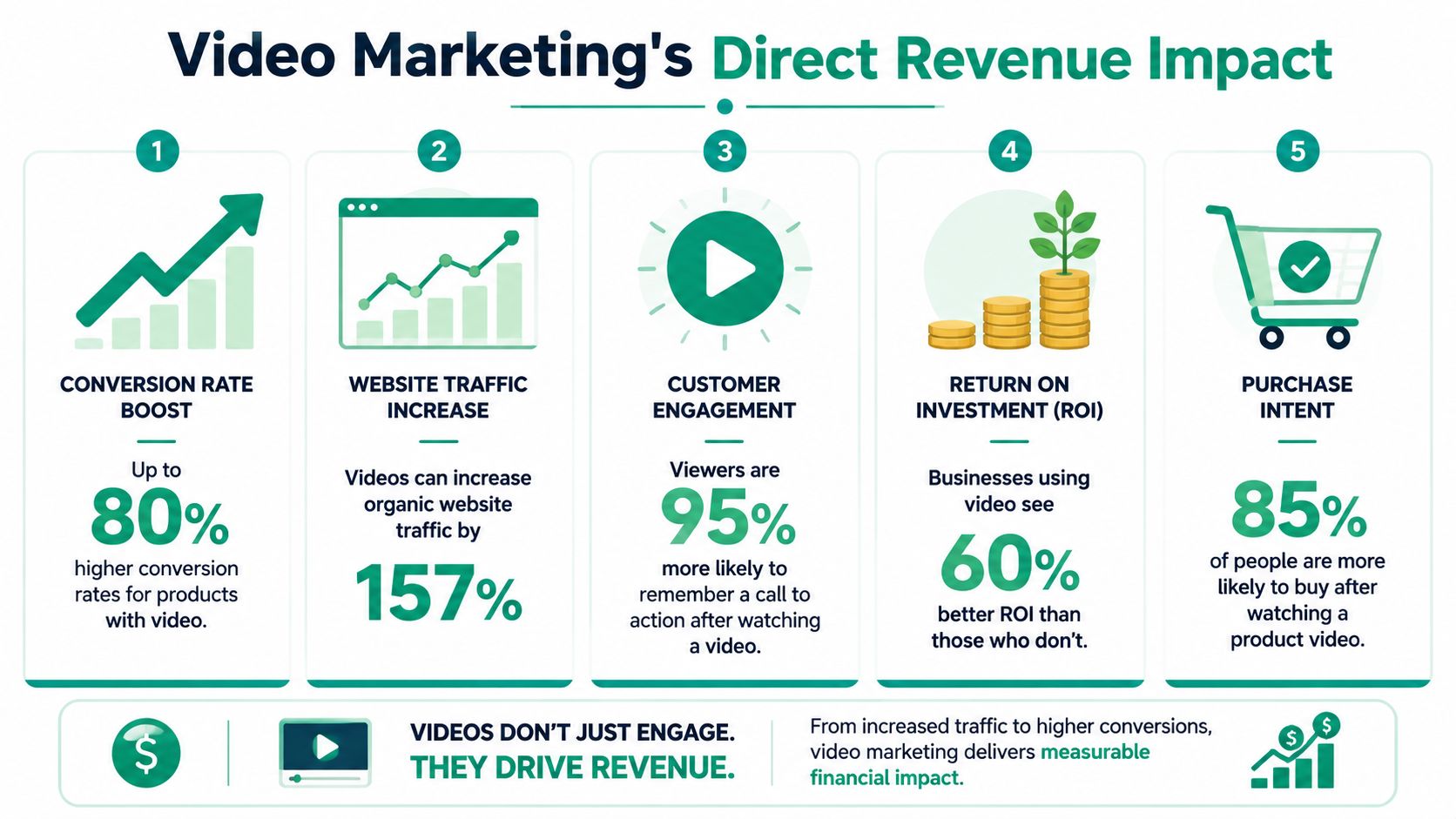
Research compiled by White Hat SEO on video in business benchmarks shows that adding video to landing pages improves conversion rates by 80–86%. The same source reports that companies investing in video achieve 49% faster revenue growth than companies that don’t, and 93% of marketers report positive ROI from video.
Conversion happens when friction drops
Most business websites ask prospects to leap. Fill out the form. Book the call. Request the quote. Start the trial. Video helps because it answers the unspoken questions before the click.
On a service page, that might mean showing the process. On a software page, it might mean showing the interface. On an e-commerce page, it usually means showing the product in use rather than listing specifications in text alone.
Here’s the trade-off. A video can increase conversion, but only if it supports the page goal. A vague brand montage above a lead form often adds motion without adding clarity. A focused demo, walkthrough, or proof clip usually does the opposite.
Revenue growth comes from better sales support
Video doesn’t just help with top-of-funnel attention. It shortens explanation time for sales and marketing teams. That matters in B2B, especially when the offer has multiple stakeholders, setup questions, or budget scrutiny.
A well-built product demo can pre-handle repetitive questions. A testimonial can reduce perceived risk. A short founder or sales video in outbound follow-up can warm up a prospect before a meeting. Those aren’t vanity uses. They support deal movement.
Teams that see revenue from video usually place it where hesitation shows up, not where the brand team wants motion.
Positive ROI depends on format discipline
The strongest video programs aren’t always the most expensive. They’re the ones that know which asset belongs in which step of the funnel.
A homepage explainer has one job. Get the right visitor to keep going. A decision-stage video has a different job. Remove doubt and support the next action. When businesses mix those roles, they get views without conversion lift.
That’s why revenue-focused video marketing for businesses starts with one question: where in the buying path are prospects getting stuck?
Matching Video Types to Your Business Goals
A video format isn’t good or bad on its own. It either matches the buyer’s stage or it doesn’t. That’s the filter that saves businesses from producing a pile of content with no clear job.
Consumer preference data from SundaySky’s 2025 video marketing statistics shows that 78% of people would rather learn about a product through a short video than through text-based articles at 9%. The same source says short-form videos under 60 seconds reach the highest engagement rate at 50%. That’s why short clips work well for first contact, but they usually aren’t enough to close a considered purchase.
Awareness stage
At the top of the funnel, the goal is simple. Earn attention from people who don’t know you yet, or who only know the category problem.
Use formats like:
- Short social clips that frame a pain point fast
- Founder or expert snippets that make one clear point
- Problem-solution videos built for paid social or organic reach
These videos work when they create recognition, not when they try to explain everything. If you’re still introducing the problem, don’t open with a full product tour.
Consideration stage
Once a prospect starts comparing options, your videos need more substance, and explainers, product walkthroughs, tutorials, and use-case videos are particularly effective.
A B2B buyer in consideration mode wants to know how the service works, what the process looks like, and whether your team understands their problem. An e-commerce buyer wants to see quality, fit, use, and differences between options.
A strong consideration video answers, “Will this work for my situation?” not “Is this content entertaining?”
Decision stage
Decision-stage video is where businesses often underinvest. This is the stage that moves the pipeline.
Use assets such as:
- Product demos
- Customer testimonials
- Objection-handling videos
- Sales follow-up clips
- FAQ videos for high-friction offers
A generic overview video won’t carry this stage. Buyers near conversion need proof, detail, and reassurance.
A working funnel map
| Funnel Stage | Business Goal | Recommended Video Types |
|---|---|---|
| Awareness | Attract attention and qualify interest | Short social clips, pain-point videos, brand introduction videos |
| Consideration | Educate prospects and show fit | Explainers, tutorials, use-case videos, walkthroughs |
| Decision | Reduce hesitation and support conversion | Product demos, testimonials, FAQ videos, sales follow-up videos |
If you're planning broader social distribution, this guide to types of content for social media is useful because it helps you fit video into the rest of your content mix rather than treating it as a separate channel.
One video rarely does every job
Businesses often ask for one master video to use everywhere. That sounds efficient. In practice, it usually creates compromise.
A homepage video, a paid social ad, and a sales demo need different pacing, different opening hooks, and different levels of detail. You can absolutely build one core asset and cut it into versions. You just shouldn't expect one untouched file to perform across all funnel stages.
Developing a Practical Video Production Plan
Most businesses don't fail at video because of camera quality. They fail earlier. No script, no clear audience, no call to action, and no production plan that matches the budget.
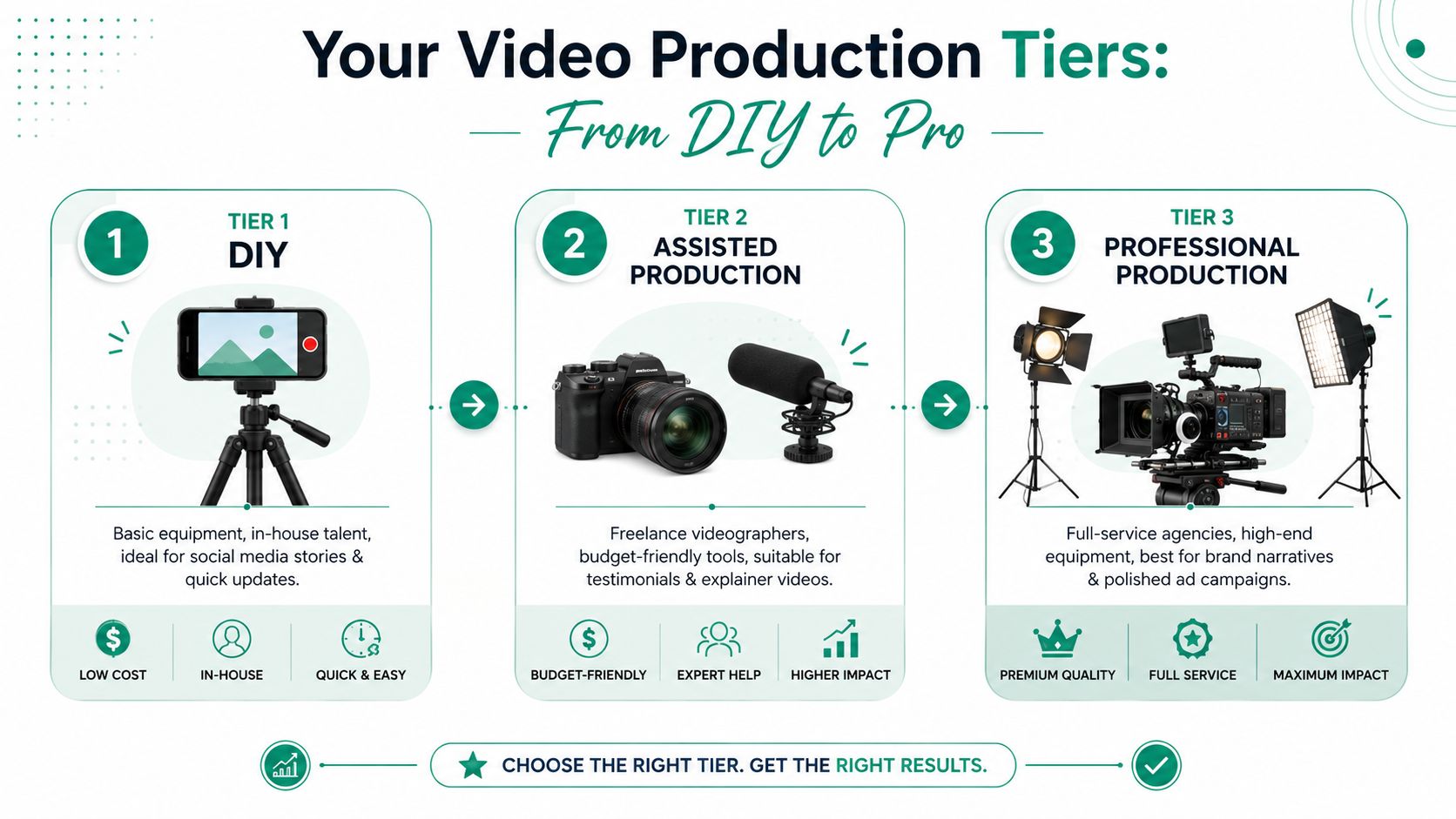
A simple tiered approach keeps production realistic.
Choose the right production tier
DIY production works for quick updates, simple social clips, behind-the-scenes footage, and founder commentary. A recent smartphone, natural light, a tripod, and a clean microphone setup are enough for many of these uses.
Assisted production fits businesses that want stronger editing, cleaner sound, and a more planned shoot without full agency involvement. Freelance videographers often help here, especially for testimonials, explainers, and basic product videos.
Professional production makes sense when the asset will sit on your homepage, support paid campaigns, or represent the brand in high-stakes sales situations. That's also where an agency partner can handle concepting, scripting, production management, and post-production. Ascendly Marketing offers video production as part of its broader digital execution, which is useful when the video needs to fit a website, paid media, and CRO plan rather than stand alone.
Pre-production decides whether the shoot works
Before anyone presses record, lock four things:
- Audience. Who will watch this and what do they need answered?
- Single goal. What action should happen after viewing?
- Core message. What must the viewer understand in one sentence?
- Shot list. What visuals prove the message?
Businesses that skip this step usually record too much footage and still miss the key scenes. They talk in generalities, then try to fix the problem in editing.
For teams that need to produce ad variations quickly, a tool like ShortGenius AI ad generator can help speed up concept testing and basic creative iteration before committing to larger production.
Here's a practical example of production thinking in motion:
Production details that change outcomes
A viewer will tolerate modest visuals. They won't tolerate weak audio. Prioritize sound before buying more camera gear.
Then focus on pacing. Most business videos improve when the opening gets tighter, the message gets more direct, and the call to action arrives sooner. Long intros, logo animations, and broad mission statements often weaken performance.
Record for the edit. Capture short takes, multiple openings, product close-ups, and customer-facing angles that let you cut versions later.
Choosing Channels and Distribution Tactics
A finished video with no distribution plan is just a file. Channel choice decides who sees it, how long they stay with it, and whether they move to the next step.
Small businesses often struggle with repurposing one asset for multiple platforms. SundaySky's strategy guide notes that 65% of email open rates increase when "video" appears in the subject line, while also pointing to platform-specific optimization needs such as TikTok's 15-second ideal and LinkedIn's 2-minute ideal. This highlights the distribution challenge. Not just posting everywhere, but adapting intelligently.
Channel comparison by business use
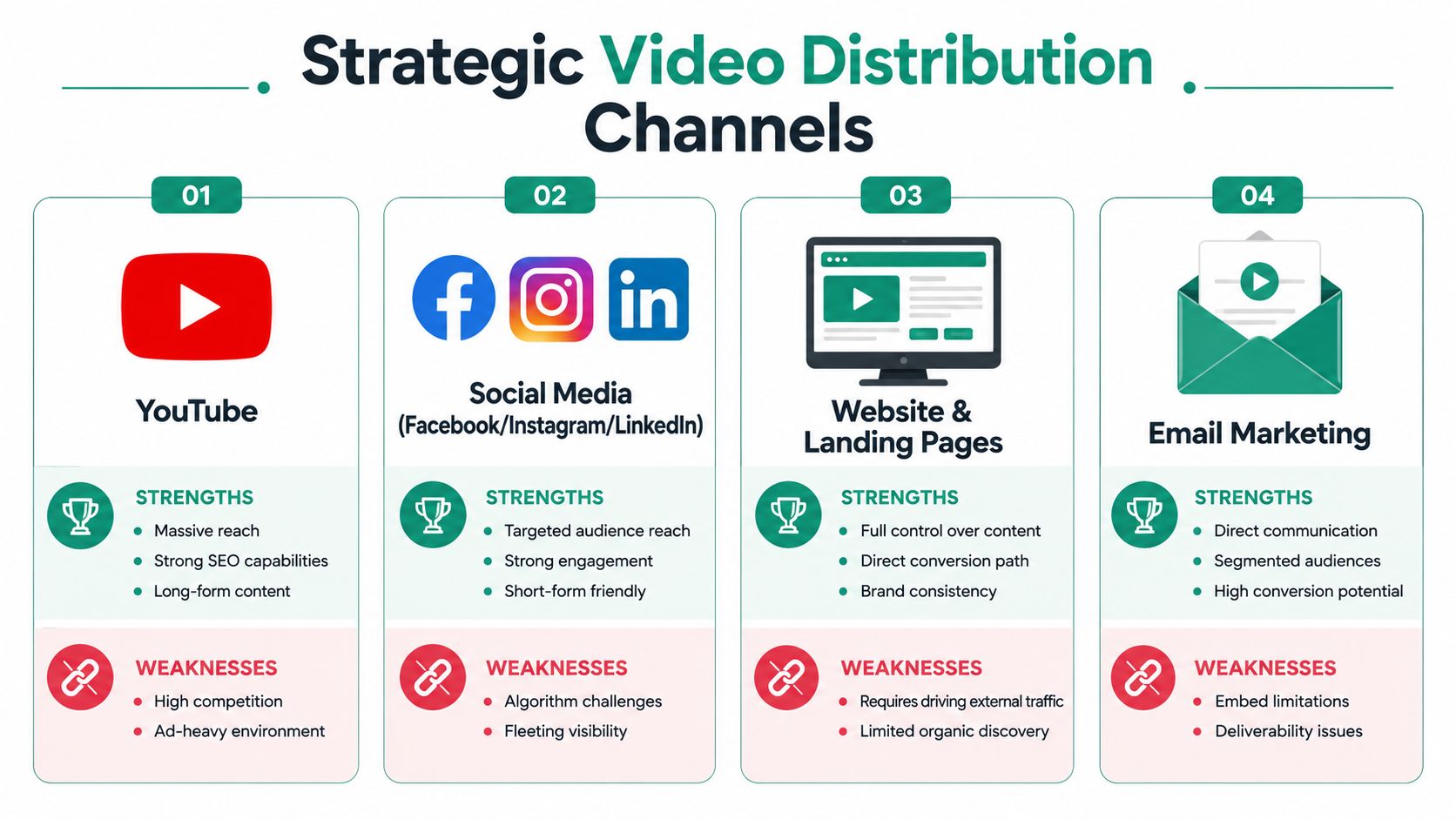
| Channel | Where it works well | Main limitation |
|---|---|---|
| YouTube | Searchable demos, explainers, evergreen education | Competition is high and attention is fragmented |
| Social platforms | Reach, retargeting, short-form discovery, audience testing | Visibility can disappear quickly |
| Website and landing pages | Conversion support and controlled messaging | You must drive traffic there |
| Re-engagement, sales follow-up, segmented campaigns | Playback and embedding can be inconsistent |
If YouTube is part of your plan, this YouTube posting guide is a useful reference for the operational side of publishing, especially when your team needs a repeatable workflow.
Repurpose without making the content feel recycled
One core recording can become multiple assets if you cut it with channel behavior in mind.
Try this pattern:
- Website version keeps the strongest explanatory sections and a clear CTA
- LinkedIn version opens with the business problem and trims extra setup
- TikTok or Reels version starts with a sharper hook and one takeaway
- Email version uses a thumbnail and direct preview language tied to the next click
That approach works better than uploading the same horizontal two-minute video everywhere and hoping the platform will do the adaptation for you.
Businesses running paid campaigns should also look at programmatic video advertising because distribution isn't limited to organic posting. Paid placement changes reach, targeting, and testing speed, especially when you already know which message converts.
Don't confuse reach with fit
YouTube can house deep educational content. LinkedIn can support B2B thought leadership and trust-building. Email can revive warm leads. Your website closes the loop.
The right choice depends on buyer intent. If the video explains a complex offer, put it where prospects already evaluate you. If the video earns cold attention, distribute it where interruption-based discovery is normal.
Measuring Video Performance Beyond View Counts
Views are easy to report and hard to act on. They tell you that a platform served a video. They don't tell you whether the right people watched, clicked, converted, or entered the pipeline.
O'Rourke Media Group's discussion of video ROI points out that while 86% of landing pages with video see conversion increases, most guidance still fails to isolate video's effect on lead quality and pipeline contribution. That's the reporting gap many businesses run into. The video appears to work, but nobody can show where revenue changed.
What to measure instead
Start with metrics that connect to business movement:
- Qualified traffic from video to product, service, or booking pages
- Form submissions or demo requests from viewers
- Lead quality by source when video is part of the path
- Sales velocity signals such as whether video viewers progress faster in CRM stages
- Pipeline influence for deals that engaged with key videos before conversion
A social clip with high reach may still be weak if it sends low-fit traffic. A testimonial with fewer views may be more valuable if it supports better close rates.
Count views for diagnostics. Count pipeline for decisions.
Build a simple attribution setup
Use trackable links, campaign naming discipline, and page-level goals. If a video appears on a landing page, compare the lead quality and downstream progression of visitors who engaged with that page against comparable traffic sources and periods.
For B2B teams, collaboration with sales is essential. Marketing can track clicks and conversions. Sales can report whether the leads arriving after certain video touches are better informed, easier to qualify, or more likely to move.
If your team needs a broader measurement model for awareness and downstream effect, brand lift studies can help frame video performance beyond surface engagement while still keeping business outcomes in view.
What usually doesn't work
Businesses get into trouble when they optimize every video for watch count. That pushes teams toward broad hooks, weak qualification, and content that attracts the wrong audience.
A better standard is this: did the video help the business attract better prospects, educate them faster, or improve the odds of conversion? If the answer is yes, the video is doing its job, even when the public metrics look modest.
Your Video Marketing Implementation Checklist
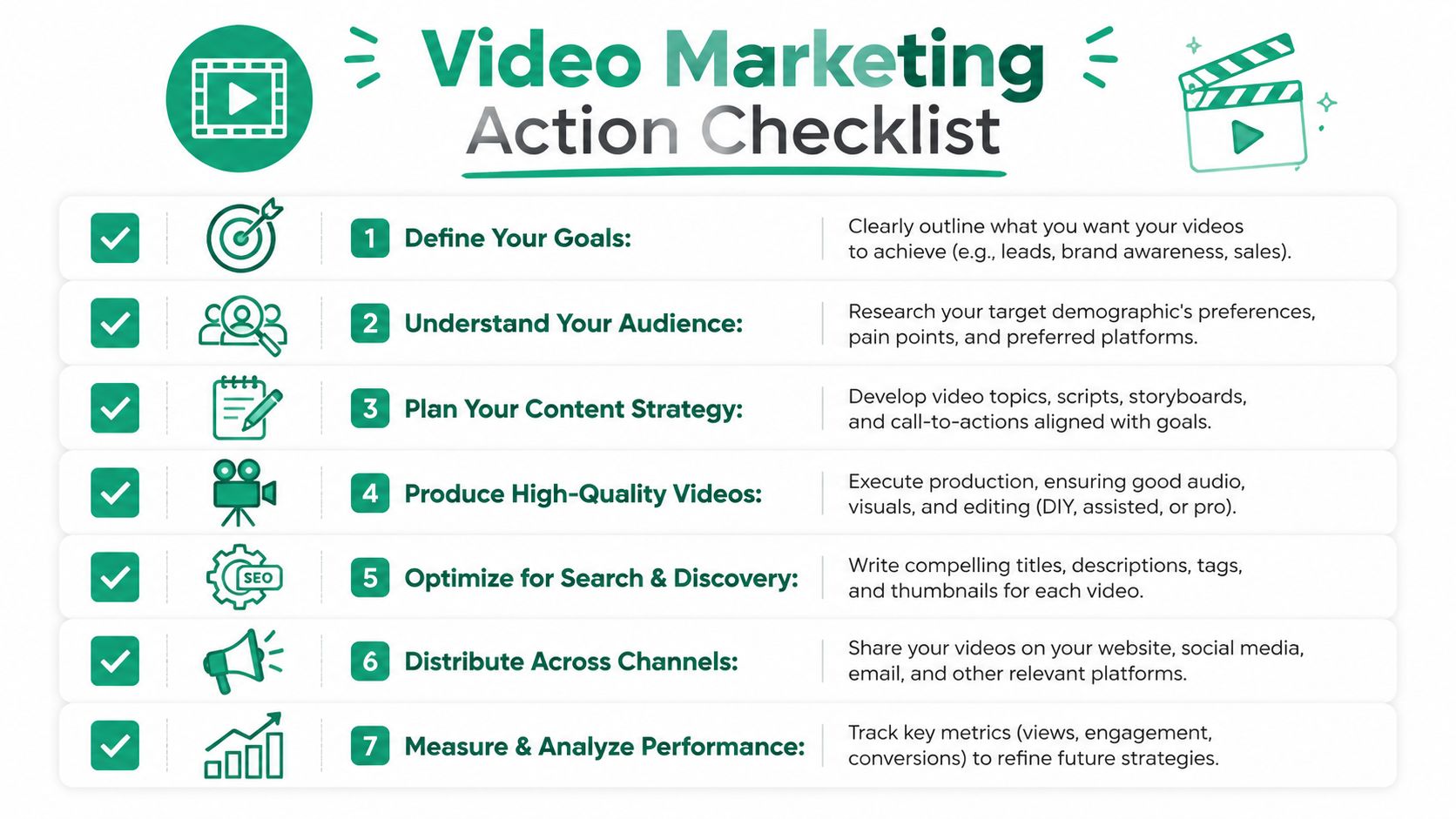
Teams that treat video as a revenue tool usually run it with the same discipline they apply to paid search or email. The goal is not to publish more assets. The goal is to produce the right video for the right stage, distribute it with intent, and measure whether it helps create pipeline.
Planning and production checks
- Define one business goal per video. Pick lead generation, sales support, product education, or reactivation. One clear objective produces a stronger brief, script, and CTA.
- Choose the funnel stage before you choose the format. Awareness videos should earn attention and qualify interest. Consideration videos should answer objections. Decision-stage videos should reduce buying risk and move the prospect toward a call, demo, or purchase.
- Write for spoken delivery. On-camera language needs short sentences, plain wording, and a point that lands early.
- Plan for silent viewing and measurement before launch. Digital Applied's 2026 video marketing benchmarks note that 85% of Facebook videos are watched with sound off. That makes captions a practical distribution requirement, and it is also a good reminder to set up UTMs and GA4 goals before the campaign goes live so performance can be tied back to traffic and conversion outcomes.
Distribution and measurement checks
- Create channel-specific cuts. A homepage explainer, a paid social cutdown, and a sales follow-up clip should not all use the same edit. Different placements have different jobs.
- Match the CTA to buyer intent. Cold audiences respond better to low-friction next steps such as learning more, watching a demo, or visiting a relevant page. High-intent audiences can handle a stronger ask.
- Review lead quality and pipeline movement. A testimonial with modest reach can outperform a broad social clip if it helps opportunities progress or improves close rates.
- Use creator distribution selectively. If your brand needs faster reach or wants third-party style content to test positioning, platforms that help you find marketing influencers can support that effort.
Weekly operating rhythm
- Monday. Review active videos by funnel stage and business goal.
- Midweek. Turn one strong core asset into a shorter cut for another channel or sales use case.
- Friday. Check CTA clicks, lead quality, influenced opportunities, and sales feedback.
This cadence keeps video tied to demand generation and revenue operations instead of letting it drift into a production exercise.
If you want a video marketing plan that connects production, distribution, conversion tracking, and pipeline reporting, Ascendly Marketing can help build the strategy and execution around your business goals.