

TL;DR:
- Organic traffic consists of unpaid visitors attracted by your website’s relevance and authority through search engines. It accounts for over half of all website traffic and offers long-term, high-intent leads for small and medium-sized businesses.
Organic traffic is defined as the visitors who land on your website through unpaid search engine results, driven entirely by your site’s relevance and authority. It is the most sustainable visitor source available to small and medium-sized businesses because it compounds over time without requiring ongoing ad spend. Google Analytics and Google Search Console are the primary tools for measuring it. Studies consistently show that organic search drives 50%–60% of all website traffic, far exceeding paid search or social visits. That single number explains why so many business owners and marketers treat SEO as their most important long-term investment.
What is organic traffic, and how does it work?
Organic traffic is the industry term for unpaid search visits, and it works through a straightforward process. A user types a query into Google, Bing, or another search engine. The engine returns a ranked list of results based on relevance, authority, and technical quality. When the user clicks your listing without you paying for that placement, that visit counts as organic traffic.
The ranking process is where SEO, or search engine optimization, comes in. Google evaluates hundreds of signals, including content quality, page speed, mobile usability, and the number of authoritative sites linking to yours. Your goal is to satisfy those signals well enough to appear on page one, where the vast majority of clicks happen. The higher your position, the more organic visitors you attract.
Pro Tip: Set up Google Search Console before you do anything else. It shows you exactly which queries trigger your pages, your average ranking position, and your click-through rate, giving you a real baseline to work from.
How does organic traffic differ from other traffic sources?
Organic traffic differs from paid, direct, referral, and social traffic in both cost structure and visitor intent. Understanding those differences helps you allocate your marketing budget more effectively.
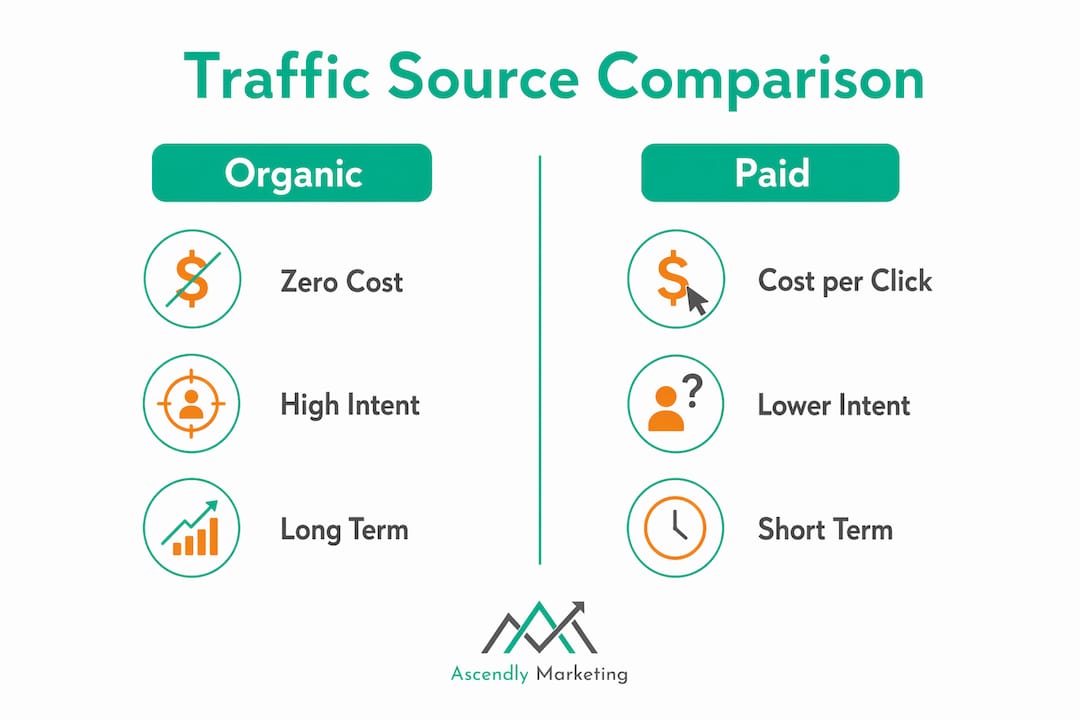
- Organic traffic: Earned through SEO and content relevance. No cost per click. Builds over months and years.
- Paid traffic: Purchased through platforms like Google Ads. Delivers immediate visits but stops the moment your budget runs out.
- Direct traffic: Visitors who type your URL directly or use a bookmark. Reflects brand awareness, not search visibility.
- Referral traffic: Visitors arriving via a link on another website. Valuable but dependent on third-party publishing decisions.
- Social traffic: Visitors from platforms like Facebook, Instagram, or LinkedIn. Driven by content sharing and paid promotion, not search intent.
The critical difference is intent. Organic visitors actively seek solutions when they search, which means they arrive with a specific need already in mind. A person who Googles “best accounting software for small business” is far closer to a buying decision than someone who sees a display ad while scrolling a news site.
| Traffic source | Cost per visit | Visitor intent | Longevity |
|---|---|---|---|
| Organic | Zero per click | High | Years |
| Paid | Per click | Medium to high | Ends with budget |
| Direct | Zero | High | Ongoing |
| Referral | Zero | Medium | Depends on third party |
| Social | Low to medium | Low to medium | Short |
Why does organic traffic matter for SMBs?
Organic traffic is the most cost-efficient acquisition channel for small and medium-sized businesses because it keeps working long after the initial investment. A well-written blog post or service page can attract visitors for years without any additional spend. That compounding effect is something paid advertising simply cannot replicate.
“Unlike paid search, which stops when spending ends, organic traffic continues to generate leads for years after content is published. For SMBs with limited budgets, that long-term payoff changes the economics of customer acquisition entirely.”
The benefits go beyond cost savings. Organic visitors convert at higher rates because they arrive with clear intent. A business that ranks for “plumber in Austin” captures someone who needs a plumber right now, not someone who might need one someday. That specificity makes organic leads more valuable per visit than most other sources.
Domain authority also plays a direct role. Sites with strong authority, built through quality backlinks and consistent content, rank more easily for new pages. Every piece of content you publish adds to that foundation. Over time, your site becomes easier to rank, and the cost per lead from organic search keeps falling.

How to increase organic traffic effectively
Growing your organic search presence requires a focused set of actions applied consistently. The following steps reflect what actually moves the needle for SMBs.
Match content to search intent. Before writing anything, search your target keyword and study the top five results. Reviewing top-ranking content formats tells you whether Google favors blog posts, product pages, how-to guides, or comparison articles for that query. Writing the wrong format, no matter how well, will cost you rankings.
Do thorough keyword research. Target keywords with clear commercial or informational intent that your site can realistically rank for. Long-tail phrases like “how to file quarterly taxes as a freelancer” are less competitive and attract visitors who are closer to taking action.
Fix your technical SEO foundation. Page speed, mobile usability, clean URL structures, and proper metadata all affect how Google crawls and ranks your pages. Use Google Search Console to identify crawl errors and fix them before they suppress your rankings. An SEO checklist for businesses gives you a structured starting point.
Build authority through backlinks. A link from a trusted, relevant website signals to Google that your content is worth ranking. Guest posts, digital PR, and creating genuinely useful resources that others want to cite are the most reliable ways to earn links.
Update existing content regularly. Google favors updated, intent-matched content to rank in organic results. Refreshing a page with new data, clearer explanations, or additional sections can recover lost rankings faster than writing a new page from scratch.
Align content with your site architecture. Internal links between related pages distribute authority across your site and help Google understand your topical depth. A page about “email marketing tips” should link to your page on “email marketing tools,” and vice versa.
Pro Tip: Before creating new content, audit your existing pages in Google Search Console. Pages ranking in positions 8–15 are close to page one. A targeted update to those pages, adding depth, fixing intent alignment, or improving metadata, often delivers faster traffic gains than publishing something brand new.
For a deeper look at the full process, Ascendly Marketing’s guide on increasing organic traffic covers each of these steps with practical examples for SMBs.
How do you measure organic traffic performance?
Measuring organic traffic accurately requires two tools working together: Google Analytics and Google Search Console. Google Analytics reports organic sessions and users; Search Console provides impressions, clicks, click-through rate, and average ranking position. Together, they give you a complete picture of what is working and what needs attention.
The metrics that matter most for SMBs are:
- Sessions: Total visits from organic search. Tracks overall volume trends.
- Users: Unique visitors from organic search. Shows audience reach.
- Click-through rate (CTR): The percentage of impressions that result in a click. Low CTR on a high-impression page signals a weak title or meta description.
- Average position: Where your pages rank on average for their target keywords. Positions 1–3 capture the majority of clicks.
- Conversion rate: The percentage of organic visitors who complete a desired action, such as a form submission or purchase.
| Metric | What it measures | Why it matters |
|---|---|---|
| Sessions | Total organic visits | Shows traffic volume trends |
| CTR | Clicks divided by impressions | Reveals title and meta description effectiveness |
| Average position | Mean ranking across keywords | Identifies ranking improvement opportunities |
| Conversion rate | Actions completed per visit | Connects traffic to business outcomes |
Pro Tip: Set a monthly benchmark for each metric in a simple spreadsheet. Tracking direction of change, not just absolute numbers, tells you whether your SEO efforts are gaining or losing ground over time.
Understanding search intent is the missing link between high traffic numbers and actual conversions. A page with strong sessions but a low conversion rate often targets the wrong stage of intent.
Key Takeaways
Organic traffic is the highest-ROI visitor source for SMBs because it compounds over time, attracts high-intent visitors, and generates leads long after the initial content investment.
| Point | Details |
|---|---|
| Definition of organic traffic | Unpaid visits from search engines, driven by content relevance and SEO authority. |
| Share of total web traffic | Organic search accounts for 50%–60% of all website traffic for most sites. |
| Visitor intent advantage | Organic visitors actively seek solutions, making them more likely to convert than other traffic types. |
| Core growth strategies | Match content to search intent, fix technical SEO, build backlinks, and update existing pages regularly. |
| Measurement tools | Use Google Analytics for session data and Google Search Console for rankings, CTR, and impressions. |
The uncomfortable truth about “free” organic traffic
Organic traffic is not free. That is the first thing I tell every SMB owner who comes to Ascendly Marketing expecting SEO to be a zero-budget channel. Organic traffic requires ongoing investment in content creation, technical maintenance, and authority building. The difference from paid advertising is that you are building an asset, not renting visibility.
What I have seen consistently over more than a decade of working with small and medium-sized businesses is this: the companies that win at organic search stop thinking about rankings and start thinking about their customers’ questions. They write for the person searching, not for the algorithm. The algorithm rewards that approach anyway, but the mindset shift changes the quality of everything they produce.
The other thing most guides will not tell you is that patience is a competitive advantage. Most businesses quit SEO within six months because they do not see immediate results. The ones who stay the course for 12 to 18 months end up owning page-one positions their competitors abandoned. That is where the real compounding begins.
— Ascendly Marketing
How Ascendly Marketing helps SMBs grow organic traffic
Ascendly Marketing has worked with small and medium-sized businesses since 2013, building organic search programs that deliver measurable, lasting results. The team includes SEO specialists, content creators, and technical experts who have worked with major brands and understand what it takes to compete in crowded search results.
Every engagement starts with a full audit of your current organic performance, identifying the gaps between where you rank now and where your customers are searching. From there, Ascendly Marketing builds a content and SEO plan tailored to your industry, budget, and growth goals. Whether you need a complete digital marketing strategy or focused organic SEO support, the team delivers transparent reporting and results you can track. Book a consultation at Ascendly Marketing to see what a focused organic growth program looks like for your business.
FAQ
What is the definition of organic traffic?
Organic traffic is the visitors who arrive at your website through unpaid search engine results. It is earned through SEO and content relevance, not purchased through advertising.
How is organic traffic different from paid traffic?
Paid traffic comes from ads you pay for on platforms like Google Ads and stops when your budget runs out. Organic traffic is earned through search rankings and continues generating visits without ongoing ad spend.
What drives organic traffic to a website?
Content quality, keyword relevance, technical SEO, and authoritative backlinks are the primary drivers. Google ranks pages that best match a user’s search intent, so aligning your content with what searchers actually want is the most direct path to organic visits.
How long does it take to see organic traffic results?
Most businesses see meaningful organic traffic growth within 6–12 months of consistent SEO effort. Competitive industries may take longer, while low-competition niches can show results faster.
What tools measure organic traffic performance?
Google Analytics tracks organic sessions and users. Google Search Console provides impressions, clicks, click-through rate, and average ranking position for your pages and keywords.