
You launch a video campaign because customers keep telling you they found competitors on YouTube, streaming TV, social feeds, and news sites. You approve the creative, set a budget, and wait for leads. A few days later, the reporting tells you people saw the ad. That’s nice, but it doesn’t answer the question you actually care about. Did the spend reach the right people, or did it drift into cheap inventory that looked busy and did very little?
That gap is where many small and mid-sized businesses get stuck. Video sounds powerful, but buying it can feel vague. You know your buyers are online. You know video can explain, persuade, and remind better than a static banner. Yet the process often feels like buying shelf space blindfolded.
Programmatic video advertising gives that problem a more accountable structure. It uses automated auctions and audience data to decide, in real time, whether a specific impression is worth buying. That shift matters because video spending is moving hard in this direction. Programmatic video ad spending is projected to reach $186 billion in 2026, a 24% year-over-year increase, while global digital video ad spending reached over $191.3 billion in 2024 and is forecast to climb to $659.16 billion by 2030, according to SearchLab’s 2026 programmatic advertising statistics.
Moving Beyond Hope as a Marketing Strategy
A business owner I often picture here isn’t confused about marketing. They’re frustrated by inconsistency.
One month, a video campaign produces branded search lift, sales calls, and a few strong inbound leads. The next month, the same budget seems to disappear into views that don’t turn into anything useful. The ad may have run on decent sites. It may even have decent watch time. But the connection between spend and revenue is still fuzzy.
What this looks like in real life
Say you run a regional home service company, an e-commerce brand, or a B2B firm with a long sales cycle. You probably don’t need “more awareness” in the abstract. You need a system that can answer practical questions:
- Who saw the ad: Existing customers, cold prospects, or people outside your buying area?
- Where it showed up: Premium streaming inventory, mobile apps, in-article placements, or low-quality environments.
- What happened next: Site visits, product views, form fills, calls, demo requests, or nothing at all.
Traditional media buying often leaves too much of that hidden or delayed. Manual placements can work, but they don’t always adapt fast enough when one audience segment performs better than another.
Practical rule: If your reporting stops at “people watched the video,” you’re still making decisions with partial information.
The shift from broad reach to controlled reach
Programmatic video advertising doesn’t remove the need for strategy. It removes a lot of the guesswork from buying and placement. Instead of buying broad blocks of inventory and hoping your audience is there, you buy impression by impression when the user, context, device, and price match your rules.
That “match” is the primary appeal for a busy owner. You’re no longer treating video as a brand exercise that sits in its own corner. You’re treating it as a paid media channel that should support leads, sales, and customer acquisition.
For small and mid-sized businesses, that changes the conversation. The question stops being, “Should we try video?” It becomes, “How do we buy video in a way that we can measure and improve?”
What is Programmatic Video Advertising Really
The cleanest way to understand programmatic video advertising is to think of it as an automated market for ad space. Not a slow negotiation. Not a sales rep emailing a rate card. A live auction that runs while a page or app is loading.
A publisher has video ad inventory. An advertiser wants to reach a certain type of viewer. Software evaluates the opportunity and decides whether to bid. That decision happens almost instantly.
A simple mental model
If the old way of buying ads felt like reserving billboard space weeks ahead, programmatic feels closer to buying one seat at a time based on who just walked into the stadium.
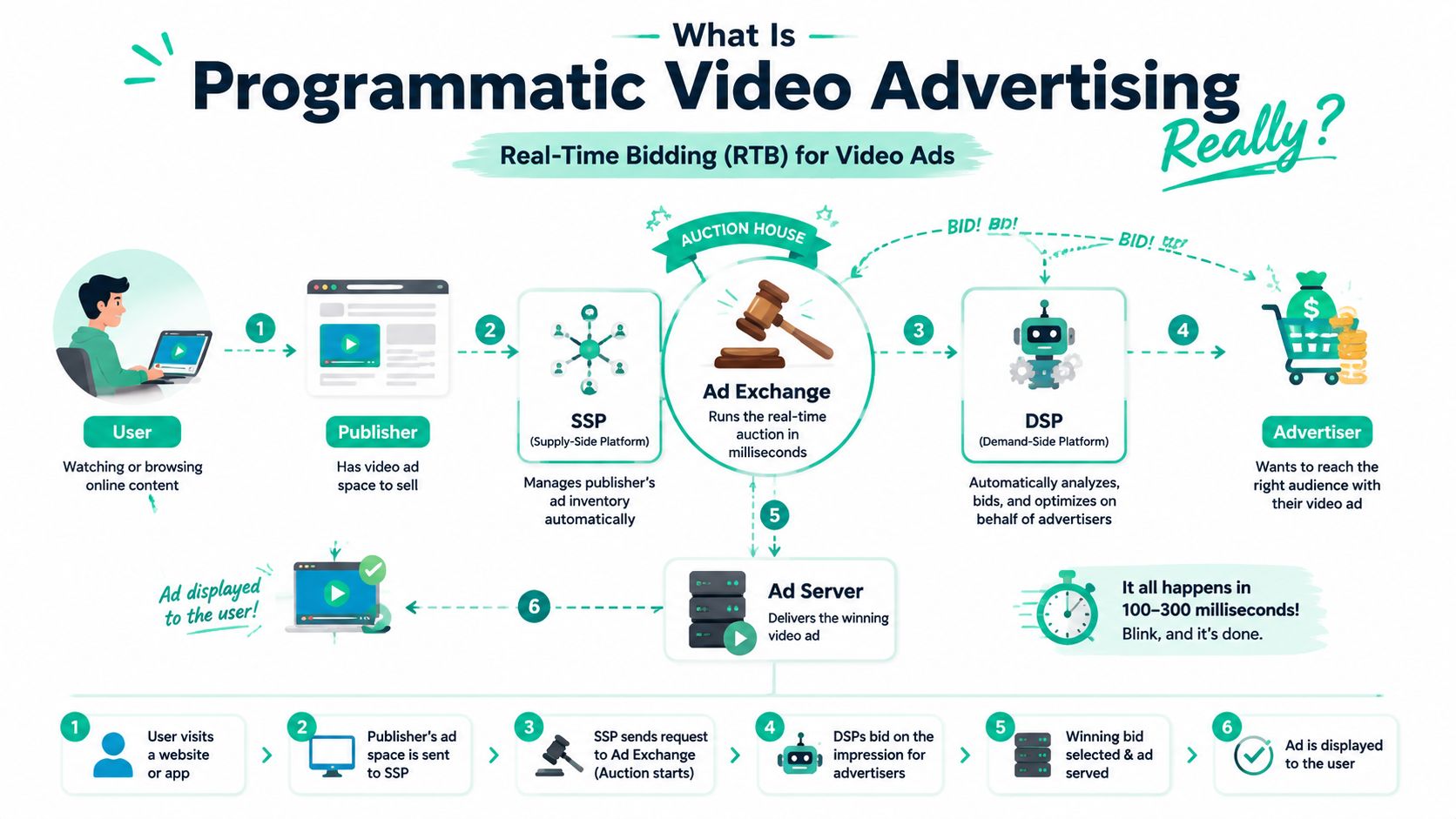
Here’s the core idea in plain English. Programmatic video replaces manual buying and guesswork with automated auctions that place ads in front of the right audience at the right time and price, using real-time bidding and data-driven algorithms rather than fixed rates or direct publisher negotiations, as described in Tappx’s guide to programmatic video advertising.
That sounds technical, but the business logic is straightforward. You set rules. The platform checks each opportunity against those rules. It bids only when the opportunity fits.
What gets evaluated in the auction
A single impression can be judged on several practical factors:
- Audience fit: Is this person likely to be a buyer, a past visitor, or an existing customer you should exclude?
- Placement quality: Is the ad appearing in a video player, an article feed, a mobile app, or a streaming environment?
- Device and screen: Mobile, desktop, tablet, or connected TV all change how creative should work.
- Price: Is the impression worth the bid based on your goal?
This is also why short-form video buying has become more advanced. Teams using evolved meme marketing strategies are moving away from loose creator placements and toward more structured, programmable distribution where buying logic and creative logic work together.
Programmatic video isn’t buying “traffic.” It’s deciding whether one specific viewing opportunity deserves your budget.
For a business owner, that framing clears up the biggest misconception. You’re not buying video as a vague channel. You’re buying selected opportunities to show a message to selected people under selected conditions.
Meet the Players in the Programmatic Ecosystem
The acronyms make this channel look harder than it is. Strip away the labels, and you have a small set of actors doing distinct jobs.
At the center is an auction. One side wants to buy an impression. The other side wants to sell it. The platforms in between handle the mechanics.
The advertiser’s side
A DSP, or demand-side platform, works like your buying agent. You tell it who you want to reach, what you want to pay, where you want to show up, and what goal matters most. Then it reviews available impressions and bids on the ones that fit.
If you’ve ever told Google Ads or Meta Ads which audience to target and what objective to optimize toward, the concept is similar. The difference is that programmatic often stretches across more inventory sources and devices, including streaming TV.
The publisher’s side
An SSP, or supply-side platform, works for the publisher. Its job is to make that inventory available, package the request, and help the publisher earn the strongest price for it.
The publisher could be a news site, a streaming app, a sports platform, or a niche content property. Their SSP sends available impressions into the auction.
A quick visual helps before going deeper.
Where the deal happens
The ad exchange is the marketplace. It’s where the bid request meets buyers. Algorithms look at audience data, behavior signals, demographics, and placement details, then determine the winning bid.
According to Amazon Ads’ explanation of programmatic video, this works through an automated auction system where DSPs and SSPs connect advertisers to publishers, send real-time bid requests for every impression, and evaluate those requests in milliseconds as a page loads.
That sounds abstract, so here is the plain version:
| Player | Who it serves | What it does |
|---|---|---|
| DSP | Advertiser | Buys impressions based on rules and bids |
| SSP | Publisher | Offers inventory and manages sell-side opportunities |
| Ad exchange | Both sides | Runs the auction and matches buyers to sellers |
| Ad server | Delivery process | Serves the winning video ad |
Why business owners should care
You don’t need to memorize the stack. You do need to know where accountability can break.
If your partner can’t explain which platform bought the media, which inventory sources were used, and how exclusions were handled, then the system stays a black box. That makes optimization harder and waste easier.
Video Formats and Advanced Audience Targeting
Video inventory doesn’t all behave the same way. A pre-roll ad before a product review has a different viewing context than a muted video inside an article feed. A streaming TV placement has different strengths than a mobile in-feed video. If you treat every format as interchangeable, creative and budget decisions get sloppy.
The main formats you’ll run into
In-stream video appears inside video content. This includes pre-roll before the main video and mid-roll during it. These placements usually feel familiar to viewers because they match the standard “watch content, then watch ad” pattern.
Outstream video appears outside a standard video player. Think in-feed placements, in-article units, or embedded videos that autoplay while someone scrolls. These often work best when the message is understandable without sound.
Connected TV, often shortened to CTV, reaches viewers in streaming environments on larger screens. If your business is exploring streaming placements, this guide to connected television advertising is useful for understanding how TV-style reach and digital targeting come together.
Targeting goes far beyond age and gender
In this context, programmatic starts earning its keep.
A local HVAC company can target households in service areas while excluding recent converters. An e-commerce brand can retarget cart abandoners with product-focused video. A B2B software company can use contextual placement to appear beside business, operations, or industry-specific content.
Here are three common ways this plays out:
- Contextual targeting: Your ad appears alongside content that matches the topic. Hiking boots beside outdoor travel content is a simple example.
- Behavioral targeting: The system looks for patterns that suggest interest, such as users browsing related categories or showing signals tied to purchase intent.
- Retargeting: Someone visits your product page, pricing page, or lead form but leaves. You show them a follow-up video later with a stronger prompt.
Matching format to message
Creative should change based on where the ad appears. A product demo may work in-stream when the viewer expects a longer watch. A short visual hook with text overlay is often better for outstream. For brands building more volume at the top of the funnel, this resource on how to scale your short video content gives a useful lens on adapting the same core message across multiple short-form placements.
A targeting plan without a format plan usually underperforms. The right audience still won’t respond if the creative doesn’t fit the screen and viewing behavior.
How to Measure Success Beyond Just Views
Views are easy to report and easy to misread. A campaign can collect a large number of views and still fail at the thing your business wants, whether that’s lead volume, revenue, qualified traffic, or pipeline movement.
A better measurement approach starts by matching the metric to the stage of the campaign.
Use the right KPI for the job
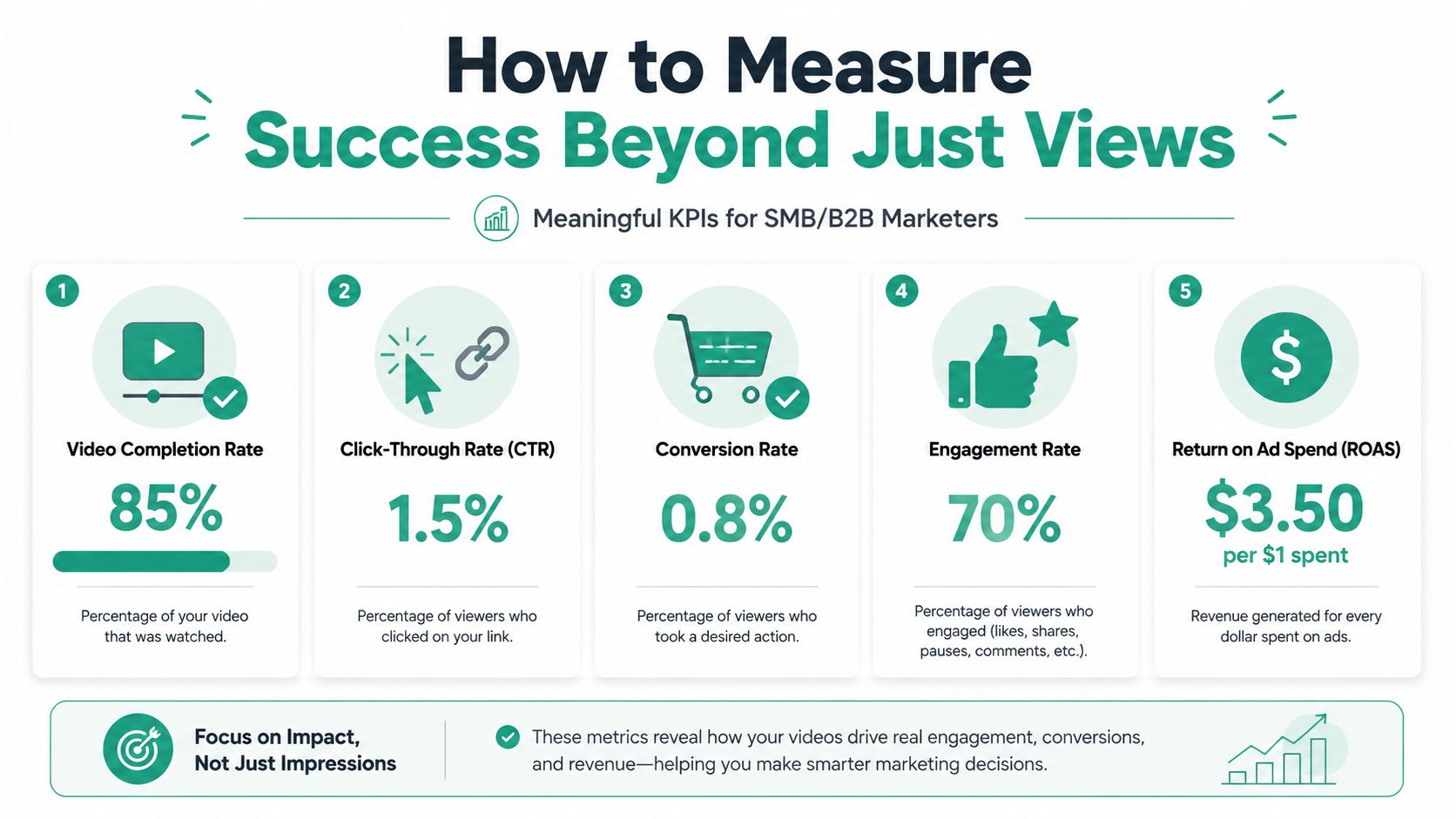
For upper-funnel work, reach and viewable completion rate, often called VCR, tell you whether the ad is being seen and watched in a meaningful way. For mid-funnel activity, qualified visits and engaged views matter more because you want proof that interest moved beyond passive watching.
For lower-funnel campaigns, the focus tightens further. According to Crimtan’s creative specifications guide, in 2026 upper-funnel campaigns prioritize on-target reach and VCR, mid-funnel tracks qualified visits and engaged views at 50%+, while lower-funnel optimizes CPCV or vCPM against target CPA or ROAS, with holdout or geo-tests used to measure true incrementality.
What each metric tells you
A simple breakdown helps:
- VCR: How often viewers finish the video. Good for judging message retention and placement fit.
- Qualified visits: Whether viewers land on the site and show real interest rather than bounce immediately.
- CPCV: Cost per completed view. Useful when completion matters more than raw impression volume.
- CPA: Cost per acquisition. It is often the target for many SMBs aiming for lead or sale generation.
- ROAS: Return on ad spend. Best used when revenue tracking is reliable enough to trust.
Don’t stop at platform-reported performance
Platform dashboards can show efficiency inside the platform. They don’t always prove incremental business impact.
That’s why brand and lift measurement matters. If you want a practical framework for separating reported engagement from actual market movement, this overview of brand lift studies is worth reviewing.
Measurement shortcut: Ask one question before launch. “If this campaign works, what business change should show up?” Then track the metric closest to that change.
A lead-gen company might care most about booked calls. An e-commerce store might care about product page visits that turn into purchases. A local service provider might care about form submissions and inbound calls from target ZIP codes. In each case, “views” is only a supporting signal.
Budgeting, Bidding, and Creative Best Practices
Most business owners ask two practical questions first. How much should we spend, and what should the ad look like?
The honest answer is that budget depends on your market, your audience size, and your goal. But the decision process is simpler than people expect. Start with a test budget large enough to gather useful data, then judge the campaign by business outcomes, not by whether the first few days look exciting.
Think in test cycles, not one-shot campaigns
Your first programmatic video campaign shouldn’t try to prove everything at once. Pick one audience, one core offer, and one success metric. That gives you cleaner feedback.
Bidding models shape how the spend is applied:
| Model | What you’re paying for | Best fit |
|---|---|---|
| CPM | Impressions | Reach and awareness goals |
| CPCV | Completed views | Campaigns where message completion matters |
| Outcome-led optimization | Delivery tuned toward CPA or ROAS targets | Lower-funnel goals with strong tracking |
If you're comparing paid video channels more broadly, including social, this breakdown of analyzing TikTok ad budgets for sellers can help frame how platform economics differ from open-web programmatic buying.
Creative rules that hold up in practice
Many programmatic placements are watched with little or no audio. That's not a side detail. It changes how you storyboard, edit, and brand the ad.
Interactive features also matter more than many teams assume. Interactive video ads double consumer consideration and increase awareness by 70% compared to non-interactive campaigns, according to StackAdapt's programmatic video advertising analysis. That makes clear calls to action and tools like QR codes more than decorative extras.
Use these creative habits from the start:
- Front-load the message: Put the offer, pain point, or product in the opening frames.
- Design for sound-off viewing: Use captions, text overlays, and clear visuals so the ad still works muted.
- Show the brand early: Don't wait until the end card if recall matters.
- Give one clear next step: Scan, click, call, shop, book, or learn more. Pick one.
- Build retargeting variants: Someone who already visited your site should see a different message from a cold prospect. This guide to what retargeting advertising is is a useful refresher if you want to structure those sequences well.
Shorter usually works better when the audience doesn't know you yet. Clearer always works better.
A polished ad isn't enough. The creative has to match the placement, the stage of awareness, and the action you want next.
Your Programmatic Video Implementation Checklist
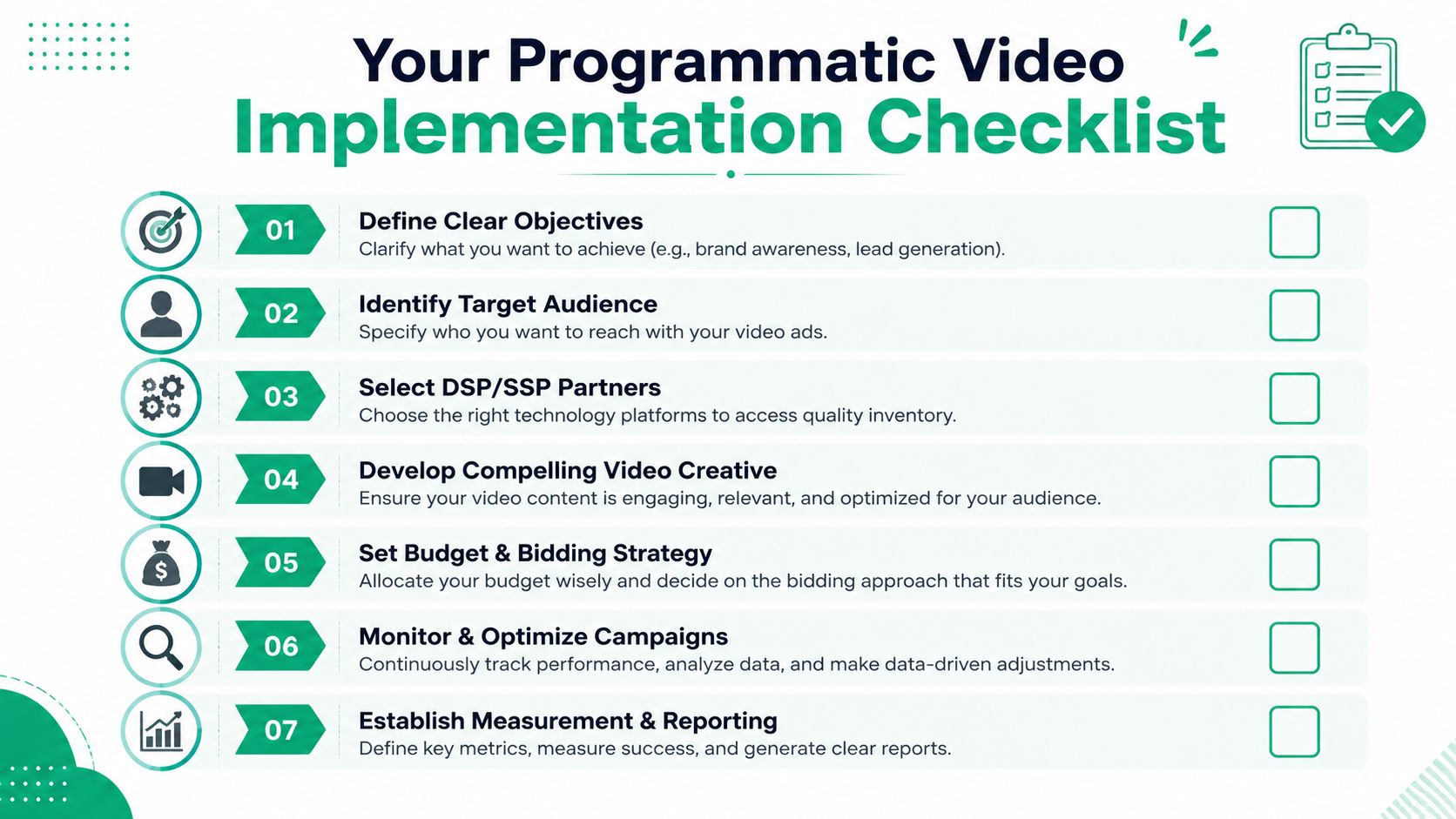
The first launch usually goes better when you treat it like an operating plan instead of a media experiment. Keep the checklist tight. Every item should support a specific business decision.
A workable launch sequence
-
Define the objective
Pick one primary goal. Leads, purchases, booked calls, demo requests, or brand lift. If the goal is fuzzy, the buying logic will be fuzzy too. -
Describe the audience in business terms
Don't stop at demographics. Include buying signals, geography, product interest, customer status, and exclusions. -
Choose the inventory and format mix
Decide whether you're prioritizing in-stream, outstream, CTV, or a combination. Match that choice to your creative assets. -
Set the budget and success metric together
Budget without a KPI becomes spend with no accountability. Tie the test to the metric that matters most.
Questions to ask your platform or partner
Not every waste problem comes from obvious fraud. Some of it comes from poor supply paths, weak reporting, and inventory you can't inspect closely enough.
According to AdExchanger's analysis of the programmatic video waste problem, 20% to 30% of ad spend is lost due to supply-side misrepresentation and invalid traffic. That's a large enough issue that transparency should be part of campaign setup, not an afterthought.
Ask direct questions:
- Where will the ads appear: Can you review placement categories, apps, sites, and screen types?
- How is waste controlled: What exclusions, quality filters, and reporting layers are in place?
- How often is optimization happening: Daily, weekly, or only after the campaign ends?
- What counts as success: Platform metrics, business outcomes, or both?
Before you press launch
Check the creative on mobile. Check the landing page. Check that tracking works from impression through conversion. Then launch with the expectation that the first round is for learning, not perfection.
The businesses that get the most from programmatic video advertising don't chase every new placement. They build a repeatable process for testing, measuring, and adjusting.
If you want a partner to help plan, launch, and refine programmatic video campaigns with clear reporting and measurable goals, Ascendly Marketing can help you connect strategy, creative, media buying, and conversion tracking into one workable growth system.