

Retargeting advertising means showing ads to people who have already visited your website or viewed a product but didn’t take the next step. Retargeted ads can reach a click-through rate of about 0.7%, compared with roughly 0.07% for standard display ads, which is why many businesses use it as a digital second chance to win back interest.
You’ve probably seen this from the customer side. Someone visits your site, looks at a service page, maybe adds a product to the cart, then leaves to answer an email or compare options. They meant to come back. Most don’t. Retargeting exists for that exact moment.
Think of it as a follow-up, not a first introduction. The person already knows your brand. They already raised a hand by visiting your site, viewing a product, or starting a form. Retargeting helps you stay visible after that first visit so the conversation doesn’t end the second they click away.
Why Some Ads Seem to Follow You Online
You visit a website, look at a few products, leave to compare options, and later see ads for the same brand while reading the news or scrolling social media. That pattern feels personal, but the goal is usually much simpler. The business is trying to continue a conversation you already started.
That is retargeting advertising.
A business uses retargeting to reach people who already visited its site, viewed a product, started a quote, or added something to a cart without finishing the next step. The message is aimed at a warm audience, not a cold one. It is closer to a store clerk remembering what you asked about than a stranger shouting for your attention from across the street.
Why businesses use it
Most visitors do not buy on their first visit. Some are still comparing vendors. Some get interrupted. Some need a second look before they feel ready to act.
Retargeting gives businesses a practical way to reappear in front of those interested visitors with a message tied to what they already did. That is why it became common in e-commerce, local services, and lead generation. A reminder about the exact service page someone viewed usually has a better chance than a generic ad shown to everyone.
The same idea matters even more now because retargeting is changing. Older guides often describe a system built mostly on third-party cookies following people around the web. That is no longer the full picture. Today, small businesses need to understand retargeting through first-party data, platform signals, customer lists, and tools built inside ad platforms themselves. If you are planning campaigns now, that shift matters because it affects what you can track, who you can reach, and how you should set up your data.
A practical example
Say you run a local HVAC company. A homeowner visits your repair page, checks financing options, then leaves before requesting a quote. Later, they see an ad about same-week service or a limited-time inspection offer. The ad works because it connects to a real action they already took.
That is the core value. You are not starting from zero. You are re-engaging someone who already showed intent.
For many small businesses, retargeting works best as one part of a broader audience strategy. If you want more context, this guide on why targeted advertising helps grow an SMB explains how focused targeting fits into the bigger picture.
What retargeting is not
Good retargeting does not rely on showing the same ad to every past visitor again and again. It works best when the message matches the stage of interest.
Someone who visited your homepage once should usually see a different message than someone who abandoned a cart or left a quote form half-finished. When businesses ignore that difference, ads start to feel careless, and people notice fast.
How Retargeting Advertising Actually Works
The technology sounds more complex than it is. In plain terms, your website places a small tracking tag on pages, and that tag helps ad platforms recognize that a visitor had been there before.
Here’s the visual version of the process.
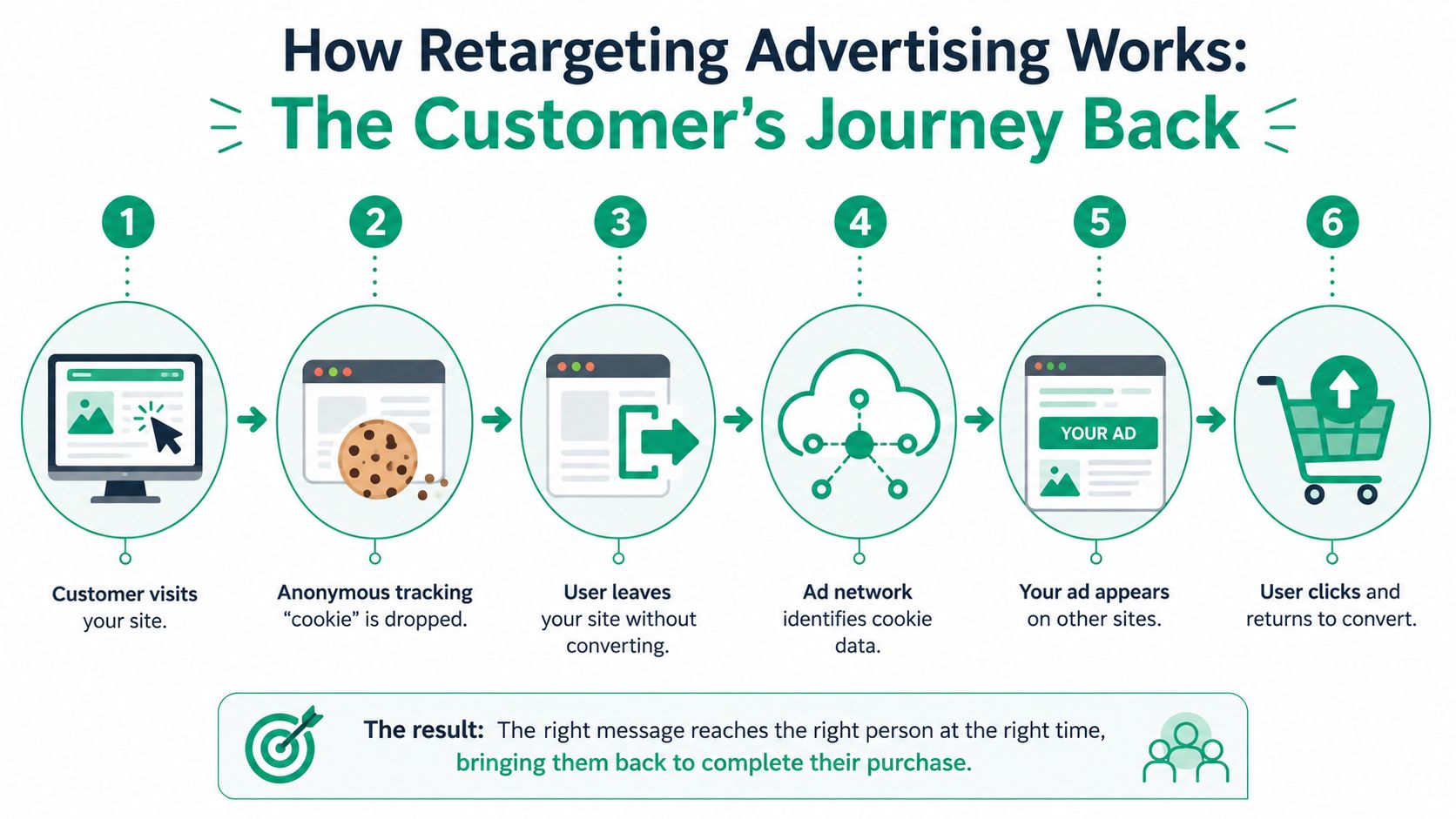
The simple version
A helpful analogy is a store clerk who remembers that a customer came in, picked up a product, asked a question, and left. The clerk doesn’t know everything about that person. They just remember the visit and use that memory to follow up later with something relevant.
Online, that memory usually starts with a pixel or tag.
According to Instapage’s explanation of retargeting mechanics, retargeting is implemented by placing a JavaScript pixel or tag on a site, which drops an anonymous browser cookie and records visit-level behavior. Ad platforms then use that identifier to serve ads to the same user as they browse elsewhere.
What the pixel and cookie do
A pixel is a small piece of code added to your website.
A cookie is the browser-level marker tied to that visit.
Together, they allow platforms to group visitors into useful audiences, such as:
- Cart abandoners who added an item but didn’t finish checkout
- Product viewers who spent time on a specific product or category page
- Pricing page visitors who looked like serious buyers
- Past leads who started, but didn’t complete, a contact form
That’s why retargeting can feel very specific. The ad someone sees often reflects the page they viewed or the action they almost took.
Where the ads show up
Once the audience is built, ads can appear across display networks, social platforms, search environments, and video placements. In programmatic setups, advertisers often use a demand-side platform, or DSP, connected to the site pixel. In video campaigns, delivery may use VAST tags. That setup lets advertisers bid when a previously observed user becomes available, while frequency capping and A/B testing help reduce fatigue and improve performance over time, as described in Epom’s overview of ad retargeting.
Here’s a short explainer if you want to see the flow in motion.
Pixel-based and list-based approaches
Not all retargeting relies on the same input.
| Approach | How it works | Best fit |
|---|---|---|
| Pixel-based retargeting | Builds audiences from website behavior | Bringing back site visitors |
| List-based retargeting | Uses customer or lead lists, such as email-based audiences inside ad platforms | Reaching known contacts across platforms |
Pixel-based retargeting is usually what people mean when they ask what retargeting advertising is. List-based retargeting matters too, especially for businesses that already have a CRM, newsletter list, or past lead database.
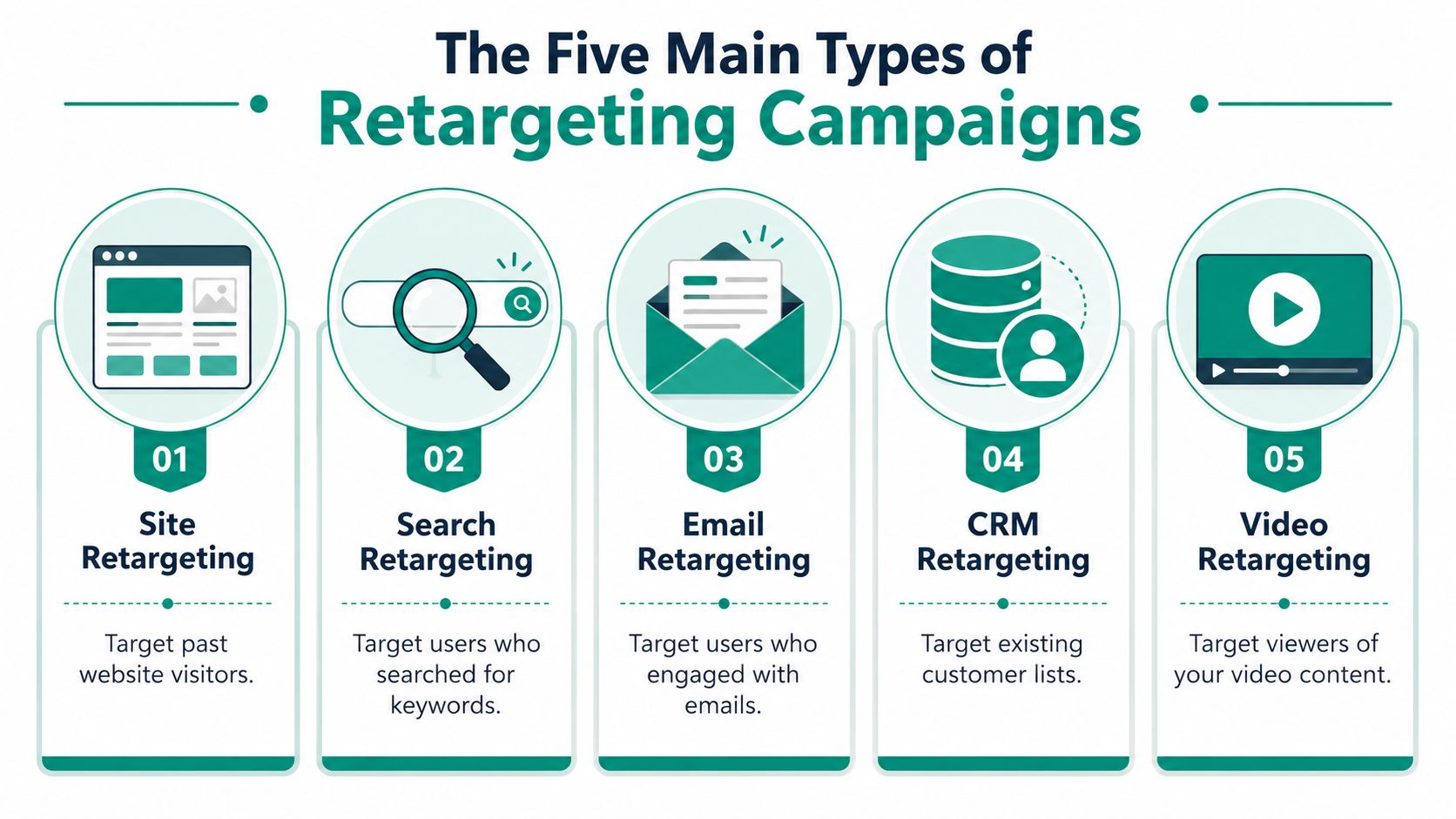
The Five Main Flavors of Retargeting Campaigns
Retargeting isn’t one campaign type. It’s a family of tactics. The version you use depends on where the earlier interaction happened and what action you want the person to take next.
Site retargeting
This is the standard model. A person visits your website, leaves, then sees your ads elsewhere.
A common use case is a product page visit with no checkout. Another is a B2B visitor who reads your services page but doesn’t book a call.
Best for: businesses that already get steady website traffic and want to recover missed conversions.
Search retargeting
Search retargeting focuses on people based on keyword intent. Someone searches for terms related to your offer, then later sees ads tied to that interest.
This can help when your buyer does a lot of comparison shopping. A person might search for accounting software, fleet repair near me, or custom metal fabrication, then continue researching across multiple sites before choosing a vendor.
Best for: high-intent categories where buyers research before they act.
Email retargeting
This version starts with email engagement. Someone opens a message, clicks a product, or interacts with a campaign, then gets follow-up ads through connected platforms.
That makes sense when email does part of the work but not all of it. If a subscriber clicks into a sale page and leaves, paid retargeting can continue the conversation.
Practical rule: Match the ad to the last meaningful action. Don’t show a generic brand ad to someone who already clicked a specific offer.
CRM retargeting
CRM retargeting uses customer or lead lists you already own. You upload a list to an ad platform and target those known contacts with ads.
This works well for re-engaging stale leads, promoting a new service to existing customers, or staying visible during long sales cycles. It’s also one of the cleaner ways to operate in a privacy-conscious environment because it relies on first-party business data.
Best for: companies with a usable customer database, sales pipeline, or segmented email list.
Video retargeting
Video retargeting focuses on people who watched your video content and then left without taking the next step. For example, someone watches a product demo, customer story, or educational clip, then later sees a follow-up ad with a stronger offer or a clearer call to action.
This format can be useful when your product needs explanation before a buyer is ready to respond.
Best for: products or services that benefit from visual education.
Choosing the right type
You don’t need all five at once. Start with the version that matches your strongest signal.
- If your site gets traffic but conversions lag, site retargeting is the obvious first move.
- If your sales team has a list of old leads, CRM retargeting often makes more sense.
- If your creative strategy already includes short-form content, video retargeting can extend that effort.
- If display advertising is part of your media mix, this overview of banners and display advertising helps place retargeting in the broader channel context.
Crafting Campaigns That Convert, Not Annoy
A shopper visits your site, looks at a service page, gets distracted, and leaves. Later, they see your ad. If the ad repeats a generic sales message five times, it feels like being followed around a store by a clerk who forgot what you asked for. If the ad reflects the page they viewed and gives them the next logical step, it feels remembered instead of chased.
That is the primary job of retargeting creative. It should continue the conversation, not restart it from zero.

Segment before you spend
Good campaigns start with separation. Someone who skimmed your homepage is different from someone who studied pricing, added a product to cart, or bought from you last month.
Treating those people as one audience usually creates wasted impressions and weak offers. A homepage visitor may still need context. A cart abandoner usually needs reassurance or a simple reason to finish. A past customer may be ready for a reorder, an add-on, or a related service.
| Audience | What they likely need | Ad direction |
|---|---|---|
| Homepage visitor | A clearer reason to care | Brand and category message |
| Pricing page visitor | Reassurance and differentiation | Offer, proof, or consultation prompt |
| Cart abandoner | A reason to complete checkout | Product reminder and checkout-focused message |
| Past customer | A relevant next step | Cross-sell, reorder, or service extension |
This matters even more now because retargeting is shifting away from broad third-party tracking and toward first-party signals you already control. Page visits, product views, customer lists, and platform engagement data are often your most useful inputs.
Set limits before people tune you out
Frequency capping is less about courtesy than performance. Repetition can help recall, but past a certain point it stops helping and starts creating irritation.
A simple rule works well for many SMB campaigns. Show enough ads to stay present, then rotate the message or pause the audience. If someone has seen the same creative several times without clicking, the problem is often the message, not the budget.
More impressions do not create relevance. Better timing and better matching do.
Match the ad to the action
Retargeting works best when the creative picks up where the visitor stopped.
A person who read one educational article is still early in the decision process. A person who viewed a specific product, pricing tier, or service page is much closer to acting. Those two people should not get the same ad.
Use behavior as the cue:
- Product page viewer: show the product, key benefit, and a clear return path
- Service page visitor: use service-specific copy, proof, and a low-friction next step
- Cart abandoner: remind them what they left behind and remove a likely objection
- Recent customer: exclude them from the original offer and show the next relevant offer instead
If your setup supports dynamic ads, use them carefully. They can feel helpful when they mirror genuine interest. They feel creepy when they overdo personalization or keep appearing long after the moment has passed. That balance is part of understanding your customer’s digital footprint and privacy expectations.
Give people a reason to return
The strongest comeback ads answer one question: why click now?
Sometimes the answer is convenience. Sometimes it is trust. Sometimes it is clarity. A pricing page visitor may need a testimonial, not a discount. A cart abandoner may need shipping details, a return policy reminder, or a shorter checkout path. A lead for a high-ticket service may respond better to a consultation offer than a limited-time promotion.
At this stage, many campaigns become noisy. They reach the right person but use the wrong ask.
For businesses that do not want to manage audience logic, creative rotation, and platform setup internally, Ascendly Marketing offers PPC campaign management and targeted advertising support alongside website and conversion work.
Tracking Performance and Respecting User Privacy
A good retargeting campaign works like a store clerk who remembers that a customer looked at a product yesterday, but does not shout their browsing history across the room today.
That is the balance to aim for. You want enough tracking to measure whether ads bring people back and produce sales, but not so much dependence on old tracking methods that your reporting breaks or your ads feel intrusive.

What to measure
Start with the numbers that tell you whether retargeting is doing its job, not just whether ads are being served.
- CTR shows whether people click after seeing the ad
- CPA shows what it costs to get a lead or sale
- ROAS compares ad spend with the revenue that came back
Those metrics answer different questions. A high CTR can mean your creative gets attention. It does not automatically mean the campaign is profitable. A reasonable CPA usually tells you more about business value than clicks alone, especially for lead generation. ROAS is useful for e-commerce, where revenue tracking is usually clearer.
Some businesses also watch view-through conversions. That metric can help when someone sees an ad, leaves, and comes back later through another channel. Treat it carefully. It can be informative, but it is easier to over-credit than a direct click conversion.
Why privacy changed the playbook?
Many older retargeting guides explain a model built mostly around third-party cookies. That model is fading.
Today, retargeting works more often through first-party data, consent-based audience building, and platform-native systems inside places like Google, Meta, and LinkedIn, where users are already logged in. Criteo’s current explanation of retargeting also reflects that shift toward newer identity and optimization methods.
For a small business owner, the practical takeaway is simple. Do not build your whole retargeting strategy on the assumption that anonymous cross-site tracking will stay accurate. It will not.
What SMBs should do now?
Focus on the customer information people choose to share with you.
That usually means:
- Collect better first-party data through lead forms, email signups, purchases, and CRM records
- Use clear consent practices so your audiences are built from permissioned data
- Set up platform-native remarketing audiences inside the ad platforms you use
- Expect imperfect attribution across devices and channels, then judge campaigns with that limitation in mind
Pixels still matter, but their role has changed. They work more like a helpful note in your own store than a tracker that can reliably follow someone everywhere online. That is why SMBs need cleaner forms, better CRM habits, and stronger audience syncing now. Those assets will still matter as cookie-based tracking keeps shrinking.
If you want a broader view of how customer tracking, privacy expectations, and brand perception connect, this guide on digital footprint, privacy, and brand visibility gives useful context.
The future of retargeting depends on using customer data with permission, clear intent, and realistic measurement.
Your Retargeting Questions Answered
Do I need a large amount of website traffic to start?
You need enough traffic for ad platforms to build a usable audience, but there isn’t one universal threshold that applies to every platform and business. If traffic is light, retargeting can still make sense, though your audience size may limit reach. In that case, many businesses start with a narrow, high-intent segment such as pricing-page visitors or cart abandoners.
When should a business avoid retargeting?
Retargeting may be a poor fit when the product or service is highly sensitive, and repeated ad exposure could feel invasive. It can also backfire when the buying cycle is so short that a follow-up ad arrives after the decision is already made. If the message would make the user uncomfortable seeing it on a shared device or screen, think carefully before using it.
What’s the difference between retargeting and remarketing?
In everyday use, people often blur the two terms. A practical distinction is this: retargeting usually refers to paid ads shown after someone interacts with your brand, while remarketing often refers to follow-up marketing using known contact data, such as email lists or CRM segments. Platforms and agencies don’t always use the terms the same way, so check how your vendor defines them.
How should I budget for a retargeting campaign?
Start from audience size and business value, not from a random monthly number. If your audience is small, you won’t need a large budget to stay present. If your site has many product views, long consideration cycles, or a large catalog, budget needs rise because there are more opportunities to segment and personalize. Review spend against conversion-focused metrics such as CTR, CPA, and ROAS, then adjust from there.
If you want help turning retargeting into a practical campaign plan, Ascendly Marketing can support PPC advertising, audience targeting, and conversion-focused website strategy for SMBs and e-commerce brands.