

TL;DR:
- Understanding search intent is vital for content ranking and conversions.
- Manual SERP analysis reveals true user needs more accurately than automated tools.
Search intent is defined as the specific goal a user has when typing a query into a search engine. Get it right, and your content ranks. Get it wrong, and even technically perfect pages fail to attract clicks or conversions. 99% of all search queries fall into four core intent categories: informational, navigational, commercial, and transactional. A fifth category, generative search intent, is now reshaping how marketers plan content in 2026. Understanding search intent is no longer optional for digital marketers, business owners, and entrepreneurs. It is the single most important filter before you write a word of content or spend a dollar on ads. Tools like Google Analytics and Google Search Console give you the data to confirm whether your content actually matches what users want.
What are the main types of search intent?
The four foundational intent types cover virtually every query your audience types into Google, Bing, or any AI-powered search tool.
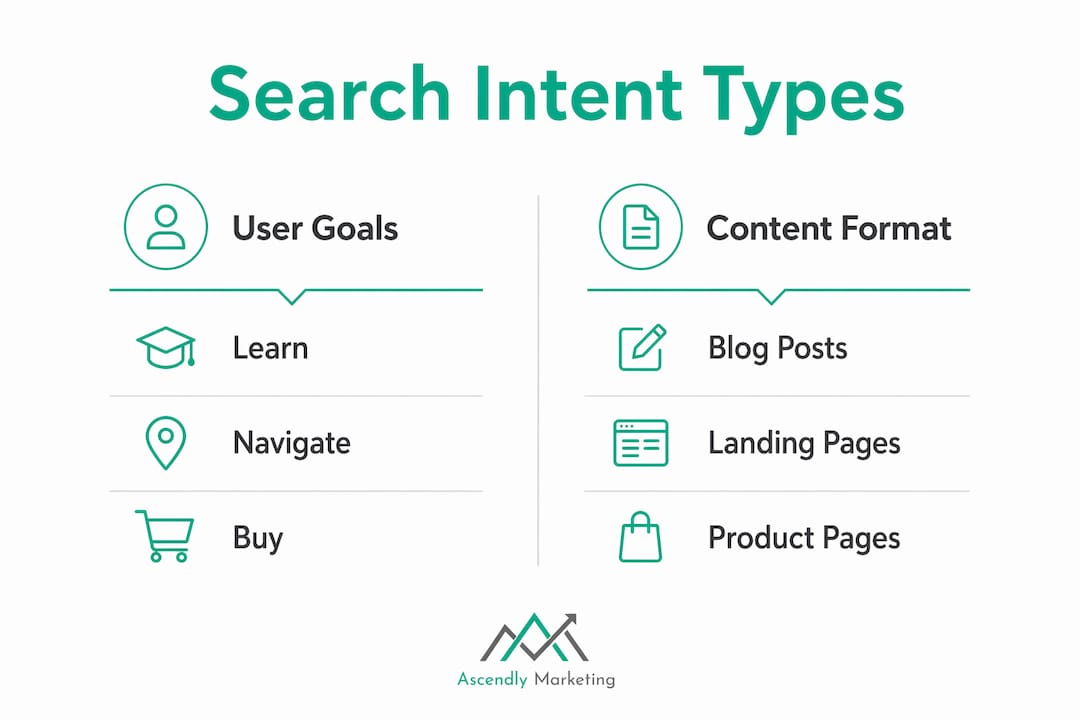
Informational intent drives queries like “how does SEO work” or “what is a content cluster.” Users want to learn. Blog posts, guides, and how-to articles are the right format here. Navigational intent means the user already knows where they want to go. They type “Ascendly Marketing SEO services” because they want your site specifically. Commercial intent sits between research and purchase. Queries like “best SEO agencies Dallas” signal a user comparing options before committing. Transactional intent is the clearest buying signal. “Hire SEO agency Dallas” means the user is ready to act. Matching content type to search intent is non-negotiable. Misalignment between intent and content type causes immediate filtering by search algorithms.
In 2026, a fifth type has entered the picture: generative search intent. These are complex, multi-part queries users direct at AI tools like Google’s AI Overviews or Perplexity. They expect synthesized, authoritative answers rather than a list of links. Advanced search intent analysis now includes monitoring these AI-generated search patterns to stay competitive.
| Intent type | User goal | Best content format |
|---|---|---|
| Informational | Learn or research | Blog posts, guides, FAQs |
| Navigational | Find a specific site or page | Brand pages, login pages |
| Commercial | Compare before buying | Reviews, comparisons, listicles |
| Transactional | Complete a purchase or action | Product pages, landing pages |
| Generative | Get a synthesized AI answer | Authoritative, structured content |
Pro Tip: When a query feels ambiguous, search it yourself in an incognito window. If the top results mix blog posts and product pages, you are looking at mixed intent. Address both angles in one piece of content to cover the full audience.
How do you analyze search intent using SERP data?
Search intent analysis is the process of reading SERP patterns and user behavior signals to confirm what Google believes users actually want. Manual SERP review is the starting point, and it is more reliable than any keyword tool prediction alone.
Follow these steps to conduct a thorough search intent analysis:
- Search your target keyword in incognito mode. This removes personalization bias and shows you the raw SERP.
- Audit the top 10 results for content format. If 70% or more results share a format, that format is what Google has confirmed users want. A page of blog posts signals informational intent. A page of product listings signals transactional intent.
- Read the SERP features. Featured snippets signal informational intent. Shopping results signal transactional intent. Local packs signal navigational or local intent. AI Overviews signal generative intent. Google’s understanding of intent is dynamic and revealed directly through these features.
- Check the content angle. Are the top results all “beginner guides”? Are they all “2026 updated” pieces? The angle tells you what emotional or practical need users have beyond just the topic.
- Validate with Google Analytics and Search Console. After publishing, check time on page, bounce rate, and conversion rate. High time on page and low bounce rates confirm your content satisfies the intent. Poor engagement tells you the match is off.
Manual SERP analysis in incognito mode is currently the most reliable method for determining search intent over keyword tool predictions alone. Automated tools classify intent at scale, but they miss nuance. A human reading the SERP catches the angle, the tone, and the format that a spreadsheet never will. Pair manual review with keyword research tools like Ahrefs for the best results.
What makes determining user intent so difficult?

Search intent is not a static label. It shifts as Google updates its understanding of what users want, and it gets complicated when queries carry more than one meaning.
The query “best running shoes” is a perfect example. It looks commercial, and mostly it is. But Google also surfaces informational content about shoe anatomy and injury prevention alongside product roundups. That is mixed intent in action. Comprehensive content strategies that address mixed intent queries by catering to multiple user stages can dominate SERPs where intent is ambiguous or dual-purpose. A single page that answers the research question and then guides the reader toward a purchase covers both bases.
A common mistake marketers make is treating intent as a column to fill in a keyword spreadsheet. Search intent requires understanding actual user needs to create content that delivers real value. The query “best plumber near me” does not need a directory. It needs a comparison of local options with reviews and contact details. Getting that distinction wrong means ranking for nothing.
Search intent acts as a binary filter for keyword research. If your site cannot deliver the content format Google expects for a given query, that keyword should be excluded regardless of its search volume. A blog-only site cannot rank for transactional queries that demand product pages. Site architecture must match intent format before you invest in ranking efforts.
Pro Tip: Set a calendar reminder to re-audit your top 20 pages every 90 days. Google’s intent interpretation shifts with algorithm updates, and a page that matched intent perfectly six months ago may now be misaligned with a changed SERP.
How to apply search intent to your marketing strategy
Knowing the intent behind a query changes every downstream marketing decision, from the headline you write to the call to action you place and the ad copy you run.
Here is how to put intent knowledge to work across your marketing channels:
- Align calls to action with intent stage. Informational content should invite readers to learn more or download a resource, not push a hard sale. Transactional pages should have a clear, direct purchase or contact button above the fold.
- Build content clusters around the customer journey. Map informational content to the awareness stage, commercial content to the consideration stage, and transactional content to the decision stage. This mirrors how users actually move through a purchase decision.
- Use intent to filter your keyword list. Before adding a keyword to your content plan, confirm your site can serve the expected format. A content marketing SEO strategy built on intent-matched keywords outperforms one built on volume alone.
- Improve PPC targeting with intent signals. Transactional keywords deserve higher bids and tighter landing page alignment. Informational keywords work better for awareness campaigns with softer conversion goals. Mixing them in the same ad group wastes budget.
- Integrate intent into your editorial calendar. Group content by intent type so you publish a balanced mix across all stages. Gaps in your informational content leave users without answers at the top of the funnel, which means fewer people reach your transactional pages.
- Monitor engagement metrics post-publication. Google Analytics and Search Console tell you whether users are satisfied. A high bounce rate on a page targeting informational intent means your content did not answer the question. Rewrite the opening, add depth, or restructure the format.
Failing to align content format with user intent is a primary reason SEO campaigns fail. The fix is not more content. It is better-matched content. Understanding how keywords drive SEO traffic at each intent stage gives you a framework to prioritize production and budget.
Key Takeaways
Search intent is the most important filter in content strategy. Every keyword decision, content format choice, and call to action must align with the specific goal behind the user’s query.
| Point | Details |
|---|---|
| Four core intent types | Informational, navigational, commercial, and transactional cover virtually all queries. |
| Generative intent is new | AI-style queries in 2026 require structured, authoritative content built for synthesis. |
| SERP analysis beats tools | Manual incognito review of the top 10 results reveals true intent more reliably than automated classifiers. |
| Mismatched format kills rankings | If your content type does not match what Google expects, the page will not rank regardless of quality. |
| Engagement metrics confirm match | High time on page and low bounce rates in Google Analytics confirm your content satisfies user intent. |
Ascendly Marketing’s take on mastering search intent
Search intent is the strategic filter I wish more marketers applied before they ever open a content brief. At Ascendly Marketing, we have seen businesses invest months into content production only to discover their pages were targeting the wrong intent category entirely. The content was well-written. The keyword volume was real. But the format was wrong, and Google filtered those pages out before they had a chance.
The biggest mistake I see is over-reliance on automated intent classification. Tools like Semrush and Ahrefs label intent at scale, and that is useful for a first pass. But they miss the nuance that a 60-second SERP review catches immediately. When I look at a SERP and see a mix of YouTube videos, Reddit threads, and product pages, I know that query is contested. No tool labels that accurately. A human has to make the call.
Generative search intent is the shift I am watching most closely right now. Users are asking Google’s AI Overviews and tools like Perplexity questions they used to ask a consultant. The content that wins those citations is structured, specific, and written with genuine authority. Generic content does not get cited by AI. Depth does. The marketers who treat intent analysis as a living practice, not a one-time setup task, are the ones who will hold rankings through whatever Google does next.
— Ascendly Marketing
How Ascendly Marketing can help you align content with search intent
Ascendly Marketing has been building intent-aligned SEO strategies for businesses since 2013. The team combines manual SERP analysis, keyword research, and content planning to make sure every page targets the right intent category before a single word is written.

Whether you are starting from scratch or auditing an existing content library, Ascendly Marketing’s organic SEO services give you a clear framework for matching content to user goals. The agency also handles PPC campaign targeting for marketers who want to apply intent signals to paid search. If your rankings have plateaued or your content is not converting, the problem is almost always an intent mismatch. Ascendly Marketing’s SEO specialists diagnose that gap and fix it with a content strategy built around what your audience actually wants.
FAQ
What is search intent in SEO?
Search intent is the specific goal a user has when entering a query into a search engine. It determines what content format and angle Google will rank for that query.
How many types of search intent are there?
There are four established types: informational, navigational, commercial, and transactional. A fifth type, generative search intent, is emerging in 2026 as AI-powered search tools become mainstream.
How do I determine user intent for a keyword?
Search the keyword in incognito mode and audit the top 10 results. If 70% or more share a content format, that format reflects the confirmed intent for that query.
Why does intent mismatch cause ranking failures?
Google filters pages that do not match the expected content format for a query. A blog post targeting a transactional keyword will not outrank product pages, regardless of its quality or backlink profile.
How do I know if my content matches search intent?
Check Google Analytics and Search Console after publishing. High time on page, low bounce rates, and strong conversion rates confirm your content satisfies the intent behind the query.