

TL;DR:
- Keyword research identifies search terms that guide SEO, content, and advertising strategies.
- Focusing on intent-based keywords improves conversion rates and aligns content with the customer journey.
Keyword research is defined as the practice of identifying, analyzing, and prioritizing the search terms people type into search engines and conversational platforms to guide SEO, content, and paid advertising strategies. Google processes over 14 billion search queries daily, which means the words your audience uses to find solutions are not guesswork. They are measurable signals. Understanding those signals is the foundation of every effective digital marketing campaign, from organic SEO to paid search advertising. Get this step right, and every other marketing decision becomes sharper.
What is keyword research and why does it matter for your business?
Keyword research is the process of finding the exact words and phrases your potential customers use when searching for products, services, or information online. In SEO, keywords are the bridge between what your audience needs and the content you create to meet that need. Without this process, you are publishing content and running ads based on assumptions rather than evidence.

The importance of keyword research goes beyond ranking on Google. Keyword research functions as a form of market research, revealing the language your customers use, the problems they are trying to solve, and where they are in the buying process. A business owner who understands these patterns can build content that attracts the right visitors, not just the most visitors.
Keywords act as building blocks for your entire online presence. They inform which pages to create, which topics to cover in blog posts, and which terms to bid on in pay-per-click campaigns. Skipping this step is like opening a store without knowing what your customers want to buy.
How to do keyword research in 2026: A step-by-step process
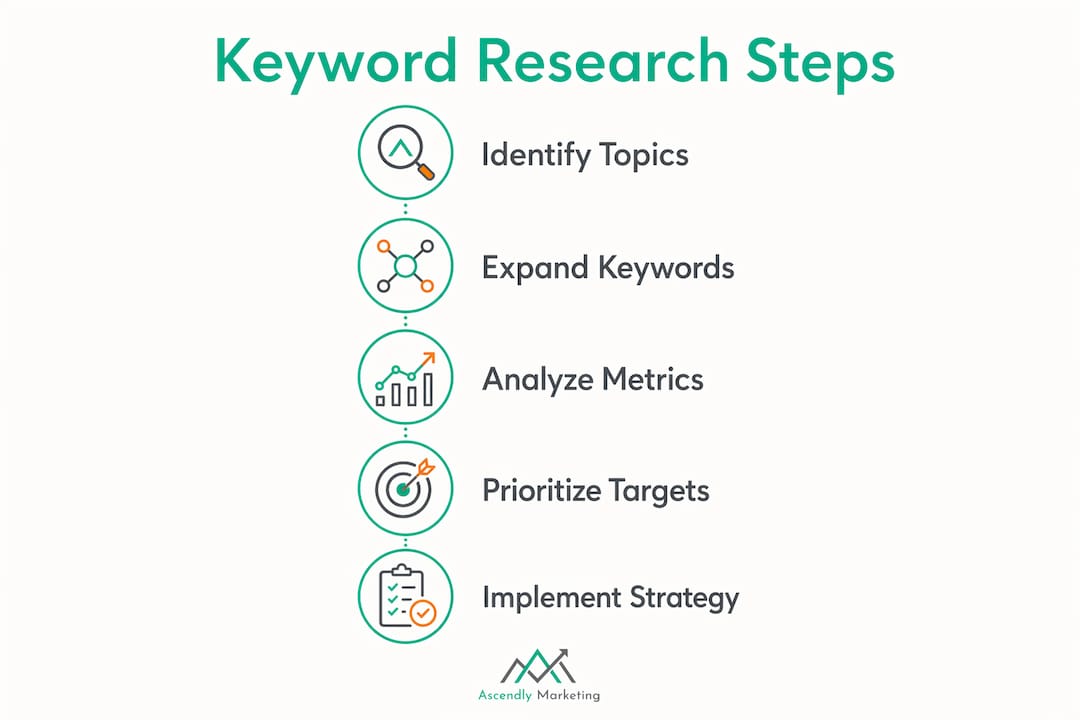
Effective keyword research follows a cyclical process that includes brainstorming, tool-based discovery, intent analysis, keyword mapping, and ongoing performance tracking. This is not a one-time task. It requires regular revisiting, especially when launching new campaigns or when organic traffic starts to decline.
Brainstorm core topics. Start by listing the main subjects your business covers. A landscaping company might list “lawn care,” “tree trimming,” and “irrigation systems.” These become your seed topics.
Use keyword research tools. Enter your seed topics into tools like Google Keyword Planner or Ubersuggest to generate related terms, search volumes, and variations. Paid platforms offer deeper data, including keyword difficulty scores and competitive analysis.
Analyze search intent. For each keyword, ask what the searcher actually wants. Are they looking for information, trying to find a specific website, or ready to buy? Intent determines whether a keyword belongs in a blog post, a product page, or an ad campaign.
Map keywords to pages. Assign each keyword to a specific page on your website. One page should target one primary keyword with supporting related terms. This prevents competing pages from cannibalizing each other in search results.
Track and update regularly. Keyword research is an ongoing process that must adapt to shifting search behaviors, algorithm updates, and competitor moves. Set a quarterly review schedule at minimum.
Pro Tip: When brainstorming seed topics, interview your sales or customer service team. They hear the exact words customers use every day, and those phrases often outperform the terms marketers assume are popular.
How do search volume, intent, and difficulty shape keyword selection?
Keyword metrics are the numbers and categories that help you decide which terms are worth pursuing. Choosing keywords without understanding these metrics leads to wasted effort on terms you cannot rank for or terms that attract the wrong audience.
Search volume measures how many times a keyword is searched per month. High volume sounds appealing, but volume alone is misleading. High search volume keywords often get captured by AI-driven search features, resulting in less actual traffic to your site. A keyword with 500 monthly searches and strong buyer intent can outperform one with 50,000 searches and no commercial value.
Search intent is the reason behind a query. The four main intent categories are:
- Informational: The searcher wants to learn something. Example: “How does SEO work?”
- Navigational: The searcher is looking for a specific website or brand.
- Commercial: The searcher is comparing options before buying. Example: “best SEO agency for small business.”
- Transactional: The searcher is ready to act. Example: “hire SEO agency Dallas.”
Prioritizing keywords by intent ensures each click has a clear business purpose. Jennah Patel, Senior Manager of Marketing Operations at LocaliQ, puts it plainly: quality beats quantity in keyword lists every time.
Keyword difficulty is an SEO metric that estimates how hard it is to rank for a given term. Keyword difficulty requires assessing backlink profiles and SERP competition quality, not just a single score. A keyword with a difficulty score of 70 may be attainable if the top-ranking pages are thin content from low-authority sites. A score of 40 may be impossible if the results are dominated by major national brands.
Pro Tip: Before targeting any keyword, search for it yourself and study the first page of results. Look at who is ranking, what type of content they have published, and how many backlinks their pages carry. This manual SERP analysis gives you a realistic picture of what it takes to compete.
What are the best keyword research tools for beginners and professionals?
Using multiple keyword research tools in combination produces more reliable data than relying on any single platform. Different tools pull from different data sources, so triangulating results reduces blind spots.
Free tools give you a solid starting point. Google Keyword Planner pulls data directly from Google’s ad network and shows search volume ranges and bid estimates. Ubersuggest provides keyword suggestions, basic difficulty scores, and content ideas without a subscription. These tools work well for businesses just starting or testing new topic areas.
Paid platforms go deeper. Semrush and Mangools both offer comprehensive keyword databases, difficulty scoring, competitor analysis, and SERP tracking. These platforms also surface related questions, long-tail variations, and keyword clusters that free tools miss. For businesses running active SEO or PPC campaigns, the investment pays off quickly.
AI and conversational search have changed the keyword landscape. AI and conversational platforms require expanded keyword research approaches that include long-tail prompts and multi-platform search behavior. Queries typed into AI chat tools tend to be longer and more conversational than traditional search queries. Factoring these patterns into your keyword list keeps your strategy aligned with how people actually search in 2026.
| Tool | Type | Best for | Key strength |
|---|---|---|---|
| Google Keyword Planner | Free | Beginners, PPC advertisers | Direct Google data, bid estimates |
| Ubersuggest | Free/Paid | Beginners, bloggers | Keyword suggestions, content ideas |
| Semrush | Paid | Professionals, agencies | Full competitive analysis, SERP tracking |
| Mangools | Paid | Mid-level users | Clean interface, accurate difficulty scores |
What are best practices for keyword research that actually move the needle?
The most common mistake in keyword research is chasing volume without considering whether the traffic will convert. A page ranking for a high-volume informational term may attract thousands of visitors who have no intention of buying. Understanding search intent is what separates a keyword list that drives revenue from one that just inflates traffic numbers.
Follow these best practices to get real results:
- Prioritize intent over volume. Match every keyword to a specific stage in the customer buying journey: awareness, consideration, or decision. Each stage needs different content.
- Use topical and question-based keywords. Exact-match keywords are only part of the picture. Modern SEO requires understanding user search intent deeply, which means covering related questions and conversational phrases, not just the head term.
- Update your keyword list regularly. Search habits shift with cultural trends, new products, and platform changes. A keyword that drove traffic last year may be irrelevant today.
- Integrate keywords across your full marketing strategy. Keyword insights should inform your blog calendar, ad copy, social media topics, and email subject lines, not just your website pages.
- Align keywords with your buying funnel. Informational keywords belong at the top of the funnel. Transactional keywords belong at the bottom, on product and service pages where conversion is the goal.
Pro Tip: Build a simple spreadsheet that maps each keyword to a funnel stage, a page URL, and a content format. This single document prevents duplication, keeps your team aligned, and makes quarterly reviews much faster.
Key Takeaways
Keyword research is the single most important input for any SEO or paid advertising strategy because it connects your content directly to what your audience is actively searching for.
| Point | Details |
|---|---|
| Definition and scope | Keyword research identifies and analyzes search terms to guide SEO, content, and paid advertising decisions. |
| Intent beats volume | A keyword with strong buyer intent outperforms a high-volume term that attracts unqualified visitors. |
| Metrics matter | Evaluate search volume, keyword difficulty, and SERP competition together, never in isolation. |
| Tools work best in combination | Pair free tools like Google Keyword Planner with paid platforms like Semrush for more complete data. |
| Ongoing process | Keyword lists must be reviewed and updated regularly to stay aligned with evolving search behavior. |
Why intent-driven keyword research is the only kind worth doing
Working with businesses since 2013, the pattern at Ascendly Marketing is clear: the clients who see the fastest SEO growth are not the ones with the longest keyword lists. They are the ones who built short, intent-filtered lists and mapped every term to a specific page and a specific goal.
The temptation to target every high-volume keyword in your industry is real. But a page optimized for “what is digital marketing” will not convert a buyer searching for “digital marketing agency Dallas.” Both terms have value. They serve completely different moments in the customer journey, and they need completely different content.
AI tools have made keyword discovery faster, but they have not replaced the need for human judgment. A tool can surface 500 keyword ideas in seconds. It cannot tell you which three of those ideas align with your business model, your content capacity, and your realistic ranking potential. That judgment still requires a person who understands both the data and the business.
The 2026 SEO trends point clearly toward conversational, multi-platform search. Businesses that adapt their keyword research to include long-tail, question-based, and AI-prompt-style queries will have a measurable advantage over those still optimizing for short, generic head terms. The shift is already happening. The question is whether your keyword strategy reflects it.
— Ascendly Marketing
How Ascendly Marketing turns keyword research into measurable growth
Knowing the theory behind keyword research is one thing. Executing it consistently across SEO, content, and paid campaigns is another challenge entirely.

Ascendly Marketing has helped businesses across industries build keyword strategies that drive real traffic and real revenue since 2013. The team handles everything from initial keyword discovery and intent mapping to ongoing performance tracking and campaign refinement. Whether you need SEO services that improve your organic rankings or a full digital marketing strategy that connects keyword insights to every channel you use, Ascendly Marketing builds it around your specific business goals. Book a consultation and find out exactly which keywords your competitors are ranking for that you are not.
FAQ
What is keyword research in SEO?
Keyword research in SEO is the process of finding and analyzing the search terms your target audience uses online, then using that data to optimize your website pages and content for higher rankings and more relevant traffic.
How often should you update your keyword research?
Keyword lists should be reviewed at least quarterly. Search behavior shifts with trends, algorithm updates, and new competitor activity, so regular updates keep your strategy aligned with current demand.
What is the difference between search volume and keyword difficulty?
Search volume measures how often a keyword is searched per month, while keyword difficulty estimates how hard it is to rank for that term based on the authority and quality of competing pages in the search results.
Why is keyword intent more important than search volume?
A keyword with high volume but the wrong intent attracts visitors who will not convert. Matching keywords to the right stage of the buying journey, informational, commercial, or transactional, produces traffic that actually supports business goals.
What are the best free keyword research tools?
Google Keyword Planner and Ubersuggest are the most widely used free options. Google Keyword Planner pulls data directly from Google’s ad network, while Ubersuggest adds keyword suggestions and basic content ideas at no cost.