

Most advice about testimonials is too forgiving.
A happy customer quote isn’t automatically useful. “Great service,” “highly recommend,” and “loved working with them” sound positive, but they don’t help a skeptical buyer decide. They don’t answer the questions that matter: what was broken, why this option got chosen, and what changed after the purchase.
A strong template for a testimonial fixes that problem. Not by making customers sound polished, but by pulling out the details that buyers use to judge risk.
Why Most Testimonials Fail to Persuade
The usual mistake is treating testimonials like decoration. A business asks for kind words, drops them into a slider, and assumes social proof is handled. That produces praise, not persuasion.
Generic testimonials fail because they don’t carry proof. They read like filler copy written to be nice. A buyer who is already unsure won’t trust them, and a buyer who is comparing vendors won’t learn anything from them.

Empty praise doesn’t answer buying objections
Most customers don’t need more positivity. They need relevance.
A testimonial should help the next prospect think, “That sounds like my situation.” If it doesn’t identify the original problem or the result, it can’t do that job. It becomes background noise on the page.
Weak testimonials usually sound like this:
- Too broad: “Fantastic team and great support.”
- Too flattering: “The best company we’ve ever worked with.”
- Too vague on outcomes: “They really helped our business.”
- Too detached from context: No company, no role, no situation, no use case.
None of those lines reduce uncertainty. They only signal that someone was pleased.
Generic praise feels safe to collect, but it wastes the moment when a customer is most willing to explain what changed.
The format matters as much as the wording
A lot of businesses search for a template for a testimonial and expect a single fill-in-the-blank quote. That misses the bigger issue. One testimonial format won’t fit every sales context.
Guidance on testimonial use shows that placement and format can materially affect performance, and that testimonials may work better as homepage content, inside case studies, or as short excerpts depending on the context. The same guidance also notes that “testimonial template” now works more like a family of use cases, with short structured collection forms often sent right after a positive interaction (video discussion on testimonial placement and collection).
That changes the way you should collect them. A homepage testimonial needs to hit fast. A sales page testimonial should handle objections. A case-study testimonial can afford more detail. If you use the same quote in all three places, one of those placements will underperform.
A testimonial is a conversion tool, not a compliment wall
The right frame is simple. Don’t ask, “Can you leave us a testimonial?” Ask, “What proof does the next buyer need?”
That shift changes everything. It changes the questions you send, the quotes you keep, and where you place them. If you want a deeper look at how testimonials support trust across the funnel, this guide on the role of testimonials in marketing is a useful companion read.
The Anatomy of a High-Impact Testimonial
A persuasive testimonial has structure. Without structure, customers drift into politeness. With structure, they give you something you can publish.
The cleanest version uses a 3-part narrative. Start with the problem before purchase, name the most credible reason the customer chose the product or service, then show the change after using it with concrete detail. That structure increases specificity, and specificity is what creates trust (guidance on writing more persuasive testimonials).
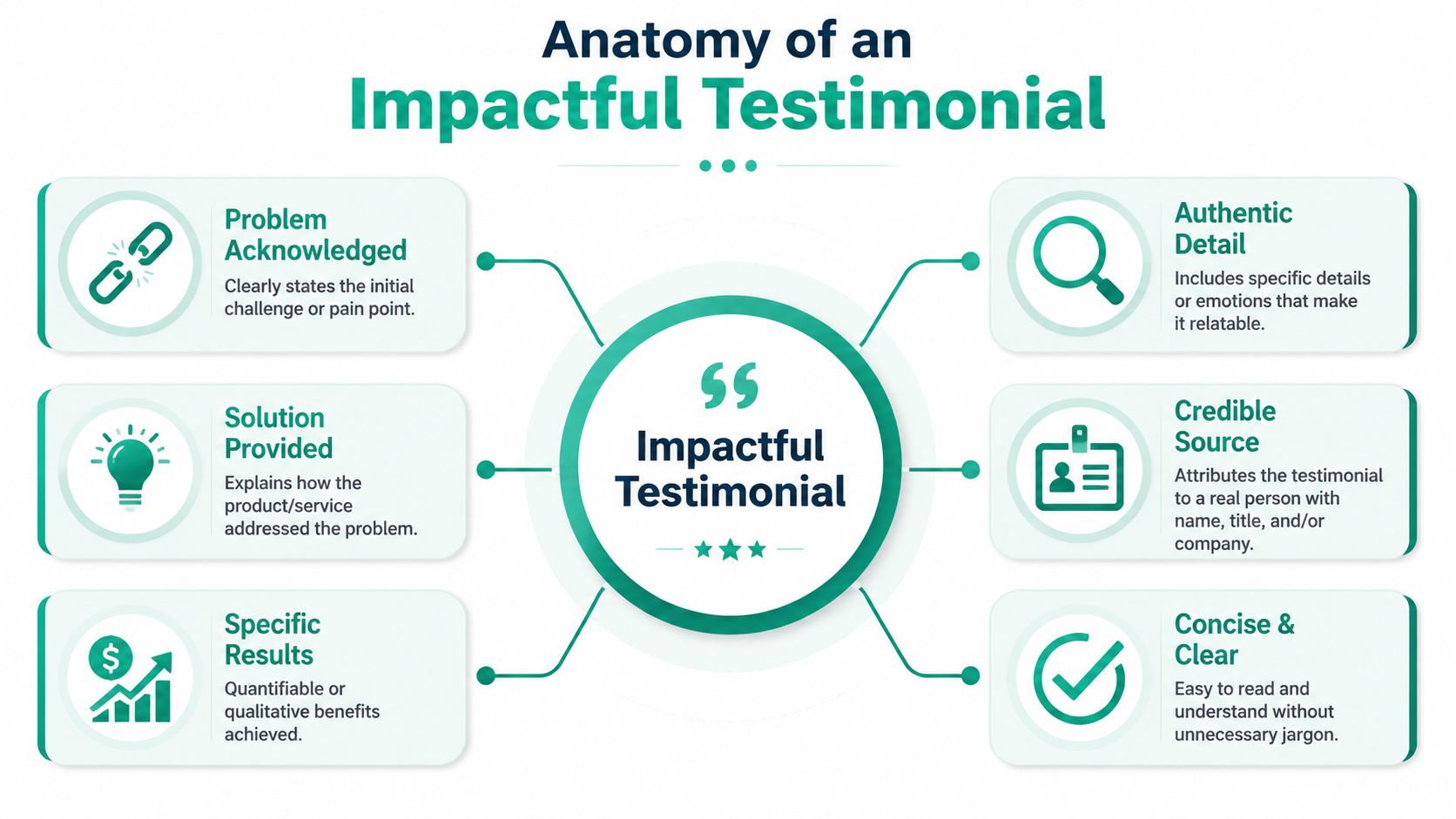
The three parts that make a testimonial believable
A testimonial doesn’t need to be long. It does need to move in the right order.
| Part | What the customer should cover | Why it works |
|---|---|---|
| Problem | What wasn’t working before | Gives the reader a point of identification |
| Choice | Why they picked this option instead of another | Makes the decision feel reasoned, not random |
| Result | What changed after implementation or purchase | Turns opinion into proof |
That middle part gets skipped all the time. It shouldn’t. “Why we chose them” often carries more weight than generic praise because it reveals the actual buying criteria. Was it speed, clarity, fit, responsiveness, technical confidence, process, or a better understanding of the brief? Those details help the next prospect compare.
Credibility markers stop the quote from feeling invented
The most credible testimonial formats that emerged around 2018-2019 require five core elements: the customer’s name, title, business entity, location, and a picture or logo. Combined with a Problem, Brand, Result narrative, this structure has been shown to increase video engagement by 25% and conversion rates by 15% in B2B sectors (reference to the verified industry fact set).
If any of those identity markers are missing, the quote gets weaker. Anonymous praise can still be true, but it won’t carry the same weight.
Use this checklist before publishing:
- Real identity: Full name, not initials.
- Professional context: Job title and company.
- Geographic signal: Location when relevant.
- Visual proof: Headshot or company logo.
- Specific outcome: A clear change, not just approval.
Practical rule: The more a testimonial asks the reader to “just trust us,” the less it will convert.
What strong testimonials sound like
Weak:
“Excellent experience. The team was wonderful and we’d recommend them.”
Strong:
“We were losing time to a slow handoff process. We chose them because their approach was clearer than the other options we reviewed. After launch, our team could move faster and the process stopped stalling between departments.”
The second version isn’t flashy. It works because it names a problem, a reason for choosing, and an operational change.
Keep detail, cut sugar
The fastest way to ruin a testimonial is to over-edit it into brand copy. Leave the customer’s voice intact, but remove the parts that don’t help the buyer.
That means keeping phrases that sound human and dropping phrases that sound ceremonial. “They answered every question without dragging things out” sells better than “Their unwavering commitment to excellence was second to none.”
Your Go-To Testimonial Template Library
One template won’t cover every business model. A B2B buyer wants different proof from a retail shopper. A local service customer cares about different risks than a software team.
The useful version of a template for a testimonial isn’t a canned paragraph. It’s a set of prompts built around the objection patterns in each type of sale. The structure stays the same. The questions change.
B2B service template
B2B testimonials need decision logic. Buyers want to know what problem existed, why your team got selected, and what changed in the workflow, sales process, or internal operations.
Send these questions:
What problem were you trying to solve before you hired us? Ask for the operational issue, not just a broad business goal.
What had you tried before, if anything?
This adds tension and shows the customer didn’t arrive casually.Why did you choose us over the other options you considered?
This often produces the most convincing line in the whole testimonial.What changed after the work started or after launch?
Push for practical change. Better process, clearer reporting, faster handoff, less confusion, stronger lead quality.What would you say to another company considering the same decision?
This gives you a clean closing quote for a sales page.
A finished B2B testimonial often reads best in this shape:
We were dealing with [problem]. We chose [company] because [credible reason]. After [implementation or project], we saw [result or operational improvement]. What stood out was [detail about process, communication, or execution].
E-commerce product template
E-commerce testimonials shouldn’t try to mimic SaaS case studies. They’re shorter, more immediate, and usually tied to concerns like product quality, fit, ease of use, delivery experience, or whether the item matched expectations.
Use prompts like these:
- What made you buy this product in the first place?
- What concern did you have before ordering?
- What was the product like when you received it?
- How has it been performing in real use?
- Who would this product be a good fit for?
Notice what’s happening here. The questions are doing the selling. They pull out the pre-purchase hesitation, then let the customer answer it in plain English.
A product-page testimonial usually benefits from compression. Pull the sharpest line for the main quote, then keep the fuller response lower on the page or in a review tab.
Local service template
For local services, buyers often care about reliability, communication, punctuality, clarity, and whether the result matched what was promised. A testimonial that ignores those issues usually sounds nice but weak.
Ask:
- What problem did you need solved?
- What was your biggest concern before hiring?
- What was the experience like during the job?
- How did the final result compare with what you expected?
- Would you hire them again? Why?
This format works because it mirrors the customer journey. Need. Hesitation. Experience. Outcome. Recommendation.
Short-form template for low-friction collection
Sometimes you don’t need a long response. You need something fast enough that the customer will complete it.
A short structured form works well when sent soon after a positive interaction. Keep it tight:
| Prompt | Why include it |
|---|---|
| What was happening before you worked with us? | Creates context |
| Why did you choose us? | Gives decision proof |
| What changed after? | Produces the usable quote |
| Your name, role, company, location | Adds credibility |
| Can we use this publicly? | Covers permission |
What doesn’t work in templates
Bad templates invite bad answers.
Avoid prompts like these:
“Can you say a few nice words?”
This guarantees fluff.“How amazing was your experience?”
Leading language produces inflated, unusable copy.“Would you recommend us?”
Fine as a closing question, poor as the main one.“Tell us anything you’d like.”
Open-ended prompts sound flexible, but they put all the cognitive work on the customer.
A strong template reduces effort while increasing specificity. That’s the balance. If the questions are too loose, you’ll get praise without proof. If they’re too demanding, the form won’t get completed.
How to Ask for Testimonials and Actually Get One
Most testimonial requests fail before the customer even reads the questions. The timing is off, the ask is vague, or the request sounds like homework.
Ask when the customer has just felt the value. Right after a successful project milestone, a resolved problem, positive feedback on a delivery, or a moment when they voluntarily say they’re happy. Don’t wait until the energy is gone.
Reduce friction first
Customers are far more likely to respond when the request feels contained.
Don’t ask them to “write a testimonial.” Send a short note and link to a simple form in Google Forms, Typeform, Jotform, or your CRM form builder. Preload the exact questions. Keep the experience short and specific.
A practical side benefit is that a structured request can also support your broader review strategy. If you’re also trying to improve public-facing proof, this article on ways to boost your Google reviews pairs well with a testimonial collection system.
Use an email that sounds easy to answer
Here’s a script that works because it lowers the commitment.
Subject: Quick testimonial request
Hi [Name],
Thanks again for working with us on [project or service]. You mentioned that [positive outcome or feedback they already shared], and I’d love to include your feedback in our marketing.
If you’re open to it, I put together a short form with a few questions. It should only take a couple of minutes: [form link]
The most helpful thing is hearing what your situation was before, why you chose us, and what changed after.
Thank you,
[Your Name]
That message works because it names the scope, reminds them of the positive moment, and tells them what kind of answer is useful.
Ask better follow-up questions
Sometimes a customer replies with something too short to publish. Don’t throw it away. Guide it.
Try follow-ups like:
- “Can you tell me what wasn’t working before?”
- “What made you choose us rather than another option?”
- “Which part of the result stood out most to you?”
- “Are you comfortable including your role and company name?”
These questions are gentle, but they move the response from approval into evidence.
A quick visual walkthrough can help if you’re building a repeatable collection process for your team:
What gets ignored
A few patterns almost always hurt response rates:
- Long requests: If the email itself feels heavy, the customer postpones it.
- No prompt: “Would you mind leaving a testimonial?” gives no structure.
- Bad timing: Asking weeks after the positive experience lowers follow-through.
- Too many approvals: If legal, marketing, and sales all need to touch the process before the ask goes out, the window closes.
Ask while the customer is still speaking in specifics. A week later, most people only remember that they were happy.
From Raw Quote to Polished Marketing Asset
A submitted testimonial is only raw material. The next job is editing for clarity, formatting for attention, and packaging for credibility without rewriting the customer’s meaning.
That’s where a lot of teams go wrong. They either publish the quote exactly as received, even if it’s muddy, or they over-polish it until it sounds fake.
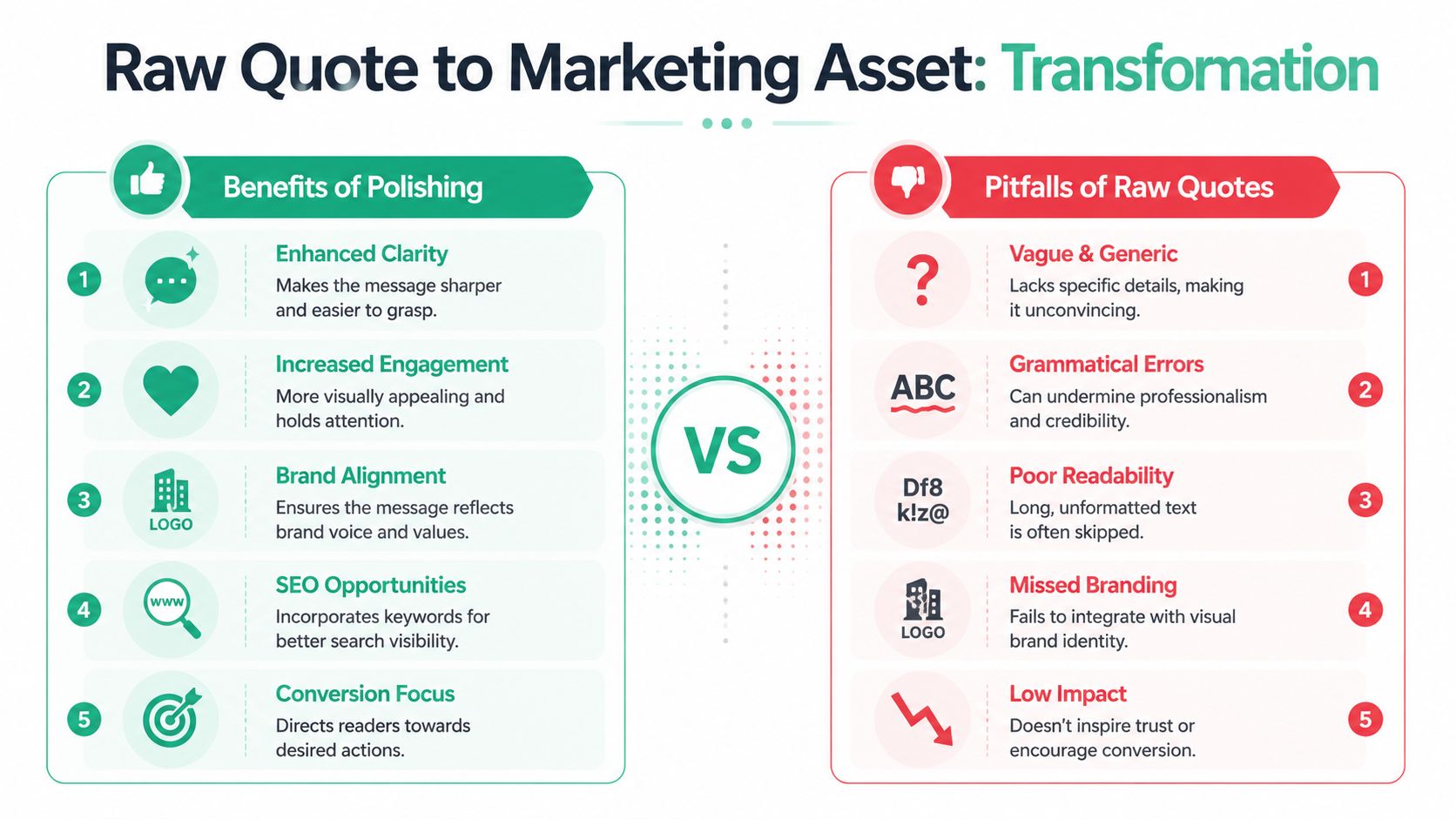
Lead with the result
For highest credibility, a testimonial should lead with the business result, then add a short quote explaining the operational change. Metrics should only be used when they are clear and permissioned, and if a metric needs a long explanation, it isn’t the right headline proof point (practical guidance on result-led testimonial formatting).
That gives you a straightforward editing rule. Put the most useful proof first.
If the original quote says:
“Working with the team was smooth, communication was great, and we were very happy with how everything turned out.”
You might publish it as:
“The rollout became much easier for our team. Communication stayed clear, and the project moved without the usual friction.”
Same meaning. Better signal.
Build a simple asset stack
A polished testimonial usually needs more than text. It needs presentation.
Use this stack:
- Headline proof line: The result or strongest takeaway.
- Supporting quote: One to three sentences in the customer’s voice.
- Identity block: Name, title, company, location if relevant.
- Visual support: Headshot, product image, brand logo, or screenshot with permission.
- Placement fit: A short card for homepage use, a longer version for landing pages, and a fuller narrative for case studies.
This is where web design matters. The testimonial itself can be strong, but poor layout weakens it. If you’re reviewing how proof elements fit into page structure, this guide for SMB lead generation websites offers useful context on designing pages that support conversion rather than just display content.
Edit for readability, not spin
Good editing keeps the customer’s substance and removes friction.
Do:
- Trim repetition: Customers repeat themselves when they write casually.
- Fix small grammar issues: Clean enough to read smoothly.
- Pull a hero phrase: Use the most concrete line as the featured quote.
- Break long blocks: A wall of testimonial text gets skipped.
Don’t:
- Invent stronger claims than the customer made
- Add metrics the customer didn’t approve
- Swap human language for brand language
- Cut out the specific detail that made the quote believable
A testimonial should sound like a customer on their clearest day, not a copywriter wearing the customer’s name tag.
Match the asset to the channel
The same testimonial should often be adapted into multiple versions.
| Channel | Best format |
|---|---|
| Homepage | Short result-led quote with identity markers |
| Service page | Quote tied to a specific objection or use case |
| Sales deck | Tighter proof line with company and role |
| Social post | Short excerpt plus visual identity |
| Case study page | Expanded narrative with context and detail |
That is why a template for a testimonial should be built backward from placement. Collection, editing, and design all get easier when you know where the quote will live before you ask for it.
Level Up From Testimonials to Case Studies
A strong testimonial already contains the bones of a case study. It gives you the problem, the choice, and the result. If that story clearly reflects a valuable client engagement, don't stop at the quote.
Turn it into a longer asset. Expand the original testimonial with implementation details, decision criteria, additional context, and supporting visuals. That gives prospects more than reassurance. It gives them a buying narrative they can map onto their own situation.
Structured video testimonials are especially useful here. Video testimonial templates built around a before-and-after journey addressing the pain point, the solution, and the tangible result can drive ROI up to 500%, and 64% of small businesses using those templates see conversion rates rise by 25% or more (verified video testimonial performance reference). That same structure naturally scales into a case study because the story is already organized around change.
When a testimonial deserves expansion
Move a testimonial into case-study territory when:
- The problem was common: Other prospects likely face it too.
- The buying decision was considered: The customer had real selection criteria.
- The result changed operations or revenue: The story has enough substance.
- The quote answers multiple objections: You can build a fuller narrative around it.
If you're developing that next layer of proof, this case study marketing guide is a useful next step.
The businesses that get the most from testimonials don't treat them as isolated quotes. They use them as source material for landing pages, sales collateral, video clips, and case studies. That's how a simple template turns into a durable proof library.
If you want help turning customer feedback into proof assets that support real conversion goals, Ascendly Marketing can help you build the strategy, collection process, and on-page execution so testimonials do more than fill space.