

TL;DR:
- Google’s search algorithms evaluate and rank web pages based on relevance, content quality, and trustworthiness. Maintaining high content standards, technical performance, and site authority is essential for enduring search visibility in 2026. Recovery from major algorithm updates can take up to a year, emphasizing continuous improvement over quick fixes.
Google’s search algorithms are defined as automated systems that evaluate and rank web pages based on signals like relevance, content quality, and trustworthiness. Understanding Google algorithms is the single most important skill a digital marketer, business owner, or website manager can develop in 2026. Google processes billions of queries daily, and its ranking systems determine whether your site earns visibility or disappears on page three. The rules have grown more complex with AI integration, but the core logic remains consistent: Google rewards content that genuinely serves people.
How do Google algorithms work to rank search results?
Google’s ranking process starts before a user types a single word. Googlebot, Google’s web crawler, visits pages across the internet, reads their content, and stores that information in Google’s index. From there, ranking algorithms evaluate indexed pages against hundreds of signals to decide which results appear for a given query.

One technical detail most marketers miss: Googlebot fetches up to 2MB per URL during each crawl. Content beyond that limit is simply ignored. That means bloated HTML, excessive inline scripts, or poorly structured pages can cause Google to miss your most important content entirely.
Once a page is indexed, ranking signals take over. The most significant ones include:
- Content relevance: Does the page directly answer the query?
- E-E-A-T signals: Does the content demonstrate Experience, Expertise, Authoritativeness, and Trustworthiness?
- User experience metrics: Does the page load fast and work well on mobile?
- Link authority: Do credible external sites reference this page?
- Structured clarity: Are headings, lists, and FAQs used to organize information?
Google also uses AI models like BERT and Gemini to interpret the intent behind queries rather than matching keywords mechanically. These models help Google understand context, synonyms, and nuance. Human search quality raters then evaluate results against Google’s Quality Rater Guidelines, and their feedback shapes how the algorithms are trained over time.
Pro Tip: Keep your most critical content within the first 100KB of your HTML. Googlebot also clears local storage and session data between rendering requests, so dynamic content loaded by JavaScript may not be crawled reliably.
What are the major Google algorithm updates and their impact?
Google does not tweak its algorithms quietly in the background. It releases formal core updates that reshape rankings across entire industries at once. Core updates roll out 2–4 times annually, with each rollout taking 2–6 weeks to fully settle. The frequency dropped from 10 updates in 2022 to 4 in 2025, signaling a shift toward fewer but more sweeping changes.
Here is what typically happens during a core update:
- Site-wide quality reassessment. Google re-evaluates your entire domain, not just individual pages. A cluster of thin or low-quality pages can drag down your strongest content.
- Helpful Content integration. Since 2023, Helpful Content evaluations are folded directly into core updates. Pages that exist to rank rather than to inform lose ground.
- E-E-A-T re-weighting. Updates recalibrate how much weight Google places on author credentials, original research, and editorial standards.
- AI visibility impact. Sites that meet high editorial standards are more likely to appear in AI Overviews, Google’s AI-generated answer summaries at the top of search results.
The recovery timeline is the part most marketers underestimate. Recovery from a negative core update impact typically requires 2–3 full update cycles, which translates to 6–12 months of sustained quality improvements. There is no shortcut. Sites that panic and make rapid, surface-level changes rarely recover faster than those that commit to genuine content improvements.
Ranking fluctuations during a rollout period are normal. Premature reactions to mid-rollout shifts can actually disrupt recovery. The right move is to monitor, document, and respond deliberately after the rollout completes.
What are the critical Google ranking factors for 2026?
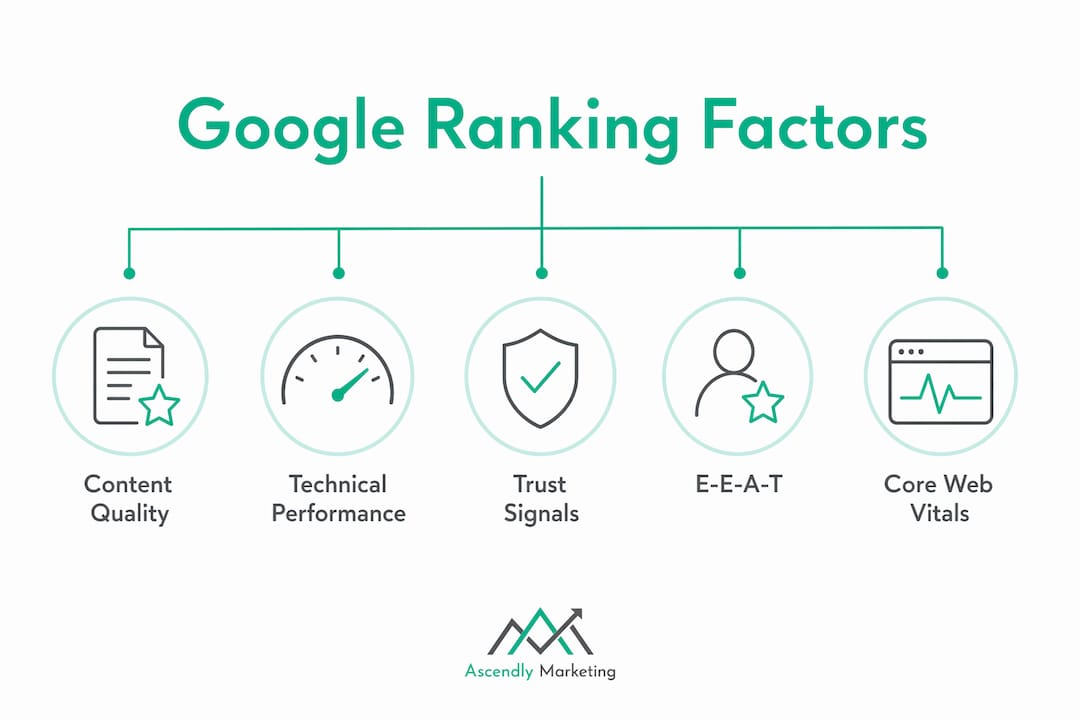
Google ranking factors fall into three broad categories: content quality, technical performance, and trust signals. Each one feeds into the others.
E-E-A-T and content quality
E-E-A-T stands for Experience, Expertise, Authoritativeness, and Trustworthiness. Google’s Quality Rater Guidelines treat these as the foundation of content credibility. They are not direct ranking factors in the algorithmic sense, but they shape the training signals that influence how algorithms score content. A medical article written by a licensed physician with cited sources outperforms a generic summary, not because of a keyword advantage, but because every quality signal points in the same direction.
Trustworthiness acts as a multiplier. Strong trust signals amplify the value of expertise and authority. Weak trust signals suppress them. This is why reputation management, accurate business information, and credible external citations matter far beyond their individual weight.
Technical performance benchmarks
Core Web Vitals set the technical floor for competitive rankings. The 2026 thresholds are specific: LCP under 3.0 seconds, INP under 200 milliseconds, and CLS under 0.1. These are measured using real-world field data, not controlled lab scores. A page that passes a lab test but underperforms for actual users will not receive full credit.
Mobile-friendliness is no longer optional. Google indexes the mobile version of your site first. If your mobile experience is degraded, your rankings reflect that regardless of how polished the desktop version looks.
Structured content for AI and search engines
Structural clarity through headings, lists, and FAQs improves both human readability and AI extractability. Google’s AI systems favor content that is organized semantically. A well-structured page is more likely to be cited in AI Overviews and featured snippets. This is one area where good writing and good SEO fully align.
Pro Tip: Add a clear author bio with credentials to every article. Link to the author’s professional profile or published work. This single change directly supports E-E-A-T signals without requiring a content overhaul.
Best practices for aligning your site with Google algorithms
Sustainable search performance comes from site-wide quality improvements, not page-level tricks. The following practices reflect what actually moves rankings under current algorithm conditions.
- Audit topical authority, not just individual pages. Google evaluates your domain’s depth on a subject. A site with 30 thorough articles on a topic outranks a site with one great article and 29 unrelated posts. Use your organic SEO strategy to build content clusters around core topics.
- Refresh stale content systematically. Update statistics, add new examples, and expand thin sections. A refreshed article signals freshness without requiring you to create something from scratch.
- Add author credentials and citations. Every piece of content should attribute a real author with verifiable expertise. Cite primary sources, studies, or official documentation where relevant.
- Fix Core Web Vitals using field data. Pull your performance data from Google Search Console’s Core Web Vitals report. Lab tools give you a starting point, but field data tells you what real users experience.
- Monitor rankings after each update. Track position changes by page and by topic cluster. This tells you whether an update affected a specific content type or your domain broadly.
- Treat algorithm updates as quality audits. Site owners who view updates as holistic reassessments rather than penalties recover faster. The question is never “what did Google penalize?” It is “where does our content fall short of what users actually need?”
Understanding 2026 SEO trends alongside these practices helps you anticipate shifts rather than react to them after rankings drop.
Key Takeaways
Google’s algorithms reward sites that consistently demonstrate content quality, technical performance, and trustworthiness across the entire domain, not just on individual pages.
| Point | Details |
|---|---|
| Crawl efficiency matters | Keep critical content within the first 2MB of HTML to avoid Googlebot truncation. |
| Core updates assess the whole site | Thin or low-quality pages anywhere on your domain can suppress your strongest content. |
| E-E-A-T drives content credibility | Author credentials, citations, and trust signals shape how algorithms score your pages. |
| Recovery takes 6–12 months | Meaningful quality improvements over multiple update cycles are the only reliable path back. |
| Structured content wins AI visibility | Headings, lists, and FAQs improve both human readability and AI Overview citation rates. |
What I’ve learned from watching algorithm updates reshape entire industries
Ascendly Marketing has worked with businesses across dozens of industries since 2013, and the pattern after every major core update is remarkably consistent. The sites that panic and start making rapid changes almost always make things worse. The sites that take a week to analyze what actually changed, then commit to a 6-month content improvement plan, recover reliably.
The most common mistake I see is treating an algorithm update like a technical bug to fix. It is not. Google’s AI-native search relies on editorial quality signals, not keyword density or metadata tricks. When a site loses rankings after a core update, the real issue is almost always that the content was never as strong as the rankings suggested. The update just corrected an earlier overvaluation.
The shift toward AI Overviews has raised the stakes further. Getting cited in an AI Overview requires meeting the same editorial standards that Google’s human quality raters apply. That means real expertise, real citations, and content that answers questions completely. Sites built on thin aggregation or recycled information are losing ground fast, and that trend will not reverse.
My honest advice: stop chasing algorithm changes and start building the kind of site that would earn top rankings regardless of what the algorithm does next. That means investing in content quality, author credibility, and technical performance as ongoing priorities, not one-time projects.
— Ascendly Marketing
How Ascendly Marketing helps you stay ahead of Google’s algorithms
Keeping pace with Google’s evolving ranking systems requires more than reading update announcements.

Ascendly Marketing has helped businesses build search visibility that holds through core updates since 2013. The team covers every layer of digital marketing services, from technical SEO audits and content strategy to Core Web Vitals fixes and E-E-A-T development. Whether your site took a hit from a recent update or you want to build a stronger foundation before the next one, Ascendly Marketing offers the analysis and execution to move rankings in the right direction. Book a consultation at ascendlymarketing.com to get a clear picture of where your site stands and what it takes to improve.
FAQ
What are Google algorithms?
Google algorithms are automated ranking systems that evaluate web pages based on signals like content relevance, E-E-A-T, and technical performance to determine search result order.
How often does Google update its algorithms?
Google releases core updates 2–4 times per year, with each rollout taking 2–6 weeks to complete. Smaller updates occur continuously in the background.
How long does it take to recover from a core update?
Recovery typically requires 2–3 full update cycles, which translates to 6–12 months of sustained, meaningful content improvements across the affected site.
What is E-E-A-T and why does it matter?
E-E-A-T stands for Experience, Expertise, Authoritativeness, and Trustworthiness. Google’s Quality Rater Guidelines use these signals to assess content credibility, and they directly influence how algorithms score pages.
How do Core Web Vitals affect Google rankings?
Core Web Vitals measure real-world page performance. The 2026 thresholds require LCP under 3.0 seconds, INP under 200 milliseconds, and CLS under 0.1, all verified through field data rather than lab testing.