

You visit a product page for office chairs during lunch. By the afternoon, that same chair, or one very close to it, shows up while you read the news, watch a video, or scroll through an app. Most business owners have seen this happen. Fewer know what decides whether that ad appears, what it costs, or whether the advertiser should have bid in the first place.
That decision often comes from real-time bidding. For a small or mid-sized business, RTB can feel like a black box built for giant brands with giant budgets. It isn’t. It’s a buying method. It helps advertisers compete for digital ad placements one impression at a time, automatically, and very fast.
The useful question isn’t “Is RTB advanced?” It is. The useful question is simpler: Does this help your business reach the right people without wasting spend? Sometimes the answer is yes. Sometimes a fixed placement or direct deal fits better. The difference comes down to goals, targeting, timing, and control.
What Is Real-Time Bidding and Why Should You Care
Real-time bidding is an automated auction for digital ad space. A publisher has an ad slot. An advertiser wants to show an ad. Software evaluates the opportunity and places a bid while the page is loading. The highest eligible bid wins, and the ad appears.
If you’ve bought print, radio, or sponsorships before, this is the opposite of reserving space ahead of time through emails and contracts. RTB buys access one impression at a time. That means your business can decide whether each ad opportunity is worth paying for based on who the user is, what page they are viewing, and whether that impression fits your campaign.
What RTB means in plain business terms
Think less about code and more about buying discipline.
With RTB, you aren’t just buying “a website.” You’re buying a chance to show an ad to a specific person in a specific context. That changes how budget gets used. A visitor reading an article related to your service may be worth a bid. A visitor on an unrelated page may not be.
For a business owner, the appeal is straightforward:
- More selective buying means you can avoid paying for every available placement.
- Broader reach means you can access inventory across many sites and apps instead of negotiating one by one.
- Faster decisions mean campaigns can react to patterns in performance without waiting for a new insertion order.
Practical rule: RTB makes the most sense when audience selection matters more than locking in one specific website placement.
Why so many advertisers use it
RTB isn’t a niche tactic. The market has grown into a major part of digital advertising. The global RTB market was valued at USD 21.18 billion in 2024 and is projected to reach USD 275.98 billion by 2033, with a projected 33.01% CAGR during that period, according to Market Data Forecast’s real-time bidding market report.
That doesn’t mean every business should rush into it. It does tell you something useful. RTB has moved from specialist ad tech to mainstream media buying infrastructure. If you’re running display, video, app, or retargeting campaigns, you’re operating in a market shaped by these auctions whether you manage them directly or through a partner.
The Players in the Real-Time Bidding Ecosystem
RTB works because a few systems each handle one part of the transaction. Once you know the roles, the process stops feeling abstract.
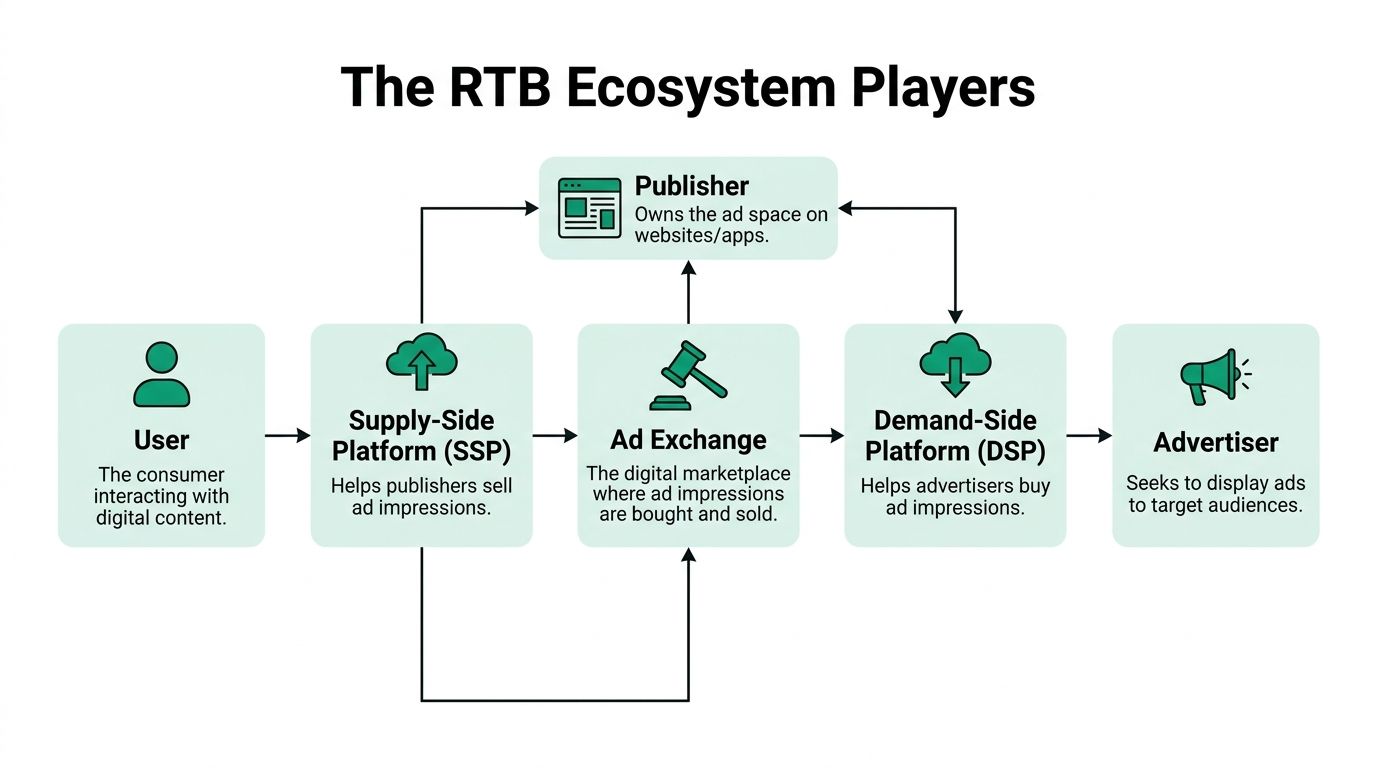
The six core participants
Here is the simplest way to map the ecosystem:
| Participant | What they do | What that means for your business |
|---|---|---|
| User | Loads a page or app | Creates the ad opportunity |
| Publisher | Owns the site or app with ad space | Supplies the inventory |
| SSP | Helps the publisher sell impressions | Packages the opportunity for auction |
| Ad exchange | Runs the marketplace | Connects supply and demand |
| DSP | Helps advertisers buy impressions | Decides whether to bid and how much |
| Advertiser | Wants to show an ad | Sets goals, audience, budget, and creative |
DSP, SSP, and ad exchange without the jargon
A Demand-Side Platform, or DSP, is the advertiser’s buying system. If you run campaigns, the DSP is where targeting, budgets, bids, exclusions, and creative rules are set. It acts like a buying desk that can review many opportunities at once and decide which ones fit your campaign.
A Supply-Side Platform, or SSP, works for the publisher side. It helps a website or app make its ad space available to buyers. It also applies the publisher’s rules, such as which types of ads can appear.
The ad exchange is the market in the middle. It receives the available impression from the SSP, sends that opportunity to DSPs, collects responses, and determines the winning ad.
A good mental model is this: the publisher wants to sell one seat, the advertiser wants to buy one seat, and the exchange runs the auction while the DSP and SSP represent each side.
Why this structure matters
If you’re a business owner, you don’t need to become an ad tech operator. You do need to know where decisions happen.
- Targeting and spend control usually live in the DSP.
- Inventory quality is shaped by the publishers and SSPs in the path.
- Auction access depends on the exchange and the connected partners.
Confusion usually starts when people say “programmatic” as if it’s one tool. It isn’t. It’s an ecosystem of connected systems. RTB is one buying method inside that ecosystem, and these players are the parts that make it function.
Anatomy of a Sub-Second Ad Auction
An RTB auction happens so fast that the user doesn’t notice it. The business impact, though, is huge. If your systems, targeting, and creative are set well, your ad enters the right auctions. If they aren’t, you either miss good opportunities or pay for weak ones.
A simple visual helps before the step-by-step breakdown.
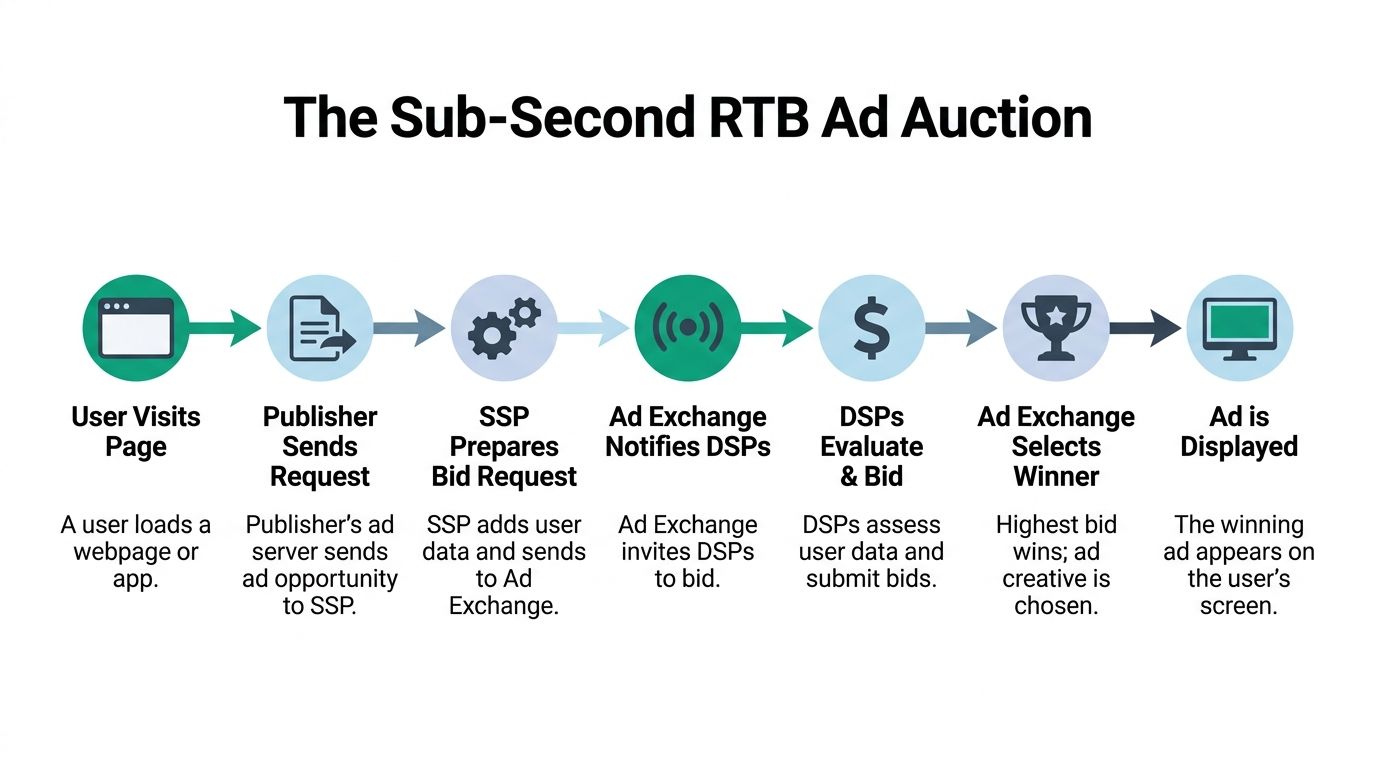
What happens from page load to ad display
A person opens a webpage. That page contains an ad slot. The publisher’s system recognizes the slot is available and sends the opportunity into the selling process.
The SSP then prepares a bid request. That request includes details needed for evaluation, such as the placement and available signals tied to the impression. The ad exchange receives that request and broadcasts it to multiple DSPs.
Each DSP checks the opportunity against advertiser rules. Does this user fit the target audience? Is the page relevant? Has the budget already been paced too far for the day? Is the predicted value high enough to justify a bid?
Then the DSP answers. Bid, or don’t bid.
According to AI Digital’s explanation of real-time bidding timing, RTB transactions occur within a strict 40 to 120 millisecond window, and the DSP must return HTTP 200 to bid or HTTP 204 to pass within 120 milliseconds. If it misses that deadline, the opportunity times out and the auction is lost.
Why milliseconds matter to advertisers
This speed creates a hard constraint. Your first decision has to be your final decision in that auction. There isn’t time for a human to review anything.
That means campaign performance depends heavily on preparation:
- Audience setup has to be defined in advance.
- Creative assets need to be approved and ready to serve.
- Bid logic must reflect your actual business priorities.
- Landing pages should match the traffic you’re paying to win.
If you’re trying to estimate budget ranges across channels before launching, a practical reference is this guide to online advertising costs. It helps frame how auction-based media fits into broader paid media planning.
Here is the process in sequence:
- User visits a page and triggers an ad opportunity.
- Publisher sends the request to the SSP.
- SSP packages the impression for the exchange.
- Exchange notifies DSPs that bidding is open.
- DSPs evaluate the impression against advertiser criteria.
- Winner is selected, and the creative is returned.
- Ad appears before the page fully settles on screen.
Video also plays a major role in auction-based buying. If you’re comparing formats, this overview of programmatic video advertising is a useful companion because video inventory follows the same broad buying logic while adding creative and placement considerations of its own.
For a quick walkthrough, watch this:
The auction is fast, but campaign success isn’t accidental. Fast systems reward the advertisers who did the slow thinking first.
Leveraging Data for Targeting and Measuring Success
RTB without data is just automated guessing. The reason advertisers use it is that each impression can be evaluated against signals that help decide whether the user and context are a fit.
In the United States, real-time bidding digital advertising spend reached approximately $57 billion in 2023, up from $23.5 billion in 2018, and the full auction takes less than 100 milliseconds, according to Wikipedia’s real-time bidding overview. Spending at that level tells you how much buying now depends on systems making very fast decisions from available data.
The main targeting approaches
Not all targeting works the same way. For small and mid-sized businesses, these are the categories that matter most:
- Contextual targeting places ads based on the content of the page. A company selling accounting software might want placements on pages about tax planning or bookkeeping.
- Behavioral targeting uses patterns from prior online activity to decide who may be interested.
- Retargeting reaches people who already visited your site or interacted with your brand. If you want a plain-English walkthrough, this explanation of what retargeting advertising is lays out how that approach works.
- Lookalike or modeled audience targeting tries to find new users who resemble people who already convert well for you.
A common mistake is assuming more data always means better targeting. It doesn’t. Bad data produces bad bids. If your audience definitions are outdated, incomplete, or inconsistent, your DSP can make the wrong call very quickly. This short piece on Digna insights on data quality is worth reading because it explains why clean inputs matter before any optimization happens.
What to measure after launch
Clicks get attention because they’re easy to see. They don’t tell the whole story.
For most RTB campaigns, you want to review a mix of delivery, efficiency, and business outcome metrics:
| Metric | What it tells you | Why it matters |
|---|---|---|
| Impressions | How often ads were served | Confirms delivery volume |
| CPM | Cost per thousand impressions | Helps compare media efficiency |
| Viewability | Whether people had a chance to see the ad | Filters out low-quality delivery |
| Clicks | Immediate response | Useful, but incomplete |
| Conversions | Desired actions after the ad | Connects spend to outcomes |
| ROAS | Revenue relative to ad spend | Shows whether the campaign supports growth |
Business check: If a campaign produces cheap impressions but weak sales activity, the problem isn’t the CPM. The problem is that you’re buying the wrong audience, the wrong context, or both.
For an e-commerce business, retargeting and product-focused creative may matter more than raw reach. For a B2B service company with a longer sales cycle, impression quality and assisted conversions often tell a more useful story than click volume alone.
Navigating Privacy Implications and Industry Shifts
RTB depends on data passing through several systems during ad selection. That creates real privacy questions. Business owners need to understand this, not because they need to memorize regulations, but because targeting choices and platform choices now sit much closer to compliance and customer trust.

Why RTB raises privacy concerns
RTB auctions happen at enormous scale. According to EPIC’s explanation of real-time bidding, these auctions occur 178 trillion times annually across the U.S. and Europe, broadcasting private user data to facilitate ad selection for each impression.
That figure explains why privacy has become central to the conversation. When a bid request moves through multiple participants, questions follow. What data is included? Who receives it? How long is it kept? How clearly did the user consent to that process?
What this means for SMBs
For many smaller businesses, the practical shift is this: broad third-party tracking is harder than it used to be, and platform policies keep tightening. Browsers, operating systems, and regulators have all pushed the market toward less reliance on cross-site tracking.
That changes media strategy in a few ways:
- First-party data becomes more valuable because it comes from your own customer relationships and site activity.
- Contextual targeting gains relevance because it doesn’t depend on the same type of user tracking.
- Retargeting can become narrower depending on platform rules, consent setup, and audience availability.
Privacy changes don’t remove the need for targeting. They force advertisers to use signals they can justify, manage, and explain.
The cookieless shift in practical terms
You don’t need to predict every technical standard that will win. You do need to prepare for a market where audience matching may be less direct and more modeled.
A sensible business response looks like this:
- Strengthen your own data sources such as CRM records, site behavior, and customer lists where allowed.
- Improve page-level relevance so contextual targeting has more to work with.
- Review your measurement setup because weaker identifiers can make attribution less tidy.
- Favor clear value exchanges with users, such as useful content, account creation, or email signups, instead of relying only on background tracking.
For SMBs, privacy isn’t just a legal issue. It changes how reachable your market is and how confidently platforms can identify likely buyers.
When to Use RTB vs Other Ad Buying Methods
RTB is useful, but it isn’t the default answer for every campaign. Sometimes you want flexibility and scale. Other times you want certainty, placement control, or a direct relationship with one publisher.
A clean comparison helps.
Side-by-side comparison
| Buying method | Best fit | Strengths | Tradeoffs |
|---|---|---|---|
| RTB | Broad reach, retargeting, audience discovery | Flexible, scalable, impression-level buying | Placement isn’t guaranteed |
| Programmatic direct | Premium inventory with more control | Greater predictability, cleaner access to specific inventory | Less auction flexibility |
| Direct publisher buy | Specific site, sponsorship, takeover, or fixed placement | Strong placement certainty and relationship control | Slower setup and less dynamic optimization |
Use RTB when flexibility matters most
RTB fits businesses that want to reach defined audiences across many sites and apps without negotiating inventory one property at a time. If your goal is lead generation, prospecting, retargeting, or testing audience segments, RTB gives you room to adjust.
It also helps when you don’t care exactly where the ad appears, as long as the placement meets your quality standards and reaches the right kind of user.
Use programmatic direct or direct buys when certainty matters more
Suppose you’re launching a brand campaign and want your business featured on one respected industry publication. RTB may touch that audience, but it won’t guarantee that exact placement. A direct arrangement may be the better fit.
The same goes for campaigns tied to sponsorship visibility, homepage ownership, or publisher-specific packages. In those cases, negotiation and reserved inventory can be more valuable than open auction efficiency.
If you’re weighing these options as a growing company, this guide to programmatic advertising for SMB marketing success gives helpful context on how smaller businesses can choose between managed scale and tighter control.
Choose RTB when you want to decide impression by impression. Choose direct buying when you want to decide placement by placement.
A simple decision filter
Ask three questions before choosing a buying method:
- Do I need guaranteed placement, or do I need audience reach?
- Am I optimizing for discovery, or for visibility on a specific property?
- Can I benefit from auction flexibility, or would fixed terms make planning easier?
A local service business trying to stay visible to past site visitors may lean toward RTB. A software company sponsoring a single niche publication may prefer a direct deal. A retailer often uses both.
Your Practical Getting Started Checklist
If you’re preparing for your first RTB campaign, keep the setup grounded. The technology is fast, but your planning shouldn’t be rushed. Every auction decision reflects choices you made beforehand.
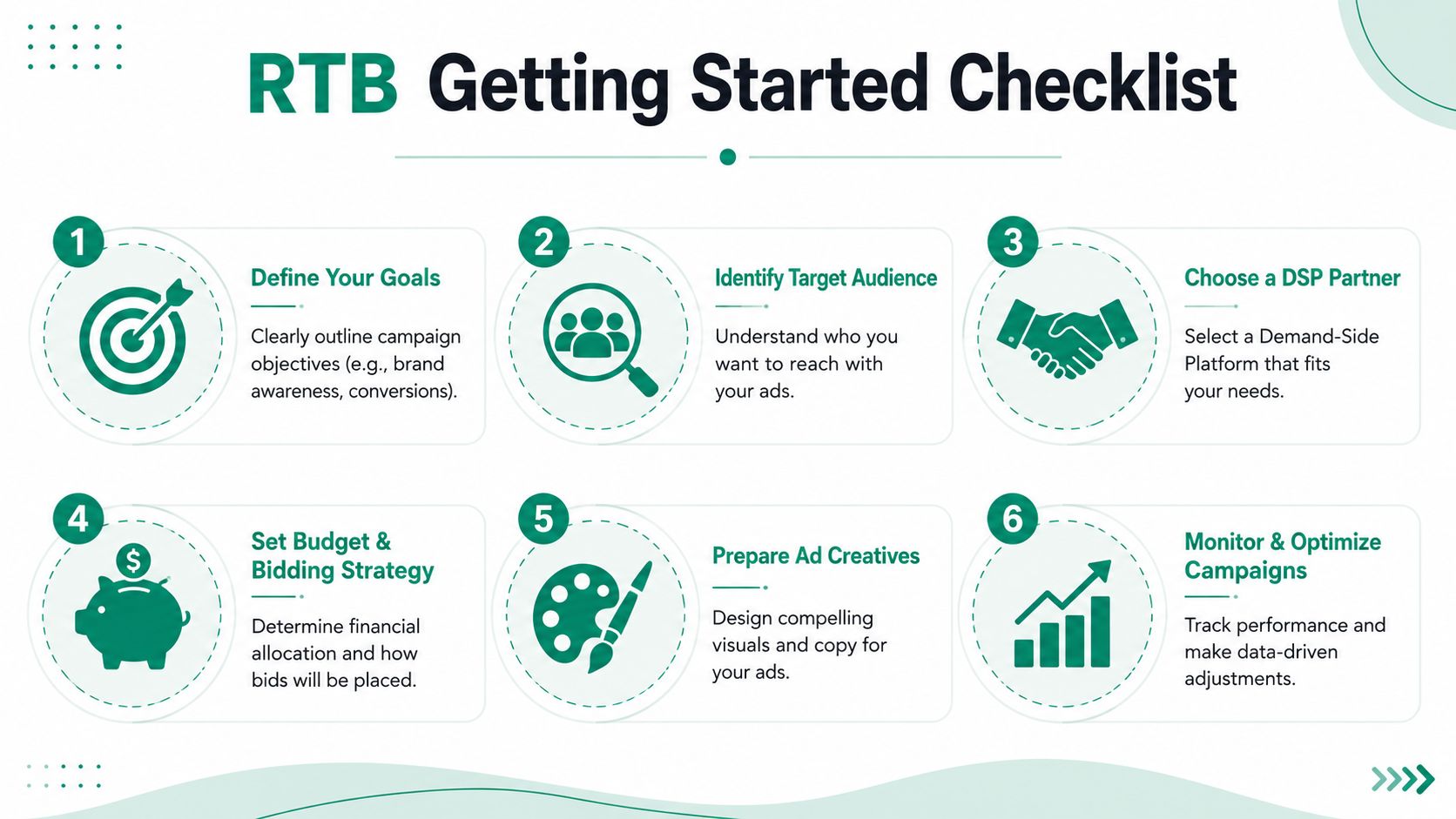
Six steps before launch
Define one clear outcome
Pick the primary goal first. Brand awareness, lead generation, e-commerce sales, and retargeting don’t use the same setup. One campaign can support several outcomes, but one should lead.Describe the audience in practical terms
Skip vague personas. Write down who you want to reach, what problem they are trying to solve, and what signals can identify them. Page category, prior site visits, product interest, and geography may all matter depending on the campaign.Choose how you’ll manage buying
You can work through a DSP directly or use a partner to manage it. The right choice depends on your internal time, ad operations knowledge, reporting needs, and appetite for day-to-day optimization.Set budget rules before spending starts
Decide how much you’re willing to test, how quickly you want the campaign to learn, and what result would justify expansion. RTB can spend efficiently, but only if the campaign has guardrails.Prepare the creative and landing page together
A display ad, video unit, or retargeting banner should match the page it sends traffic to. A weak message match wastes even well-targeted impressions.Decide what you’ll optimize weekly
You need a review cadence. That could mean audience segments, placements, frequency, creative rotation, conversion actions, or bidding logic. If nobody owns that review, the campaign drifts.
Two examples that make this real
An e-commerce brand selling skincare may start with product page visitors, cart abandoners, and contextual placements on beauty or wellness content. The first questions are usually about product feed quality, creative refreshes, and which audience groups justify higher bids.
A B2B IT services company will likely structure things differently. It may focus on account-level relevance, remarketing to prior visitors, and lead quality after form submissions rather than chasing cheap clicks.
According to ZeroPark’s RTB explainer, the full RTB transaction completes in approximately 100 milliseconds, which is four times faster than a human blink, and the advertiser’s first bid is their final bid in that auction. That makes pre-launch setup more than an administrative task. It directly shapes what the platform can do on your behalf.
The final pre-launch check
Before spending starts, confirm these points:
- Tracking is working, and the conversion events reflect business value.
- Creative is approved and loads correctly across formats.
- Audience logic is clean so overlap doesn’t muddy reporting.
- Landing pages are aligned with the ad message and offer.
- Reporting access is clear so someone can evaluate results without delay.
If those basics are in place, your first campaign won’t be perfect, but it will be readable. That’s what you need at the start. Not magic. Clear signals.
If you’re deciding whether real-time bidding fits your growth plan, Ascendly Marketing can help you sort through the options, build a practical media strategy, and align paid campaigns with the outcomes your business cares about.