

TL;DR:
- Conversion optimization increases the percentage of website visitors who complete desired actions by using data-driven testing and user analysis. It is a continuous process that improves revenue per visitor, lowers customer acquisition costs, and builds trust through iterative tests. SMBs should prioritize mobile, reduce friction, segment traffic, and use AI tools to sustain growth and avoid common pitfalls.
Conversion optimization is the systematic process of increasing the percentage of website visitors who complete a desired action, such as making a purchase, submitting a lead form, or signing up for a newsletter. Formally known as conversion rate optimization, or CRO, it uses data-driven testing, user behavior analysis, and iterative design to extract more revenue from existing traffic. Ascendly Marketing has worked with small and medium-sized businesses since 2013 and consistently finds that CRO delivers faster returns than simply buying more traffic. A 30% lift in conversion rate can add substantial revenue without increasing ad spend. That math makes CRO one of the highest-leverage activities available to any growing business.
What is conversion optimization and how does it work?
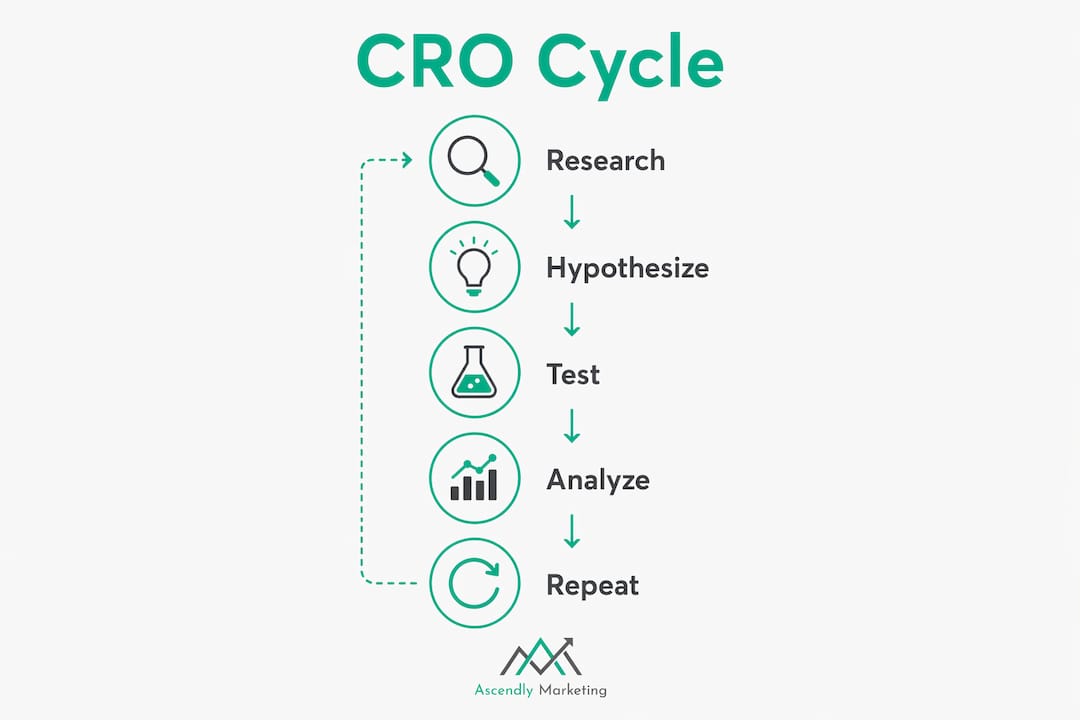
Conversion optimization works through a repeatable cycle: research, hypothesize, test, analyze, and repeat. You start by identifying where visitors drop off in your funnel, then form a specific hypothesis about why. That hypothesis becomes an A/B test, where one version of a page competes against a variation. The winning version rolls out, and the cycle begins again.

The business case for CRO is straightforward. CRO lowers customer acquisition cost by getting more value from the traffic you already pay for. Every dollar spent on SEO or PPC goes further when your site converts at 4% instead of 2%.
For small and medium-sized businesses, this matters even more. You rarely have the budget to outspend larger competitors on paid ads. CRO levels the playing field by making your existing traffic work harder.
The core benefits of conversion optimization include:
- Higher revenue per visitor without increasing ad spend
- Lower cost per lead across every traffic channel
- Better user experience, which reduces bounce rates and builds trust
- Faster feedback loops on what your customers actually want
- Compounding growth, where each test builds on the last
Pro Tip: Track revenue per visitor, not just conversion rate. A page can show a higher conversion rate but lower average order value, which means you actually earn less. Revenue per visitor tells the full story.
What are the most effective conversion optimization strategies for 2026?
The highest-impact CRO work in 2026 falls into five categories. Prioritize them in this order based on where your traffic and revenue gaps are largest.
Fix mobile first. Mobile accounts for 78% of e-commerce sessions, yet mobile converts 37% lower than desktop. Cart abandonment on mobile reaches 77.8%. Companies that fix mobile UX see a 27% uplift in smartphone conversions. Start with page speed, then simplify your checkout flow to as few steps as possible. A detailed mobile optimization guide covers the specific technical steps worth prioritizing.
Remove friction from your checkout and forms. Every additional second of load time can cut conversions by more than 50%. Checkout abandonment sits at 63.7%, which is more fixable than cart abandonment at 83.5%. Eliminate unnecessary form fields, show pricing clearly, and add trust signals like security badges and return policy summaries near the buy button.
Segment by channel and device. Email marketing converts at 19.3%, far above paid search and social media. That gap means your optimization effort should match the channel. A landing page built for email traffic needs different copy and offers than one built for cold paid search visitors.
Test shipping and return communication. Experiments around free shipping thresholds, return policy clarity, and delivery time estimates consistently rank among the highest-performing CRO tests. These address the two biggest objections buyers have before they commit.
Use AI tools for audit work. AI handles 60–80% of CRO audit work in 2026, and adoption grew from under 10% in 2024 to 38% in 2026. AI tools speed up hypothesis generation and help prioritize which pages to test first. They do not replace human judgment on test design, but they dramatically reduce the time spent on analysis.
| Strategy | Primary Benefit | Best Starting Point |
|---|---|---|
| Mobile UX improvement | 27% uplift in smartphone conversions | Page speed and checkout flow |
| Friction removal | Reduces 63.7% checkout abandonment | Form fields and hidden pricing |
| Channel segmentation | Email converts at 19.3% | Separate landing pages per channel |
| Shipping and return tests | Addresses top buyer objections | Policy visibility near checkout |
| AI-assisted audits | Cuts audit time by 60–80% | Heatmap and session recording analysis |
Pro Tip: Run your first tests on pages with the highest traffic and the clearest drop-off point. Testing a low-traffic page takes months to reach statistical significance. Start where the data is richest.
What common pitfalls should SMBs avoid in conversion optimization?
The most expensive CRO mistake is copying industry “best practices” without testing them on your own site. Generic best practices frequently fail without local validation against your specific audience and traffic mix. What works for a large e-commerce retailer may actively hurt a local service business.
Treating CRO as a one-time project is the second most common failure. Conversion optimization is a continuous process that must adapt to changing user behavior, new traffic sources, and evolving product offerings. A single round of tests is not a program. It is a starting point.
Three other pitfalls consistently derail SMB CRO efforts:
- Chasing vanity metrics. Clicks, bounce rate, and time on page feel measurable, but they do not directly connect to profit. Measure revenue per visitor and cost per acquisition instead.
- Skipping behavioral research. Top CRO teams spend over 30% of their time on behavioral research, including surveys, session recordings, and heatmapping. That investment doubles A/B test win rates. Most SMBs skip this step entirely and wonder why their tests produce flat results.
- Lacking C-level buy-in. CRO requires cross-functional cooperation between design, development, and marketing. Without executive sponsorship, tests stall in approval queues, and learnings never get implemented.
A CRO audit is the fastest way to identify which of these pitfalls currently applies to your site. It surfaces the specific friction points and behavioral gaps that generic advice will never catch.
How do you build a sustainable CRO program for your business?
A sustainable CRO program follows a structured process, not a random series of tests. Here is how to build one that compounds over time.
Set a baseline. Measure your current conversion rate, revenue per visitor, and cost per acquisition before changing anything. You cannot improve what you have not measured. Use Google Analytics 4 or a comparable analytics platform to establish these numbers by channel and device.
Build a hypothesis backlog. Every test idea needs a documented hypothesis in the format: “We believe that changing X for audience Y will result in Z because of behavioral evidence W.” Vague ideas produce vague results. A searchable test library lets you build on past learnings instead of repeating failed experiments.
Apply a prioritization framework. The ICE framework (Impact, Confidence, Ease) scores each hypothesis on three dimensions. The AXR framework adds an extra layer for revenue impact. Either approach forces you to test high-value ideas first instead of whatever is easiest to build.
Match testing velocity to your traffic. Average CRO programs run 2–3 tests per month. Mature programs run 4–6 tests monthly with a dedicated team of 2–5 people. The quality of your hypotheses matters more than the number of tests you run. Low-quality tests at high volume produce noise, not learning.
Measure lifetime value, not just conversion rate. A test that increases conversions by 10% but attracts lower-quality customers can hurt long-term revenue. Track customer lifetime value (LTV) alongside immediate conversion metrics to catch this problem early.
Invest in ongoing research. Combine monthly surveys, weekly session recording reviews, and quarterly user interviews. Successful CRO programs integrate continuous research with a documented prioritization framework, a searchable test library, and C-level visibility. These five traits define the programs that generate compounding revenue growth.
Pro Tip: Partner with a CRO professional or agency if your internal team lacks dedicated bandwidth. A part-time internal effort spread across other responsibilities produces slower results than a focused external program. The math on ROI usually favors the investment. Explore proven improvement techniques to see what a structured approach looks like in practice.
Key Takeaways
Conversion rate optimization is the highest-leverage growth activity for SMBs because it multiplies the value of every traffic source you already pay for.
| Point | Details |
|---|---|
| CRO definition | CRO increases the percentage of visitors who complete desired actions using data-driven testing. |
| Mobile is the biggest gap | Mobile converts 37% lower than desktop despite driving 78% of e-commerce sessions. |
| Remove friction first | Every extra second of load time can cut conversions by more than 50%; fix speed and checkout before running tests. |
| Research drives win rates | Top teams spend over 30% of their time on behavioral research, which doubles A/B test success rates. |
| CRO is continuous | A one-time test round is not a program; sustainable growth requires ongoing testing, learning, and iteration. |
Why CRO has become non-negotiable for growing businesses
Organic search traffic is shrinking as AI-generated answers replace traditional search results. Paid traffic costs keep rising. The businesses that grow in this environment are the ones that convert more of the visitors they already have.
What I have seen working with SMBs at Ascendly Marketing is that most businesses underestimate how much revenue they leave on the table by not testing. They run ads, drive traffic, and accept whatever conversion rate they get as fixed. It is not fixed. It is a variable you can control.
The uncomfortable truth is that most CRO failures come from impatience, not bad ideas. Businesses run two or three tests, see mixed results, and conclude that CRO does not work for them. What they actually experienced was the warm-up phase. The compounding returns come after you have built a test library, learned your audience’s specific objections, and developed hypotheses grounded in real behavioral data.
CRO works best when it sits at the intersection of marketing, product, and design. It is not a marketing department project. It is a business-wide commitment to understanding what your customers need and removing every obstacle between them and that outcome. SMBs that treat it as a core growth function, not an optional add-on, consistently outperform those that treat it as a quarterly campaign.
— Ascendly Marketing
Ascendly Marketing can help you convert more of your traffic
Ascendly Marketing has helped SMBs build data-driven digital programs since 2013, combining SEO services and PPC advertising with conversion-focused strategy to maximize the value of every visitor. The team includes SEO specialists, designers, and content creators who understand how traffic quality and on-site experience work together to drive revenue.
If your site is generating traffic but not enough leads or sales, the problem is almost always fixable through structured testing and targeted improvements. Ascendly Marketing builds CRO programs tailored to your traffic mix, your audience, and your revenue goals. Book a consultation to find out where your biggest conversion gaps are and what it would take to close them.
FAQ
What is conversion optimization in simple terms?
Conversion optimization is the process of making changes to your website so more visitors take a desired action, such as buying a product or filling out a contact form, without increasing your ad spend.
What is a good conversion rate for a small business?
Conversion rates vary widely by industry and traffic source. Email marketing converts at 19.3%, while paid search and social media convert at significantly lower rates, so benchmarks depend on your channel mix.
How long does it take to see results from CRO?
Most businesses see meaningful data from individual A/B tests within 2–4 weeks, depending on traffic volume. Building a program that compounds results takes 3–6 months of consistent testing and research.
What is the difference between CRO and SEO?
SEO increases the number of visitors who find your site. CRO increases the percentage of those visitors who convert. Both work together: more qualified traffic from organic SEO gives CRO more data to work with and faster test results.
Do SMBs need a dedicated CRO team?
Not necessarily. Average CRO programs run 2–3 tests per month with a small team. SMBs can start with one dedicated person or an external partner, then scale as the program matures and ROI justifies additional investment.