
You’re publishing blog posts, posting on social, maybe sending a newsletter, and the numbers still don’t line up with revenue. Traffic comes in waves. A few leads appear. Sales asks for better prospects. Marketing says content is working, but nobody can point to a clean path from first click to signed deal.
That problem usually isn’t a content volume problem. It’s a sequencing problem.
A content marketing funnel gives your content a job at each stage of the buyer journey. Instead of treating every asset like it needs to sell immediately, you match content to buyer intent. One piece earns attention. Another builds trust. A later asset removes friction and helps someone choose.
The Content Marketing Funnel Engine for Growth
A content marketing funnel turns scattered publishing into an operating system. Without one, businesses often produce decent content that lands in the wrong moment. They promote product pages to cold traffic, write educational blog posts for buyers who are already comparing vendors, or send the same nurture sequence to every lead no matter what triggered the signup.
That mismatch slows growth.
The business case for getting this right is clear. The global content marketing industry was valued at about $63 billion in 2022 and is projected to reach $107 billion by 2026, according to Neil Patel’s content marketing statistics. The same source states that content marketing costs 62% less per lead than traditional marketing methods while generating three times as many leads. Those numbers don’t mean every blog post works. They show that structured content systems can produce efficient demand when teams stop publishing randomly.
What the funnel changes in practice
A working funnel answers a simple question at every stage: what does this prospect need next?
For an SMB, that might mean:
- Early interest: A search-driven article or short video that helps a prospect name a problem
- Mid-funnel evaluation: A practical guide, comparison page, or webinar that helps them sort options
- Late-stage decision: A pricing page, consultation offer, or product demo that removes hesitation
For a local company, the pattern is similar, even if the content format changes. A home services business may rely more on service pages, FAQs, and quote requests than downloadable guides. A brokerage team may use neighborhood content and educational resources. If you want a sector-specific example, these real estate marketing strategies show how content and lead capture can work together when the sales cycle depends on trust and timing.
Practical rule: Content that tries to do everything usually does nothing well.
Why businesses miss the mark
Failure often doesn’t stem from a lack of ideas. It occurs because orchestration is overlooked.
A blog calendar isn’t a funnel. Neither is a pile of lead magnets. The funnel starts working when content, distribution, calls to action, CRM stages, and reporting all point in the same direction. That’s where measurable revenue starts to show up. Awareness becomes a lead. A lead becomes a conversation. A conversation becomes a sale.
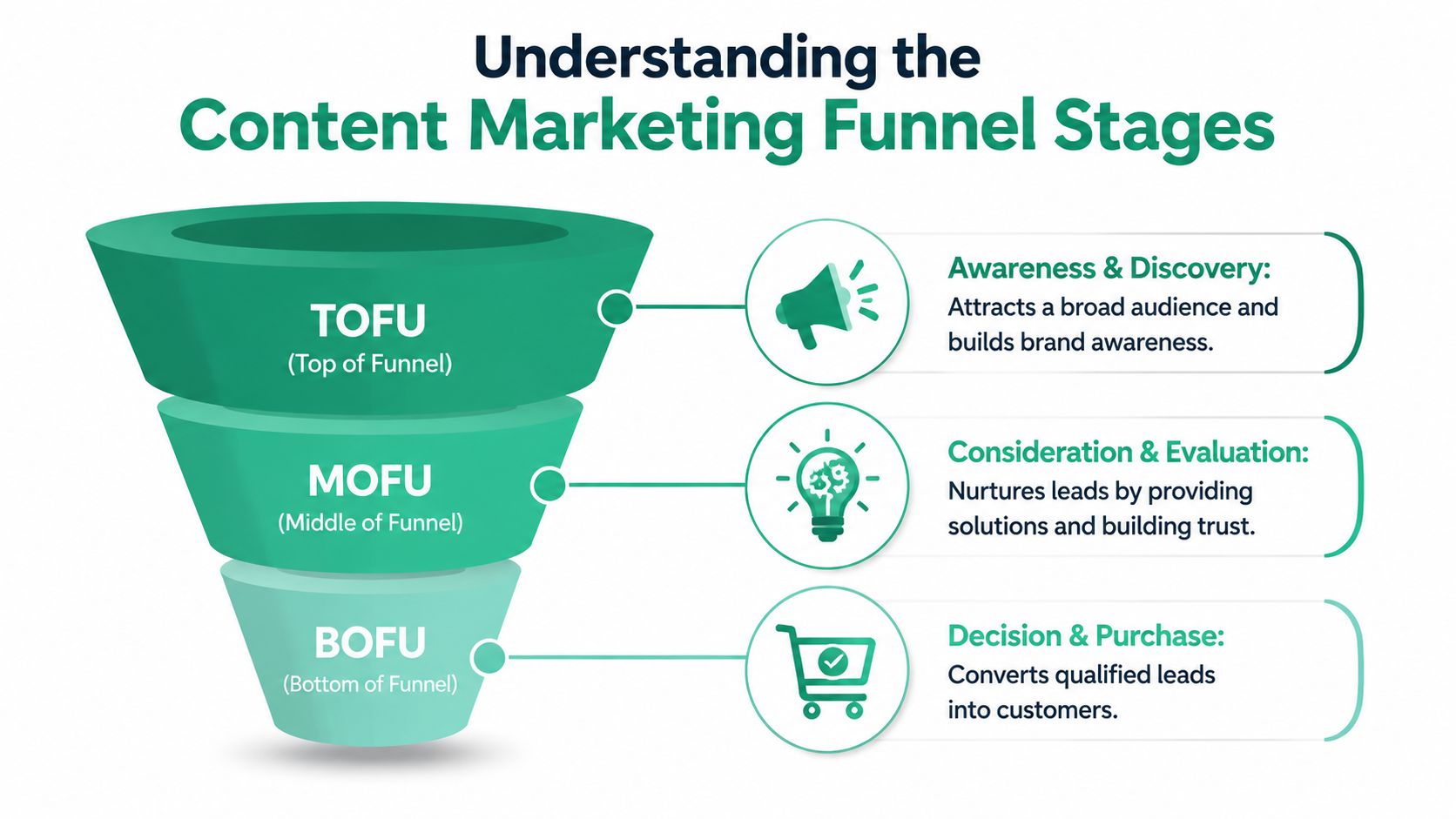
Understanding the Funnel Stages: TOFU, MOFU, BOFU
Think of the content marketing funnel like building a business relationship. You wouldn’t meet someone for the first time and immediately push for a contract. You’d start with relevance, earn attention, show that you understand the problem, and then make a clear offer when the timing is right.
That’s what the three core stages do.
TOFU means attention and discovery
Top of funnel, usually shortened to TOFU, is where buyers first encounter your brand. They may not know your company. In many cases, they don’t fully understand the problem yet either. They’re researching symptoms, looking for options, or trying to frame a decision.
Content here should be easy to consume and easy to find. Search articles, short educational videos, social posts, infographics, and broad explainers all fit. The point isn’t to close a deal. The point is to become useful enough that a qualified visitor wants to continue.
MOFU means evaluation and trust
Middle of funnel, or MOFU, is where interest becomes active consideration. The buyer is no longer asking only “what’s my problem?” They’re asking “which approach should I trust?” and “which provider seems credible?”
At this stage, shallow content starts to break down. Generic listicles don’t help much when someone needs proof, context, or a way to compare options. Strong mid-funnel content educates while narrowing choices. That might include webinars, product comparisons, deep guides, expert commentary, or case-study-style explanations.
According to HubSpot marketing statistics, 74% of marketers say content marketing strategies generate demand and leads, and 62% say those strategies nurture subscribers and existing audiences. That tracks with what happens in real campaigns. The middle of the funnel carries a lot of the burden because that’s where curiosity either matures into buying intent or fades out.
Buyers rarely drop because they got too much clarity. They drop when the next step feels vague.
BOFU means decision and action
Bottom of funnel, or BOFU, is where the buyer is close to choosing. They need confidence, not more broad education. They want direct answers: pricing, implementation, turnaround, product fit, support, proof, and risk reduction.
At this stage, your content should make action simple. Demo pages, pricing pages, sales decks, consultations, trial offers, and detailed service pages do the heavy lifting. Good BOFU content doesn’t keep talking around the point. It helps someone decide.
If your funnel feels weak, ask one direct question. Are you giving each stage the kind of content that matches the buyer’s state of mind, or are you repeating the same message in three different formats?
Mapping Content Types to Each Funnel Stage
Once the stages are clear, content planning gets easier. You stop asking, “What should we publish next?” and start asking, “What does this audience need before they can move forward?”
That shift changes the calendar, the offer, and the CTA.
TOFU content that earns attention
At the top of the funnel, broad educational content does the best work. These assets should answer common questions, surface pain points, and attract qualified visitors through search, social, and referral traffic.
Useful TOFU formats include:
- Blog posts: Good for ranking on problem-aware searches and bringing in recurring traffic
- Infographics: Helpful when a concept is easier to scan visually than read in long form
- Social media posts: Useful for distribution, short-form education, and repeated exposure
- Introductory videos: Strong when the buyer needs a quick explanation before committing time
The trade-off is straightforward. TOFU content scales reach, but it usually produces lower intent than later-stage assets. That’s fine. Trying to force cold audiences into hard conversion pages usually reduces performance.
MOFU content that helps buyers compare options
Mid-funnel content needs more specificity. The buyer already knows enough to care. Now they need substance.
Typical MOFU assets include:
- Case studies: Useful when the buyer wants to see application, process, and outcome
- Webinars: Strong for education with nuance, especially in B2B
- Product comparisons: Good for buyers who are shortlisting solutions
- Email newsletters and nurture emails: Effective when someone has already raised a hand and needs continued guidance
If your team struggles here, a practical reset helps. Start by reviewing your existing asset library and labeling every piece by funnel stage. Most companies find an imbalance. They have plenty of awareness content and a few sales pages, but very little that bridges the gap. If you need a framework for organizing that work, this guide on what content creation means for businesses in 2026 is a useful reference point for planning formats, workflows, and outputs.
BOFU content that removes friction
Bottom-funnel content should make commitment easier. Buyers don’t need another general article at this point. They need pages and assets that answer practical buying questions.
That usually means:
- Pricing pages: Clear packaging, scope, or buying paths
- Testimonials and trust pages: Useful when the prospect needs validation
- Free trials or consultations: Strong when the product or service benefits from firsthand experience
- Demos and sales enablement assets: Helpful when internal approval is part of the buying process
A weak BOFU page often has plenty of information but no clear next step.
Content formats by funnel stage
| Funnel Stage | Primary Goal | Content Formats |
|---|---|---|
| TOFU | Build awareness and attract qualified traffic | Blog posts, infographics, social media posts, introductory videos |
| MOFU | Educate, nurture, and support evaluation | Case studies, webinars, product comparisons, email newsletters |
| BOFU | Help the buyer decide and convert | Pricing pages, testimonials, demos, free trials, consultations |
Not every business needs every format. An e-commerce brand may lean on category guides, comparison content, and product pages. A B2B firm may need webinars, research summaries, and sales collateral. A local service company may get farther with service pages, FAQs, and quote-focused landing pages. The structure stays the same. The execution changes.
Measuring Success with Funnel KPIs and Metrics
A funnel usually looks healthy until someone asks a simple question. Which content is producing qualified pipeline, not just activity?
That question exposes the gap between publishing and performance management. Traffic, leads, sales conversations, and revenue do not belong in one bucket. Each funnel stage needs its own scorecard, or the team ends up rewarding the wrong outcomes. I see this often with SMBs that celebrate traffic growth while sales still says lead quality is inconsistent, and with e-commerce brands that push more sessions without improving product page conversion.
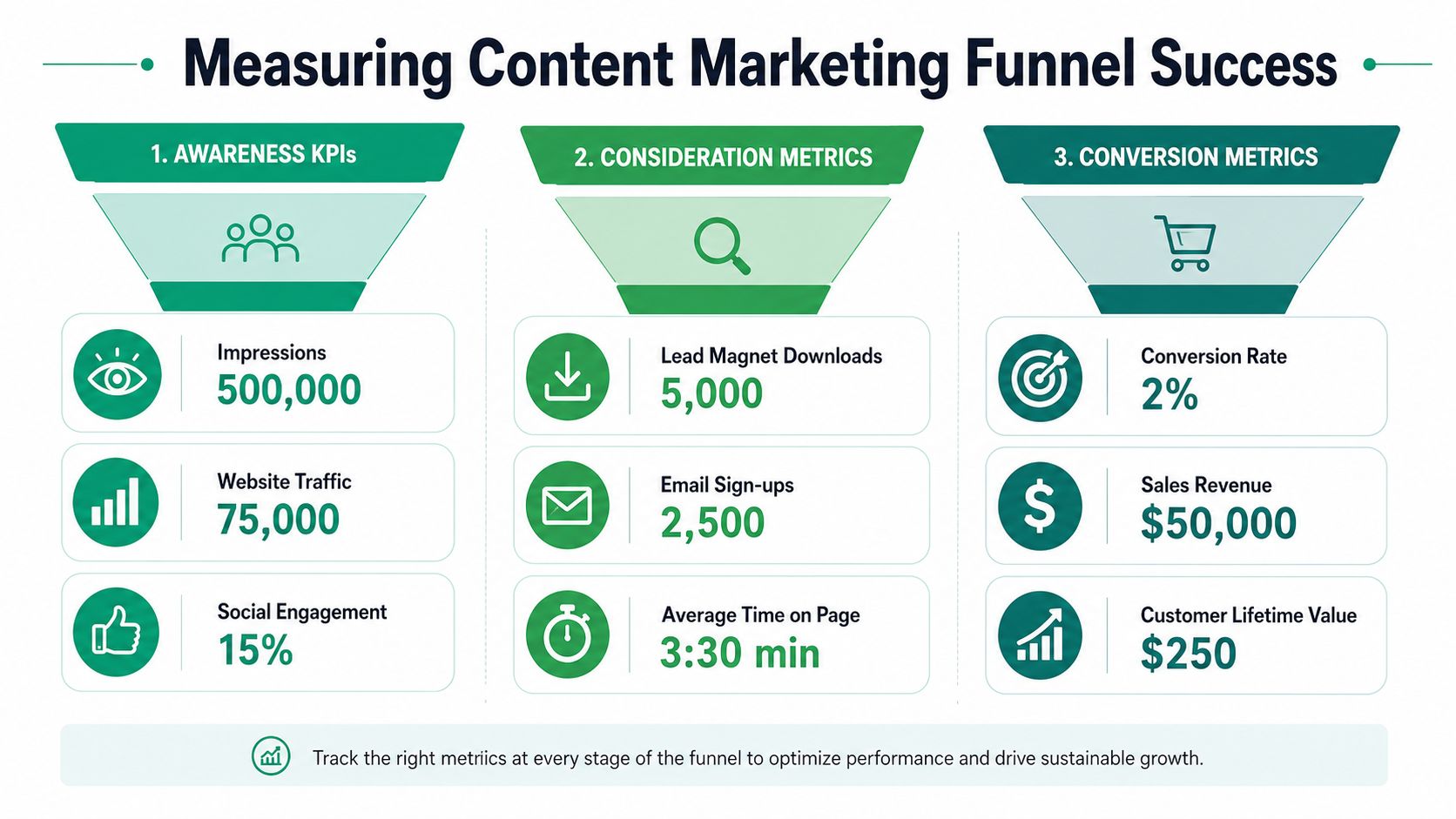
TOFU metrics that show reach quality
Top-of-funnel measurement starts with visibility, but reach alone is not enough. A local business may want map-driven and organic visits from nearby buyers. A B2B company may care more about visits from target accounts, return visitors from email, and traffic to educational pages tied to a specific service line. An e-commerce brand may watch category page entrances and assisted product views.
A useful TOFU dashboard usually includes:
- Unique visitors: Shows whether awareness content is attracting new potential buyers
- Traffic source mix: Clarifies whether discovery is coming from organic search, paid campaigns, direct visits, local listings, or referrals
- Engaged sessions, bounce rate, and time on page: Helps you judge whether the page matched the search intent and held attention
- New visitor conversion signals: Tracks early actions such as email signups, product views, quote clicks, or secondary page visits
If TOFU traffic climbs and engagement stays weak, the problem is usually targeting or message fit. The content may rank for broad terms that bring the wrong audience. The headline may promise a solution the page does not deliver. In local and SMB campaigns, weak geographic intent is another common cause. You get visits from people who were never in the service area to begin with.
MOFU metrics that reveal nurture strength
Mid-funnel reporting should answer a harder question. Are prospects moving closer to a buying conversation, or just consuming content?
The core KPI here is lead progression. That includes form fills, booked consultations, email subscriber growth, webinar registrations, pricing page visits after a content touch, and movement from inquiry to marketing-qualified or sales-qualified status inside the CRM. For B2B teams, I pay close attention to source-to-MQL trends, email response by segment, and the percentage of leads that engage with more than one mid-funnel asset. For e-commerce, the MOFU equivalent may be wishlist adds, account creation, quiz completions, and cart starts after educational content. For local service businesses, it often looks more like estimate requests, financing-page visits, or repeat sessions before a call.
Useful MOFU metrics include:
- Lead conversion rate by asset or page
- Cost per lead by channel
- Email click and reply rates
- Content-assisted return visits
- MQL and SQL progression in the CRM
This stage is where weak handoffs create expensive waste. Marketing may count a download as success, while sales sees no buying intent behind it. The fix is shared definitions. If an SMB team calls every form fill a lead, reporting stays inflated. If a B2B firm waits for a demo request before scoring intent, good prospects may sit untouched for weeks.
BOFU metrics that connect content to revenue
Bottom-funnel measurement has to tie content to sales actions. That means tracking demo requests, trial starts, quote requests, booked calls, proposal acceptance, purchase conversion, and close rate by content path.
At this stage, attribution gets messy fast. A buyer may read a comparison page, leave, return from branded search, click a case study from an email, and convert through a direct visit. If the tracking setup is loose, the final click gets all the credit and your highest-impact BOFU assets look weaker than they are.
A practical BOFU scorecard often includes:
- Conversion rate on pricing, service, or product pages
- Sales-qualified opportunities influenced by content
- Booked meetings or quote requests by source
- Pipeline value and revenue tied to content-assisted journeys
- Close rate and sales cycle length for content-influenced leads
The trade-off here is simple. The tighter your attribution rules, the more setup work the team needs in analytics and CRM. For smaller businesses, that does not mean waiting for a perfect reporting system. Start with stage-based goals and clean tracking on your highest-value conversion points. Then improve attribution once the funnel is producing enough volume to justify the extra configuration.
If you are building reporting from scratch, use one shared framework across marketing and sales:
- TOFU: Qualified reach and engagement
- MOFU: Lead capture and stage progression
- BOFU: Sales actions, pipeline creation, and revenue contribution
For a stronger setup, this marketing analytics guide for SMB growth in 2026 walks through how to connect campaign performance, CRM stages, and business outcomes without cluttering your dashboard with vanity metrics.
Aligning Your Funnel with Audience Segments
A generic funnel usually looks neat in a slide deck and underperforms in practice.
A local service buyer, an e-commerce shopper, and a B2B operations leader don’t move through the same decision process. Even inside one business, a founder, a marketing manager, and a procurement contact won’t respond to the same message. If they all get the same content, one group may convert while the others stall.
Segment by need, not just by job title
Basic segmentation starts with role, company size, geography, or industry. That’s useful, but it’s not enough on its own. Strong funnel segmentation also uses intent and friction.
A practical way to segment is to ask:
- What problem triggered the search?
- How urgent is the need?
- What type of proof does this buyer need before acting?
- What could block the purchase later?
An SMB owner may want speed, clarity, and direct pricing. A B2B buying committee may need implementation detail, internal buy-in material, and comparisons. An e-commerce shopper may need product education, shipping clarity, and confidence in the return process. Same funnel model. Different content path.
Match offers to buying context
Segmentation changes the offer, not just the copy.
For example, a local HVAC company might use educational service pages and seasonal maintenance articles for awareness, then move prospects toward estimate requests and appointment booking. A SaaS firm selling to operations teams may attract visitors with workflow content, nurture them with webinars and comparison pages, then route qualified leads into demos.
The right segmentation removes irrelevant steps. Buyers move faster when the content feels built for their situation.
Build lightweight persona paths
You don’t need a massive persona document to get this right. Start with two or three audience groups that matter most and map a simple path for each:
- Entry point: What content gets them in
- Evaluation asset: What helps them trust your approach
- Decision asset: What helps them choose
This method is especially useful for companies with mixed revenue streams. A business that serves both small clients and enterprise accounts shouldn’t force both groups through the same nurture sequence. The small account may need directness. The enterprise account may need more depth and more stakeholders addressed.
Segmentation makes the content marketing funnel less elegant on paper and far more effective in practice.
Building Your First Content Marketing Funnel
The first funnel doesn’t need to be large. It needs to be connected. A narrow funnel that maps to one offer, one audience segment, and one buying path will outperform a bloated setup full of disconnected assets.

Start with one business goal
Pick a single commercial outcome. More qualified consultation requests. More demo bookings. More purchases from a product category. Keep it specific enough that reporting stays clean.
Then define the KPIs that show progress from stage to stage. If the goal is demo requests, don’t judge the whole funnel by traffic alone. You’ll need awareness metrics, lead capture signals, and sales-action tracking.
Map the buyer journey before creating anything new
Many teams jump straight to production. That wastes time. First map the path:
Entry point
How does the buyer first find you? Through search, paid ads, social, referral, or email?Trust checkpoint
What question appears after the first visit? Do they need comparison content, proof, or a deeper explanation?Decision step
What finally gets them to act? A demo, a quote request, a consultation, or a product page visit?
That map tells you which assets you need and which assets you can skip.
Audit what already exists
Most businesses already have usable pieces. They just haven’t arranged them into a funnel.
Review your website, blog, sales collateral, email flows, and landing pages. Tag each asset as TOFU, MOFU, or BOFU. Mark gaps. In many cases, social content can also support the top and middle of the funnel if it’s built from actual audience questions rather than generic posting prompts. This piece on data-driven social media content is a good example of using distribution content as part of a larger conversion path rather than treating social as a separate program.
A content audit often shows that the missing asset isn’t another blog post. It’s the bridge between interest and action.
Build a production and tracking routine
Once the gaps are clear, create a simple workflow:
- One TOFU asset to attract the right audience
- One MOFU asset to capture and nurture interest
- One BOFU asset to convert high-intent prospects
Assign ownership for writing, design, approvals, publishing, email setup, CRM tagging, and reporting. If no one owns reporting, the funnel will drift.
A short walkthrough can help you visualize how the parts fit together:
Keep the first version simple
Use tools you already have where possible. Google Analytics, your CRM, your CMS, and your email platform are usually enough to launch a first version. The goal isn’t sophistication. The goal is visibility. You need to see where people enter, where they convert, and where they disappear.
Once that path is working, expand carefully. Add another audience segment. Build another nurture sequence. Create a second decision-stage path. The funnel grows best when each new layer solves a specific operational need.
Funnel Examples for Different Business Types
A content funnel should match how the business sells. A five-person B2B software company does not need the same content path as a local HVAC provider or an e-commerce brand with hundreds of SKUs. The stage labels stay the same. The buying friction, proof requirements, and conversion points do not.
That difference matters because a generic funnel often produces the wrong content at the wrong time. SMBs need a system they can run. B2B teams need assets that support longer sales cycles. E-commerce brands need content that reduces hesitation fast. Local businesses need pages that turn urgent searches into calls and booked jobs.
B2B startup example
B2B startups usually struggle in the middle of the funnel. They can earn traffic with problem-aware content, but prospects hesitate before booking a call because the company has limited brand recognition, a shorter customer list, or a new category to explain.
GrowthBadger’s content marketing funnel analysis points to the same pattern. Buyers drop off when the validation layer is weak. For an early-stage company, that means MOFU content has a harder job. It has to prove the team understands the problem, the stakes, and the implementation reality.
A practical B2B startup funnel often looks like this:
- TOFU: Search-focused articles tied to the operational problem, category explainers, and pain-point content built around the terms buyers already use
- MOFU: Original research, expert webinars, ROI frameworks, integration explainers, and comparison pages that help a prospect defend the decision internally
- BOFU: Demo page, pricing or qualification page, implementation overview, security or compliance FAQs, and customer proof that addresses common objections
The trade-off is straightforward. Founder-led insight, customer evidence, and original analysis take more effort to produce than generic educational posts. They also create the trust needed to move from lead to sales conversation. For B2B teams, I usually watch content-qualified leads, demo request rate, meeting-booked rate, and sales-cycle velocity by source.
E-commerce example
E-commerce funnels compress the timeline, but they still need stage discipline. A shopper might discover the brand on Instagram, Google, YouTube, or through an email campaign. If the first page assumes they already know the product, conversion rates suffer.
A strong e-commerce funnel usually works like this:
- TOFU: Category guides, gift guides, product education articles, short-form videos, creator content, and search pages built around use cases
- MOFU: Comparison pages, buying guides, quiz flows, bundles, SMS or email follow-up, and browse-abandon sequences
- BOFU: Product pages, reviews, shipping and returns content, offer pages, cart recovery emails, and checkout support content
The operational challenge is balancing discovery with intent. Sending all paid and organic traffic to product pages can work for branded searches and repeat buyers. It often underperforms for colder audiences who still need help choosing. E-commerce teams should track product page view rate, add-to-cart rate, checkout completion, revenue per session, and repeat purchase rate to see where the funnel is leaking.
Local service business example
Local service businesses often have the opposite problem. Intent is high, but the website does a poor job turning that intent into action. Someone searching for a roofer, dentist, or estate planning attorney usually wants proof, availability, and a clear next step.
A workable local funnel often includes:
- TOFU: Localized service pages, FAQs, blog posts tied to common customer problems, neighborhood or city pages, and Google Business Profile support content
- MOFU: Service comparison pages, financing explainers, insurance or process details, team bios, review highlights, and problem-specific landing pages
- BOFU: Quote request page, booking form, call-first landing pages, scheduling details, and customer proof close to the form or phone number
Speed matters here. So does specificity.
Local prospects rarely want a long nurture sequence unless the service is expensive or elective. They want enough information to feel safe contacting the business now. The KPIs that matter most are form completion rate, call conversion rate, booked appointment rate, and cost per qualified lead by location.
SMB service business example
Many SMBs sit between these models. They have a consultative sale, limited internal marketing capacity, and a need for content that works across SEO, email, and sales enablement. In practice, the best funnel is usually the one the team can publish, measure, and improve without creating operational drag.
That often means starting with one clear path:
- TOFU: Problem-aware articles built around high-intent search themes
- MOFU: One strong lead magnet or case-study-driven nurture asset
- BOFU: A focused service or contact page matched to that audience segment
If execution feels harder than strategy, that is normal. The challenge is usually staffing, consistency, and cross-channel coordination. Businesses comparing internal execution against outside support should review what to look for in a digital marketing agency selection process.
Different businesses use the same funnel logic. Results improve when the proof, pace, and conversion action match how that business actually buys and sells.
How to Implement Your Funnel with Agency Support
At some point, the question stops being “should we use a content marketing funnel?” and becomes “who’s going to run this consistently?”
That’s where many businesses hit a wall. The strategy is clear enough. Execution isn’t. Someone has to research topics, build pages, write copy, design assets, manage SEO inputs, configure email flows, connect CRM stages, and generate performance reports. When that work gets spread across busy internal teams, the funnel often stalls in the middle. Content ships, but the system around it never quite locks into place.
When outside support makes sense
Agency support usually makes sense in a few situations:
- Your team lacks bandwidth: Content planning exists, but production and optimization keep getting pushed
- Your funnel has visible gaps: Traffic is coming in, but leads aren’t progressing cleanly
- Your reporting is fragmented: Marketing, sales, and leadership all see different numbers
- You need cross-channel execution: Search, email, landing pages, paid media, and CRO all need to work together
The benefit isn’t just extra hands. It’s orchestration.
What a good engagement should look like
A strong agency process mirrors the funnel itself. First comes discovery, where goals, buyer paths, and current assets are reviewed. Then planning, where content, offers, pages, and measurement are mapped. Then execution, where assets launch and campaigns run. Then reporting, where the team looks at movement through the funnel and adjusts.
That process is worth comparing carefully before you sign anything. If you’re evaluating options, this guide on how to choose a digital marketing agency is a solid checklist for reviewing fit, capability, and accountability.
What to expect from the partnership
The best agency relationships are operational, not theatrical. You should expect:
- Clear ownership: Who handles strategy, production, approvals, analytics, and optimization
- Stage-based reporting: Performance by awareness, nurture, and conversion, not just raw traffic
- Content tied to offers: Assets that support a real buying path
- Regular iteration: Pages, CTAs, and nurture flows adjusted based on performance
If the agency can’t explain how a blog post connects to a lead path, or how a landing page connects to downstream pipeline, the funnel isn’t being managed. It’s just being decorated.
If you want a content marketing funnel that connects traffic, lead quality, and sales activity into one measurable system, Ascendly Marketing can help you plan it, build it, and improve it over time. Start with a conversation about your audience, your offer, and where prospects drop out today.