
TL;DR:
- AI has become essential for small and medium-sized businesses to improve efficiency, decision-making, and customer experience. Most SMBs use AI for automation and gaining a competitive edge, but deep integration remains rare. Proper implementation, security, and strategy are key to unlocking AI’s full business potential.
Artificial intelligence is now a primary driver of business growth, efficiency, and competitive advantage for small and medium-sized enterprises. Understanding why AI matters for business is no longer optional for decision-makers. 7 in 10 SMBs in major markets now use AI regularly, with daily use more than doubling since July 2024, according to the 2026 Intuit QuickBooks AI Impact Report covering over 5.3 million businesses. That figure signals a fundamental shift. AI is not a future consideration. It is the operating standard right now.
Why AI matters for business: The core case
AI in a business context is defined as software systems that automate tasks, analyze data, and generate outputs that previously required human judgment. The practical industry term is “applied AI,” covering tools from natural language processing to predictive analytics. The benefits of AI for companies show up in three areas: cost reduction, faster decisions, and better customer experiences.
77% of small businesses report feeling more competitive against larger firms because of AI. That is a striking reversal of the traditional size advantage. Larger companies once dominated because they could afford more analysts, more staff, and more infrastructure. AI closes that gap by giving a 10-person team the analytical power of a 50-person department.
The importance of AI in business also comes down to speed. AI processes customer data, flags inventory issues, and drafts marketing copy in seconds. A human team doing the same work takes hours or days. That time difference compounds into a real competitive edge over months and years.
What are the core benefits of AI for SMBs?
The most direct benefit is automation of repetitive work. Scheduling, invoice processing, email sorting, and basic customer service responses are all tasks AI handles without human input. 9 out of 10 small businesses using AI report increased operational efficiency by reducing manual tasks and refocusing teams on customer-facing work, per Salesforce’s 2026 Small and Medium Business Trends Report. That reallocation of human attention is where the real value lives.
The second major benefit is better decision-making. AI tools analyze sales patterns, customer behavior, and market trends far faster than any spreadsheet. A retail SMB can use AI to predict which products will sell next quarter and adjust orders accordingly. A service business can identify which customer segments generate the most revenue and focus marketing there. These are decisions that used to require a data analyst on staff.
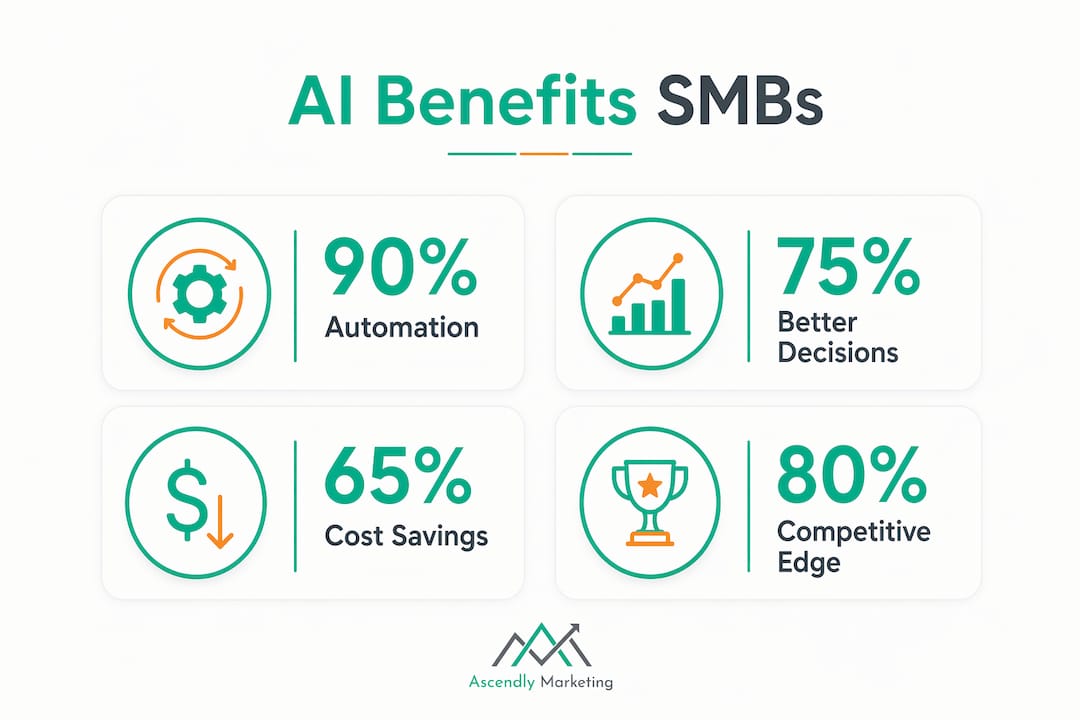
The third benefit is customer experience. AI-powered chat tools handle inquiries at 2:00 AM. Personalized email campaigns, driven by AI segmentation, outperform generic blasts by a wide margin. For a deeper look at how AI-driven personalization lifts engagement and sales, the Ascendly Marketing resource library covers the mechanics in detail.
Key AI benefits for SMBs include:
- Task automation: Removes repetitive work from your team’s plate, freeing time for higher-value activities.
- Data analysis: Surfaces patterns in sales, customer, and operational data that humans miss.
- Customer service: AI chat and response tools handle volume without adding headcount.
- Marketing efficiency: AI generates, tests, and refines content and ad targeting faster than manual methods.
- Cost reduction: Lower labor costs on routine tasks translate directly to margin improvement.
Pro Tip: Start with one high-volume, repetitive task. Automate it with an AI tool, measure the time saved over 30 days, then use that data to build the case for broader adoption across your team.
How is AI adoption evolving among small and medium businesses?
Adoption is broad but shallow. While 61% of SMEs use AI, 76% are classified as “AI novices” using simple off-the-shelf tools, and only 3.6% have organization-wide deployment that enables transformational impact, according to the OECD’s 2026 SME AI report. That gap between basic use and deep integration is where most SMBs leave value on the table.

Cost is no longer the barrier it once was. Average monthly AI spending by small businesses has dropped to $20–$30, down from around $50 in 2019, per JPMorgan Chase Institute research. That price drop makes AI accessible to businesses that previously could not justify the expense.
The table below shows the three main stages of AI adoption and what each stage typically delivers:
| Adoption stage | Description | Business outcome |
|---|---|---|
| Novice | Uses one or two off-the-shelf AI tools | Minor time savings on isolated tasks |
| Intermediate | AI integrated into 2–3 core workflows | Measurable efficiency gains and cost reduction |
| Champion | Organization-wide AI deployment | Transformational impact on revenue and operations |
The gap between novice and champion is not just about tools. It is about strategy. Champions treat AI as a core business capability, not a productivity shortcut. SMBs that move from novice to intermediate see compounding returns as each integrated workflow feeds data into the next.
Pro Tip: Audit your current AI tool use quarterly. If you are using AI in only one department, identify one adjacent workflow where the same tool or a similar one could apply. Incremental expansion beats waiting for a full overhaul.
What challenges and risks do SMBs face in AI implementation?
Regulatory complexity is the first major challenge. No single federal law governs AI in the United States. SMB owners must navigate executive orders, agency guidance, and state-level regulations, particularly in sensitive industries like healthcare, finance, and legal services. That patchwork creates real compliance risk for businesses that adopt AI without legal review.
Data privacy is the second challenge. AI tools require data to function. The more data you feed them, the better they perform. But collecting and storing customer data creates obligations under state privacy laws like the California Consumer Privacy Act. Transparency with customers about how their data is used is not just ethical. It is increasingly a legal requirement.
Cybersecurity is the third risk, and the most underestimated. SMBs frequently treat security and AI implementation as separate decisions, but integrating these on a secure foundation is critical for lasting AI success, per Microsoft’s cloud research. An AI tool connected to your customer database is a high-value target. If the security layer is weak, the AI layer becomes a liability.
Practical steps to reduce AI implementation risk:
- Conduct a data audit before deploying any AI tool. Know what data you hold, where it lives, and who can access it.
- Review state privacy laws relevant to your customer base. California, Virginia, and Texas each have distinct requirements.
- Integrate security from day one. Do not add security protocols after the AI tool is live. Build them into the deployment plan.
- Document AI use cases so you can demonstrate compliance if regulators or customers ask.
- Train your team on what data they can and cannot feed into AI tools, especially public-facing platforms.
The skills gap is real too. Most SMB teams did not grow up using AI in a professional context. Investing in basic AI literacy training pays off faster than most owners expect.
How can SMBs effectively implement AI to maximize business value?
Effective AI implementation follows a clear sequence. Skipping steps is the most common reason SMBs fail to see returns. The Microsoft Work Trend Index 2026 found that 58% of AI users in SMBs report producing work they could not accomplish a year ago, and 66% spend more time on higher-value activities because AI handles execution. Those results come from deliberate implementation, not accidental tool adoption.
Define your AI strategy before selecting tools. Identify which business goals AI will support. Revenue growth, cost reduction, and customer retention each point to different AI applications. Strategy first, tools second.
Prioritize high-impact, high-volume tasks for initial automation. Customer inquiry responses, appointment scheduling, and marketing content generation are strong starting points. They are repetitive, measurable, and low-risk.
Train your team before and after deployment. Pre-deployment training sets expectations. Post-deployment training addresses real-world friction. Both are necessary. An untrained team will underuse or misuse even the best AI tool.
Bring in external expertise when internal knowledge runs short. Ascendly Marketing works with SMBs to build AI-powered marketing strategies that connect directly to revenue goals. External partners accelerate the learning curve significantly.
Monitor AI outputs continuously. AI tools produce errors. They also drift as data patterns change. Build a review process into your workflow so a human checks AI outputs on a regular cadence.
Measure return on investment at 30, 60, and 90 days. Time saved, cost reduced, and revenue influenced are the three metrics that matter most. If the numbers do not move, the tool or the implementation needs adjustment.
SMBs have a structural advantage here. Shorter decision cycles mean faster pivots. An SMB can test, evaluate, and redeploy an AI tool in weeks. A large enterprise takes months to do the same thing.
Key Takeaways
AI delivers measurable business value when SMBs move beyond basic tool adoption and integrate it as a core operational strategy supported by security and continuous training.
| Point | Details |
|---|---|
| Adoption is already mainstream | 7 in 10 SMBs use AI regularly, making non-adoption a competitive disadvantage. |
| Efficiency gains are documented | 9 in 10 AI-using small businesses report higher operational efficiency from reduced manual work. |
| Cost barriers have dropped | Monthly AI spending now averages $20–$30, making access realistic for most SMBs. |
| Deep integration is rare | Only 3.6% of SMEs have organization-wide AI deployment, leaving most value uncaptured. |
| Security must be built in | Treating AI and cybersecurity as separate decisions creates compounding risk over time. |
The AI advantage most SMB owners miss
Working with SMBs since 2013, Ascendly Marketing has watched the AI conversation shift from curiosity to urgency. The owners who get the most out of AI are not the ones who buy the most tools. They are the ones who connect AI to a specific business problem and measure the result.
The counterintuitive truth is that SMBs have a real structural advantage over large enterprises in AI adoption. Shorter approval chains, tighter teams, and direct owner involvement mean faster testing and faster learning. A 50-person company can run an AI pilot in two weeks. A 5,000-person company takes six months to clear procurement.
The pitfall I see most often is fragmented adoption. A business uses one AI tool for social media, another for customer service, and a third for invoicing, but none of them share data or inform each other. That is not AI integration. That is just adding software. The businesses that see transformational results treat AI as a connected system, not a collection of apps.
The other overlooked risk is security. Most SMB owners think about AI in terms of what it can do for them. Few think about what it exposes. Every AI tool connected to customer data is a potential entry point for a breach. Building security into the AI strategy from the start is not optional. It is the foundation everything else rests on.
AI will not replace your team. It will multiply what your team can do. The owners who understand that distinction are the ones who build durable competitive advantages.
— Ascendly Marketing
How Ascendly Marketing helps SMBs put AI to work
Ascendly Marketing has built its digital marketing services around the same AI-driven principles covered in this article. From SEO and paid advertising to content creation and social media management, every service is designed to generate measurable results for SMBs.
The team at Ascendly Marketing combines deep marketing expertise with practical AI application. Whether you need a full digital marketing strategy or targeted help with one channel, the agency builds solutions around your specific business goals. Since 2013, Ascendly Marketing has helped SMBs grow their online presence and convert that visibility into revenue. If you are ready to put AI-powered marketing to work for your business, the Ascendly Marketing team is the right place to start.
FAQ
What is the most direct benefit of AI for small businesses?
The most direct benefit is automation of repetitive tasks. 9 out of 10 small businesses using AI report higher operational efficiency by reducing manual work and redirecting teams toward customer-facing activities.
How much does AI cost for a small business?
AI tools for small businesses now average $20–$30 per month, down from around $50 in 2019. That price point makes AI accessible to most SMBs regardless of budget size.
Is AI adoption widespread among SMBs?
Adoption is broad but not deep. While 61% of SMEs use AI, only 3.6% have organization-wide deployment that delivers transformational results.
What are the biggest risks of AI for SMBs?
Regulatory complexity, data privacy obligations, and cybersecurity exposure are the three primary risks. No single federal AI law exists in the United States, so SMBs must track state-level regulations and build security into every AI deployment from the start.
Can AI help a small business compete with larger companies?
Yes. 77% of small businesses report feeling more competitive against larger firms because of AI. Shorter decision cycles also give SMBs a speed advantage in testing and deploying new AI tools compared to large enterprises.