

Traffic is up. Form fills are coming in. Sales still feel random.
That usually means the marketing work isn’t broken. The leads process is. A business can publish content, run ads, launch outreach, and still end up with a pipeline full of junk because there’s no system for deciding who enters, who gets filtered, who gets nurtured, and who gets handed to sales.
Most owners see the symptom first. Their team says lead volume looks healthy, but reps complain that inquiries aren’t serious. Marketing reports clicks and submissions. Sales reports missed targets. Both are looking at activity. Neither is looking at flow.
A structured process fixes that gap. It turns raw attention into a series of controlled steps tied to revenue.
From Website Traffic to Actual Revenue
A familiar pattern shows up in growth meetings. The website gets more visitors. A paid search campaign drives form fills. SEO starts bringing in people who were never finding the company before. Then the sales team opens the CRM and finds spam, students, vendors, competitors, and buyers who were only browsing.
That doesn’t mean demand generation failed. It means nobody built the bridge between interest and purchase.
The leads process is that bridge. It defines what happens after someone clicks an ad, reads a service page, downloads a guide, or replies to an email. Without that structure, businesses collect names instead of opportunities.
Activity isn’t the same as pipeline
A contact form submission has very little value on its own. It only becomes useful when someone can answer a few basic questions:
- Where did the lead come from
- Does the lead match the company’s ideal customer
- Has the lead shown buying intent
- What should happen next
- Who owns follow-up
If those questions don’t have clear answers, revenue gets delayed or lost. Sales follows up too late. Marketing keeps paying for weak traffic. Good leads sit untouched beside bad ones.
A healthy funnel doesn’t start with more traffic. It starts with better control over what happens to traffic after it arrives.
That shift matters more now because businesses are investing heavily in lead operations. The global lead generation process market is projected to grow at a 17.2% CAGR from 2024 to 2035, rising from $5.59 billion to $32.1 billion, according to Roots Analysis research on the lead generation market.
What revenue-focused teams do differently
Teams that get steady sales from digital channels usually aren’t doing mysterious things. They’re doing ordinary things in the right order.
They capture demand from search, ads, and outbound. They filter it. They keep warm leads moving. They route ready buyers fast. Then they review where conversion slows down and fix that point.
That’s the whole game. Not more noise. More control.
The Five Stages of a Winning Leads Process
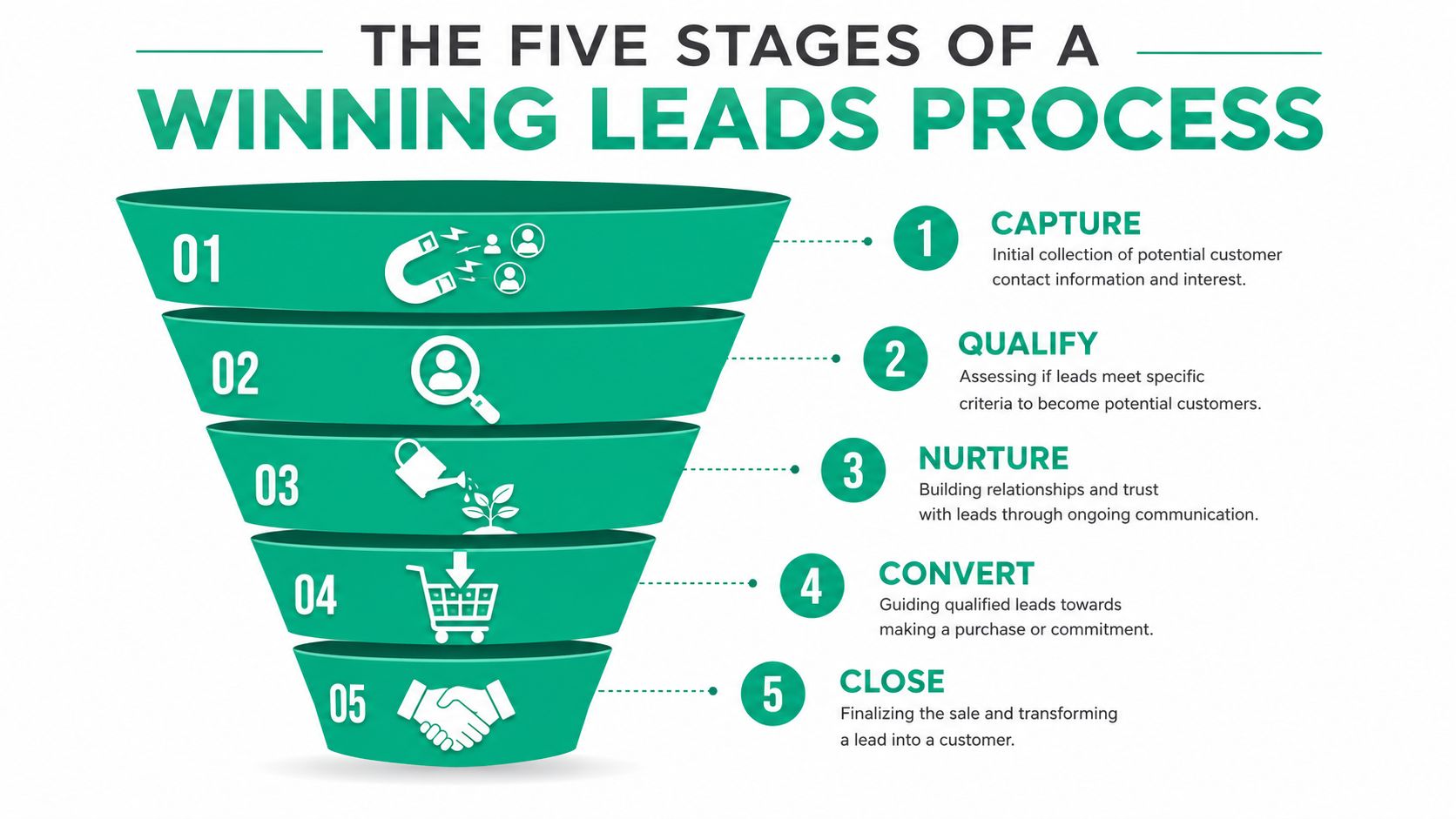
A working leads process has five stages. Capture, Qualify, Nurture, Convert, Close. The process operates like a production line. Raw material goes in at the top, and each stage removes friction, adds context, or moves the buyer closer to a decision.
Stage one through stage three
Capture is where interest enters the system. Someone finds a page through SEO, clicks a PPC ad, responds to outreach, or fills a form on a landing page. The goal here isn’t just volume. It’s getting enough information and context to know what kind of lead just arrived.
Qualify is the first filter. This stage answers whether the lead fits your offer, whether the problem is real, and whether the behavior suggests intent. A company that skips this step usually sends too many weak inquiries to sales.
Nurture keeps the conversation going when timing isn’t right yet. Many leads won’t buy on the first touch. They need reminders, proof, education, and a reason to come back when the problem becomes urgent.
A clear visual helps when you’re mapping this out with your team. This short walkthrough breaks down the funnel from a practical angle.
Stage four and stage five
Convert is the point where a qualified lead takes the action that signals real sales readiness. That might be booking a demo, requesting a quote, replying with buying questions, or reaching a lead score threshold. During conversion, marketing transitions from considering the contact a prospect pool to classifying it as pipeline.
Close belongs to sales, but marketing still affects it. The quality of messaging, the pages the lead saw, the content they engaged with, and the speed of handoff all shape close rates.
A lot of businesses blur convert and close together. That creates confusion fast. Sales thinks marketing handed over weak leads. Marketing thinks sales ignored ready ones. Clean definitions solve most of that conflict.
Why the sequence matters
These stages work because each one prepares the next.
- Capture without qualification floods the funnel with noise
- Qualification without nurture throws away future demand
- Nurture without a handoff trigger creates stalled leads
- Conversion without reporting leaves bottlenecks hidden
If you want a deeper look at how the full B2B system fits together, this guide on a B2B lead generation funnel is a useful companion.
Fueling Your Funnel with High-Quality Leads
A business can have traffic from three channels at once and still miss revenue targets. The usual problem is not volume. It is channel mismatch.
SEO, PPC, and outreach produce different kinds of intent, at different speeds, with different conversion paths. If they all send visitors and prospects into the same offer, the funnel starts losing efficiency before qualification even begins. The fix is to assign each channel a clear role, then build capture points around that role.
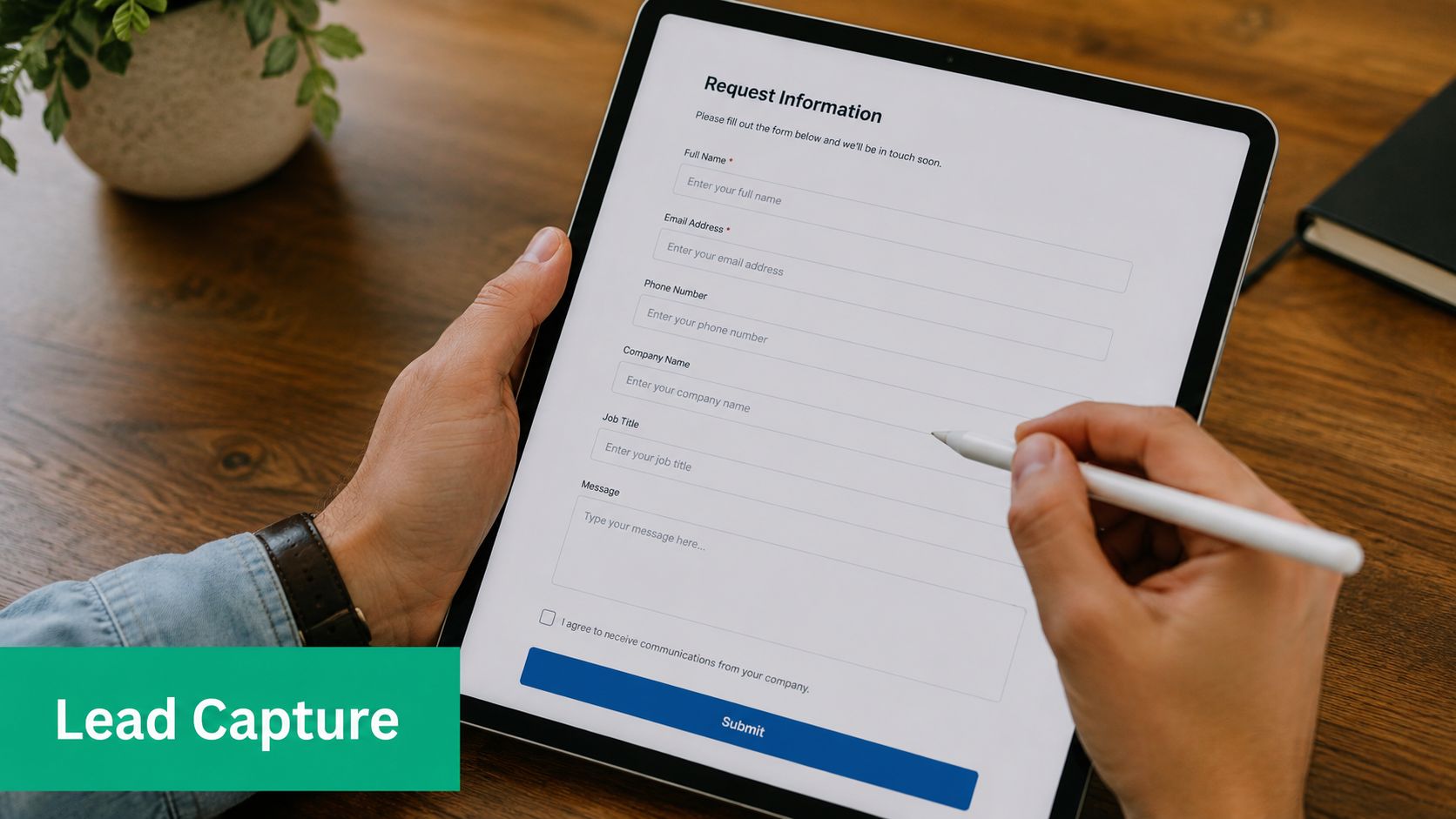
SEO captures researched intent
SEO brings in buyers who are already defining the problem, comparing options, or looking for a provider. That makes it effective for demand capture, but only if the page matches the visitor’s stage.
A service page should pull commercial-intent searches toward a direct action such as a quote request or consultation. An educational article should move earlier-stage visitors into a lower-friction conversion, such as a guide, assessment, or email signup tied to the topic they came for. Traffic without a next step does not help pipeline.
The strongest SEO capture systems usually include:
- Pages built around search intent instead of broad topic coverage
- Forms with only the fields needed to route and follow up
- Offers that match the page context so the ask feels relevant
- Source and landing-page tracking so lead quality can be reviewed later
This is also where sales-readiness definitions matter. A top-of-funnel blog conversion is not the same as a buyer asking for pricing. Teams that need a tighter definition can use this breakdown of what qualifies as a sales-qualified lead to separate early interest from real pipeline potential.
PPC buys speed, but it punishes weak funnel design
Paid search and paid social can generate demand fast. They also expose bad alignment fast.
If the keyword, ad, and landing page promise different things, conversion rates fall and lead quality drops with them. I see this often with campaigns that send every click to the homepage. The business pays for intent, then forces the visitor to figure out where to go next.
A better structure is simpler. One audience, one offer, one landing page, one primary action.
That matters even more for companies with multiple locations, service lines, or buyer types. Franchise groups are a good example because national campaigns and local lead handling often need separate routing logic. This outside resource on lead generation for franchises gives a useful view of how central strategy and local execution can support the same funnel without creating reporting confusion.
Outreach creates demand before a search happens
Some high-value prospects will never discover you through search at the right moment. Outreach fills that gap by starting the conversation earlier.
This channel works when targeting is narrow, and the message is tied to a specific pain point, trigger event, or market condition. Broad lists and generic copy usually produce low reply rates and weak-fit leads. Tight ICP filters, short emails, and a clear reason for contact create better entry points into the funnel and make follow-up easier for sales.
At Ascendly, this is the practical advantage of running SEO, PPC, website conversion work, email marketing, and cold outreach as one system. Channel performance improves when the capture process is planned across the full funnel instead of managed as separate tactics with separate goals.
| Channel | Best use in capture | Common mistake |
|---|---|---|
| SEO | Attract problem-aware buyers | Publishing traffic content with no conversion step |
| PPC | Generate immediate intent-driven visits | Sending all clicks to generic pages |
| Outreach | Open direct conversations with ICP accounts | Targeting too broadly with vague copy |
Separating Signal from Noise with Qualification
A lead isn’t qualified because a form was completed. It’s qualified because the business has evidence that the person or company fits, shows intent, and deserves the next level of attention.
That sounds obvious, but many teams still rely on gut feel. A rep scans a company name, opens a website, and decides whether to call. Another rep follows up because the message “felt serious.” That approach creates inconsistency. Two salespeople look at the same lead and make different choices.
Why old qualification models break down
BANT still shows up in sales conversations because it’s simple. The problem is that modern buying behavior is rarely simple. Prospects research anonymously, compare vendors before speaking to anyone, and often show intent through behavior long before they state it directly.
According to Highspot’s explanation of modern lead qualification, qualification has moved beyond BANT to a multi-signal model that evaluates fit, intent, authority, timing, pain, budget, and buying signals, with product usage signals carrying the highest weight for product-led prospects.
That model is more useful because it reflects how buyers behave. A prospect who matches your ICP and keeps returning to high-intent pages is different from a prospect who filled out one top-of-funnel form and disappeared.
What a scoring model should evaluate
A practical scoring system usually blends profile data with behavior. Some criteria are fixed. Others change as the lead interacts with your site, emails, or product.
Use questions like these:
Fit
Does the company match your target industry, size, service area, or business model?Intent
Did the lead visit pricing, service comparison, or quote-related pages?Authority
Is the contact likely to influence the purchase, or are they only gathering information?Timing
Are there signs the problem needs to be solved now rather than later?Pain
Did the inquiry describe a clear operational or revenue problem?Signals
Did the lead reply to outreach, re-engage with nurture emails, or use the product in a meaningful way?
Don’t score only who the lead is. Score what the lead does.
A clean handoff depends on clear definitions. If your team needs a working benchmark for that moment, this guide on what a sales-qualified lead is gives a practical reference point.
What works and what fails
What works is a visible scoring model that both marketing and sales can review. Reps should know why a lead was flagged. Marketers should know which behaviors correlate with better conversations.
What fails is hidden logic inside a platform that nobody trusts. If the score rises because someone opened three emails but ignores stronger buying behavior, the team starts bypassing the system. Once that happens, qualification collapses back into opinion.
The Art of Nurturing and the Perfect Handoff
Most leads don’t arrive ready to buy. They arrive curious, cautious, comparing options, or waiting for internal timing. That’s why nurturing matters. It keeps a lead moving without forcing a sales call too early.
The handoff matters just as much. A nurtured lead can still be lost if routing is slow, context is missing, or nobody knows who owns follow-up.
What nurture should actually do?
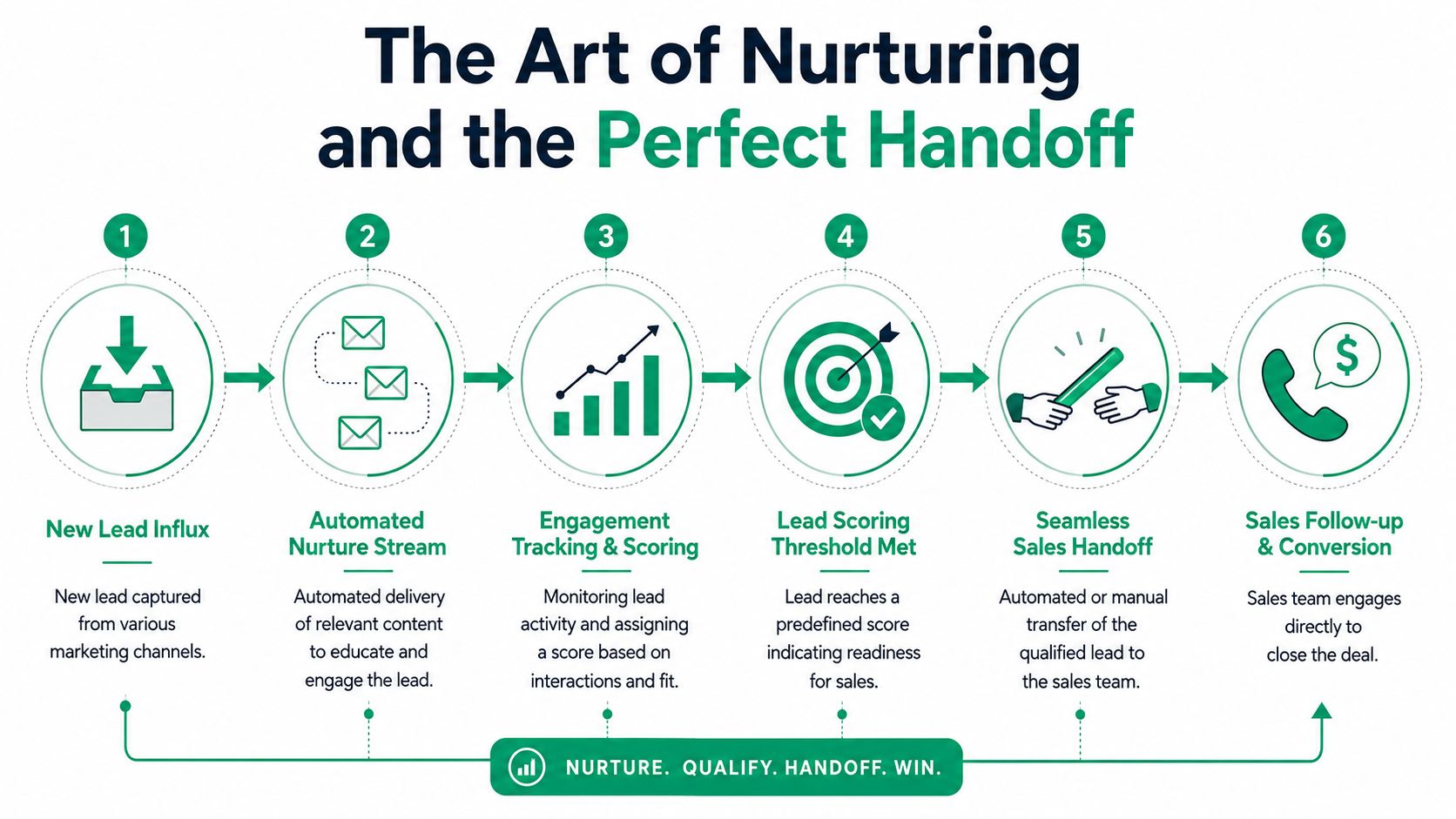
A nurture sequence isn’t a pile of generic emails. Each message should answer a buyer question, reduce uncertainty, or create a reason to take the next action. That can be an educational article, a service comparison, a short proof point, or a direct invitation to talk.
Good nurture tracks behavior and adjusts timing. If someone clicks a service page twice, they shouldn’t keep receiving broad awareness content. If someone goes quiet, the system should slow down instead of pushing harder.
A simple nurture flow often includes:
- Initial response with the promised resource or next step
- Educational follow-up tied to the original interest
- Intent check based on page visits, replies, or repeat engagement
- Escalation once buying signals appear
The four tools that prevent the handoff gap
In B2B lead management, the core stack requires a CRM, a Marketing Automation Platform, a Sales Engagement Platform, and Data Intelligence or Enrichment tools, according to ZoomInfo’s lead management process breakdown. When one is missing, a handoff gap opens.
Each tool has a specific job.
| Tool category | What it does in the leads process |
|---|---|
| CRM | Stores the lead record, ownership, stage, and pipeline history |
| Marketing Automation Platform | Runs nurture, tracks engagement, and updates qualification status |
| Sales Engagement Platform | Triggers rep outreach sequences and follow-up tasks |
| Data Intelligence and Enrichment | Adds firmographic context and buying signal detail |
If a business has a CRM and email automation but no sales engagement layer, routing often stalls after qualification. The lead becomes “ready” in theory, but no sequence starts, no task fires, and no rep responds quickly.
The buyer doesn’t care which platform failed. They only notice that nobody replied when their interest was highest.
How to set up the handoff cleanly
The cleanest handoff happens when one threshold changes ownership automatically. A score is met. A form with high-intent language is submitted. A target account shows repeated buying behavior. Then the system assigns the lead, logs the context, and launches follow-up.
That works best when the rep can see the full history, including pages viewed, forms completed, emails clicked, and source channel. Without that context, sales starts the conversation blind.
For teams building nurture around email, this resource on email marketing for lead generation is a useful reference for how messaging and automation support the transition.
Measuring What Matters with Process KPIs
A lead process without measurement isn’t a process. It’s a set of opinions attached to a dashboard.
Most reporting problems start because the wrong numbers get attention. Teams watch traffic, impressions, open rates, and raw submissions, then wonder why revenue still feels unpredictable. Those numbers can be useful, but they don’t tell you where leads are getting stuck.
The numbers that expose bottlenecks
You need metrics that show movement from one stage to the next. That’s how you spot whether the issue is poor capture, weak qualification, slow handoff, or a sales follow-up problem.
The value of that discipline shows up in the data. Effective lead scoring models deliver a 26% average increase in lead conversion rates and a 25% average decrease in cost per lead, and marketing automation can increase qualified leads by 451%, according to research summarized in the National Library of Medicine article.
Those gains don’t come from reporting for its own sake. They come from seeing what the funnel is doing and changing the weak point.
Key KPIs for Each Stage of the Leads Process
| Stage | Primary KPI | Secondary KPI | What it Measures |
|---|---|---|---|
| Capture | Cost per lead | Landing page conversion rate | Whether traffic sources are producing leads efficiently |
| Qualify | Lead-to-MQL conversion rate | Score distribution by source | Whether incoming leads match your targeting and intent standards |
| Nurture | Re-engagement rate | Content click pattern | Whether mid-funnel messaging is moving leads forward |
| Convert | MQL-to-SQL rate | Demo or quote request rate | Whether qualified leads are becoming sales-ready |
| Close | Lead-to-sale rate | Sales cycle length | Whether handoff and follow-up are turning opportunities into revenue |
What to review every month
A useful review rhythm doesn’t need to be complex. It needs to be consistent.
- Compare channels so you can see whether SEO, PPC, or outreach sends the strongest leads
- Review stage conversion so drop-offs are visible
- Check speed to follow-up because delayed response hurts handoff performance
- Look at closed sales by source so budget decisions reflect revenue, not just lead count
When those numbers are visible, decisions get cleaner. You stop arguing about which channel feels productive and start adjusting the actual machine.
Common Leads Process Pitfalls to Avoid
A leads process usually breaks at the handoffs. Traffic can be strong, offers can be clear, and sales can still miss target because channel intent, qualification rules, and follow-up timing are misaligned.
One of the most expensive mistakes is treating all lead sources the same. An SEO lead who searched for a specific service, a PPC lead who clicked a high-intent offer, and an outreach lead who responded to cold contact do not enter the funnel with the same context. If your team scores and routes them the same way, sales gets mixed signal quality and conversion rates slip.
Another common failure is a shared language problem between marketing and sales. Marketing counts a form fill. Sales looks for fit, urgency, budget, or authority. If those definitions were never set together, SEO may look productive in reports while PPC or outreach gets blamed for poor close rates, even when the underlying issue is inconsistent qualification.
Data problems make that worse fast. Missing company details, duplicate contacts, weak UTM tracking, and bad source attribution break the feedback loop you need to know which channels produce revenue. Then budget decisions get made on lead volume instead of sales outcomes.
Automation also creates problems when teams use it without judgment. A lead from a bottom-funnel PPC campaign should not receive the same nurture sequence as an early-stage SEO subscriber. Outreach replies often need fast human follow-up, not another automated email. Good automation removes delay. It does not flatten buyer intent.
Start with the points that affect revenue first:
- Match qualification to source intent so SEO, PPC, and outreach leads enter the right path
- Tighten form fields and routing rules so sales gets the details needed to act
- Use one scoring model that both teams accept and review against closed-won deals
- Audit attribution and CRM hygiene weekly so source data stays usable
- Check response time by channel because high-intent leads decay fast when follow-up lags
I see this often with growing companies. They assume they have a traffic problem, but the actual issue is that good leads are getting mishandled after capture.
Ascendly Marketing helps fix that by connecting channel strategy to funnel operations. SEO brings in demand with clear intent signals. PPC creates controlled tests around offers, keywords, and landing pages. Outreach fills pipeline gaps and reaches accounts that may never find you through search. Then the process behind those channels decides whether that demand turns into qualified opportunities and sales.
If your business is getting traffic but not enough qualified pipeline, Ascendly Marketing can help you build a lead process that ties SEO, PPC, outreach, qualification, nurturing, and reporting into one revenue system.