

A coffee shop opened near me and skipped the usual pile of discount flyers. The owner invited a handful of local regulars and food-focused creators to try a “barista for a day” session, and within days the shop had more real conversation around it than many businesses get from a paid ad run.
That’s grassroots marketing in practice. It starts small, earns trust, and grows because people choose to talk about it.
The Power of Starting Small
Small businesses usually don’t lose because they lack options. They lose because they spread themselves too thin.
A local shop, service business, or startup often assumes marketing means trying to reach everyone nearby at once. So they buy broad ads, print too many promos, and post the same generic message everywhere. The result is familiar. Plenty of activity, very little traction.
Grassroots marketing works in the opposite direction. You choose a narrow group first, give that group a reason to care, and let their response carry the message outward. That first audience might be neighborhood parents, people in one hobby group, regulars at a local market, or members of a business association.
Here’s what that looks like in the world:
- A coffee shop invites a few local food fans to a hands-on tasting event.
- A fitness studio runs a free beginner session for people who already meet in a nearby running club.
- A home service company sponsors a small community cleanup and talks with residents face to face instead of pushing coupons.
None of those tactics look big. That’s the point.
Practical rule: If your first audience is too broad, your message won’t feel personal enough for anyone to repeat.
This approach works well for owners who need traction without a large media budget. It also fits businesses that depend on trust. If someone is choosing a dentist, accountant, plumber, or contractor, they’re more likely to act on a recommendation from someone they know than on a broad awareness message.
If you want a practical companion to this local-first approach, this guide on how to advertise locally pairs well with grassroots tactics because it helps narrow where your budget and attention should go.
Defining Grassroots Marketing From the Ground Up
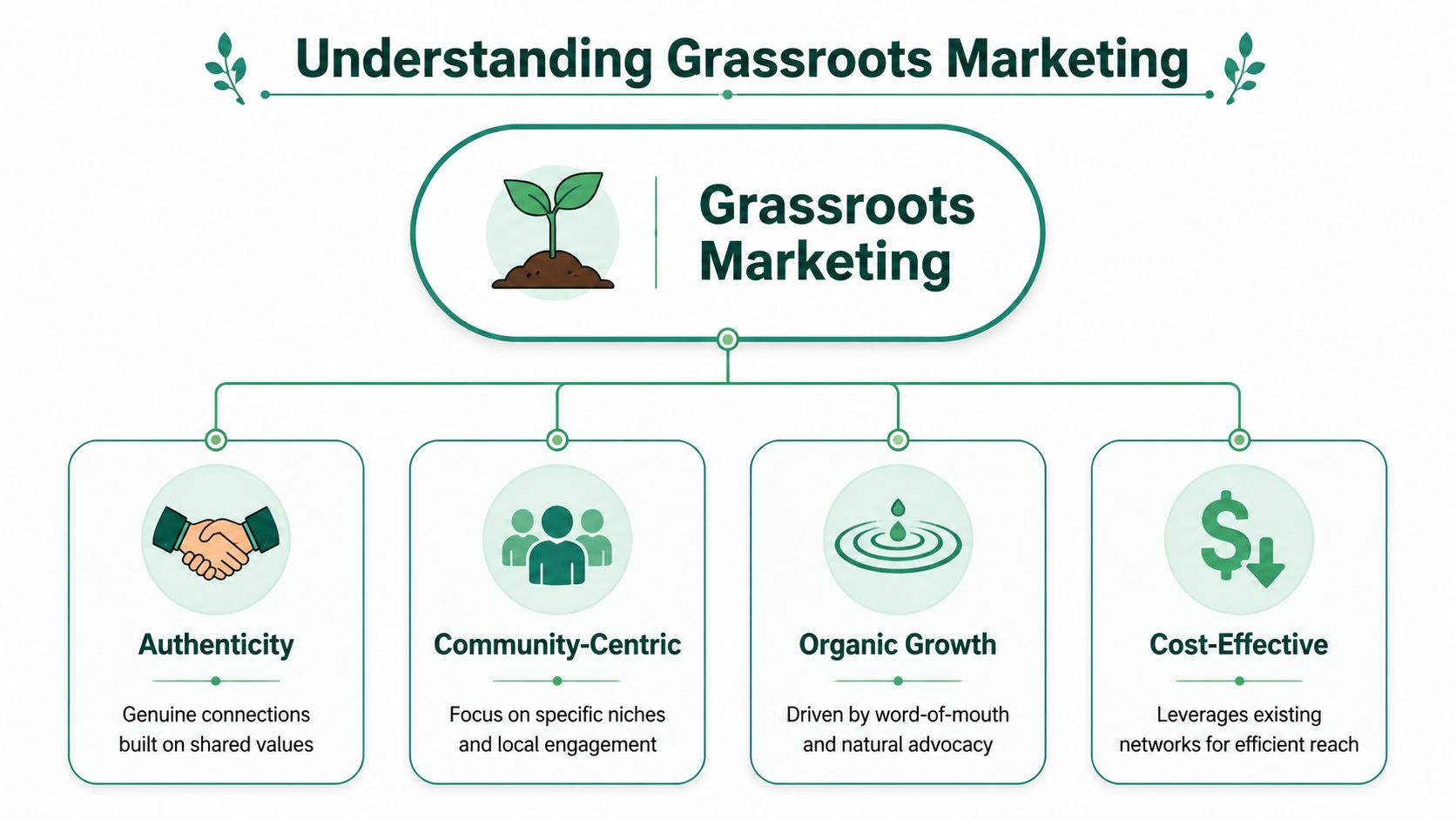
When people ask what grassroots marketing is, the shortest useful answer is this: it’s a bottom-up marketing approach that starts with a small, specific audience and turns that audience into advocates.
According to Mailchimp’s grassroots marketing guide, the modern model is built on word-of-mouth, community trust, and niche targeting. Campaigns are aimed at smaller, highly specific audiences whose members then amplify the message organically. That same guidance also points marketers toward metrics such as event attendance, email open rates, user-generated content, shares, and conversions, rather than broad awareness alone.
What makes it different
Traditional advertising pushes a message outward to a large audience and hopes some part of that audience responds.
Grassroots marketing starts lower and narrower. You identify a group that already shares a context, problem, interest, or location. Then you give them something worth talking about. The campaign grows because the early group carries it forward.
A simple way to think about it is root growth. You don’t start with a full canopy. You start underground, where support forms first. If the roots take hold, the visible growth follows.
That’s why grassroots campaigns often feel more personal than polished. They’re less about reach on day one and more about getting the right people to care enough to participate.
The four working parts
In practice, most effective grassroots campaigns rely on four parts:
| Part | What it means in practice |
|---|---|
| Niche focus | Target a small audience with a clear shared trait, not a broad market |
| Trust | Use real interactions, relevant value, and consistency instead of hype |
| Participation | Give people something to do, share, attend, post, or join |
| Amplification | Make it easy for that initial group to spread the message naturally |
If one of these is missing, the campaign usually weakens fast. A niche with no trust won’t convert. Trust with no participation won’t travel. Participation with no amplification stays isolated.
What businesses get wrong
The most common mistake is treating grassroots marketing like cheap advertising.
It isn’t just “small budget promotion.” It’s a specific operating model. You’re not buying attention at scale. You’re earning endorsement from a group that others listen to.
That changes how you build the campaign:
- Message first, not media first, because the audience has to care before they share
- Specific invite, not generic awareness, because a narrow group needs a clear reason to engage
- Community proof, not brand self-praise, because people trust what other people say more than what businesses say about themselves
Grassroots marketing asks a different question from most campaigns. Not “How many people can we reach?” but “Who will willingly carry this forward?”
A good grassroots effort doesn’t always look dramatic from the outside. Sometimes it’s a workshop with a small turnout, a partnership with one local group, or a customer story that starts appearing in community feeds. Those signals matter because they show movement from exposure to advocacy.
Grassroots vs Guerrilla vs Community Marketing
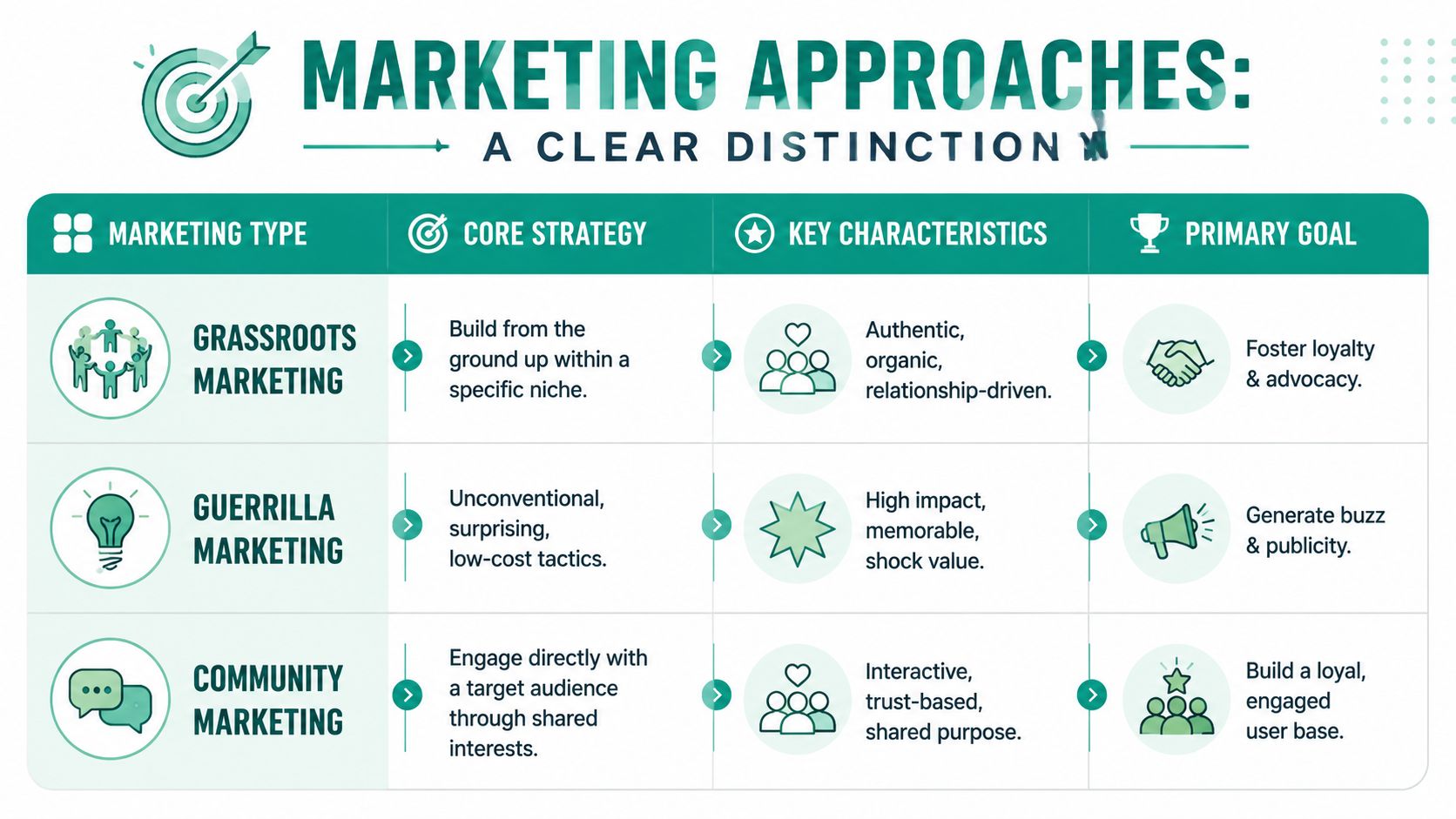
Business owners mix these terms all the time, and that creates expensive mistakes. A team says it wants grassroots marketing, but what it really wants is a one-off attention stunt. Or it starts a community program when it needs a customer referral engine.
Those are different jobs.
Grassroots marketing
Grassroots marketing is built to turn a small audience into a distribution channel. You focus on a niche group, create a reason for that group to engage, and rely on organic sharing, referrals, and conversation to extend the campaign.
It suits businesses that need trust before scale. Think local services, specialty retail, wellness brands, education businesses, and early-stage companies with limited budget.
Typical tactics include:
- Small in-person experiences such as demos, workshops, neighborhood events, and tastings
- Advocate-friendly content like customer stories, useful templates, or event recaps people want to repost
- Local partnerships with non-competing businesses or organizations that already have credibility with your audience
Guerrilla marketing
Guerrilla marketing aims for surprise and memorability. It uses unconventional tactics to get attention fast.
That can work. It can also flop if the stunt gets noticed, but the offer doesn’t. Many owners are drawn to guerrilla ideas because they sound cheap and clever. The trade-off is that buzz doesn’t always turn into trust.
Use guerrilla tactics when the main goal is visibility. Don’t confuse that with building a steady base of advocates.
Community marketing
Community marketing is about ongoing engagement with a defined audience around shared interests, identity, or use case. The business creates spaces or supports spaces where members interact with each other and with the brand.
That can overlap with grassroots marketing, but it isn’t identical. Community marketing often focuses on retention, education, and belonging. Grassroots marketing focuses more directly on outward spread through member advocacy.
For teams building a member-driven engine, especially in software or subscription businesses, this guide on how to grow an online community for SaaS is useful because it shows what sustained audience participation looks like beyond one campaign.
Influencer marketing isn’t the same thing
Many small businesses think influencer marketing and grassroots marketing are interchangeable. They aren’t.
Here’s the practical difference:
| Approach | Main asset | Cost structure | Main goal |
|---|---|---|---|
| Grassroots | Community trust | Usually lower cash outlay, higher time investment | Advocacy and local or niche spread |
| Influencer | Borrowed audience access | Often higher direct spend or product cost | Fast exposure and social proof |
Influencer marketing can support a grassroots effort, but it won’t replace one. Paying a creator to post may produce attention. It does not automatically create local loyalty, repeat discussion, or word-of-mouth among your actual buyers.
If the campaign depends on rented attention, you’re closer to influencer marketing than grassroots marketing.
For SMBs, the choice usually comes down to objective. If you need quick visibility for a launch, influencer support can help. If you need trust, referrals, and repeat local traction, grassroots is usually the stronger fit.
The Business Case for Going Grassroots
Small businesses don’t need another channel that eats budget and produces vague awareness. They need a method that gives them a fair shot against larger competitors.
That’s where grassroots marketing has a strong business case. It aligns well with limited budgets because it focuses effort where trust can compound.
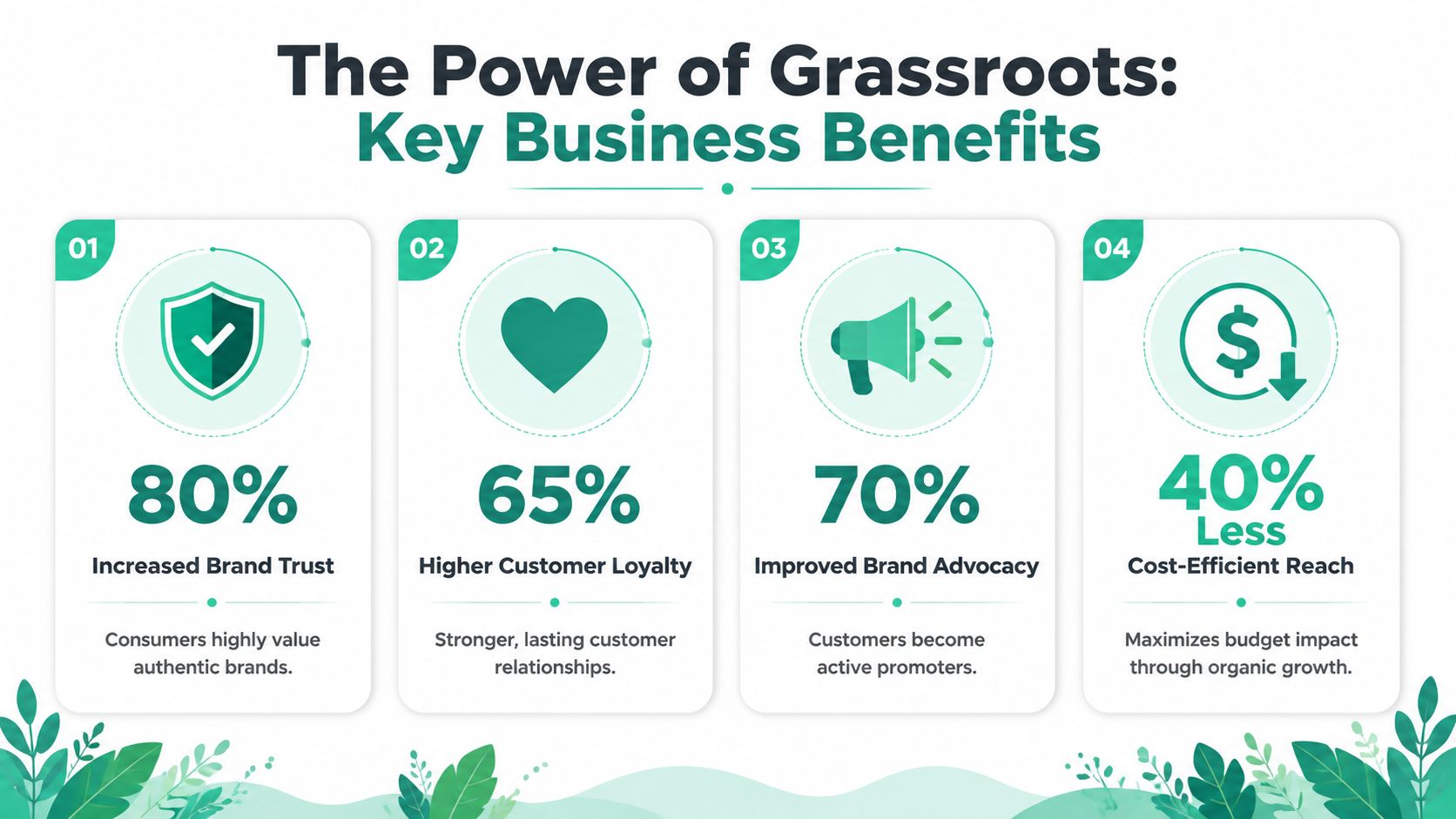
One useful summary from Arfadia’s grassroots marketing glossary reports that organizations using grassroots methods can save up to 62% versus traditional marketing approaches, can see a return of $36–$42 for every $1 spent, and that community-based campaigns can generate 5x the engagement of generic ones. It’s a secondary summary rather than a primary research paper, but the pattern matches what many marketers see in practice. When the audience is tightly matched and engaged, waste drops.
Why the economics work
Mass advertising pays for volume, whether the audience is relevant or not.
Grassroots marketing pays in time, effort, coordination, and consistency. That changes the cost profile. Instead of buying broad exposure, you invest in a smaller number of interactions that are more likely to lead to referrals, repeat business, and better-quality conversation.
This matters most in a few common SMB situations:
- You sell trust-heavy services and need recommendations more than impressions
- You operate in one region and broad reach creates waste
- You have a narrow niche where generic messaging falls flat
- You can deliver a memorable experience that customers will talk about
Here’s the hard part. Grassroots isn’t effortless. It’s usually cheaper in media spend, but it asks for hands-on execution. Someone has to show up, follow up, coordinate partners, answer messages, and keep the momentum moving.
What it looks like inside a real budget
A broad campaign often burns money on reach that never had purchase intent.
A grassroots campaign uses smaller assets with clearer purpose. That might include local event supplies, printed leave-behinds, simple branded merchandise, email follow-up, short-form video from a workshop, or physical materials that travel well in the community. For example, many owners use simple wearables or team items at events because they help staff and supporters stand out without much production overhead. If you’re exploring low-cost physical brand assets, this resource on embroidered hats for small businesses gives a practical sense of one option.
A short video can also help if you’re trying to show the difference between broad promotion and advocate-driven growth:
What works and what doesn’t
What works is narrow targeting, useful experiences, and a message people can repeat in plain language.
What doesn’t work is treating grassroots like a smaller version of generic advertising. If the offer is vague, the event is forgettable, or the audience has no reason to share, nothing compounds.
The strongest business case isn’t just lower spend. It’s that a good grassroots campaign builds an advantage that’s harder for competitors to copy. They can copy your product page. They can copy your ad style. They can’t easily copy the trust you’ve built inside a local or niche community.
Your Grassroots Marketing Action Plan
A usable grassroots plan should fit inside a real week, not just a strategy deck. If you run a small business, you need steps that can be launched without a production team or a giant budget.

Step one: Pick a tighter audience
Most campaigns fail here because the audience description is lazy.
“Local homeowners” is too broad. “First-time homeowners in two nearby neighborhoods who are trying to improve curb appeal before summer” is much more useful. “People who like fitness” is weak. “Parents who want short weekday workouts near school drop-off” is actionable.
Write down these four items:
- Who they are
- Where they already gather
- What problem or identity they share
- Why they’d talk to others about your business
If you can’t answer the fourth point clearly, stop and fix the offer first.
Step two: Map their gathering places
Grassroots marketing lives where people already pay attention. Don’t invent a new audience space if one already exists.
Look for a mix of offline and online channels:
- Offline spots like markets, business groups, local events, classes, churches, neighborhood meetups, trade associations, and partner storefronts
- Digital spaces such as Facebook Groups, Reddit threads, local newsletters, Discord servers, niche Instagram circles, and email lists
Use a simple sheet with three columns: place, audience type, and likely opening. The “opening” is your angle for showing up. Maybe that’s a demo, a free checklist, a short talk, a collaboration, or a useful giveaway.
A strong local campaign usually works better when offline and digital support each other. This guide on social media marketing strategy for small businesses is useful if you need to connect in-person activity with posts, follow-up, and audience nurturing.
Step three: Create a seed offer
Your first move needs to be easy to join and easy to describe.
Good seed offers are small, useful, and specific:
- A free mini workshop for a narrow group
- A product sampling moment tied to a local event
- A co-hosted session with a non-competing business
- A quick-start guide or checklist distributed in a trusted community space
- A cause-based activity that aligns with your audience’s values
Bad seed offers are broad, self-centered, or too sales-heavy. “Come learn about our company” is weak. “Bring your dog for a quick fit check and leave with a local trail guide” is stronger if you run a pet business.
A grassroots offer should be easy for someone to explain to a friend in one sentence.
Step four: Design for sharing
A lot of owners create a decent event, then forget the part that makes it spread.
Build sharing into the experience. That doesn’t mean begging for posts. It means giving people a natural prompt, takeaway, or artifact that travels.
Try a few practical options:
| Tactic | Why it helps |
|---|---|
| Photo spot or demo moment | Gives attendees something visual to post |
| Simple branded handout | Keeps your name present after the event |
| Referral prompt | Gives happy attendees a direct next step |
| Follow-up email | Reinforces the moment while interest is still fresh |
Physical assets can help if they’re tied to a real use case. For mobile businesses, trades, clubs, and local service brands, even simple vehicle-friendly materials can extend visibility after an event. This example of custom stickers for cars and trucks shows the kind of portable branding some businesses use when they want supporters or team members to carry the message beyond one location.
Step five: Activate your first advocates
Your earliest supporters matter more than your biggest audience.
After the event or first interaction, follow up with the people who showed the most enthusiasm. Ask for feedback. Invite them to the next small thing. Give them a reason to return with a friend. Feature their story or post if it fits.
Keep it personal. A grassroots campaign weakens fast when every message feels automated.
Use this short follow-up sequence:
- Day one: Thank them and share any promised resource
- A few days later: Ask one direct question about their experience
- Next touchpoint: Invite them to something small and specific
- After that: Encourage a referral or shared story only if the experience earned it
Step six: Repeat what gets traction
Don’t rebuild from zero every month.
If one workshop format works, run it again. If one local partner brings the right people, deepen that relationship. If one audience segment responds faster than another, narrow further. Grassroots momentum comes from repetition inside the right pocket of attention, not from constantly chasing novelty.
The businesses that do this well usually look boring from the outside. Same audience. Same kind of event. Same clear message. That repetition is often what makes the campaign stick.
Measuring Real Success and Avoiding Pitfalls
The easiest way to kill a grassroots campaign is to judge it by the wrong scoreboard.
Many teams still look first at broad exposure metrics. They want big reach, fast spikes, and immediate attribution. That pushes them toward premature decisions. One verified data point captures the problem clearly: 74% of B2B marketers cannot quantify the revenue impact of community-driven word-of-mouth efforts, and that often leads to early abandonment of the effort. The same verified guidance says success should be reframed around long-term indicators such as customer lifetime value, and those effects can take 12–18 months to materialize.
What to measure instead
For grassroots work, start with behavior that signals trust and movement:
- Event attendance and who attended
- Email open rates from campaign follow-up
- User-generated content tied to the effort
- Shares and referrals from the participating audience
- Conversions from the community you targeted
Those metrics show whether the campaign is getting carried forward.
Then track business impact over a longer window. Look at repeat purchases, referral quality, customer retention, and customer lifetime value. If your business relies on trust, these indicators often matter more than a temporary burst of impressions.
Stop asking whether the campaign looked big. Ask whether it produced people who return, refer, and participate again.
The common mistakes
Most failed grassroots campaigns break down in one of five places:
| Mistake | What happens |
|---|---|
| Audience too broad | Nobody feels the message is for them |
| Offer too generic | People attend once and don’t talk about it |
| No follow-up | Interest fades before trust compounds |
| Over-selling | The community disengages |
| Impatience | The campaign gets cut before the deeper value shows up |
Referral behavior deserves special attention because it's often where grassroots traction becomes visible in revenue terms. If you want a simple breakdown of that mechanism, this explainer on how referrals work is a useful reference.
A disciplined grassroots campaign usually looks modest at the start. That's normal. The wrong response is to abandon it because it doesn't resemble a mass campaign. The right response is to keep the niche tight, improve the offer, and watch whether advocacy is getting stronger over time.
If your business needs a marketing strategy that turns attention into measurable growth, Ascendly Marketing can help you build the right mix of local visibility, digital performance, and conversion-focused execution. Their team works with SMBs that need clear strategy, strong implementation, and reporting that shows what's moving the business forward.