

TL;DR:
- Website speed influences conversions, search rankings, and user trust by reducing load times and bounce rates. Core Web Vitals and TTFB are critical metrics; improving them significantly boosts organic traffic and AI search visibility. Consistent monitoring and prioritized technical optimizations are essential for sustained online growth and higher revenue.
Website speed is defined as the time it takes for a web page to fully load and become usable for a visitor. Every second of delay reduces conversions by approximately 7% per second, harms Google search rankings, and signals incompetence to users before they read a single word. For business owners and digital marketers, this is not a technical footnote. It is a direct revenue variable. Google’s Core Web Vitals, which measure real-world loading, interactivity, and visual stability, became critical ranking signals in 2026. Sites that pass them see measurably more traffic. Sites that fail lose ground to competitors who do.
Why website speed matters: The direct impact on conversions
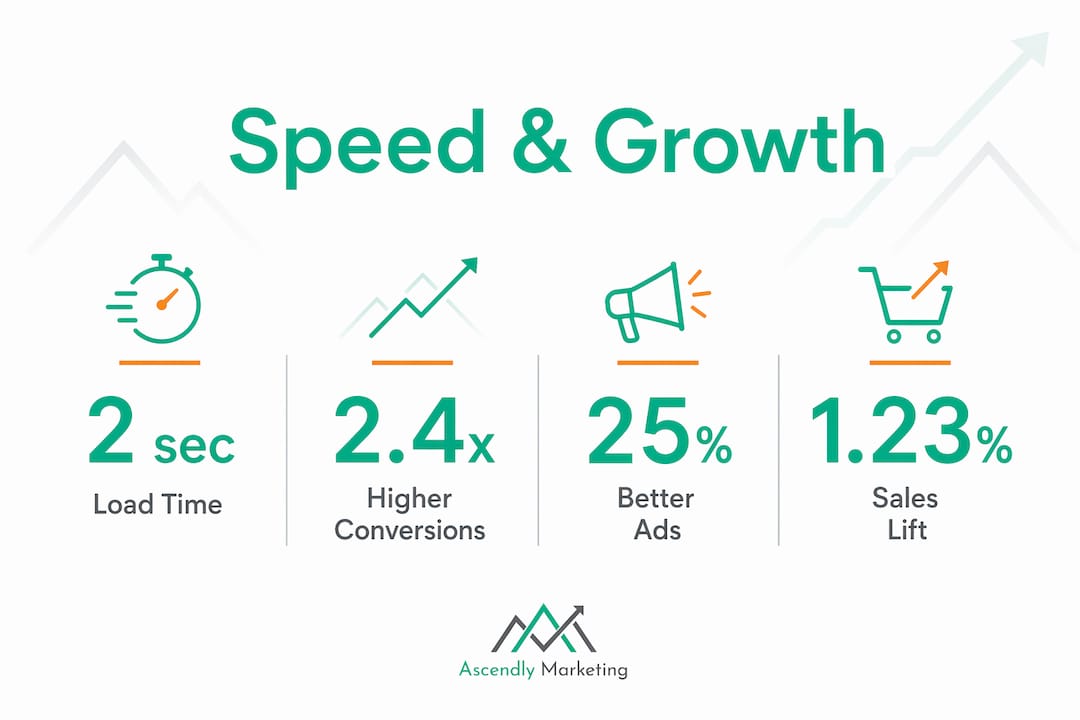
Loading time and revenue are tightly linked. Sites loading under 2 seconds convert at up to 2.4 times higher rates than those loading above 5 seconds. That gap is not a rounding error. It is the difference between a campaign that pays for itself and one that bleeds budget.
Bounce rate tells the same story. When a page takes more than 3 seconds to load, a significant portion of visitors leave before seeing any content. Those visitors do not come back. They go to a competitor whose page loaded first. The website loading time impact on bounce rate is direct and measurable, and it compounds across every paid and organic channel you run.
User trust is the less obvious casualty. Speed signals competence and reliability to visitors even before they read your headline. A slow site tells the user that you either do not care about their time or cannot manage your own technology. Neither impression helps you close a sale.
Mobile users are the most demanding segment. Mobile connections are slower and less stable than desktop broadband, so the same page that loads acceptably on a laptop may frustrate a smartphone user into leaving. If your site is not optimized for mobile load times, you are losing the majority of your traffic before the conversation starts.
Amazon measured this precisely. A 100ms improvement in load time increased their sales by 1.23%. At Amazon’s scale, that is hundreds of millions of dollars. At your scale, the same principle applies to every product page, landing page, and contact form on your site.
Pro Tip: Start your conversion rate improvements by fixing load time first. No copy test or button color change will outperform the lift you get from cutting 2 seconds off a slow page.
What role does website speed play in SEO rankings?
Google treats page speed as a direct ranking factor, and the stakes rose significantly in 2026. Core Web Vitals now include three specific metrics: Largest Contentful Paint (LCP), which measures loading speed; Interaction to Next Paint (INP), which measures responsiveness; and Cumulative Layout Shift (CLS), which measures visual stability. Passing all three correlates with 18% higher organic traffic on average. That is not a marginal gain. It is a meaningful competitive edge in any industry.
Google’s mobile-first indexing means the search engine evaluates your mobile site performance first. If your mobile pages are slow, your desktop rankings suffer too. This is a common blind spot for businesses that built their sites on desktop and never stress-tested the mobile experience.
Time to First Byte (TTFB) is the metric most business owners overlook. TTFB measures how quickly your server starts sending data after a browser requests a page. TTFB above 1,800ms harms both SEO and AI search visibility. Good TTFB is considered under 800ms, with under 200ms being the competitive standard for high-traffic sites.
AI search engines add a new dimension to this equation. Platforms like ChatGPT and Perplexity deprioritize sources that time out or fail to return server-rendered HTML quickly. Slow TTFB directly reduces your Mention Rate and Citation Rate in AI-generated results. As AI-driven search grows, speed becomes a prerequisite for visibility in both traditional and AI-powered results.
Page speed in 2026 is a prerequisite for both organic and AI search visibility. Treating it as a side task risks losing traffic from two directions at once.
Pro Tip: Use Google Search Console alongside tools like GTmetrix or WebPageTest to monitor Core Web Vitals continuously. A single plugin update can silently tank your scores overnight.
How do speed metrics compare, and what are realistic goals?
Understanding the metrics is the first step toward fixing them. The table below maps each key metric to its ideal target and its business consequence.

| Metric | Ideal Target | Business Impact |
|---|---|---|
| Load Time | Under 2 seconds | 2.4x higher conversion rate vs. sites over 5 seconds |
| TTFB | Under 200ms | Strongest SEO and AI visibility advantage |
| LCP | Under 2.5 seconds | Core Web Vitals pass; higher organic rankings |
| INP | Under 200ms | Better perceived responsiveness; lower bounce rate |
| CLS | Under 0.1 | Stable layout; fewer accidental clicks and exits |
A Google PageSpeed Insights score above 90 is the standard benchmark for competitive sites. Scores between 50 and 89 indicate room for improvement. Scores below 50 signal problems that are actively costing you traffic and conversions.
The most important insight here is prioritization. Not all fixes deliver equal returns. Cutting TTFB at the edge through CDNs and pre-rendering delivers the highest ROI in speed optimization. Front-end tweaks like font loading and animation adjustments matter, but they come second. Fix the server response before you touch the CSS.
Pro Tip: Run your site through Google PageSpeed Insights and focus on the “Opportunities” section first. Those are the fixes Google itself says will move your score the most.
What practical steps can businesses take to improve site speed?
Speed optimization follows a clear hierarchy. Start with the changes that affect the most users and deliver the fastest measurable results.
Upgrade your hosting and reduce TTFB. Shared hosting is the most common cause of slow TTFB. Moving to a managed cloud host like WP Engine, Kinsta, or a VPS with SSD storage cuts server response time significantly. Pair this with a CDN like Cloudflare or Amazon CloudFront to serve assets from servers closest to each visitor.
Compress and properly size images. Images are the single largest contributor to page weight on most business websites. Use WebP format instead of JPEG or PNG. Tools like Squoosh, ShortPixel, or Imagify compress images without visible quality loss. Lazy loading ensures images below the fold only load when a user scrolls to them.
Audit and remove third-party scripts. Every third-party script, whether it is a chat widget, analytics tag, or social media embed, adds load time. Third-party scripts and plugin updates silently cause performance regressions that are hard to trace. Run a script audit quarterly and remove anything that does not directly contribute to revenue.
Minimize render-blocking resources. JavaScript and CSS files that load before your page content delay the first visible paint. Defer non-critical JavaScript, inline critical CSS, and use asynchronous loading where possible. WordPress users can handle most of this with plugins like WP Rocket or NitroPack.
Set up continuous speed monitoring. Reactive quarterly checks are often too late to prevent ranking or revenue loss. Tools like Datadog, Pingdom, or SpeedCurve monitor real-browser performance from multiple locations and alert you when scores drop. This is how you catch a plugin update that slows your site before Google does.
Speed improvements also directly affect your paid advertising returns. Site speed impacts Google Ads Quality Scores, delivering up to 25% better return on ad spend, 15% lower cost per click, and 2x higher conversion rates. Every dollar you spend on PPC goes further when the landing page loads fast. You can learn more about reducing bounce rates as a complementary strategy to speed improvements.
Pro Tip: Before any major site update or plugin install, run a baseline PageSpeed Insights test and save the score. Compare immediately after the change. This single habit catches regressions before they affect rankings.
Key takeaways
Website speed is a direct revenue driver: faster sites convert more visitors, rank higher in Google, and cost less to advertise on.
| Point | Details |
|---|---|
| Speed drives conversions | Sites loading under 2 seconds convert at up to 2.4x higher rates than slow sites. |
| Core Web Vitals affect rankings | Passing LCP, INP, and CLS correlates with 18% higher organic traffic on average. |
| TTFB is the highest-ROI fix | Cutting server response time via CDNs delivers more impact than front-end tweaks alone. |
| AI search rewards fast sites | ChatGPT and Perplexity deprioritize sources with slow TTFB or server errors. |
| Monitoring prevents silent losses | Third-party scripts cause undetected regressions; continuous monitoring is non-negotiable. |
Speed is a marketing KPI, not a developer checkbox
After working with businesses across industries since 2013, Ascendly Marketing has seen one pattern repeat itself constantly. Business owners treat speed as a one-time technical fix. They pay someone to “speed up the site,” get a green score, and move on. Six months later, a plugin update or a new marketing script has quietly pushed load times back above 4 seconds. Nobody notices until the lead volume drops.
The more useful frame is to treat speed as a marketing KPI alongside cost per lead and conversion rate. When you track it monthly, you catch problems early. When you tie it to revenue, you justify the investment in better hosting or a CDN without a long internal debate.
There is also a brand perception angle that rarely gets discussed. Speed signals competence to users before they read a word of your copy. A fast site tells a prospect that you are organized, professional, and worth trusting. A slow site does the opposite, regardless of how good your product is. That perception gap affects customer acquisition cost in ways that are hard to measure but very real.
The businesses that win online in 2026 are not necessarily the ones with the best content or the biggest ad budgets. They are the ones whose sites load fast, pass Core Web Vitals, and stay that way through consistent monitoring. Speed is a compound growth factor that improves traffic, lowers acquisition costs, and strengthens brand trust at the same time. That combination belongs on your growth dashboard, not buried in a developer’s backlog.
— Ascendly Marketing
How Ascendly Marketing can help you build a faster, higher-converting site
Speed optimization is not a standalone task. It connects directly to your SEO performance, paid advertising efficiency, and overall conversion rate. Ascendly Marketing has been helping small and mid-sized businesses build faster, better-performing websites since 2013.

The team at Ascendly Marketing combines web design expertise with deep SEO and PPC knowledge to deliver sites that load fast, rank well, and convert visitors into customers. Whether you need a full site rebuild or a targeted speed audit, the process starts with understanding your current performance gaps and mapping them to revenue impact. Visit Ascendly Marketing to book a consultation and find out exactly where your site is losing speed, rankings, and revenue.
FAQ
What is a good website load time in 2026?
A good load time is under 2 seconds. Sites loading under 2 seconds convert at up to 2.4 times higher rates than those loading above 5 seconds, making this the primary benchmark for competitive business sites.
How does page speed affect Google rankings?
Google uses Core Web Vitals (LCP, INP, CLS) as direct ranking signals. Sites that pass these metrics see an average of 18% higher organic traffic compared to those that fail them.
Why does TTFB matter for SEO?
TTFB measures how fast your server responds to a browser request. TTFB above 1,800ms harms both Google rankings and visibility in AI search platforms like ChatGPT and Perplexity, making it the highest-priority speed metric to fix.
Does website speed affect paid advertising performance?
Yes. Site speed directly impacts Google Ads Quality Scores, with fast sites achieving up to 25% better return on ad spend and 15% lower cost per click compared to slow-loading pages.
How often should I check my site speed?
Continuous monitoring is the standard, not quarterly checks. Third-party script updates and plugin changes can silently degrade performance between manual audits, causing ranking and revenue losses before you notice them.