
Traffic up, sales flat. Has your team started calling that a “top of funnel win” because nobody knows what to fix next?
That’s usually the gap. More visitors don’t solve weak product pages, unclear offers, poor forms, slow pages, or bad experiment design. Conversion rate optimization training gives teams a way to stop guessing and start working through evidence, user behavior, and test structure. Given how small baseline conversion rates often are, that discipline matters. Research summarized by Matomo notes average website conversion rates of 2.35%, while VWO reports a 2.9% average across industries and 1.8% for B2B e-Commerce, which is why even modest improvement work gets taken seriously in CRO programs (Matomo CRO statistics summary).
The stronger programs don’t just teach button colors and headline tweaks. They teach how to benchmark your own baseline, segment by channel, and build repeatable tests. If your team also needs practical ideas for turning site traffic into orders, this e-commerce conversion playbook is a useful companion to formal training.
1. CXL – Conversion Optimization Minidegree (and All‑Access membership)
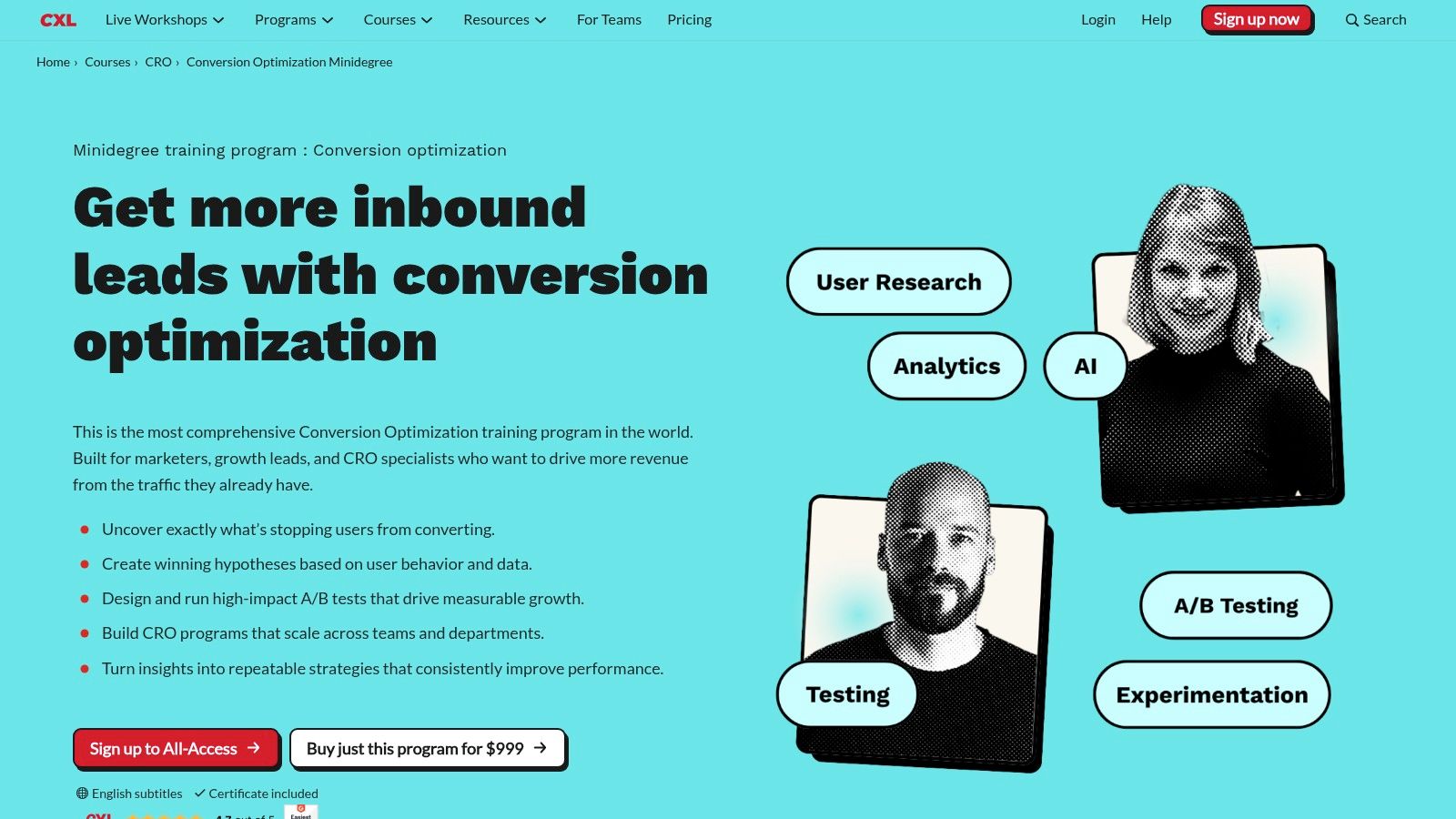
CXL’s Conversion Optimization training is the option I’d put in front of a team that wants a real operating system, not a quick overview. It suits in-house growth teams, agencies, and marketers who need research frameworks, experimentation logic, UX thinking, copy, and analytics in one place.
What separates CXL from lighter training is the structure. You’re not just learning how to click through a testing platform. You’re learning how to investigate why users hesitate, how to rank hypotheses, and how to avoid low-quality tests that waste traffic.
Where it fits best
A lot of teams jump into tools before they understand what conversion rate optimization means in practice. CXL works better in the opposite direction. It builds the mental model first, then supports ongoing skill growth through the wider library.
- Best for multi-role teams: Designers, growth marketers, analysts, and copywriters can all pull something useful from the same ecosystem.
- Best for deeper capability building: This is the kind of program you use when CRO is becoming a function, not just a side project.
- Less ideal for quick onboarding: If you only want a fast intro for one marketer, the subscription model can feel heavy.
Practical rule: Buy CXL when you want your team to argue about research quality and test design. Skip it when all you need is a platform walkthrough.
The trade-off is time. Strong training takes work, and CXL asks for it. That’s a benefit when you’re building a durable experimentation practice, but it’s not the easiest path for a busy founder who needs an answer by Friday.
2. Baymard Institute – E‑commerce UX Training & Certification
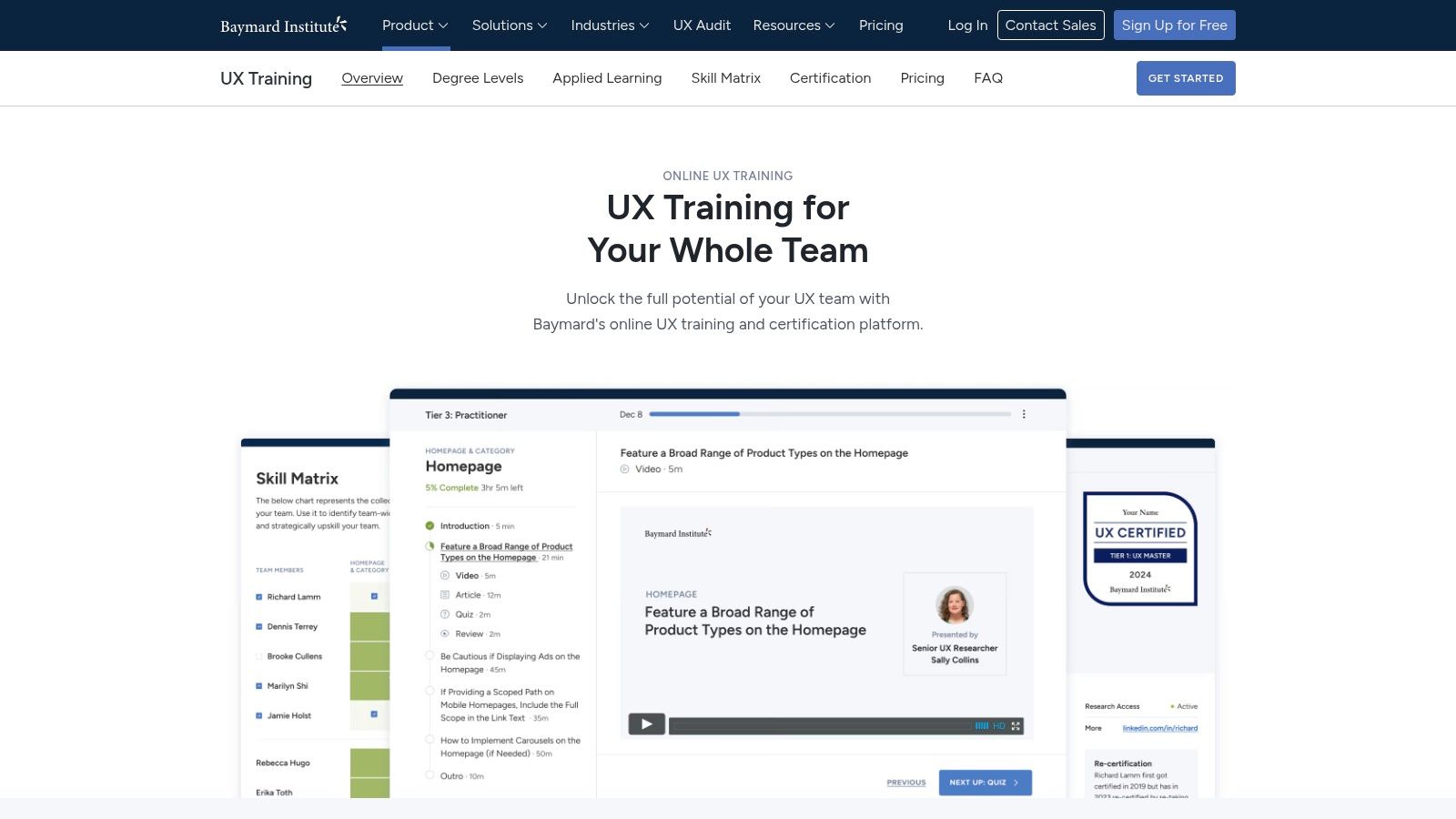
What if the conversion problem is not test velocity, but a checkout that keeps creating avoidable hesitation? In that case, Baymard Institute’s UX training deserves serious consideration.
Baymard is built for e-commerce teams working on product pages, site search, category navigation, cart flow, and checkout UX. The value is specific. It helps teams answer practical questions about why shoppers abandon, where discovery breaks down, and which UX issues deserve attention before another round of A/B tests goes live.
Best for retail teams
Baymard works best for brands with meaningful traffic and a clear commerce funnel. DTC teams, retailers, and in-house UX or merchandising groups usually get the most from it because the training maps closely to the issues they deal with every week.
A few trade-offs matter:
- Strong fit for e-commerce operations: Teams can apply the research to PDPs, navigation, mobile shopping, and checkout without much translation.
- Useful for cross-functional alignment: Product managers, designers, and executives tend to respond well to detailed UX evidence tied to purchase flow.
- Limited outside retail: SaaS, lead generation, and trial-based businesses will find gaps because the material is centered on shopping behavior, not broader experimentation strategy.
Baymard’s value lies in answering the specific UX questions that stall online purchases. It is less useful when statistical testing discipline, experiment prioritization, or analytics implementation is needed.
I recommend Baymard when a business already has traffic and the main friction sits in product discovery, cart behavior, or checkout completion. I would not use it as the first training purchase for a B2B team still trying to improve demo requests or lead form conversion.
Practical rule: Choose Baymard if your team needs sharper e-commerce UX decisions. Pair it with experimentation and analytics training if you also need to validate changes and measure impact cleanly.
3. Nielsen Norman Group (NN/g) – UX Certification and courses
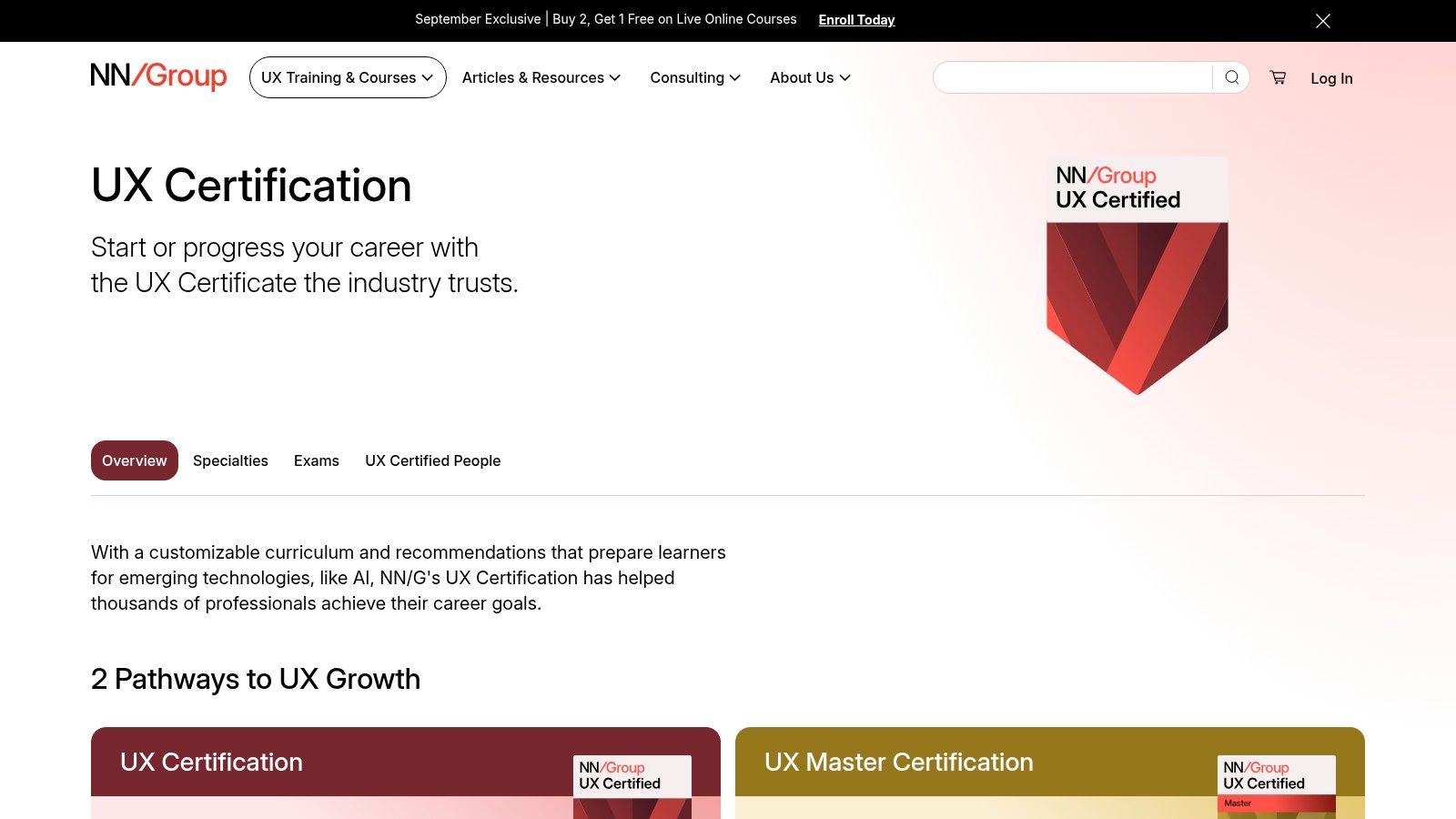
Nielsen Norman Group’s UX certification isn’t packaged as one dedicated CRO bootcamp, and that’s exactly why some teams should pick it. NN/g is a better match when the actual problem isn’t just test execution. It’s weak research, shaky usability work, and low internal confidence in UX-driven decisions.
This route works well for product teams, UX researchers, service designers, and senior marketers who need stronger methodology behind optimization work. You assemble the relevant courses instead of buying one fixed “CRO” track.
Why teams choose NN/g
Executive teams often trust a rigorous UX training brand faster than they trust ad hoc growth language. That matters when your optimization roadmap depends on research approvals, cross-functional buy-in, and changes that affect design systems.
A few practical trade-offs stand out:
- Strong for research maturity: Better hypotheses usually come from better user understanding, not more test volume.
- Strong for documentation: Teams tend to leave with frameworks they can reuse in research plans and internal reviews.
- Weak if you need tool-level speed: NN/g won’t replace hands-on training in Optimizely, VWO, or your analytics stack.
This also isn’t the cheapest route for a full team. But if your company tends to challenge every UX recommendation, NN/g can help move CRO out of the “marketing opinions” bucket and into a more disciplined workflow.
4. Optimizely Academy – Experimentation Certifications and Training
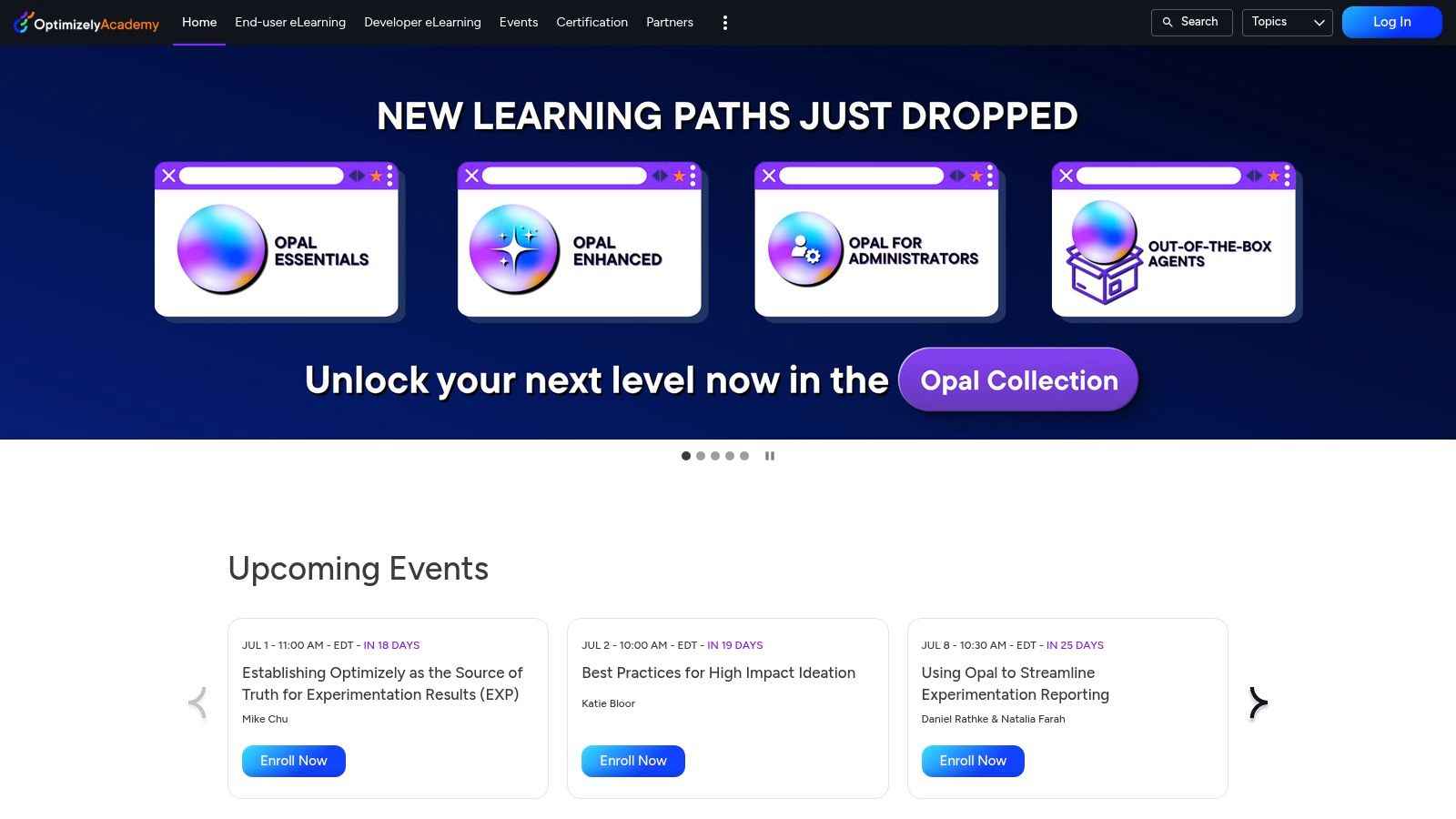
Already running Optimizely and still seeing uneven test quality? Optimizely Academy is often the fastest way to tighten execution because the training is built around the platform your team uses every day. It covers the operational work that generic CRO courses usually leave abstract, including audience setup, experiment QA, rollout controls, and role-specific workflows.
That makes it a strong fit for experimentation leads, analysts, developers, and product teams working inside an established program. The role-based paths are useful in real organizations where strategy, implementation, and analysis sit with different people and handoff quality affects speed.
Best when the platform decision is already made
I would not recommend this to teams still comparing testing tools. I would recommend it to companies that already have Optimizely in the stack and need more consistency in how experiments are planned, launched, and reviewed. In that situation, the payoff usually comes from fewer avoidable errors, cleaner collaboration, and better use of a platform you are already paying for.
If your team is standardizing its process before training, these conversion rate optimization strategies can help connect experiment execution to a broader program plan.
- Best for platform proficiency: Teams get better at the mechanics that affect launch quality and experiment governance.
- Best for larger teams: It fits organizations with formal review steps, shared ownership, and stricter release processes.
- Limited outside Optimizely: Some principles carry over, but much of the training value stays tied to the platform.
Another key consideration is measurement discipline. Teams can complete platform training and still misread results if tracking is unstable, consent handling is inconsistent, or cross-domain journeys are not validated properly. Optimizely Academy improves execution inside the testing environment, but your team still needs a separate habit of analytics QA and result verification outside the platform.
5. VWO Training (VWO Academy/Learning Hub)
VWO Training is easier to recommend to SMB and mid-market teams than some enterprise-heavy alternatives. It gives marketers and optimization leads a clearer path from basic A/B testing to more advanced workflows inside one stack.
I like this kind of training when the team needs both broad testing habits and practical execution help. The learning curve feels less abstract than some theory-first programs, especially for teams that need to launch, review, and iterate without a large analytics department.
What makes it useful
VWO sits close to day-to-day CRO work. You can train on test setup, rollouts, behavioral insight tools, and analysis without splitting the team between too many systems. That usually helps smaller companies keep momentum.
The broader CRO benchmark context also supports why this matters. VWO reports a 2.9% average conversion rate across industries and 1.8% for B2B e-Commerce in the benchmark set cited earlier through Matomo’s summary, which reinforces how much pressure sits on small improvements in testing programs already linked above.
- Strong for operational learning: Good fit when marketers need to go from idea to launch inside one environment.
- Strong for smaller teams: The training feels more accessible than enterprise-only ecosystems.
- Less useful if you want tool-agnostic depth: It’s still a platform-centered education.
A common mistake is assuming a tool academy will teach research depth on its own. Usually it won’t. VWO helps teams execute and learn the platform. Pair it with stronger user research habits, and you get much better output.
6. MECLABS Institute – “Become a Marketer‑Philosopher” CRO course
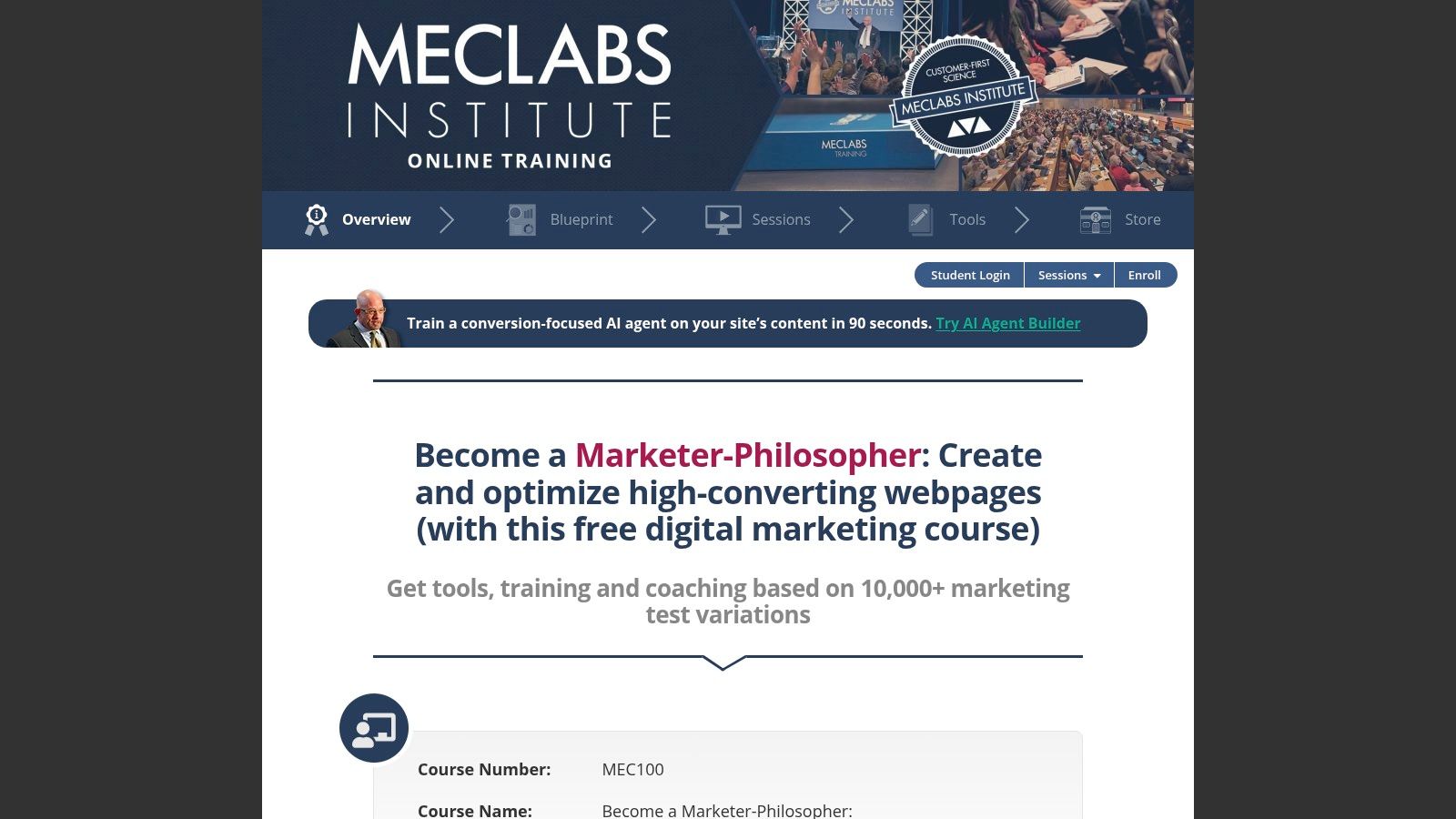
What if the actual problem is not test volume, but weak thinking behind the test ideas?
MECLABS Institute’s course focuses on the logic behind conversion decisions: value proposition, message clarity, customer motivation, anxiety, and friction. That makes it a strong fit for copywriters, demand gen managers, founders, and mixed teams that need a better way to judge why a page should convert before they start changing buttons and layouts.
I would not put this at the center of a mature experimentation program. I would use it earlier, or alongside technical training, because it improves the inputs. Teams with weak hypotheses usually have a research and messaging problem before they have a tooling problem.
Best for teams that need a shared decision model
MECLABS is useful when marketing, product, and leadership are all using different explanations for poor conversion performance. The course gives them a common framework for evaluating offer strength, page clarity, and user motivation. That is especially useful in SaaS, lead generation, and service businesses where the conversion path depends heavily on promise, credibility, and timing.
For e-commerce teams, I would treat it as a supplement rather than the main training investment. It helps with product page messaging and checkout friction, but it will not replace platform-specific work on UX patterns, experimentation setup, analytics QA, or merchandising analysis.
If your team plans to review pages before building a test roadmap, a structured conversion rate optimisation audit pairs well with this kind of training.
“Why should someone act now?” is still one of the best CRO questions a team can ask, and MECLABS keeps the focus there.
- Best for cross-functional alignment: Good choice when non-specialists need to evaluate pages with the same criteria.
- Best for messaging-led optimization: Strong fit if weak offers, unclear copy, or low trust are hurting results.
- Less suitable as a standalone path: Teams still need separate training for analytics, testing operations, and experiment QA.
I recommend this course when a business has plenty of opinions but no consistent decision framework. It helps teams write better hypotheses, critique pages with more discipline, and avoid running shallow tests that never address the actual conversion problem.
7. Growth Tribe – Conversion Rate Optimisation Certificate
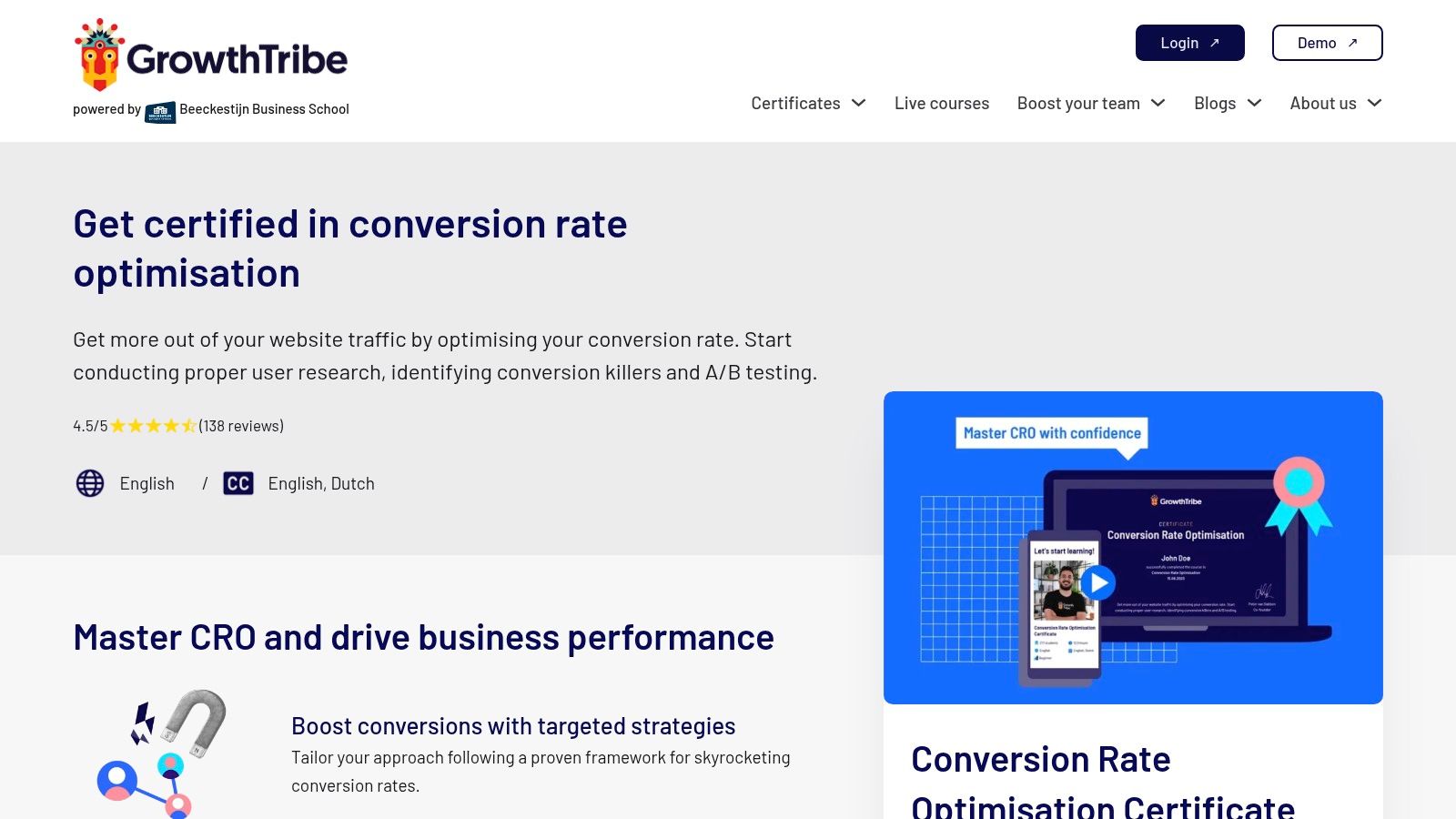
Need a CRO course that gives a marketer a working process, not just a stack of theory? Growth Tribe’s CRO certificate is a solid option for that middle tier.
It pulls together analytics, user behavior analysis, UX patterns, copy, and A/B testing in a guided sequence. That makes it easier to turn lessons into an actual review and testing routine, especially for marketers who are still building confidence across the full CRO workflow.
This training fits best when one person, or a small team, needs to cover several jobs at once. That is common in startups, lean SaaS teams, and in-house marketing groups without a dedicated experimentation lead. The course gives enough structure to evaluate pages, spot friction, frame test ideas, and move into execution without sending people through five separate specialist programs.
The trade-off is depth. Growth Tribe is stronger as a practical operating model than as an advanced specialization path. Teams running a mature experimentation program, with established analytics, research, and testing operations, will usually outgrow it faster than they would CXL or a platform-specific certification track.
This is particularly relevant for landing pages and campaign traffic, where small issues in clarity, proof, page speed, or mobile experience can have an outsized effect on results. As noted earlier in the article, those page-level inputs often influence conversion performance more than teams expect. Growth Tribe’s value is that it teaches a repeatable way to assess and test them instead of chasing isolated tactics.
- Best for generalist marketers: Strong fit for people who need one course that covers research, page analysis, and testing basics together.
- Best for small teams: Easier to apply inside a weekly marketing workflow without building a formal experimentation department first.
- Less suitable for advanced specialists: It is not the strongest choice for teams that need deep statistical rigor, platform administration, or enterprise testing governance.
- Watch the delivery format: Live scheduling can be easier for Europe-based teams than for some US-based teams.
I recommend Growth Tribe for businesses that need competent CRO execution faster than they need deep specialization. It helps a team build a shared process, start reviewing pages with more discipline, and run better-informed tests without overcomplicating the rollout.
CRO Training: 7-Provider Comparison
| Program | Implementation complexity | Resource requirements | Expected outcomes | Ideal use cases | Key advantages |
|---|---|---|---|---|---|
| CXL – Conversion Optimization Minidegree (All‑Access) | Medium–High, multi‑course path, sustained learning | Time‑intensive; subscription cost; team access recommended | End‑to‑end CRO capability, certification, broad transferable skills | Agencies and in‑house growth teams seeking continuous upskilling | Deep, practitioner‑led curriculum; regularly updated; hiring‑recognized |
| Baymard Institute – E‑commerce UX Training & Certification | Medium, apply research to product pages and checkout | Premium/team pricing; access to research database | Actionable, benchmarked UX changes and test ideas for commerce funnels | Retailers, DTC brands, marketplaces focused on checkout/cart UX | Evidence‑based, highly actionable guidelines from large-scale research |
| Nielsen Norman Group – UX Certification and courses | Medium–High, modular, rigorous methodology | High cost; time for multiple modules; optional exams | Strong UX research capability and stakeholder credibility | Teams needing rigorous UX methods to underpin testing programs | Prestigious reputation; rigorous, reproducible research methods |
| Optimizely Academy – Experimentation Certifications | Low–Medium, role‑based, platform‑tied learning | Optimizely access preferred; certification fees for some paths | Faster platform competency and certified experimenters | Organizations using or adopting Optimizely for experimentation | Platform‑specific, role‑based training that speeds operational use |
| VWO Training (VWO Academy/Learning Hub) | Low–Medium, tool‑centric operational focus | VWO platform access; pricing/quotes for private training | Practical A/B and experiment workflows within VWO | SMBs and mid‑market teams running CRO on VWO stack | Operational, end‑to‑end execution guidance; accessible format |
| MECLABS Institute – “Become a Marketer‑Philosopher” | Low, foundational theory and heuristics | Low barrier (free); optional paid certification | Clear value‑proposition and messaging improvements for tests | Cross‑functional teams and non‑specialists needing CRO fundamentals | Free, research‑driven principles emphasizing clarity and psychology |
| Growth Tribe – Conversion Rate Optimisation Certificate | Medium, practical workflows plus tooling | Cohort scheduling; paid cohorts; tooling (GA4/Hotjar) for exercises | Defined start‑to‑finish CRO process and hands‑on execution skills | Marketers and small teams wanting practical, toolled training | Balanced mix of frameworks, analytics tooling and execution; community |
From Training to Transformation: Your Next Steps
What happens after the team finishes the course and goes back to work on Monday?
Training only pays off when it changes how decisions get made on a live funnel. The cleanest way to do that is to tie the course to one active conversion problem and one accountable team. Pick a pilot with enough traffic and enough business value to matter: a checkout step, a demo request flow, a pricing page, or a weak product detail page. Then require the team to use the training on that pilot within the next few weeks.
This is also the point where course selection becomes a management decision, not just a learning decision. A broad program like CXL fits teams building internal CRO capability across functions. Baymard is the better fit when e-commerce UX friction is the primary problem. NN/g helps teams that need stronger research practice and more credibility with design and product stakeholders. Optimizely Academy and VWO Training fit best when the experimentation platform is already chosen, and the immediate goal is better execution inside that stack. MECLABS is useful when messaging, offer clarity, and value proposition work are holding tests back. Growth Tribe suits marketers who need a practical workflow they can run without building a full experimentation department.
A pilot should create operating discipline, not just ideas. Assign clear ownership for research, hypothesis writing, QA, launch approval, and readouts. Define what counts as a decision-ready result before the test starts. If nobody owns those steps, the result is half-finished tests, conflicting dashboards, and lessons that never make it into the next experiment.
Measurement usually breaks before strategy does.
Training will not fix bad instrumentation, weak event definitions, or attribution gaps across devices and domains. Build a simple QA checklist into every experiment cycle. Check event naming. Check tracking against backend submissions or sales data. Check whether consent settings, cross-domain journeys, and platform reporting create blind spots large enough to change the decision. That habit matters more than another slide deck on testing theory.
Some companies should train the team and still bring in outside support. In that situation, an agency relationship can make sense, especially when the business needs help with prioritization, implementation, and review cadence while internal skills are still developing. Ascendly Marketing is one option for teams that want conversion optimization support as part of a broader digital marketing and website performance program.
The practical test is simple. If the training helps your team improve one live funnel, document what changed, and repeat the process with more confidence, it was the right choice. If the material stays in a shared drive and never reaches a real page, the fit was wrong for your team, your workflow, or your current stage.