

TL;DR:
- Client acquisition is a full-funnel system that transforms prospects into paying customers through integrated marketing, sales, and onboarding. Achieving a healthy 3:1 LTV to CAC ratio ensures sustainable growth, with each funnel stage requiring tailored tactics to prevent drop-offs. SMB success depends on disciplined funnel management, tracking key metrics, and leveraging multi-channel strategies to optimize conversion and reduce costs.
Client acquisition is the end-to-end process of attracting, nurturing, and converting prospects into paying customers through a coordinated marketing and sales strategy. The industry term is customer acquisition, though “client acquisition” is the preferred language in service-based businesses where relationships drive revenue. For small and medium-sized businesses, mastering this process is not optional. It is the engine that generates revenue, funds operations, and creates the customer base needed for long-term growth. Tools like Salesforce, HubSpot, and Stripe have built entire frameworks around this process because getting it right determines whether a business scales or stalls.
What is client acquisition and how does it work?
Client acquisition is organized as a funnel from the moment a prospect first learns about your business to the moment they become a paying, onboarded customer. It is not a single transaction. It is a system that combines marketing, sales, and customer success into one continuous process. Businesses that treat acquisition as a series of isolated activities, running ads here, sending emails there, consistently underperform against those that manage it as a unified funnel.

The distinction between client acquisition and what is customer acquisition in broader terms is mostly semantic. In B2B and professional services, “client” signals a deeper, ongoing relationship. In e-commerce or SaaS, “customer” is standard. The underlying mechanics are identical: attract, engage, convert, and onboard.
Client acquisition cost (CAC) is the primary metric used to measure how efficiently a business converts spending into new customers. CAC is calculated by dividing total sales and marketing expenses by the number of new customers acquired in a given period. If you spent $10,000 last quarter and gained 50 new clients, your CAC is $200. That number means nothing in isolation. It only becomes useful when compared to customer lifetime value (LTV).
What are the core stages of the client acquisition funnel?
The client acquisition funnel has five distinct stages: awareness, interest, consideration, conversion, and onboarding. Each stage requires a different tactic, a different message, and a different measure of success. Collapsing them into one generic “marketing push” is the fastest way to waste budget.
| Funnel stage | Primary goal | Key activities |
|---|---|---|
| Awareness | Get discovered | SEO, paid ads, social media, PR |
| Interest | Build engagement | Blog content, email capture, webinars |
| Consideration | Demonstrate value | Case studies, demos, free trials |
| Conversion | Close the deal | Sales calls, proposals, pricing pages |
| Onboarding | Deliver first value | Welcome sequences, setup support, check-ins |
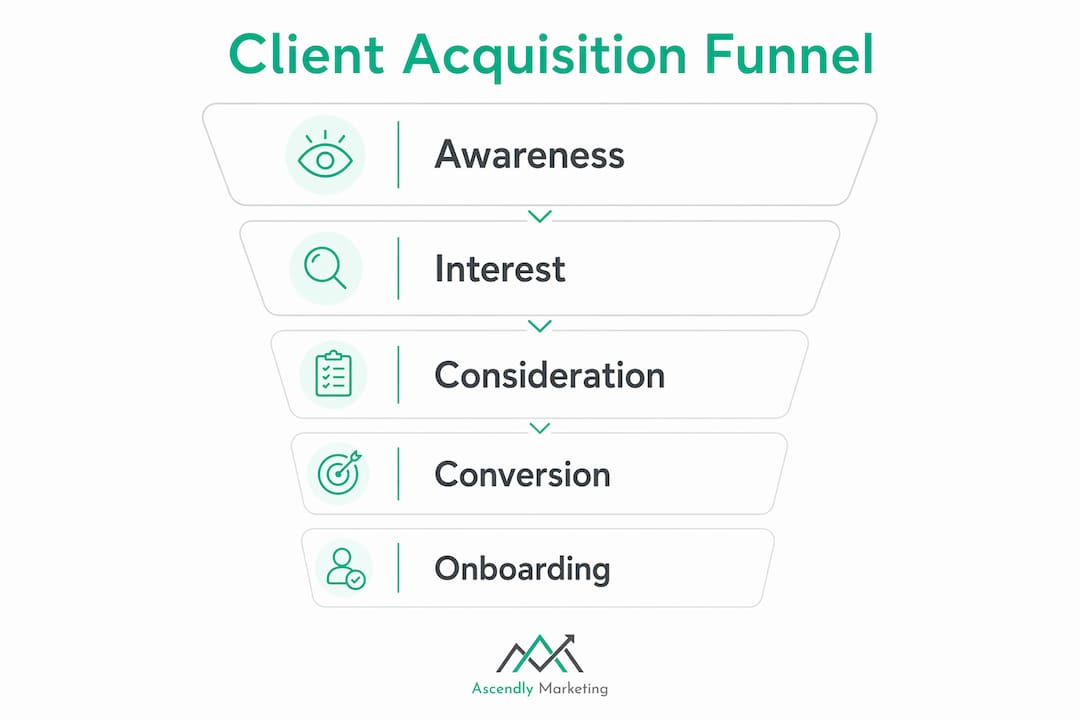
At the awareness stage, your job is visibility. At the interest stage, you are earning attention. Consideration is where you prove you are the right choice, not just a visible one. Conversion is the handoff from marketing to sales. Onboarding is where most SMBs drop the ball entirely, treating it as an afterthought rather than the first proof point of your value.
Each funnel stage requires tailored tactics to move a prospect forward effectively. A prospect in the consideration stage does not need another awareness ad. They need a case study, a comparison page, or a direct conversation with a sales rep. Sending the wrong message at the wrong stage increases drop-off and inflates your CAC.
Pro Tip: Track conversion rates between each funnel stage, not just total traffic or total leads. If 1,000 people reach your consideration stage but only 50 convert, the problem is in your conversion mechanics, not your awareness spend.
How is client acquisition cost (CAC) calculated and why does it matter?
CAC is the financial heartbeat of your acquisition strategy. Stripe highlights the importance of a 3:1 LTV to CAC ratio as the benchmark for sustainable acquisition economics. That means for every dollar you spend acquiring a client, that client should generate at least three dollars in lifetime revenue. Falling below this ratio signals that your acquisition model is burning cash faster than clients can repay it.
Here is a simple comparison that illustrates why the ratio matters more than the raw number:
| Metric | Business A | Business B |
|---|---|---|
| CAC | $300 | $300 |
| LTV | $600 | $1,200 |
| LTV:CAC ratio | 2:1 (unsustainable) | 4:1 (healthy) |
Both businesses spend the same to acquire a client. Business B is building a profitable model. Business A is slowly losing money on every customer it wins.
To calculate CAC accurately, include every relevant cost: paid advertising spend, sales team salaries, marketing software subscriptions, content production, and any agency or professional service fees. Underestimating these costs produces a falsely low CAC and leads to overconfident spending decisions.
Practical ways to reduce CAC without cutting reach:
- Improve landing page conversion rates so more ad clicks become leads
- Invest in organic SEO to reduce dependence on paid traffic over time
- Build a referral program that turns existing clients into acquisition channels
- Tighten lead qualification criteria so sales teams spend time on high-probability prospects
- Shorten the sales cycle by addressing objections earlier in the funnel with content
Pro Tip: LTV is not fixed. Improving onboarding, adding upsell paths, and increasing retention all raise LTV without touching your acquisition spend, which effectively improves your LTV: CAC ratio without reducing marketing investment.
What is the difference between client acquisition, lead generation, and marketing?
These three terms are used interchangeably in most SMB conversations. They are not the same thing, and conflating them leads to misaligned teams and wasted budget.
| Concept | Scope | Primary goal | Success metric |
|---|---|---|---|
| Marketing | Broadest | Build awareness and brand visibility | Reach, impressions, traffic |
| Lead generation | Mid-funnel | Capture contact information and initial interest | Leads, form fills, email subscribers |
| Client acquisition | Full funnel | Convert prospects into paying, onboarded customers | New clients, CAC, revenue |
Marketing builds visibility, but client acquisition requires driving measurable actions that result in paying customers. A business can run excellent marketing campaigns and still fail at acquisition if there is no sales process to convert the interest those campaigns generate. HubSpot is explicit on this point: awareness is not acquisition.
Lead generation is distinct from client acquisition because it stops at contact capture. Acquisition continues through qualification, nurturing, conversion, and onboarding. A CRM like HubSpot or Salesforce is the operational tool that manages this progression, tracking where each lead sits in the funnel and what action is needed next.
Acquisition integrates marketing and sales as a single motion, including the lead-to-opportunity handoff. When marketing and sales operate in silos, leads fall through the cracks at the handoff point. That gap is one of the most common and costly failures in SMB acquisition systems. A CRM marketing approach closes that gap by creating shared visibility across both teams.
Pro Tip: If your marketing team measures success by traffic and your sales team measures success by closed deals, you have a structural misalignment. Agree on a shared metric, such as qualified leads converted to customers, that both teams own.
What are effective client acquisition strategies and best practices for SMBs?
Multi-channel acquisition strategies consistently outperform single-channel approaches because they meet prospects at multiple touchpoints across the funnel. HubSpot recommends combining organic, paid, and relationship-based channels rather than betting everything on one source of traffic.
The three main categories of acquisition strategy:
Organic strategies include SEO, content marketing, and social media. These build compounding returns over time. A well-optimized blog post or B2B SEO strategy can generate qualified leads for years without additional spend. The tradeoff is time. Organic channels take months to build momentum.
Paid strategies include PPC advertising, display ads, and sponsored content. These generate traffic immediately and allow precise targeting by audience, intent, and geography. The tradeoff is cost. Paid channels stop producing the moment you stop spending, which is why they work best alongside organic efforts.
Relationship-based strategies include referral programs, strategic partnerships, and networking. These often produce the highest-quality leads because they arrive with built-in trust. A referred prospect converts at a higher rate and typically has a lower CAC than a cold ad click.
High-impact tactics to implement now:
- Audit your funnel for the stage with the highest drop-off rate and fix that first
- Use conversion rate optimization tactics on your highest-traffic landing pages
- Build an email nurture sequence that moves leads from interest to consideration automatically
- Create one detailed case study per quarter that addresses your most common buyer objection
- Set up a referral incentive for existing clients; even a simple thank-you gift drives behavior
- Track lead nurturing metrics to identify where prospects disengage before converting
Optimizing only top-of-funnel metrics without tracking conversion rates between stages leads to poor acquisition outcomes. More traffic does not fix a broken conversion stage. Salesforce is direct on this: the businesses that win at acquisition are the ones measuring what happens between stages, not just at the top.
Poor onboarding after conversion increases effective CAC by driving early churn. Stripe’s research links onboarding quality directly to retention and LTV. A client who churns in month two effectively costs you twice as much to acquire as one who stays for two years. Onboarding is not a post-sale courtesy. It is a core part of the acquisition investment.
Pro Tip: A 10% improvement in your funnel conversion rate produces more new clients than doubling your ad spend. Focus on improving conversion rates before scaling traffic.
Key takeaways
Client acquisition is a full-funnel system that requires marketing, sales, and onboarding to work together, measured by CAC and LTV to determine whether growth is actually profitable.
| Point | Details |
|---|---|
| Client acquisition defined | It is the end-to-end process from prospect awareness through paid onboarding, not just a sale. |
| CAC and LTV are inseparable | A healthy 3:1 LTV to CAC ratio determines whether your acquisition model is sustainable. |
| Funnel stage discipline matters | Each of the five stages requires different tactics; mismatched messaging increases drop-off. |
| Acquisition is not marketing | Marketing builds awareness; acquisition converts that awareness into paying, retained customers. |
| Onboarding protects your investment | Poor onboarding raises effective CAC by increasing churn and reducing lifetime value. |
The mistake that costs SMBs the most
After working with SMBs across industries since 2013, the pattern Ascendly Marketing sees most often is not a lack of marketing spend. It is a lack of funnel discipline. Business owners invest heavily in awareness, generate real interest, and then lose prospects somewhere between consideration and conversion because no one owns that stage.
The second most common mistake is treating onboarding as the client’s problem. When a new client struggles to get started, they do not always ask for help. They quietly disengage, cancel, and tell two people about the experience. That churn erases the acquisition investment and raises your effective CAC without a single additional dollar spent on ads.
What actually works is treating acquisition as a closed loop. Every stage feeds the next. Marketing generates awareness, sales convert interest, and onboarding locks in the value that justifies the acquisition cost. When you track CAC and LTV together, you stop optimizing for vanity metrics and start optimizing for profit. That shift in thinking is where real growth begins.
The businesses Ascendly Marketing has seen scale most effectively are not the ones with the biggest ad budgets. They are the ones who know their numbers, fix their weakest funnel stage first, and build referral systems that reduce CAC over time. That is not a complex strategy. It is a disciplined one.
— Ascendly Marketing
How Ascendly Marketing helps SMBs build a winning acquisition system
If your acquisition funnel has gaps, whether in traffic, conversion, or onboarding, Ascendly Marketing builds the systems to close them. Since 2013, the team has helped SMBs across industries reduce CAC, increase qualified lead flow, and convert more prospects into long-term clients through SEO, PPC, content marketing, and CRM-integrated strategy.
Ascendly Marketing’s digital marketing services cover every stage of the acquisition funnel, from organic search visibility to paid advertising to conversion optimization. The team includes SEO specialists, content strategists, and paid media experts who have worked with major brands and understand what moves the needle for growing businesses. If you are ready to build an acquisition system that produces measurable, repeatable results, start with Ascendly Marketing today.
FAQ
What is the simplest definition of client acquisition?
Client acquisition is the process of attracting and converting prospects into paying customers through a coordinated marketing and sales strategy. It covers every stage from first awareness through onboarding.
How is client acquisition cost calculated?
CAC equals total sales and marketing expenses divided by the number of new customers acquired in the same period. All costs, including ad spend, salaries, and software, should be included for an accurate figure.
What is a good LTV to CAC ratio?
Stripe identifies a 3:1 LTV to CAC ratio as the benchmark for sustainable acquisition economics. Ratios below 2:1 typically indicate the business is spending more to acquire clients than those clients generate in revenue.
How does client acquisition differ from lead generation?
Lead generation captures contact information and initial interest. Client acquisition goes further, qualifying, nurturing, and converting those leads into paying customers, then onboarding them successfully.
What are the most effective client acquisition strategies for SMBs?
The most effective approach combines organic SEO, paid advertising, and relationship-based referrals with a CRM to manage the full funnel. Marketing funnel optimization and conversion rate improvements consistently outperform simply increasing ad spend.