

You’ve got a list, a sequence, and pressure to turn outbound into pipeline fast. So you launch. A few days later, the inbox is quiet, the call block feels worse, and sales asks whether outbound still works at all.
That result usually comes from treating outbound like a sending problem instead of a systems problem. In outbound B2B lead generation, the message matters, but the setup matters more. Bad targeting, stale data, weak sequencing, poor deliverability, and sloppy handoff can sink a campaign before a prospect even reads line one.
Why Most Outbound Fails and How Yours Will Succeed
Most outbound misses for a simple reason. Teams send too much to too many people with too little relevance.
That approach was always shaky. Now it’s worse. 97% of people actively ignore cold calls, and the close rate for traditional outbound leads is 1.7%, according to lead generation statistics from Invesp. That doesn’t mean outbound is dead. It means random outreach is dead.
The common failure pattern looks like this:
- The list is broad: Titles look close enough, but the buyer is not responsible for the problem you solve.
- The message is generic: It describes your service, not the prospect’s situation.
- The channel mix is weak: One email gets sent, then the team declares the market unresponsive.
- The technical setup is ignored: Mailboxes aren’t warmed, domains aren’t watched, and deliverability drops before testing even starts.
A lot of new managers blame copy first. Sometimes the copy is bad. More often, the campaign was broken upstream.
Practical rule: Outbound works when each step narrows risk. Better accounts, cleaner contacts, tighter messaging, cleaner sending, clearer qualification.
There’s another issue that trips up teams early. They think no replies means no interest, when the actual problem is that their emails aren’t landing well. If you’ve seen open and reply performance collapse right after launch, this guide on Why Are My Emails Going to Spam is worth reviewing before you rewrite your sequence.
A workable outbound program has a simple shape. Pick a narrow ICP. Build and verify a segmented list. Write messages around pain, timing, and fit. Run a short multichannel sequence across email, phone, and social. Then pass only engaged leads to sales with context attached.
That’s the playbook. Nothing flashy. Just disciplined execution.
Building Your Unshakeable Foundation for Outreach
Campaign performance is usually decided before the first email goes out. If the targeting is loose and the data is dirty, the sequence never gets a fair shot.
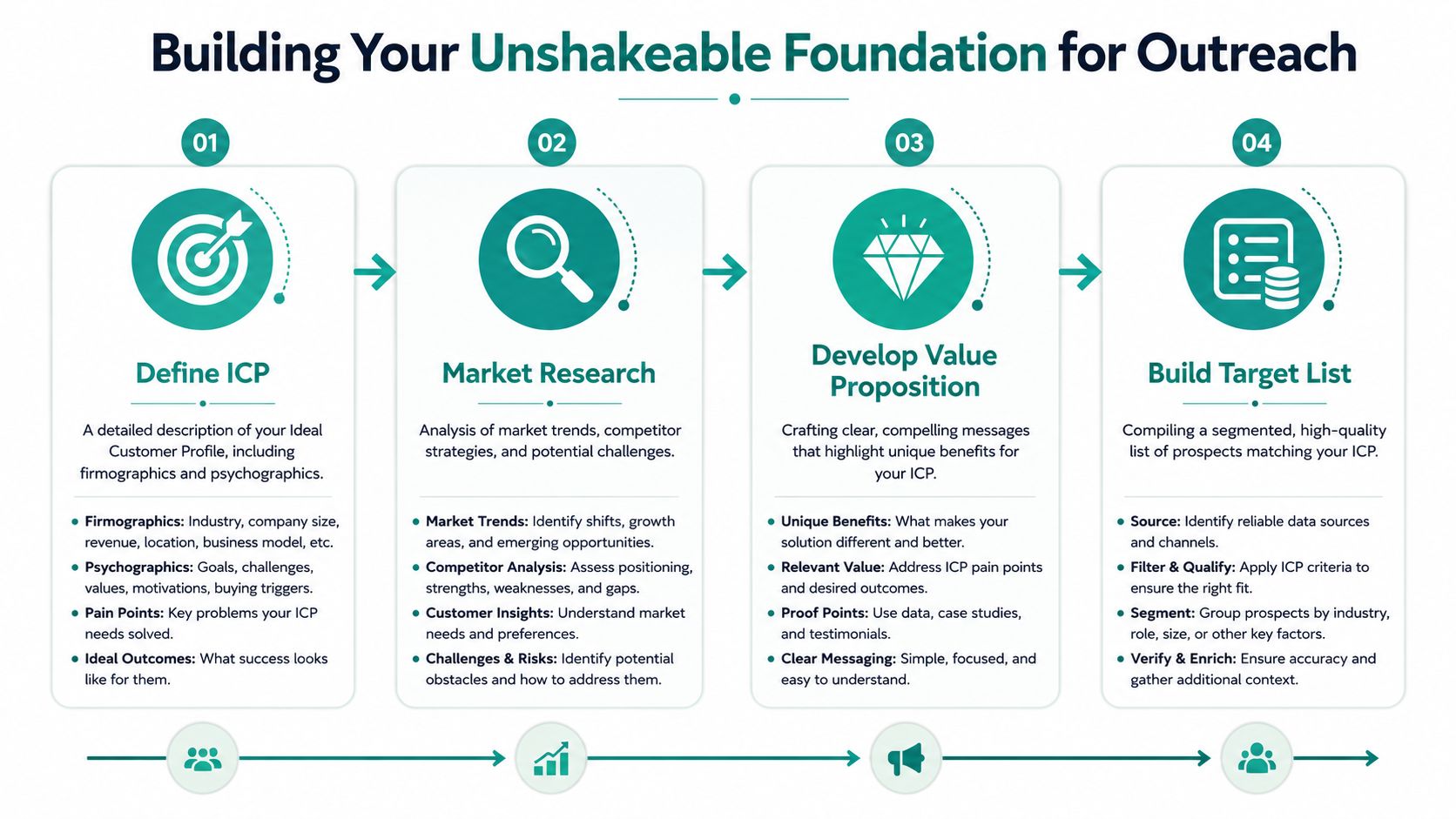
Define the ICP like you mean it
A weak ICP sounds like this: “mid-sized SaaS companies” or “healthcare businesses.” That’s not enough for outbound B2B lead generation. You need a picture of the account and the buying situation.
Build your ICP with four layers:
Firmographic fit
Industry, company size, geography, and operating model.Role fit
Who owns the pain, who feels the pain, and who can approve a solution.Trigger fit
Recent hiring, expansion, a new product line, a visible demand problem, or a process bottleneck.Pain fit
The problem your offer can solve without a long explanation.
If your offer helps companies improve lead handling, don’t target every head of marketing. Target companies showing signs they’re generating demand but not converting it well. That’s a very different list.
Build segments before you build a list
A lot of teams pull one giant prospect list and try to personalize later. That usually leads to vague copy because the segment is too mixed.
Instead, create a few small groups with shared context. For example:
- Segment one: Companies hiring sales reps
- Segment two: Agencies expanding service lines
- Segment three: Firms with outdated forms or weak follow-up
Each segment gets different language, objections, and proof points. You don’t need endless variants. You need enough separation that your first message sounds grounded in reality.
A good outbound segment lets you write one opening line and reuse the logic across the whole group without sounding lazy.
Treat data like a live asset
Contact data goes bad fast. B2B contact data can decay at a rate of 22% to 70% annually, which is why this outbound lead generation guide from The Small Business Expo puts list verification and refresh at the center of the process. If your list was accurate a few months ago, parts of it are already wrong now.
That changes how you should source and maintain lists.
Here’s the trade-off:
| List approach | What works | What fails |
|---|---|---|
| Bought or exported lists | Fast starting point for testing a segment | High bounce risk if you trust the data blindly |
| Manual research | Better fit and richer context for personalization | Slow if you do it for every account |
| Hybrid workflow | Fast enough to scale, precise enough to stay relevant | Breaks when no one owns verification |
The hybrid workflow is the recommended approach. Pull a candidate list from a data source, enrich it, verify it, then check a small sample manually before launch. That catches title mismatches, brand confusion, and accounts that should never have made the cut.
Write the value proposition before the sequence
You don't need polished brand messaging here. You need one clear answer to a prospect's silent question: why should I care?
A usable outbound value proposition has three parts:
- Problem: what's going wrong
- Impact: what that costs in time, revenue, or missed opportunities
- Change: what gets easier if they fix it
Avoid feature stacks. Nobody replies because your tool has dashboards, workflows, or integrations. They reply when the message connects to a live problem they already recognize.
Crafting a Multichannel Sequence That Gets Replies
A single cold email is not a strategy. It's a touchpoint.
Teams that run outbound seriously coordinate email, phone, and social because buyers don't all respond in the same place or at the same moment. Sellers who use a multichannel outbound strategy book meetings 24% more often than sellers using only one channel, according to Apollo's guide to inbound and outbound B2B lead generation.
Start with the message hierarchy
Before writing the sequence, decide the order of your points. A common error is getting this backward and leading with who they are.
Use this order instead:
-
Context
Why this person, this company, now. -
Problem
A plausible issue tied to their role or situation. -
Point of view
A short take on what usually causes the issue. -
Offer
A low-friction next step.
That structure travels well across channels. Email can hold all four. LinkedIn might only carry context and offer. A phone call can use context, problem, and a question.
What the first email should do
The first email has one job. Earn enough interest for a reply.
Keep it short. A strong cold email for outbound B2B lead generation usually has:
- A direct subject line that sounds human, not clever
- A first sentence tied to fit rather than fake familiarity
- One specific problem
- A simple CTA such as whether the issue is on their radar
Bad example: “Helping you scale revenue with a full-service solution”
Better structure:
- reason for contact
- likely issue
- one sentence on how you help
- easy question
If you want a practical reference for tightening body copy and reducing friction in first-touch emails, these cold email tips are a useful checklist.
Don't ask for fifteen minutes in the first line. Ask a question that can be answered in one sentence.
Layer social touchpoints without being strange
LinkedIn works best when it supports the sequence instead of replacing it. Don't send a connection request with a hidden pitch disguised as a greeting. That tends to get ignored.
A cleaner pattern looks like this:
- Email first: establish the reason for contact
- Profile view or connection request: create familiarity
- Short follow-up message after connection: reference the problem category, not a full pitch
Keep the tone flat and professional. The point is recognition, not charm.
Use calls to open conversations
Calling still works in outbound when the rep knows why they're calling and what answer they're trying to uncover. The fastest way to ruin a call is to read a product pitch to someone who hasn't agreed they have the problem.
Use a call opener built around three pieces:
- who you are
- why you picked them
- one question that tests fit
For teams that need a starting point, these outbound call scripts that convert are useful because they focus on conversations rather than monologues.
After the opener, listen for one of three outcomes:
| Prospect response | What it means | What to do next |
|---|---|---|
| Clear interest | There’s a live problem and timing may be real | Move to qualification and book the next step |
| Soft curiosity | The issue exists but priority is unclear | Ask one follow-up and send a short recap |
| No relevance | Bad fit, bad timing, or wrong contact | Log it and stop forcing the account |
Here’s a good point in the process to watch someone walk through the mechanics of sequencing and outreach rhythm:
Build short sequences, not endless ones
Long sequences often turn into repeated nudges with no new information. A shorter sequence is easier to manage and easier to diagnose.
A practical sequence might include:
- Touch one: first email
- Touch two: LinkedIn view or connection
- Touch three: follow-up email with a different angle
- Touch four: phone call
- Touch five: final email that closes the loop
Each step should add something. A new trigger, a different pain point, a clear question, or a short case for why now. If every touch says “just following up,” the campaign will feel automated because it is.
Launching Your Campaign and Testing for Winners
Monday morning, the sequence goes live. By Wednesday, reply volume is flat, one mailbox starts landing in spam, and the team cannot tell whether the problem is targeting, copy, or setup. That usually happens because launch was treated like a switch instead of a controlled rollout.
A strong outbound launch works more like a systems check. Send low volume first. Watch inbox placement, bounce patterns, and reply quality before adding more mailboxes or increasing daily sends. The goal in week one is not reach. It is getting a clean read on what is working.
Warm up before you try to scale
Mailbox warm-up is basic operational discipline. New domains and fresh inboxes need time to build a sending reputation, and established mailboxes still need a gradual ramp if they have been idle or recently reconfigured.
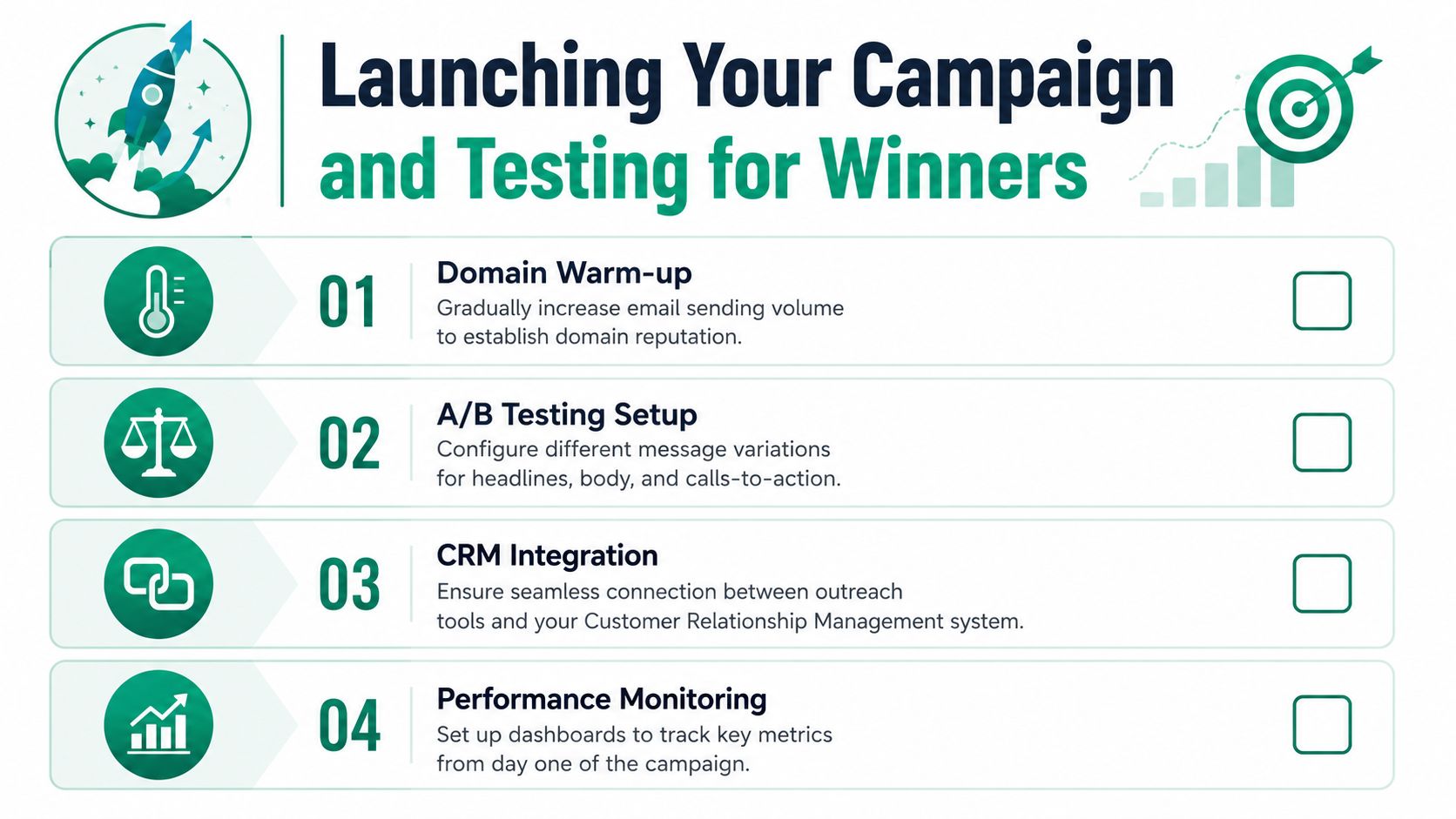
Use a simple launch checklist:
- Increase volume gradually: start small and add sends in stages
- Keep early tests tight: change a few inputs, not the whole program
- Sync activity to the CRM: replies, objections, and outcomes should be logged automatically
- Review performance every day in week one: small issues get expensive fast if nobody catches them
That last point matters more than teams expect. If one sender has poor inbox placement or one list segment is producing weak replies, waiting a full week can waste hundreds of touches and muddy the test.
Test one variable at a time
A/B testing fails when the team changes copy, audience, sender identity, and CTA all at once. That is not a test. It is a relaunch with no clear lesson.
Start with the variable that matches the problem you see:
Subject line
Test this when emails are not getting opened enough to judge the body copy.Opening line
Test this when opens look healthy but prospects are not engaging.CTA style
Test this when prospects respond but avoid the next step.
Make the differences meaningful. Compare a direct subject line against a trigger-based one. Compare an opener tied to a hiring signal against one tied to a process problem. Compare a clear meeting ask against a low-friction question.
Small wording tweaks rarely produce useful learning.
Protect the signal
Early campaign data gets distorted easily. Keep ICP segments separate. Do not let reps rewrite messaging in the middle of a test. Do not call a winner after two positive replies from one vertical.
I usually want one more layer of discipline here. Write down the hypothesis before launch. Example: “Operations leaders will respond better to a process bottleneck opener than a generic cost-savings opener.” That forces the team to judge results against a real question instead of hunting for a story after the fact.
If leadership wants a cleaner way to connect these test results to pipeline discussions, this framework for calculating marketing ROI from campaign outcomes helps structure that conversation without turning every review into an attribution debate.
The practical trade-off is simple. A controlled launch feels slower for the first week, but it gives you usable signal. That is what lets you scale a system, not just send a campaign.
Tracking What Matters and Optimizing for Meetings
A lot of outbound reporting is cluttered with activity metrics that don’t help anyone make a decision. High send volume looks busy. It doesn’t tell you whether the program is healthy.
For outbound B2B lead generation, the useful questions are simple. Are people replying? Are the replies positive? Are those replies turning into meetings? If not, where does the sequence break?
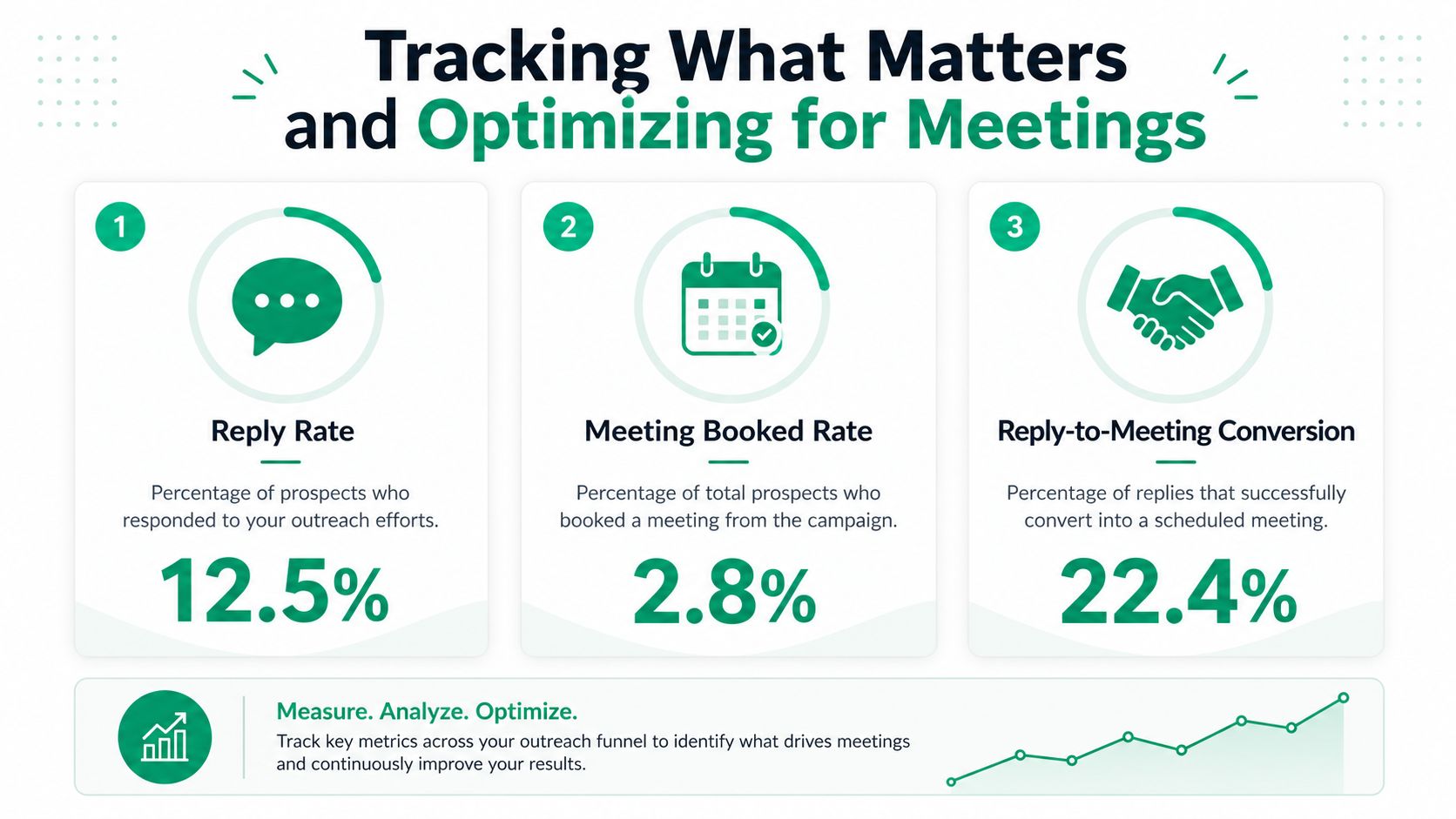
Watch the right metrics
The three numbers that deserve the most attention are:
Reply rate
Are prospects engaging at all?Positive reply rate
Are the replies useful, or mostly brush-offs?Meeting booked rate
Is the program creating real sales conversations?
Then add one operational layer underneath them. Track objections, disqualifications, and no-show patterns in your CRM. That’s where the genuine optimization work happens.
If you need to connect these campaign outcomes back to revenue discussions, this guide on how to calculate marketing ROI helps frame the conversation without turning every review into an argument over attribution.
Diagnose by pattern, not by hunch
Outbound gets easier when you stop asking “is this working?” and start asking “where is it failing?”
Use patterns like these:
| Pattern | Likely issue | Adjustment |
|---|---|---|
| Strong opens, weak replies | Subject line is doing its job, body copy isn’t | Rewrite the problem statement or CTA |
| Replies, but few positive ones | The angle gets attention but misses fit | tighten segmentation or offer |
| Positive replies, few meetings | Interest exists, but the next step feels heavy | simplify booking ask and qualification flow |
| Mixed results across reps | Execution gap, not just message gap | review notes, follow-up timing, and call handling |
Many teams tend to overreact. One rough batch leads to a total rewrite. That usually makes things worse. Keep what’s working, change the pressure points, and give each test enough room to produce a signal.
When a prospect replies with “not a priority,” log the exact wording. Repeated phrases tell you more about your offer than dashboard summaries do.
Use sales feedback as campaign data
The SDR or AE talking to prospects hears objections that won’t show up in a sequence report. That input should shape future messaging.
Ask sales for specifics, not opinions:
- Which opener started the easiest conversations?
- Which objections showed up repeatedly?
- Which titles engaged but couldn’t buy?
- Which booked meetings were clearly a poor fit?
When marketing and sales share the same notes, the sequence gets sharper fast. Without that loop, teams keep polishing copy while the underlying issue sits in qualification or handoff.
Scaling Your Program with Tools and Compliance
Once you’ve found a sequence and segment that consistently create meetings, the next mistake is scaling volume without protecting quality. More mailboxes, more contacts, more automations. That can expand reach, but it can also multiply bad data, weak messaging, and compliance risk.
Add tools in layers
You don’t need a huge stack on day one. You need coverage across a few jobs:
- Data sourcing and enrichment: Pull candidate accounts and contacts, then refresh them regularly
- Verification: Check addresses before sending
- Sales engagement: Schedule multichannel steps and keep timing consistent
- CRM: Store replies, notes, objections, and stage changes in one record
The right stack depends on team size and workflow. Some teams piece together separate tools. Others prefer a platform approach. If you’re comparing categories, this overview of B2B lead generation software is a practical starting point. Agencies can also run the process for clients. For example, Ascendly Marketing offers outbound support that includes cold email outreach, cold calling, and LinkedIn prospecting.
Automate the repetition, not the judgment
Automation should handle scheduling, task creation, follow-up timing, and CRM logging. It shouldn’t decide whether an account belongs in the campaign, what pain point matters most, or whether a reply counts as real interest.
Keep human review in these places:
- segment creation
- message approval
- reply qualification
- sales handoff
That split is what keeps outbound scalable without turning it into spam.
Build compliance into the workflow
Compliance doesn’t sit outside the program. It belongs inside daily operations.
For US outreach, your process should support basic CAN-SPAM behavior such as accurate sender identity, honest subject lines, and a working opt-out path. For European contacts, GDPR raises the bar around personal data handling and lawful outreach practices. The practical takeaway is straightforward. Keep records clean, know why a contact is in the sequence, respect opt-outs fast, and avoid vague list imports that no one can explain later.
A mature outbound program isn’t just a campaign engine. It’s a documented system with rules, ownership, and a clear trail from targeting to meeting handoff.
If you want help building that system, Ascendly Marketing can support outbound programs alongside SEO, PPC, websites, email, and conversion work. That’s useful when you need lead generation tied to the rest of your growth stack instead of managed in a silo.