

TL;DR:
- Content quality is crucial for website rankings, trust, and AI citation, with higher optimization scores driving more traffic.
- Small businesses should focus on independent systems of optimization, readability, and credibility, each requiring separate evaluation.
Content quality is the single most measurable factor determining whether your website ranks, earns trust, and gets cited by AI platforms like ChatGPT, Perplexity, and Google’s AI Overviews. For small and medium-sized businesses, this is not a theoretical concern. A 2026 DesignRush study found that articles with optimization scores above 70% received 5.4 times more monthly traffic than those scoring 40 to 49%. That gap separates businesses that grow organically from those that pay for every click. Understanding why content quality matters means understanding three independent systems: optimization, readability, and credibility. Each one drives a different outcome, and none of them fixes the others automatically.
Why content quality matters for SEO rankings
Google does not evaluate your pages in isolation. It applies a site-wide quality signal that can suppress an entire domain’s rankings when too much of its content is deemed unhelpful. This means one weak blog post is not just a missed opportunity. It actively drags down your best-performing pages.

The Helpful Content Update, which Google has refined through multiple cycles, works by assessing the ratio of helpful to unhelpful content across your whole site. If that ratio tips in the wrong direction, even your strongest pages lose visibility. Recovery is not quick. It requires site-wide improvements and can take months before Google’s algorithm reassesses your domain favorably.
For SMBs with limited publishing budgets, this creates a clear priority: fewer, better pages outperform a high volume of thin content every time. The impact of content quality on rankings is not just about individual articles. It shapes how Google perceives your entire domain’s authority.
Here is what the suppression risk means in practice:
- A site publishing 20 low-effort AI-generated posts per month can suppress the rankings of its 5 genuinely useful pages.
- Removing or substantially improving weak content is often more effective than publishing new content.
- Google’s self-assessment questions, such as “Does this content provide original information or analysis?”, are designed to help publishers evaluate helpfulness before publishing.
- Recovery timelines depend on algorithm reassessment cycles, not just the date you made improvements.
Pro Tip: Run a content audit before publishing anything new. Identify pages with high bounce rates and low time-on-page. Improving or consolidating those pages often produces faster ranking gains than adding fresh content.
What are the three systems of content quality?
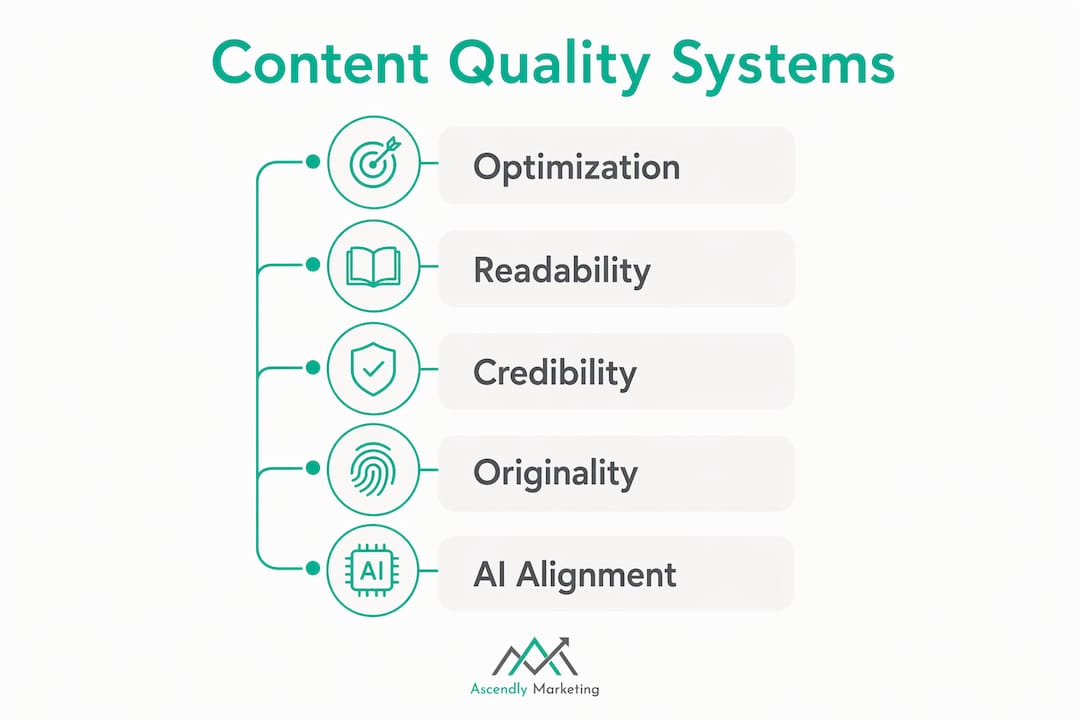
Content quality is multi-dimensional: optimization drives acquisition, readability improves comprehension, and fact accuracy ensures credibility. These three systems operate independently, which means a well-optimized article can still confuse readers, and a beautifully written piece can still rank poorly if it lacks keyword signals.
Optimization is the system search engines measure most directly. It includes keyword placement, semantic relevance, internal linking, and structured data. Optimization determines whether your content gets found at all.
Readability governs how easily your audience processes what they find. Improving readability keeps audiences engaged once they arrive, but it does not directly correlate with search traffic on its own. Tools like Hemingway Editor and Grammarly help writers identify dense sentences, passive voice, and structural problems that push readers away.
Credibility is the most fragile system. Fact accuracy reflects source verifiability and is not always fixable with editing. If your content makes claims that cannot be traced to a reliable source, no amount of optimization or clean formatting will recover the trust you lose. AI platforms, in particular, are increasingly selective about citing sources they can verify.
| System | Primary function | Key tools and signals |
|---|---|---|
| Optimization | Drives search acquisition | Keyword density, semantic coverage, internal links, schema markup |
| Readability | Improves audience comprehension | Hemingway Editor, Grammarly, sentence length, formatting clarity |
| Credibility | Maintains trust and AI citation eligibility | Source citations, verifiable data, author expertise signals |
Pro Tip: Treat each system as a separate editorial checklist. Run your optimization review first, your readability pass second, and your fact-check last. Mixing them in one pass leads to shortcuts in all three.
Content quality in 2026 demands serving human readers, search engines, and AI tools simultaneously. Businesses that optimize for only one of these audiences leave measurable performance on the table.
Does originality matter as much as quality?
Originality and timing are not the same as quality, but they amplify it significantly. Being first to publish unique insights often yields AI search advantages that quality content alone cannot guarantee if published too late. This is a distinction most SMB marketers miss entirely.
AI platforms like Perplexity and ChatGPT pull from indexed sources when generating responses. If your competitor publishes a well-sourced breakdown of a trending topic two weeks before you do, their article gets embedded in AI responses first. Your equally good article, published later, competes for a slot that is already occupied.
Originality helps most in queries requiring judgment, perspective, or synthesis. For purely factual queries, being first matters less because AI platforms can compare multiple sources. But for opinion-driven or analysis-heavy topics, the first credible voice often becomes the default citation.
This has direct implications for your content calendar:
- Publish original analysis and proprietary data as soon as it is ready. Do not wait for a “perfect” polish pass that delays you by weeks.
- Monitor trending topics in your industry using tools like Google Trends or SparkToro. Being three days early beats being three weeks late with a better-formatted post.
- Derivative content, meaning articles that summarize what others have already said, rarely earns AI citations regardless of how well it is written.
- First-party research, client case studies, and original surveys give your content a credibility signal that no amount of rewriting can replicate.
Understanding the role of AI in SMB marketing helps you see why originality is now a competitive asset, not just a creative preference.
How to improve content quality as a small business
The benefits of high-quality content only materialize when you build systems to produce it consistently. Here is a prioritized process for SMBs working with limited time and budget.
Set editorial standards before you publish. Define what “helpful” means for your audience. Google’s self-assessment questions are a practical starting point. Ask whether your content provides information that cannot be found easily elsewhere, and whether a subject-matter expert would stand behind it.
Audit existing content before creating new content. Scaling without quality control leads to short-lived traffic spikes followed by declines. Identify your lowest-performing pages by organic traffic and engagement metrics. Improve, consolidate, or remove them before adding to your site’s content volume.
Optimize for search intent, not keyword density. Place your primary keyword in the title, first paragraph, and at least one subheading. Then write for the question your reader is actually asking. Keyword stuffing signals low quality to Google and reads poorly to humans.
Format for readability. Use subheadings every 200 to 300 words. Keep paragraphs to three to five sentences. Write at a 10th to 12th grade reading level. Readers who can process your content quickly are more likely to stay, share, and convert.
Fact-check every claim before publishing. Link to primary sources, not secondary summaries. If a statistic cannot be traced to an original study or report, remove it. Unverifiable claims damage credibility with both readers and AI citation systems.
Track AI citations alongside traffic. Use tools like Semrush’s AI Overviews tracking or manual searches in Perplexity and ChatGPT to see whether your content is being cited. AI citation is now a measurable quality signal independent of traffic, and it predicts future organic growth.
Pro Tip: Build a simple content scorecard with columns for optimization score, readability grade, and source count. Score every piece before publishing. A consistent scoring habit catches quality gaps before they become ranking problems.
For a deeper look at how these tactics connect to search performance, the content marketing strategy guide for SMBs from Ascendly Marketing covers the full planning cycle.
Key takeaways
High-quality content requires optimization, readability, and credibility to work as independent, parallel systems rather than a single linear process.
| Point | Details |
|---|---|
| Optimization drives traffic | Articles scoring above 70% in optimization receive 5.4x more traffic than low-scoring content. |
| Site-wide quality affects all pages | Google suppresses entire domains with high ratios of unhelpful content, not just individual weak pages. |
| Three systems work independently | Improving optimization does not fix readability or credibility. Each requires its own review process. |
| Originality amplifies quality | Being first with unique insights gives AI platforms a reason to cite you over later, equally good content. |
| Audits beat volume | Removing or improving weak content often produces faster ranking gains than publishing new articles. |
What working with SMB content since 2013 has taught us
The most common mistake we see from small and medium-sized businesses is treating content as a volume game. The logic sounds reasonable: more posts mean more chances to rank. In practice, it backfires. A site with 200 thin articles suppresses its own best content. We have watched businesses spend months recovering from that exact pattern after Google’s quality signals caught up with them.
The second mistake is treating optimization, readability, and credibility as one job. They are not. A writer who is great at SEO is not automatically a great fact-checker. A fact-checker is not automatically a great editor for readability. When one person handles all three without a structured process, at least one system gets shortchanged every time.
What actually works is treating content quality as an ongoing operational discipline, not a one-time creative effort. The businesses that grow consistently through content are the ones that audit regularly, set measurable standards, and track AI citations alongside traditional traffic metrics. They also publish original perspectives rather than summaries of what everyone else has already said.
The search engine marketing strategies that compound over time are built on this foundation. Quality is not a differentiator anymore. It is the baseline requirement for staying visible.
— Ascendly Marketing
How Ascendly Marketing can help you build content that ranks

Ascendly Marketing has helped SMBs build content programs that perform across search, AI citations, and audience engagement since 2013. Our team of SEO specialists and content creators applies the three-system quality framework described in this article to every piece we produce, from initial keyword research through editorial review and fact-checking.
If your current content is not generating the organic traffic your business needs, the problem is almost always fixable. Start with our organic SEO guide to understand exactly how content quality connects to search rankings, or book a consultation with our team to get a site-wide content audit tailored to your business goals.
FAQ
Why does content quality matter more than content volume?
Google’s site-wide quality signal suppresses entire domains with too much unhelpful content, meaning a high volume of thin articles actively harms your best-performing pages. Fewer, well-optimized, credible articles consistently outperform large libraries of low-quality posts.
How does content quality affect SEO rankings?
Articles with optimization scores above 70% receive 5.4 times more monthly traffic than those scoring 40 to 49%, according to a 2026 DesignRush study. Optimization, readability, and fact accuracy each contribute to rankings through separate mechanisms.
What is the role of originality in content quality?
Originality matters most for queries requiring judgment or perspective. Being first to publish unique insights gives AI platforms like Perplexity and ChatGPT a reason to cite your content over later, derivative articles covering the same topic.
How long does it take to recover from Google’s quality suppression?
Recovery from Google’s quality suppression requires site-wide improvements and can take several months before the algorithm reassesses your domain. Simply publishing new content is not enough. Existing unhelpful content must be improved or removed.
What tools help improve content quality for SMBs?
Hemingway Editor and Grammarly address readability. Semrush and similar platforms measure optimization scores. For credibility, the most effective practice is linking every factual claim to a primary source and running a structured fact-check before publishing.