

TL;DR:
- A website redesign is a strategic overhaul affecting architecture, UX, branding, and SEO to solve business problems.
- Redesigns are necessary when multiple structural issues like high bounce rates or slow load times persist.
- Proper planning, testing, and ongoing monitoring are essential to protect SEO and achieve measurable growth outcomes.
A website redesign is one of the most misunderstood investments a small business can make. Most owners assume it means picking new colors, swapping photos, and calling it done. The reality is far more strategic. A well-executed redesign can shift how your site ranks in search results, how many visitors convert into paying customers, and how much revenue flows through your digital front door. This guide breaks down exactly what website redesign means, when your business needs one, what the process looks like, and how to protect your search traffic while doing it.
Table of Contents
- What is website redesign? Definition and core elements
- When (and why) should an SMB consider redesigning?
- What does the website redesign process involve?
- Avoiding traffic loss: The SEO and conversion checklist
- Our take: Website redesigns that deliver real results
- Partner with experts for your next redesign
- Frequently asked questions
Key Takeaways
| Point | Details |
|---|---|
| Redesign goes beyond visuals | Effective website redesign addresses structure, SEO, and conversion—not just look and feel. |
| Know when to redesign | Pursue a full redesign only if key performance and technical warning signs are present. |
| Preserve your SEO | Protect search traffic with proper planning, 301 redirects, and SEO audits. |
| Invest in outcomes, not just appearance | Set clear goals and focus resources where they’ll directly impact your business growth. |
What is website redesign? Definition and core elements
A website redesign is a strategic overhaul of your existing site. It goes well beyond swapping out fonts or refreshing your logo. A true redesign touches your site architecture, user experience (UX), branding, technical performance, and search engine optimization (SEO) all at once. Think of it like renovating a building rather than repainting the walls.
The goal is to solve real business problems. That might mean reducing a high bounce rate, improving page load speed, modernizing an outdated content management system (CMS), or restructuring your navigation so visitors find what they need faster. As redesign best practices confirm, addressing structural issues rather than aesthetics alone is what separates a redesign that drives growth from one that just looks good.
Here are the core elements typically involved in a full website redesign:
- Site architecture: How pages are organized and linked together
- User experience (UX): How easy and intuitive it is to navigate
- Visual branding: Colors, typography, imagery, and overall design language
- Performance: Load speed, mobile responsiveness, and Core Web Vitals scores
- SEO structure: URL patterns, metadata, heading hierarchy, and internal linking
- Content strategy: Updating, consolidating, or removing outdated pages
Understanding website design essentials before starting helps you set realistic goals. Here is a quick comparison of what triggers a redesign versus what does not:
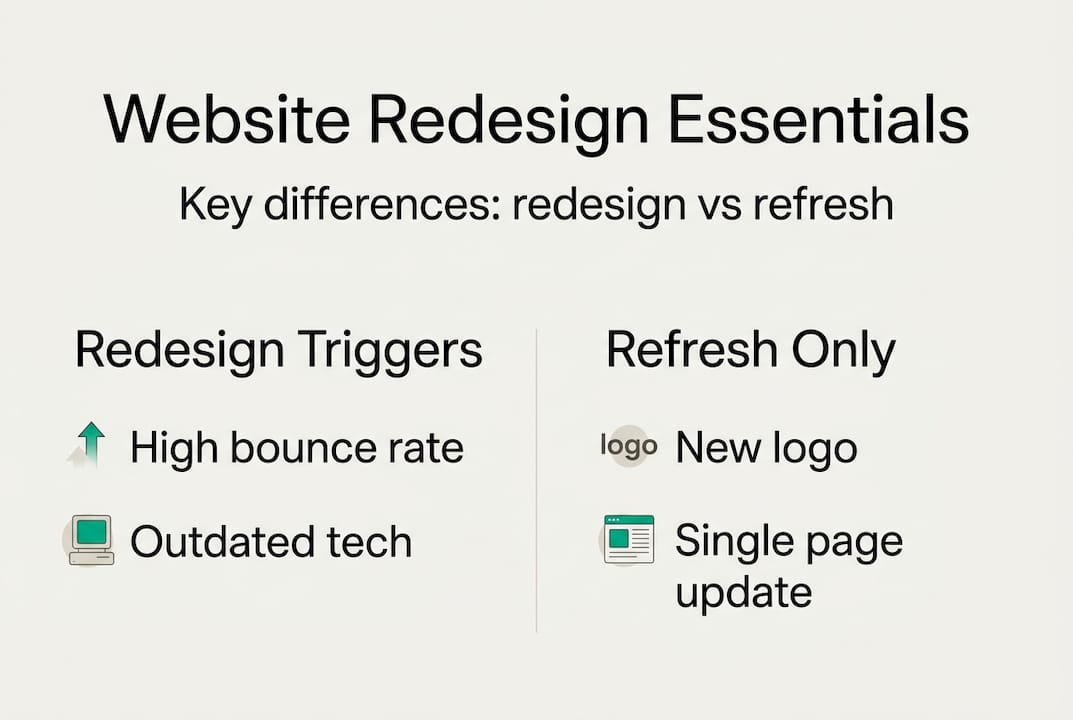
| Redesign trigger | Not a redesign trigger |
|---|---|
| Bounce rate above 70% | Updating a single blog post |
| Outdated CMS or broken plugins | Changing a hero image |
| Mobile experience is broken | Tweaking button colors |
| Conversion rate below 1-2% | Adding a new team member photo |
| Site loads in over 3 seconds | Minor copy edits |
If you are seeing multiple items from the left column, it is time to have a serious conversation about website design tips and what a full overhaul could do for your bottom line. Working with a professional web design agency ensures that every element is addressed with strategy, not guesswork.
When (and why) should an SMB consider redesigning?
Not every site problem calls for a full redesign. Knowing the difference between a refresh and an overhaul saves you time, money, and headaches. A refresh is a lighter-touch update: adjusting visuals, updating content, or improving a single page’s layout. A redesign is a structural rebuild that changes how your entire site functions and performs.
The rule of thumb we use: if your site has three or more persistent structural issues, a redesign is likely justified. Data-driven audits consistently show that multiple compounding problems rarely get solved by surface-level fixes.
Here are the red flags that signal a redesign is overdue:
- High bounce rate (above 70%) with no clear single-page cause
- Outdated technology such as a CMS that no longer receives security updates
- Slow load times exceeding 3 seconds on mobile devices
- Declining conversions over 2 or more consecutive quarters
- Poor mobile experience that frustrates visitors on phones and tablets
- Brand inconsistency where your site no longer reflects your current business identity
- Inaccessible design that fails basic accessibility standards
If only one or two of these apply, a targeted refresh may be the smarter move. It carries less risk, costs less, and can still deliver a meaningful bump in your website conversions. Applying best website design practices during a refresh can also extend the life of your current site by 12 to 18 months before a full overhaul becomes necessary.
Pro Tip: Before committing to either option, run a basic analytics audit. Pull your top 10 landing pages, check bounce rates and average session durations, and look for patterns. If your highest-traffic pages are also your highest-bounce pages, that is a structural problem, not a content problem.
The key is to make this decision based on data, not frustration. A site that feels old to you may still be performing well for your visitors. Let the numbers guide the conversation.

What does the website redesign process involve?
Once you have recognized the signs, what should you expect from a well-managed redesign project? The process is more structured than most business owners realize, and skipping steps is where projects go sideways.
Here is the typical sequence for a results-driven SMB website redesign:
- Audit your current site for performance, SEO, content gaps, and UX issues
- Set measurable goals tied to business outcomes (leads, sales, rankings)
- Define your sitemap and architecture before any design work begins
- Design wireframes and mockups for key pages and get stakeholder sign-off
- Develop the site on a staging environment, never on your live site
- Migrate SEO using 301 redirects, updated metadata, and a full URL map
- Test thoroughly across devices, browsers, and load conditions
- Launch and monitor analytics closely for the first 30 to 60 days
One of the most overlooked steps is SEO migration. Skipping it can cost you dearly. The role of SEO in website redesign is critical because changing URLs or removing pages without redirects signals to Google that your content has disappeared. For ecommerce businesses, following ecommerce SEO best practices during the redesign is especially important for protecting product page rankings.
Pro Tip: Always build and test your redesign on a staging site. Launching directly to your live domain without testing is one of the fastest ways to break your existing SEO and frustrate current visitors.
As for cost and time, here is a realistic breakdown based on industry data:
| Project type | Estimated cost | Typical timeline |
|---|---|---|
| Basic small business site | $2,000 to $8,000 | 6 to 8 weeks |
| Mid-size business site | $8,000 to $20,000 | 8 to 12 weeks |
| Complex or ecommerce site | $20,000 to $40,000+ | 12 to 16 weeks |
Budget and timeline expectations set early in the project prevent scope creep and miscommunication later.
Avoiding traffic loss: The SEO and conversion checklist
The process itself is vital, but how do you protect your hard-won search traffic and conversion rates during these changes? This is where many SMB redesigns stumble. A beautiful new site that loses 30% of its organic traffic is not a win.
Failing to plan your SEO migration carefully can result in 20 to 40% traffic drops after launch. That is not a small dip. For a business generating 500 leads per month from organic search, that could mean losing 100 to 200 leads every single month.
Here is a prioritized checklist to protect both your rankings and your conversions:
- Map every existing URL and create 301 redirects for any that will change
- Preserve existing metadata (title tags and meta descriptions) on high-performing pages
- Audit internal links post-launch to eliminate broken links
- Test page speed on mobile before going live using Google PageSpeed Insights
- Submit a new XML sitemap to Google Search Console immediately after launch
- Set up conversion tracking in Google Analytics before the site goes live
- Monitor 404 errors daily for the first two weeks after launch
Applying best UX practices during the redesign also directly supports conversions. Clear calls to action, logical page flow, and fast load times all reduce friction for visitors. A redesign that improves your guide to improve conversions while protecting rankings is the real goal.
Post-launch monitoring is not optional. Set a 30-day review cadence where you check organic traffic, conversion rates, and crawl errors. Catching issues early means fixing them before they compound into larger revenue losses.
Our take: Website redesigns that deliver real results
Here is something most redesign guides will not tell you: the majority of SMB website redesigns underperform not because of bad design, but because of misaligned goals. Business owners come in wanting a new look. What they actually need is a higher conversion rate, better search visibility, or a lower cost per lead.
We have seen it repeatedly in our agency case studies. The projects that deliver transformational results are the ones where the business owner could answer one question before the first wireframe was drawn: What specific business problem are we solving? Not “our site looks old.” Something measurable. Something tied to revenue.
The other uncomfortable truth is that a redesign is not a finish line. It is a starting point. The businesses that see sustained growth from a redesign are the ones that continue testing, adjusting, and iterating after launch. They treat their website like a living sales tool, not a brochure that gets updated every few years.
If your redesign plan does not include post-launch testing milestones and conversion goals, it is incomplete. Aesthetics matter, but they are the last thing you should be optimizing for.
Partner with experts for your next redesign
Putting these strategies into practice requires more than good intentions. A website redesign that moves the needle on traffic, leads, and revenue needs coordinated expertise across design, development, SEO, and conversion strategy.

At Ascendly Marketing, we have been helping small and medium-sized businesses build websites that work as hard as they do since 2013. Our integrated team handles everything from initial audits to post-launch monitoring, so nothing falls through the cracks. Explore our website design services to see how we approach redesigns with a results-first mindset, or browse our full range of digital marketing services to understand how your site fits into a broader growth strategy. Let’s build something that performs.
Frequently asked questions
How much does website redesign cost for small businesses?
Costs typically range from $2,000 to over $40,000, depending on the scope, complexity, and features required for your project.
How long does a typical website redesign take?
Most SMB website redesigns are completed within 6 to 16 weeks, with timelines scaling based on the number of pages, integrations, and revision rounds involved.
Will I lose SEO rankings if I redesign my website?
Without proper planning, traffic drops of 20 to 40% are possible, but implementing 301 redirects, preserving metadata, and running pre-launch audits significantly reduces that risk.
When should I choose a redesign instead of a website refresh?
Opt for a full redesign when your site has three or more structural issues such as high bounce rates, outdated technology, or broken mobile experiences. Choose a refresh for minor visual or content updates.
How do I ensure my redesign actually improves results?
Set specific business goals before the project starts, track key metrics throughout, preserve your SEO structure, and monitor conversions closely after launch to connect the redesign directly to measurable outcomes.