

Many business owners believe a fresh website design automatically improves search rankings. The truth is, redesigning without SEO integration can tank your organic traffic overnight. Search engines penalize sites that lose their structural integrity during redesigns, and recovering lost rankings costs far more than preventing them. This guide shows you exactly how to embed SEO into every redesign phase, protecting your visibility while amplifying lead generation. You’ll learn the strategies that turn redesign projects into growth engines rather than traffic disasters.
Table of Contents
- Why Ignoring SEO During Website Redesign Can Hurt Your Business
- Core SEO Strategies to Integrate Seamlessly into Your Website Redesign
- Maintaining Technical SEO Foundations During and After Redesign
- Collaboration and Ongoing SEO Monitoring for Successful Redesign Outcomes
- How Ascendly Marketing Can Support Your SEO-Friendly Website Redesign
- FAQ
Key takeaways
| Point | Details |
|---|---|
| SEO prevents traffic loss | Integrating SEO during redesign protects existing rankings and maintains organic visibility. |
| Keyword strategy matters | Updated keyword research ensures content aligns with current search intent and user behavior. |
| Technical foundations essential | Mobile responsiveness, site speed, and crawlability must be maintained or improved throughout redesign. |
| Team collaboration critical | Coordinated efforts between designers, developers, and SEO specialists deliver better outcomes. |
| Ongoing monitoring required | Post-launch analytics tracking identifies issues early and guides continuous optimization. |
Why ignoring SEO during website redesign can hurt your business
Redesign projects often prioritize aesthetics over function, creating beautiful sites that search engines can’t properly index. Neglecting SEO in a redesign can cause significant organic traffic loss that takes months to recover. The most damaging mistakes happen when teams change URL structures without implementing proper redirects, essentially telling search engines that your valuable content no longer exists.
Common pitfalls include removing optimized content to make room for flashy design elements. When you strip away keyword-rich copy for minimalist layouts, you’re sacrificing the very signals that brought visitors to your site. Another critical error involves changing navigation structures without considering how search engines crawl your pages. If bots can’t find your content easily, neither can potential customers.
Consider these frequent redesign mistakes:
- Launching new sites without 301 redirects from old URLs
- Removing or drastically shortening content for design simplicity
- Implementing JavaScript-heavy frameworks that block crawlers
- Changing title tags and meta descriptions without keyword analysis
- Ignoring mobile optimization in favor of desktop aesthetics
“A website redesign without SEO consideration is like renovating a store but forgetting to update the address. Your customers can’t find you, no matter how beautiful the new location looks.”
The disconnect between design teams and the role of SEO specialists creates these problems. Designers focus on user interface while developers prioritize functionality, leaving SEO as an afterthought. This siloed approach means nobody owns the responsibility of maintaining search visibility during transitions. Small businesses suffer most because they lack dedicated SEO resources to catch issues before launch.
Timing matters enormously. Discovering SEO problems after launching means scrambling to fix technical debt while your competitors capture the traffic you’re losing. The cost of emergency SEO repairs often exceeds what proper planning would have required. Beyond immediate traffic drops, damaged rankings can suppress lead generation for quarters, directly impacting revenue growth.
Core SEO strategies to integrate seamlessly into your website redesign
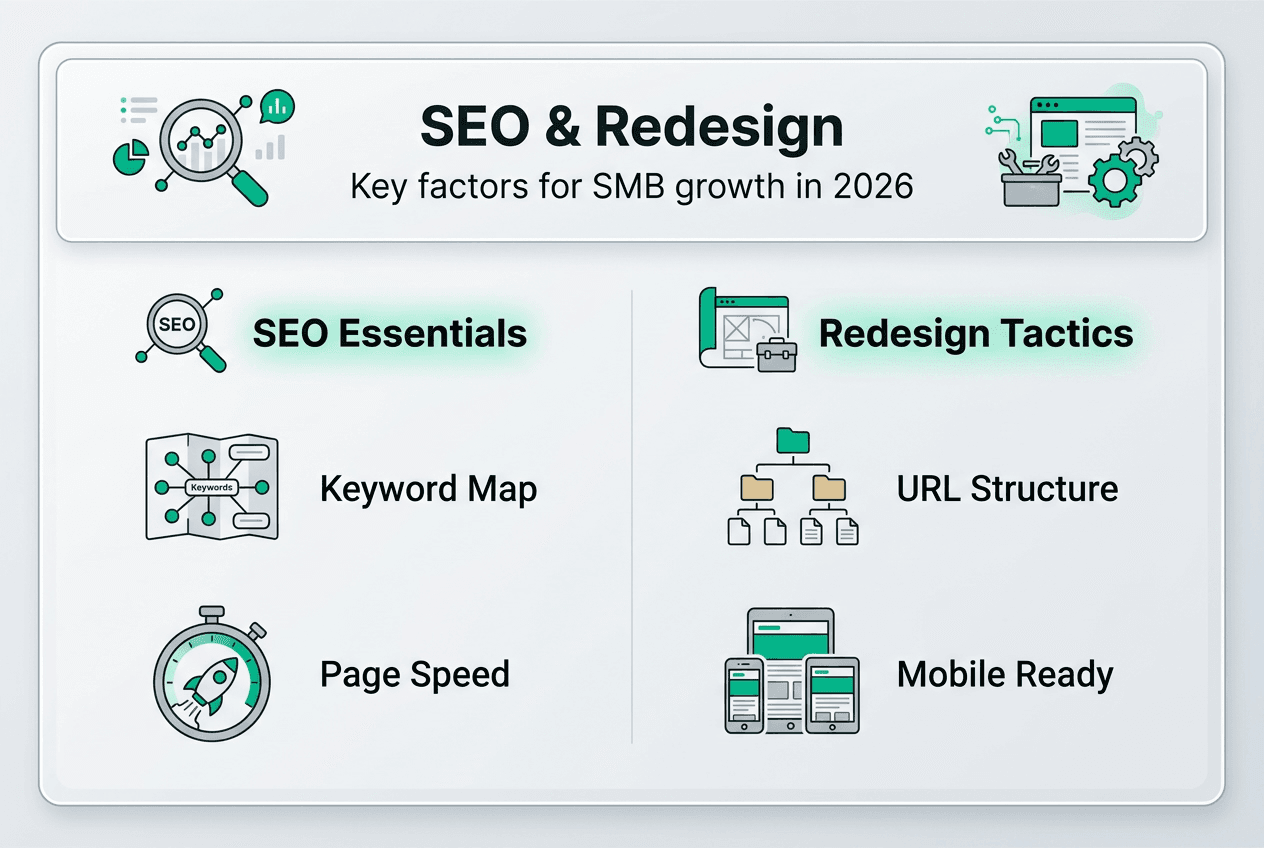
Successful redesigns start with comprehensive keyword research before any design work begins. Search behavior evolves constantly, so keywords that drove traffic two years ago might not reflect current user intent. Analyze your existing top-performing pages, identify which keywords still matter, and discover new opportunities your competitors are capturing. This foundation ensures every redesigned page targets terms your audience actually searches.
URL structure decisions made early prevent massive redirect chains later. Keep existing URLs whenever possible, especially for pages with strong backlink profiles or established rankings. When changes are necessary, create a detailed redirect map matching every old URL to its new equivalent. Implement 301 redirects properly to transfer link equity and maintain search engine trust. Never launch without testing every redirect to confirm it works correctly.

On-page optimization must improve, not just maintain current standards. Craft title tags that include primary keywords while staying under 60 characters for full display in search results. Write meta descriptions that compel clicks while naturally incorporating target phrases. Structure content with H1, H2, and H3 tags that create clear hierarchy for both users and crawlers. Each heading should advance your topic while including relevant semantic keywords.
Content strategy deserves equal attention to design aesthetics. Audit existing content to identify high-performers worth preserving and thin pages needing consolidation or removal. Create new content that fills gaps in your topic coverage, addressing questions your audience asks, but your old site didn’t answer. Align every piece with specific search intent, whether informational, navigational, or transactional. Quality content that genuinely helps users will always outperform keyword-stuffed fluff.
- Conduct competitive keyword gap analysis to find untapped opportunities
- Map keywords to specific pages based on search intent and business goals
- Optimize image alt text with descriptive, keyword-relevant phrases
- Implement internal linking strategies that distribute page authority effectively
- Create compelling calls to action that guide users toward conversion goals
Pro Tip: Set up Google Search Console and Analytics before launch to establish baseline metrics. This allows immediate comparison of pre- and post-redesign performance, helping you spot issues within days rather than months.
The organic SEO guide emphasizes that keyword and content strategy during redesign significantly influence search visibility. Following best website design practices ensures your visual improvements support rather than sabotage your SEO efforts. Integration means considering search implications for every design decision, from color schemes to content placement.
Maintaining technical SEO foundations during and after redesign
Technical infrastructure determines whether search engines can access and understand your content. Mobile responsiveness isn’t optional anymore; it’s the primary factor Google uses for indexing and ranking. Test your redesigned site across multiple devices and screen sizes, ensuring every element adapts properly. Page speed directly impacts both user experience and search rankings, so optimize images, minimize code bloat, and leverage browser caching before launch.
Create a comprehensive technical SEO checklist covering these priorities:
- Verify robots.txt file allows crawler access to important pages
- Submit updated XML sitemap to Google Search Console and Bing Webmaster Tools
- Implement HTTPS across the entire site with proper SSL certificates
- Fix broken internal and external links that create dead ends
- Add structured data markup for rich snippets in search results
- Optimize Core Web Vitals including Largest Contentful Paint and Cumulative Layout Shift
- Ensure proper canonical tags prevent duplicate content issues
- Set up breadcrumb navigation for improved crawlability
Technical SEO issues like poor crawlability or slow speed undermine redesign success. Following best UX practices creates sites that satisfy both human visitors and search engine algorithms. The intersection of technical performance and user experience defines modern SEO success.
Schema markup deserves special attention because it helps search engines understand your content context. Implement appropriate schema types for your business, whether local business, product, article, or FAQ schema. Rich results increase click-through rates by making your listings more prominent and informative. This structured data also powers voice search results, capturing traffic from an increasingly important channel.
| Technical Element | Pre-Redesign Check | Post-Launch Verification |
|---|---|---|
| Page Load Speed | Establish baseline metrics | Confirm improvements or maintain speed |
| Mobile Usability | Identify current issues | Test across multiple devices |
| Crawl Errors | Document existing problems | Monitor for new errors |
| HTTPS Status | Verify certificate validity | Ensure no mixed content warnings |
| Core Web Vitals | Measure current scores | Track improvements in real user data |
Pro Tip: Use Google’s PageSpeed Insights and Mobile-Friendly Test tools weekly during development. Catching technical issues early prevents expensive fixes after launch when changing course becomes complicated.
Security considerations tie directly to SEO performance. Search engines prioritize secure sites, and browsers warn users away from non-HTTPS pages. Implement security headers, keep software updated, and monitor for vulnerabilities regularly. A hacked site can lose all its rankings overnight, making security an essential SEO component rather than a separate concern.
Collaboration and ongoing SEO monitoring for successful redesign outcomes
Seamless redesigns require breaking down silos between departments. Establish weekly meetings where designers, developers, and SEO specialists review progress together. Create shared documentation outlining SEO requirements for every redesign phase, from wireframes through launch. When everyone understands how their work impacts search visibility, they make better decisions that support rather than conflict with optimization goals.
Define clear ownership for SEO-related tasks throughout the project timeline. Assign someone to verify that developers implement redirects correctly, that designers maintain content hierarchy, and that content creators follow keyword strategies. Without explicit accountability, critical tasks fall through the cracks during the chaos of launch preparation. Collaboration improves SEO outcomes during website redesign by ensuring no aspect of optimization gets overlooked.
Analytics tracking must continue seamlessly through the redesign process. Set up goal tracking and conversion monitoring before making any changes, establishing baseline performance metrics. Compare traffic patterns, keyword rankings, and user behavior before and after launch. This data reveals whether your redesign achieved its goals or created new problems requiring immediate attention.
Best practices for team collaboration include:
- Schedule design reviews with SEO specialists before finalizing layouts
- Create a shared project management system tracking all SEO-related tasks
- Document decisions and their SEO implications for future reference
- Conduct cross-functional training so everyone understands basic SEO principles
- Establish escalation procedures for resolving conflicts between design and SEO needs
Post-launch monitoring identifies issues while they’re still manageable. Check Google Search Console daily for the first two weeks, watching for crawl errors, indexing problems, or manual penalties. Track organic traffic in Google Analytics, comparing weekly performance to pre-launch baselines. Monitor keyword rankings for your most important terms, noting any significant drops that signal problems.
| Metric | Monitoring Frequency | Action Threshold |
|---|---|---|
| Organic Traffic | Daily for 2 weeks, then weekly | 15% drop triggers investigation |
| Keyword Rankings | Weekly | Top 10 keywords dropping 5+ positions |
| Crawl Errors | Daily for 1 month | Any new 404 errors |
| Page Speed | Weekly | Core Web Vitals falling below thresholds |
| Conversion Rate | Weekly | 10% decline from baseline |
Don’t expect immediate ranking improvements after launch. Search engines need time to recrawl your site, process changes, and adjust rankings accordingly. Most redesigns show their full SEO impact within three to six months. Patience combined with diligent monitoring ensures you catch actual problems rather than panicking over normal fluctuations.
Working with experienced SEO specialists provides expertise most SMBs lack internally. Professional top SEO services offer the technical knowledge and tools needed to navigate complex redesign challenges. This investment protects your existing search visibility while positioning your new site for improved performance.
How Ascendly Marketing can support your SEO-friendly website redesign
Planning a website redesign that actually grows your business requires expertise across multiple disciplines. Ascendly Marketing combines award-winning design with deep SEO knowledge, ensuring your new site looks stunning while dominating search results. Our integrated approach means SEO specialists collaborate with designers from day one, preventing the costly mistakes that plague typical redesign projects.

We’ve guided dozens of SMBs through successful redesigns that increased organic traffic by an average of 47% within six months. Our process includes comprehensive keyword research, technical SEO audits, content optimization, and ongoing monitoring that keeps your site performing at peak levels. Whether you need complete digital marketing services or focused support from an experienced SEO service agency, we tailor solutions to your specific growth goals. Explore our web design services to see how we transform redesign projects into revenue-generating assets.
FAQ
What happens if I don’t include SEO in my website redesign?
Ignoring SEO during redesign typically causes immediate organic traffic drops ranging from 20% to 70%, depending on the severity of technical issues introduced. Recovery requires identifying and fixing problems retroactively, often taking six months or longer while competitors capture your lost market share. The financial impact includes both lost leads during the recovery period and the cost of emergency SEO repairs that proper planning would have prevented.
How early should SEO planning start in a redesign project?
SEO planning must begin during initial strategy discussions, before any wireframes or design mockups are created. Early integration allows keyword research to inform content strategy, ensures URL structures support optimization goals, and prevents design decisions that conflict with search engine requirements. Starting SEO work after design completion forces compromises that weaken both aesthetics and search performance.
What are the most important SEO factors to preserve during redesign?
URL structure preservation or proper 301 redirect implementation ranks as the most critical factor, protecting link equity and established rankings. Maintaining optimized title tags, meta descriptions, and header hierarchies ensures search engines understand your content’s relevance. High-quality content must be preserved and enhanced rather than removed for design simplicity, as this content drives the organic traffic that generates leads and revenue.
How can I measure the SEO success after my website redesign?
Google Analytics tracks organic traffic trends, showing whether your redesign maintained or improved visitor numbers from search engines. Google Search Console reveals keyword ranking changes, indexing status, and technical issues requiring attention. Monitor conversion rates to ensure your new design doesn’t just attract traffic but actually generates more leads than your old site. Compare metrics monthly for at least six months to account for normal search engine fluctuations and seasonal variations.