
Most advice about a b2b lead generation funnel starts with the same bad target: get more leads.
That target creates busy dashboards and weak pipeline. Marketing celebrates form fills, sales rejects half the list, and leadership wonders why revenue still feels unpredictable. The issue usually isn't effort. It's that the funnel was built as separate tactics instead of one connected system.
A working funnel behaves like a machine. Your ICP shapes the traffic you buy and the topics you publish. Your content matches buying stage. Your forms capture just enough information to move the conversation forward. Your automation routes, scores, and nurtures. Your CRM tells sales what happened before the handoff. If one part is disconnected, the whole thing slows down.
Your Funnel Is Leaking Money Let's Fix It
The popular advice says volume solves pipeline problems. In practice, volume often hides them.
If you're paying for clicks, sponsoring content, sending outbound campaigns, and producing articles, low-quality demand gets expensive fast. According to Zero Gravity Marketing's analysis of why B2B lead generation fails, for an SMB spending a median of $213 per lead and targeting $10K deals, converting just 0.94% of leads means $22,578 is wasted per closed deal. The same analysis notes that if 90% of MQLs stall because of weak nurturing or poor handoffs, a business generating 1,000 MQLs per year loses approximately $2M in potential pipeline.
That changes the conversation. The problem isn't "we need more names in the CRM." The problem is that too many companies buy traffic, collect contacts, and then let the middle of the funnel collapse.
Practical rule: If sales keeps saying leads are weak, don't increase spend first. Audit the journey between first conversion and sales handoff.
The fix is system design. Each part of the funnel needs a job, and each job has to connect to the next one. That means:
- Attraction tied to fit so the right companies enter the funnel
- Offers tied to intent so early-stage visitors don't get forced into sales calls
- Nurture tied to behavior so follow-up reflects what the lead did
- Handoffs tied to criteria so sales receives leads with context, not guesses
A lot of conversion work starts before the landing page. If the audience, message, and offer don't line up, the page won't save you. That's why a funnel audit usually sits next to a broader conversion rate improvement process, not apart from it.
You don't need a bigger funnel. You need a tighter one.
Architecting Your Funnel Foundation
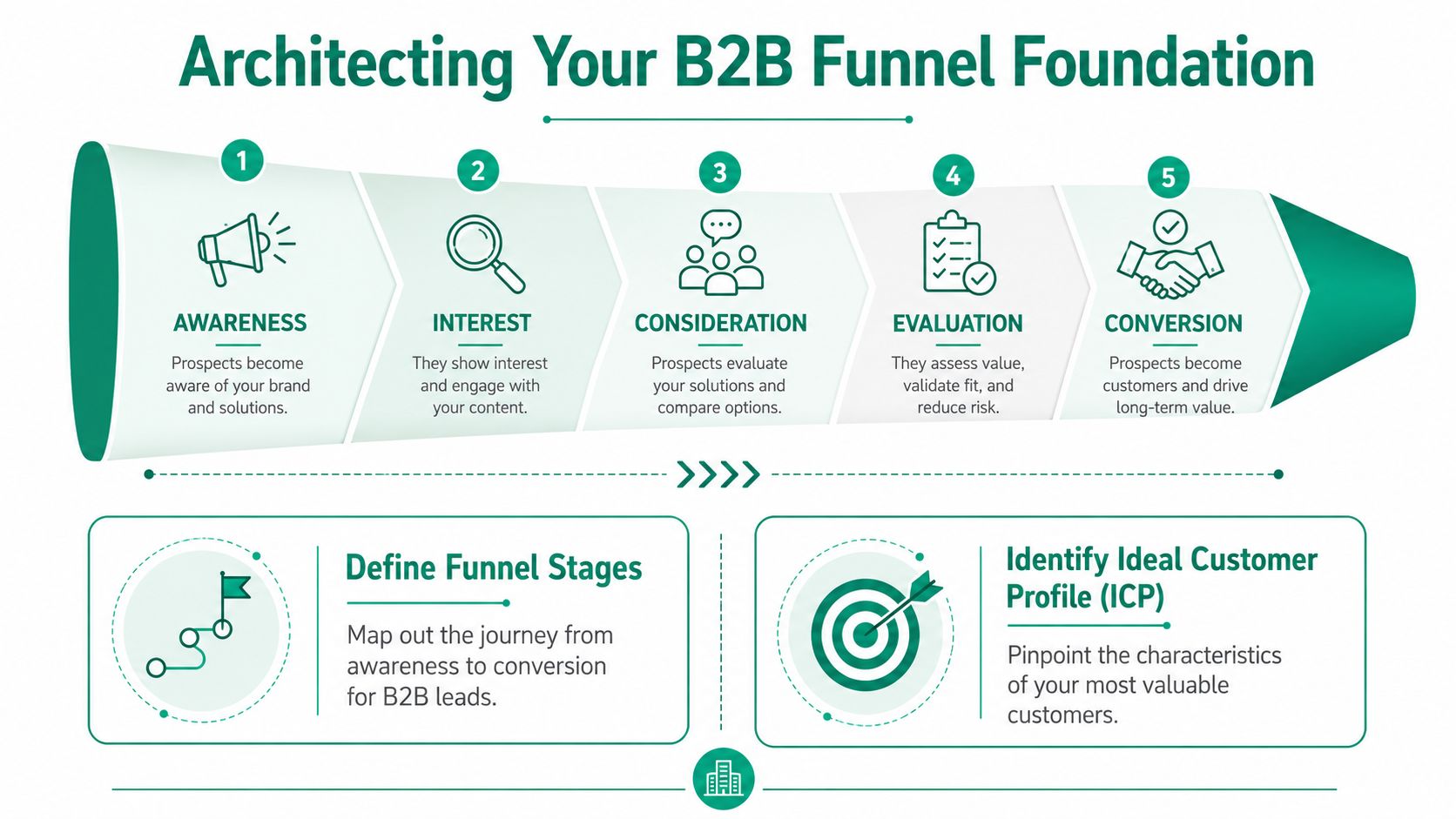
A funnel breaks down when the business hasn't decided who it wants or how buying intent develops. Before campaigns go live, define the path and define the fit.
Define the stages clearly
Most B2B teams still work with three practical stages.
TOFU is awareness. The prospect knows a problem exists, but hasn't decided what kind of solution to pursue.
MOFU is consideration. The prospect is comparing approaches, vendors, and internal priorities.
BOFU is decision. The prospect wants proof, specifics, and a clear next step.
Those labels only help if your team applies them consistently. A blog visitor reading one educational article is not a demo-ready lead. A pricing-page visitor who also requested a consultation isn't in the same bucket as someone who downloaded a checklist two weeks ago.
A simple stage model avoids two common mistakes:
| Stage | What the buyer needs | What your team should do |
|---|---|---|
| TOFU | Clarity on the problem | Educate and earn attention |
| MOFU | Confidence in possible solutions | Nurture, segment, and qualify |
| BOFU | Proof and buying support | Remove friction and hand off fast |
Build the ICP before you build campaigns
The Ideal Customer Profile, or ICP, is the filter for the whole funnel. Without it, teams create content for everyone, launch ads to broad audiences, and then act surprised when low-fit leads show up.
According to Zigaflow's write-up on common mistakes in B2B lead generation, funnels with a clearly defined ICP achieve 2-3x higher conversion rates from leads to opportunities, while imprecise ICPs lead to 68% of marketing resources being wasted on unqualified prospects.
That stat matters because it points to where efficiency starts. Not with ad creative. Not with sales scripts. With targeting discipline.
What to put inside the ICP
A usable ICP doesn't live in a slide deck. It gives your team decisions it can act on.
Include these inputs:
- Firmographics such as industry, company size, business model, and market position
- Operational pain points that your service or product addresses
- Buying committee roles involved in research, approval, and implementation
- Known disqualifiers so you stop forcing low-fit accounts through the funnel
- Channel behavior so you know where these buyers pay attention
If your targeting can't explain why one company belongs in the funnel and another doesn't, the ICP isn't finished.
The strongest ICPs also reflect reality from closed deals and lost deals. Sales hears objections. Account managers hear implementation friction. Marketing sees content engagement and source quality. Put those views together, and the funnel starts with better raw material.
Mapping Channels and Content to Funnel Stages
Teams often pick channels first. That's backwards.
A channel only works when it matches buyer intent and when the content on that channel matches funnel stage. SEO isn't "good for lead gen" by itself. LinkedIn Ads aren't "for B2B" by default. Email isn't "nurture" unless the message fits what the lead has already shown interest in.
Use one content map for the whole system
At this point, many funnels stop acting like a machine. Content gets planned by topic, paid media gets planned by budget, and outbound gets planned by the sales calendar. The result is overlap in some places and empty space in others.
A better setup maps stage, goal, asset, and distribution in one view.
Content and Channel Mapping by Funnel Stage
| Funnel Stage | Goal | Content Types | Channels |
|---|---|---|---|
| TOFU | Reach the right prospects and frame the problem | Educational blog posts, guides, infographics, industry explainers | SEO, organic social, broad paid social, newsletter sponsorships |
| MOFU | Help prospects compare approaches and stay engaged | Webinars, comparison pages, solution guides, email sequences, case-based content | LinkedIn Ads, retargeting, email nurturing, YouTube, remarketing |
| BOFU | Remove buying friction and create sales conversations | Demos, pricing pages, consultation pages, sales emails, proposal support content | Branded search, direct outreach, sales follow-up, high-intent retargeting |
That table should drive your editorial calendar, your paid media plan, and your CRM workflow. If a stage has no defined content, leads will stall there. If a stage has content but no distribution, the asset won't matter.
What works at TOFU and what doesn't
Top-of-funnel content works when it speaks to the buyer's problem in plain language. It fails when it introduces your service too early.
Use TOFU for:
- Problem education through search-focused articles and practical guides
- Audience qualification by publishing topics that low-fit buyers won't care about
- Traffic shaping so future retargeting pools contain better prospects
Avoid TOFU content that acts like a disguised product page. Early-stage buyers don't want a pitch disguised as thought leadership.
A focused B2B content marketing strategy usually starts by identifying which topics pull in relevant visitors, then attaching the right next-step offer to those pages.
MOFU is where intent gets built
Middle-of-funnel content should narrow the field. This is the stage where buyers ask harder questions. How does this work? How is this different? Will this fit our process? What happens after implementation?
That means your channels also get narrower. Retargeting works well here because it keeps your brand in front of people who already engaged. Email becomes useful here because you're responding to a known action. LinkedIn targeting becomes stronger here because messaging can speak to role and use case.
A TOFU article earns attention. A MOFU asset earns continuation.
BOFU needs specificity
Bottom-of-funnel assets don't need to be clever. They need to be clear.
Good BOFU content usually includes direct answers to buying questions:
- Scope so the buyer understands what they are evaluating
- Process so internal stakeholders know what happens next
- Fit so weak opportunities self-select out
- Action so high-intent leads can move without friction
When content and channels are mapped this way, your funnel stops behaving like a set of random campaigns. It becomes sequenced. That changes lead quality before sales ever gets involved.
Designing Your Lead Capture and Nurture Engine
Traffic becomes pipeline only after capture and follow-up work together.
A lot of funnels fail right after the first conversion. Someone downloads a guide, fills out a form, or signs up for a webinar, and then nothing useful happens. They get a generic confirmation email, maybe a sales touch at the wrong time, and then they disappear.
What a healthy capture flow looks like
Say a prospect lands on an SEO article about a common operational problem. The article offers a downloadable guide that goes deeper on evaluation criteria. The form asks for enough information to route and segment the lead, but not so much that the page feels like procurement paperwork.
Once the form is submitted, the lead shouldn't go straight to sales unless the action signals buying intent. In most cases, the better move is to place that contact into a nurture path based on topic and source.
If your team is refining form strategy, a practical example is this guide on collecting Salesforce leads with AI forms, which shows how form capture and CRM sync can reduce manual cleanup and route lead data more cleanly.
Nurture should follow the lead's behavior
The first follow-up email should deliver the promised asset and point to the next logical step. If the lead engaged with educational content, offer related educational content. If they viewed a service page after downloading, introduce a more direct consideration asset. If they request high-intent information, route them faster.
According to LeadsBridge's overview of the B2B lead generation funnel, nurtured leads generate a 20% increase in sales opportunities, a 47% larger average purchase size, and have 23% shorter sales cycles compared to non-nurtured leads. The same source notes that 79% of leads fail to convert without proper nurturing.
That lines up with what practitioners see every day. Most leads aren't ready for a call the moment they identify themselves. They need sequencing, context, and a reason to continue.
The first conversion isn't proof of readiness. It's permission to keep the conversation relevant.
A simple nurture path often includes:
- Email one with asset delivery and one related resource
- Email two with a use-case or comparison angle
- Email three with a stronger commercial signal such as a consultation or demo
- Behavior rules that change the path when the lead revisits key pages
This is also where marketing automation for B2B becomes useful. Automation isn't there to flood inboxes. It gives your team a way to deliver the next right message based on timing and behavior.
A short explainer helps if you're reviewing this flow with your team: