

TL;DR:
- AI-driven budget optimization reallocates ad spend instantly based on real-time data, improving ROAS and reducing waste. Conduct a 90-day pilot by defining clear objectives, unifying measurement, and establishing governance to ensure measurable results and scale effectively. The success depends on proper measurement infrastructure, transparent AI capabilities, and disciplined management to avoid early overrides and creative fatigue.
AI-driven budget optimization reallocates ad spend in real time, raising ROAS while cutting wasted dollars. Start here: define your optimization objective, pick one paid channel for a 90-day pilot, and assign a measurement owner before you touch a single budget line.
Your immediate checklist:
- Define the objective function. Short-term ROAS, cost per acquisition, or lifetime value? Pick one and document it.
- Pick a scoped pilot: One product line, one channel, one cohort. Paid search or paid social are the fastest to instrument.
- Set measurement before you spend. GA4 conversion events, UTM governance, and a CRM revenue join must be live on day one.
Dependencies to confirm before launch:
- Ad platform API connections (Google Ads, Meta, or your DSP) feeding a unified data layer
- Server-side event tracking configured and tested
- A named measurement owner with authority to pause or escalate reallocations
- One or two vendor options shortlisted for evaluation (see the selection criteria below)
Table of Contents
- What does AI budget optimization actually do for ROAS and CPA?
- Which AI capabilities actually move the needle on budget performance?
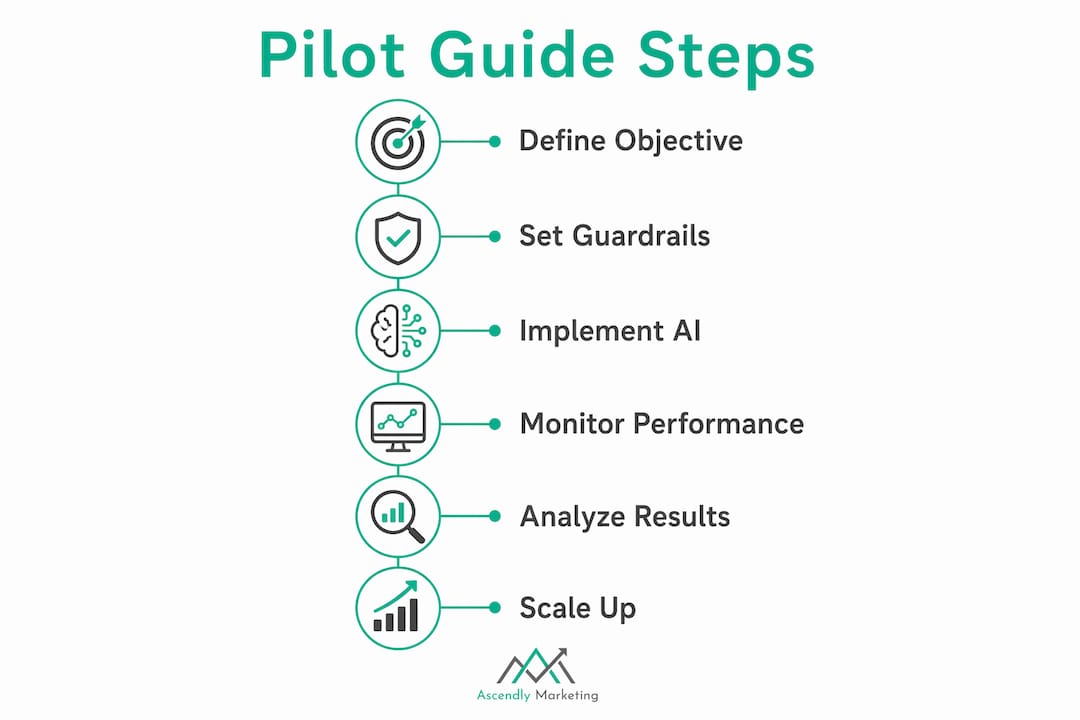
- How to run a 90-day AI budget optimization pilot
- What KPIs and reporting cadence should you track?
- What the research says about measurement maturity and where teams fail
- Where does AI budget optimization deliver results in practice?
- How do you evaluate and choose the right AI budget optimization tool?
- Two budget allocation templates to start your pilot
- What does AI budget optimization actually cost?
- Key Takeaways
- The part most teams get wrong about AI budget optimization
- Ascendly Marketing can scope and run your first AI budget pilot
- Useful sources and further reading
What does AI budget optimization actually do for ROAS and CPA?
The core promise is speed and precision. A human media buyer reviews performance weekly; an AI agent reviews it continuously and adjusts the budget within the guardrails you set. That difference in decision latency is where the gains come from.
Primary outcomes marketing teams report after implementing AI-driven reallocation:
- Higher ROAS from shifting spend toward campaigns and audiences with the strongest predicted conversion probability
- Lower CPA/CAC by deprioritizing placements and creatives that consume budget without converting
- Reduced manual overhead as automated bid and budget rules replace hours of spreadsheet work
- Faster reaction to market shifts — a competitor price drop or a trending search query triggers reallocation in minutes, not the next weekly review
AI-augmented campaigns deliver 27% higher conversion rates and 19% lower cost-per-acquisition than non-AI campaigns in head-to-head tests. Those gains compound: second-year AI adopters see substantially higher performance gains than first-year adopters as models accumulate campaign data.
Where gains show up fastest: paid search and shopping (clear conversion signals, tight feedback loops), programmatic display (audience-level bidding), and social prospecting (lookalike scaling). Personalization-driven spend takes longer because it requires richer first-party data, but content personalization and predictive analytics consistently rank among the highest-ROI applications once that data is in place.
One pattern worth noting: organizations that over-invest in content generation tools while under-investing in analytics and visibility monitoring tend to see lower relative ROI. The measurement layer is what turns AI activity into provable business outcomes.
Which AI capabilities actually move the needle on budget performance?
Not every AI feature in a vendor deck translates to budget efficiency. These five capabilities are the ones that drive measurable results.

Dynamic budget reallocation. Real-time or near-real-time shifting of spend across campaigns and channels based on live performance signals. This is the core capability. Without it, you have reporting, not optimization.
Predictive spend forecasting and lift modeling. The system estimates which campaigns will scale profitably before you commit the budget. Good forecasting surfaces diminishing returns early, so you pull back before efficiency collapses.
Incrementality and experiment automation. Holdout tests and A/B splits baked into the optimization loop. This separates genuine AI-driven lift from spend that would have converted anyway. Without it, you cannot tell whether the AI is helping or just taking credit for organic demand.
Cross-channel attribution and data unification. Connecting ad clicks to CRM revenue and offline conversions. AI agents operating on noisy signals — platform-reported metrics disconnected from actual revenue — commonly produce optimizations that look efficient on dashboards but fail on business outcomes. The data layer is not optional.
Explainability features and control knobs. Objective function definition, spend guardrails, human approval thresholds, and audit logs. A model that reallocates budget without explaining why is a governance liability. The best platforms let you set a floor and ceiling per channel, require human sign-off above a threshold, and show the reasoning behind each recommendation.
How to run a 90-day AI budget optimization pilot
A well-scoped pilot should produce measurable ROAS improvement and a lower CPA within one quarter. Here is the playbook.
1. Define your objective function and guardrails.
Decide what you are optimizing for before you configure anything. Short-term ROAS is the easiest to measure and the fastest to validate. CAC works well when sales cycles are short. LTV-weighted outcomes require CRM joins and longer observation windows. Document the objective, the acceptable ROAS floor, the maximum CPA, and the channel spend caps. These guardrails are what keep an autonomous agent from making a technically correct but strategically wrong decision.
2. Unify your measurement stack.
Required data feeds: ad platform APIs, server-side conversion events, UTM parameters on every URL, and a CRM revenue join. Connecting platform signals to first-party conversion data rather than relying on platform-reported metrics is the single most important technical step. Without it, the AI learns from incomplete signals. Run an instrumentation audit: confirm GA4 conversion events fire on actual revenue events (not just page views), check UTM coverage across all paid channels, and verify the CRM join is pulling closed revenue, not just leads.
3. Run a scoped pilot.
Select one product or category, one or two channels, and a defined cohort. Paid search is the fastest to instrument; social prospecting is a close second. Set a 90-day timeframe with three milestones:
- Days 1–30: Setup and calibration. No performance judgment. The model is learning baseline signals.
- Days 31–60: First optimization cycles. Monitor for anomalies. Check that reallocations align with your guardrails.
- Days 61–90: First attribution window. Compare pilot cohort ROAS and CPA against a holdout or prior-period baseline.
4. Set your decision cadence and governance.
Assign a named human owner for reallocation approvals above your threshold. Define escalation paths: who gets notified if the model proposes a reallocation that exceeds 20% of a channel budget in a single cycle? Set a reporting cadence: daily operational checks, weekly tactical reviews, and a monthly finance-facing summary. The AI-powered marketing checklist from Ascendly Marketing covers the governance steps in detail for teams running their first pilot.
5. Analyze results and scale.
At day 90, run a statistical check: is the ROAS improvement outside normal variance? Do incrementality signals confirm the AI drove the lift, not a seasonal tailwind? If yes, expand scope to additional channels or product lines. If results are mixed, diagnose before scaling: check data lag, match rates, and whether the objective function was correctly specified.
Pro Tip: Monitor creative fatigue on a separate cadence from bid optimization. AI will shift budget toward winning creatives, but it cannot refresh them. Plan a creative review at day 45 and again at day 75. If click-through rates on top creatives drop more than 15% from their peak, queue new variants before the model starts compensating with higher bids on stale assets.
What KPIs and reporting cadence should you track?
Measurement hygiene is what separates a pilot that proves value from one that generates noise.
Core performance KPIs:
- ROAS (revenue attributed to ad spend/ad spend): your primary optimization signal
- CPA/CAC (cost per acquisition or customer acquisition cost): the efficiency metric finance cares about most
- Conversion rate by channel and cohort: tells you whether the AI is finding better audiences or just spending more on existing ones
- Incremental revenue: holdout-validated lift above the baseline, not platform-reported conversions
- CLTV (customer lifetime value): relevant when your objective function is LTV-weighted; requires a CRM join with 90+ days of purchase history
Measurement hygiene KPIs:
- Data lag: how many hours between a conversion event and its appearance in your reporting layer?
- Match rates: what percentage of ad clicks are successfully joined to CRM records?
- Signal coverage: what share of conversions are captured by server-side events vs. browser-side (more vulnerable to signal loss)?
- Total AI cost visibility: many organizations underestimate total AI costs due to fragmented resources — include platform fees, integration labor, and analyst time in your cost denominator
Reporting cadence:
| Audience | Frequency | Content |
|---|---|---|
| Media team/operations | Daily | Spend pacing, anomaly flags, reallocation log |
| Marketing leadership | Weekly | ROAS vs. target, CPA trend, pilot vs. holdout delta |
| Finance / CMO | Monthly | Incremental revenue, total AI cost, ROI vs. baseline |
For a deeper look at calculating marketing ROI to present to finance, Ascendly Marketing’s ROI guide covers the formula and reporting structure in practical terms.
What the research says about measurement maturity and where teams fail
CMOs allocate a mean 15.3% of marketing budgets to AI, but only 30% of organizations have the internal readiness to scale those capabilities. That gap is not a technology problem. It is a measurement and operational problem.
The measurement gap is stark: 90% of organizations increased AI marketing investment over the past two years, but only 12% can measure the real impact.
The most common failure points, in order of frequency:
- Fragmented cost tracking. Teams count platform license fees but miss integration labor, data engineering hours, and analyst time. The true cost of AI budget optimization is typically 30–50% higher than the SaaS line item alone.
- Poor attribution. Platform-reported conversions overcount; last-click models misattribute. Without server-side events and a CRM join, you cannot validate whether the AI is driving incremental revenue or just claiming credit for organic demand.
- No experiment discipline. Running AI optimization without a holdout group means you have no baseline. You cannot prove the AI helped; you can only observe that results changed.
- Undefined objective function. Teams deploy AI tools without specifying what they are optimizing for. The model defaults to platform-level metrics (clicks, impressions) that do not map to business outcomes.
What to fix first:
- Configure attribution before you run any AI optimization. GA4 conversion events, UTM governance, server-side tracking.
- Define and document the objective function. One metric, one owner.
- Measure full AI cost, not just license fees.
- Build a holdout group into every pilot from day one.
Operational readiness — data ingestion, experiment discipline, and measurement ownership — is a stronger predictor of AI ROI than the number of tools purchased. Teams that fix measurement first consistently outperform those that add more tools to an unmeasured stack.
Where does AI budget optimization deliver results in practice?
These are the use cases where reallocation agents produce the clearest, fastest returns.
Paid search and shopping campaigns. Real-time bid and budget shifts capture high-intent queries as they spike. When a competitor goes out of stock, or a news event drives search volume, an AI agent can shift budget to capture that demand within minutes. Human buyers catch it in the next weekly review, if at all.

Social prospecting and audience scaling. AI identifies which lookalike segments are converting at the lowest CPA and scales spend toward them while protecting brand-reach budgets from being cannibalized. The key guardrail: set a minimum brand-reach floor so the model does not strip awareness spend to chase short-term conversion signals.
Cross-channel orchestration. When cohort data shows a retargeting audience has low predicted LTV, an AI agent can shift that budget toward high-LTV acquisition campaigns on a different channel. This is the use case where AI transforming SEO and paid strategies intersects with budget decisions: the same audience signals that inform content targeting also inform where to place paid dollars.
Personalization-driven spend. Micro-segmentation pairs offers with predicted conversion probability. A visitor who browsed a premium product tier gets a different ad and a different budget weight than a first-time visitor. The ROI here is real but slower: personalization engines typically take 8–16 weeks to show measurable lift.
A quick example of how an agent works in practice: A retail brand’s AI agent detects that a cohort of high-LTV repeat buyers is showing elevated purchase intent signals on Friday afternoons. The agent proposes shifting 12% of the weekend social budget toward that cohort. The proposal sits in the approval queue. The marketing manager reviews it in 20 minutes, approves it, and the reallocation executes before the Friday evening peak. Without the agent, that signal would have appeared in Monday’s report, too late to act on.
How do you evaluate and choose the right AI budget optimization tool?
The single most important vendor attribute is transparent integration with your conversion dataset and explainability controls. A tool that cannot connect to your server-side events or CRM is optimizing against the wrong signal from day one.
Ten questions to ask every vendor:
- How does your platform connect to server-side conversion events, offline conversions, and CRM revenue data?
- What attribution model does the optimization engine use, and can we override it?
- Does the platform support recommendation-only mode, or does it require automated execution?
- What human approval workflows are available, and what is the minimum reallocation threshold we can set?
- How does the system define and accept a custom objective function (e.g., LTV-weighted ROAS)?
- What audit logs are available, and how long is reallocation history retained?
- What is the full pricing model: license fee, percentage of media spend, setup costs, and integration labor?
- What is the model retraining cadence, and how does the system handle data gaps or tracking outages?
- What SLAs apply to engineering support and model performance?
- Can you provide a reference customer with a similar data infrastructure and budget scale?
Evaluation criteria at a glance:
| Criterion | What to look for |
|---|---|
| Integration & data sources | Server-side events, CRM joins, MMP connections, offline conversions |
| Automation level | Recommendation-only vs. auto-reallocation vs. full managed execution |
| Explainability | Objective function support, audit logs, human approval thresholds |
| Pricing model | License + % of media + setup + integration labor + ongoing monitoring |
| Scalability & support | Model retraining cadence, SLAs, customer success resources |
Understanding the types of AI services available — SaaS platforms, managed services, and hybrid models — helps frame which delivery model fits your team’s capacity before you enter vendor conversations.
Industry playbooks recommend phased scaling: start with foundation tools and basic analytics, then expand to specialized optimization and experimentation as measurement matures. Do not buy the enterprise tier of a platform before you have the data infrastructure to feed it.
Two budget allocation templates to start your pilot
Template A: Conservative pilot allocation
Best for: Teams with low measurement maturity, limited data infrastructure, or no prior AI optimization experience.
| Budget layer | Allocation | Rationale |
|---|---|---|
| Paid media (existing channels) | — | Maintain current channel mix; do not shift until baseline is established |
| Analytics and attribution tools | 15% | Priority one: measurement before optimization |
| AI optimization platform (pilot tier) | 10% | Recommendation-only mode; no automated execution |
| Training and governance | 5% | Internal upskilling and process documentation |
Execution checklist for Template A:
- GA4 conversion events and UTM governance live before any AI tool is activated
- Measurement owner named and accountable for weekly reporting
- Holdout group configured (minimum 20% of pilot audience)
- 90-day calibration window respected — no performance judgment before day 60
- Success threshold: measurable CPA improvement vs. holdout at day 90
Template B: Aggressive optimization allocation
Best for: Teams with solid measurement infrastructure, 12+ months of AI tool experience, and governance processes in place.
| Budget layer | Allocation | Rationale |
|---|---|---|
| Paid media (AI-reallocated) | 60% | AI agent manages cross-channel shifts within guardrails |
| Analytics, attribution, and experimentation | 20% | Incrementality testing, holdout automation, CLTV modeling |
| AI optimization platform (full tier) | 12% | Automated reallocation with human approval above threshold |
| Creative production and refresh | 8% | Dedicated budget for creative cycling to prevent fatigue |
Execution checklist for Template B:
- Server-side tracking, CRM join, and MMP connections all verified
- Objective function documented and loaded into the platform
- Reallocation approval thresholds set (e.g., human sign-off required above 15% channel shift)
- Creative refresh cadence scheduled at 45-day intervals
- Success threshold: incremental revenue lift confirmed via holdout at 90 days
Moving from A to B: The trigger is measurement confidence, not time. When your match rates exceed 80%, your holdout tests show statistically significant lift, and your team has completed at least one full 90-day calibration cycle, you are ready to expand automation and shift budget toward Template B proportions.
What does AI budget optimization actually cost?
Budget for three cost categories, not one. Most teams only count the platform license and miss the other two.
Technology and platform costs. Entry-level AI optimization tools (recommendation-only, single-channel) typically run $500–$2,000 per month for SMB-scale budgets. Mid-market platforms with cross-channel automation and CRM integrations range from $3,000–$15,000 per month, often plus a percentage of managed media spend (commonly 1–3%). Enterprise platforms with full agentic reallocation, custom objective functions, and dedicated support can exceed $20,000 per month before media percentage fees. Growing businesses allocating an average of 15.3% of total marketing budgets to AI tools are within the range reported by recent survey data; allocations below 10% may underinvest in calibration.
Integration and data engineering costs. Server-side tracking setup, CRM joins, and MMP connections require engineering time. For a mid-market team without dedicated data engineering, expect 40–80 hours of setup work before the AI platform has clean signals to learn from. Ongoing maintenance (UTM audits, tracking QA, data pipeline monitoring) runs 5–10 hours per month.
Human resource allocation. AI budget optimization does not reduce headcount — it changes what people do. The Gartner 2026 CMO Spend Survey found labor’s share of marketing budgets rose as AI adoption increased. You need a measurement owner, a media strategist who can interpret AI recommendations, and periodic creative production to prevent fatigue. Budget for these roles explicitly; teams that treat AI as a headcount replacement consistently underperform those that treat it as a force multiplier.
The 60–90 day calibration cost is real. AI marketing tools require a calibration period before ROI is measurable. Budget allocated during days 1–60 is setup cost, not performance spend. Canceling a tool before day 60 because results are not visible restarts the calibration clock on the replacement tool.
Key Takeaways
AI budget optimization delivers measurable ROAS improvement and lower CPA when measurement infrastructure precedes automation, a defined objective function guides the model, and human governance prevents short-term over-optimization.
| Point | Details |
|---|---|
| Measurement comes first | Configure GA4 conversion events, UTM governance, and a CRM revenue join before activating any AI optimization tool. |
| Define the objective function | Document whether you optimize for ROAS, CPA, or LTV-weighted outcomes — the model defaults to platform metrics without explicit direction. |
| Run a scoped 90-day pilot | Limit the pilot to one channel and one product line; expect no measurable ROI before day 60 of the calibration window. |
| Track full AI cost | Include platform fees, integration labor, and analyst time — total AI costs are typically 30–50% higher than the SaaS line item alone. |
| Ascendly Marketing supports pilot design | Ascendly Marketing provides pilot scoping, measurement setup, and managed optimization for teams ready to run their first AI-driven budget pilot. |
The part most teams get wrong about AI budget optimization
Marketing teams are often surprised by what the first 30 days of an AI pilot actually look like: nothing moves. The model is calibrating. Spend pacing looks normal. No dramatic reallocations. And that is exactly when the pressure to “do something” is highest.
The real risk is not that the AI makes a bad decision. It is that a human overrides the model too early, before it has enough signal to make a good one, and then concludes the tool does not work. Governance cuts both ways: guardrails protect you from runaway automation, but they also need to protect the model’s learning window from impatient intervention.
Creative fatigue is the other thing that catches teams off guard. An AI agent will find your best-performing creative and pour budget into it. That is correct behavior. But it accelerates the fatigue curve. A creative that might have lasted 12 weeks at normal spend levels can exhaust its audience in six weeks under AI-amplified distribution. Teams that do not plan a creative refresh cadence alongside their optimization cadence end up with a model that is technically optimizing toward a dead asset.
One governance example worth sharing: a mid-market e-commerce team running automated reallocation saw the model propose shifting 28% of their branded search budget to a high-converting non-branded campaign over a single weekend. The reallocation was within the platform’s automated threshold. A human reviewer flagged it before execution because the non-branded campaign was tied to a promotional period that was ending Monday. The AI had no visibility into the promotional calendar. The reviewer blocked the shift, updated the guardrails to include promotional calendar inputs, and the model’s recommendations improved immediately. That is human-on-the-loop governance working the way it should.
Ascendly Marketing can scope and run your first AI budget pilot
Skipping the pilot design phase is the most expensive mistake in AI-driven budget optimization. Ascendly Marketing works with marketing teams to design the measurement infrastructure, define the objective function, and manage the 90-day pilot from instrumentation through performance review.

What a short engagement looks like: a discovery session to map your current data infrastructure and identify gaps, followed by pilot scoping (channel selection, objective function, guardrails, and holdout design), a 90-day managed optimization period with weekly reporting, and a performance review that produces a scaling plan tied to your finance team’s ROI requirements. The digital marketing services Ascendly Marketing provides cover PPC management, analytics setup, and measurement — the three layers a pilot needs to produce credible results.
If you are ready to move from planning to execution, book a pilot scoping session with Ascendly Marketing. The first conversation focuses on your current measurement state and what it would take to run a defensible 90-day test.
Useful sources and further reading
The claims in this guide draw from the following primary sources. Each one is worth reading directly if you are building a business case or briefing stakeholders.
Gartner 2026 CMO Spend Survey — The most authoritative source on marketing budget allocation. Establishes the 15.3% mean AI allocation and the 30% readiness gap. Use this to justify a phased pilot approach to skeptical stakeholders.
Comviva Global CMO Survey Report — Documents the 90% investment increase alongside the 12% measurement capability figure. The clearest evidence that spending more on AI without fixing measurement is the dominant failure pattern.
Presenc AI: AI in Marketing Statistics 2026 — Detailed ROI benchmarks by use case, including the 4.1x median ROI for AI-powered ad optimization. Useful for setting realistic expectations with finance.
Presenc AI: AI Marketing ROI Statistics 2026 — Head-to-head performance data showing 27% higher conversion rates and 19% lower CPA for AI-augmented campaigns. Also covers cost savings by category.
Presenc AI: AI Marketing Budget Guide 2026 — Phased scaling recommendations and the misallocation pattern (over-investment in content tools, under-investment in analytics). Directly supports the template framework in this guide.
AI Smart Ventures: What a Correct AI Marketing Budget Actually Looks Like — Practical guidance on the three-layer stack (content production, distribution, analytics) and the 10–15% allocation benchmark. Covers the 60–90-day calibration window in detail.
StackAdapt: AI in Advertising 2026 — Platform-level guidance on connecting optimization signals to first-party conversion data. Relevant for the data instrumentation steps in the pilot playbook.
Ethicore: Your AI Agent Just Reallocated Your Marketing Budget — Covers agentic reallocation capabilities and the governance risks of autonomous execution. Good background for the vendor selection and governance sections.
- Ascendly Marketing: AI Marketing Guide for SMBs — Ascendly Marketing’s practical guide to AI adoption challenges and ROI measurement for smaller marketing teams.