

TL;DR:
- Small and medium businesses can effectively utilize AI marketing to improve campaigns and increase conversions.
- AI tools automate personalization, optimize ads, and reduce repetitive tasks, boosting ROI.
- Successful AI marketing relies on clear strategy, human oversight, and phased implementation starting with one channel.
AI marketing is no longer a luxury reserved for companies with massive budgets and dedicated data science teams. Small and medium-sized businesses are using it right now to run smarter campaigns, cut wasted ad spend, and connect with customers in ways that actually convert. The misconception that AI belongs only to enterprise brands is costing SMBs real growth. This guide breaks down what AI marketing actually means, how it works in practice, and how you can build a strategy around it without needing a PhD in machine learning or a Fortune 500 budget.
Table of Contents
- What is AI marketing? Core concepts, tools, and terminology
- How AI marketing transforms SMB digital strategy
- A practical AI marketing framework for SMBs
- Risks, limitations, and human factors in AI marketing
- A fresh perspective: Why AI marketing success starts with strategy, not tools
- Next steps: Level up your marketing with expert AI support
- Frequently asked questions
Key Takeaways
| Point | Details |
|---|---|
| AI marketing defined | AI marketing uses advanced technology to automate, personalize, and optimize your business’s digital marketing efforts. |
| Big impact for SMBs | AI tools help small and mid-size businesses compete by improving efficiency, ROI, and campaign targeting. |
| Start small, scale smart | The best approach is to begin with one marketing funnel and optimize with human expertise and weekly feedback. |
| Human oversight is essential | While AI is powerful, brand-voice, data privacy, and strategy must always be managed by real people. |
What is AI marketing? Core concepts, tools, and terminology
Before you can use AI marketing effectively, you need to know what it actually is. AI marketing uses machine learning, predictive analytics, and generative AI to automate, personalize, and optimize marketing tasks. That covers everything from writing ad copy to predicting which leads are most likely to buy.
This is different from traditional marketing automation, which mostly handles scheduling and rule-based triggers. AI goes further by learning from data patterns and making decisions in real time. Think of basic automation as a timer on your sprinkler system. AI is more like a smart irrigation system that checks the weather forecast and adjusts on its own.
Here are some common AI marketing terms you’ll encounter, explained plainly:
- Machine learning: Software that improves its own performance by analyzing past data
- Predictive analytics: Using historical data to forecast future customer behavior
- Generative AI: Tools like ChatGPT or Jasper that create original text, images, or video
- Natural language processing (NLP): How AI understands and generates human language
- Audience segmentation: Automatically grouping customers by behavior, interest, or demographics
- Programmatic advertising: AI-driven ad buying that targets the right person at the right moment
Here’s a quick look at the major AI marketing tools and what they do:
| Tool category | Example tools | Primary task |
|---|---|---|
| Content generation | ChatGPT, Jasper, Copy.ai | Writing blogs, ads, emails |
| Ad optimization | Google Performance Max, Meta Advantage+ | Smarter ad targeting and bidding |
| Email personalization | Klaviyo, ActiveCampaign | Personalized email sequences |
| SEO and keyword tools | Surfer SEO, Semrush AI | Content optimization and ranking |
| CRM and segmentation | HubSpot AI, Salesforce Einstein | Lead scoring and customer insights |
For SMBs already exploring marketing automation for B2B, many of these tools slot right into existing workflows without a major overhaul.
“AI marketing is not a single tool. It’s a category of technologies that, when applied correctly, can make every part of your marketing smarter and more responsive.”
How AI marketing transforms SMB digital strategy
With the basics covered, let’s explore how AI is actively changing the way small businesses approach digital marketing.
The biggest shift AI brings is the ability to personalize at scale. Before AI, a small team could write one email blast and hope it resonated. Now, tools can automatically tailor subject lines, product recommendations, and send times based on each contact’s behavior. That kind of personalization used to take a large team. Today, it takes a few smart tool settings.

AI also dramatically reduces the time spent on repetitive tasks. Writing five variations of an ad headline, resizing images for different platforms, or A/B testing landing page copy can all be handled or accelerated with AI. That frees your team to focus on strategy and relationships.
Here’s how traditional and AI-driven marketing processes compare:
| Task | Traditional approach | AI-driven approach |
|---|---|---|
| Ad targeting | Manual audience selection | Real-time behavioral targeting |
| Content creation | One version, manual edits | Multiple variations generated instantly |
| Lead scoring | Spreadsheet-based guesswork | Predictive scoring from CRM data |
| Campaign reporting | Weekly manual pull | Live dashboards with AI insights |
| Email personalization | Merge tags (name only) | Full behavioral personalization |
A typical AI-powered marketing workflow for an SMB might look like this:
- Define your audience using AI segmentation tools inside your CRM
- Generate content variations with a generative AI writing tool
- Launch targeted ads using platforms with built-in AI bidding
- Monitor performance through automated dashboards
- Let the algorithm optimize ad spend toward top-performing segments
- Review and refine weekly based on AI-generated insights
The ROI potential is real. Optimists project 3 to 6x ROI gains for businesses that implement AI marketing effectively, though results depend on how thoughtfully the tools are applied. That’s a significant opportunity for SMBs willing to invest the time to learn.
Pro Tip: Don’t try to automate everything at once. Pick one channel, such as paid search or email, and run a 30-day AI pilot before expanding. The learning curve is much easier when you’re focused. You can also explore how AI and SEO for small businesses work together to build organic traffic alongside paid efforts and combine that with lead generation with AI strategies to build a fuller funnel.
A practical AI marketing framework for SMBs
Understanding the transformation is one thing, but how do you actually start using AI marketing effectively for your own business?
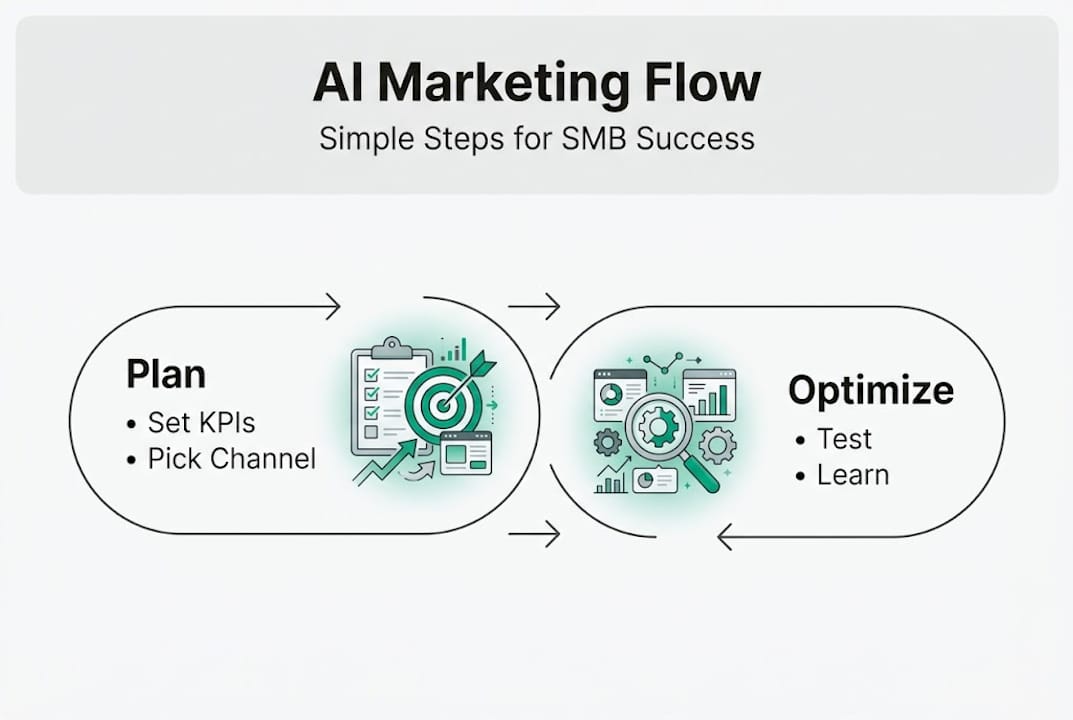
The answer is phased adoption. Trying to overhaul your entire marketing stack in a single month is a recipe for confusion and wasted budget. Instead, focus on one funnel, one offer, and one channel first. Build your confidence and your data before scaling.
A proven 4-week pilot plan gives you a structured way to do exactly that:
- Week 1: Define your KPIs and channel. Choose one measurable goal (cost per lead, email open rate, conversion rate) and one channel to test. Write down what success looks like before you touch any tools.
- Week 2: Build your creative engine. Use a generative AI tool to create 3 to 5 content or ad variations. Set up your AI-enabled platform (Google Ads, Klaviyo, etc.) and connect it to your data source.
- Week 3: Launch and test. Go live with your campaign. Don’t adjust anything for the first 7 days. Let the AI gather enough data to start optimizing.
- Week 4: Optimize and document. Review performance against your Week 1 KPIs. Identify what worked, what didn’t, and what you’ll change in the next cycle. Document your findings for future reference.
This structure works because it creates a feedback loop. Each cycle teaches you something new about your audience and your tools. Over time, that compounding knowledge becomes a real competitive advantage.
When it comes to tooling, you have two main options. A DIY AI tool stack (using individual platforms like ChatGPT, Surfer SEO, and Google Performance Max) gives you flexibility and lower cost. A managed service, like working with a digital marketing strategy for SMBs specialist, gives you expertise and faster results, but at a higher investment. Many SMBs start DIY and bring in experts once they know what they need.
Pro Tip: Set your KPIs before you choose your tools. If you pick tools first, you’ll end up measuring what’s easy to track rather than what actually matters to your business growth. A solid step-by-step SMB marketing guide can help you map goals to the right metrics from the start.
Risks, limitations, and human factors in AI marketing
As with any new technology, there are important pitfalls and trade-offs to be aware of before going all-in.
The most overlooked risk is brand voice dilution. AI excels at drafts and scale but needs human editing for brand voice and local nuance. If you publish AI-generated content without review, you risk sounding like every other business using the same tool with the same default settings. Generic content doesn’t build trust.
Data privacy is another serious concern. Many AI tools require access to customer data to function well. You need to understand what data you’re sharing, where it’s stored, and whether your usage complies with regulations like GDPR or CCPA. This isn’t optional fine print. It’s a legal and reputational issue.
Here are the top pitfalls SMBs should watch for:
- Generic output: AI content can sound flat and interchangeable without human editing
- Data privacy gaps: Sharing customer data with third-party AI tools without proper review
- Bias in targeting: AI systems can reinforce existing biases in your audience data
- Black-box decisions: Some AI tools can’t explain why they made a specific optimization choice
- Over-reliance: Using AI as a crutch instead of building genuine marketing expertise
- Misaligned KPIs: Optimizing for the wrong metrics because the tool makes it easy
“Success requires clear strategy first. AI amplifies good plans and genericizes bad ones. Focus on outcomes over tools.”
Human oversight is not optional. Someone on your team needs to review AI outputs, check for accuracy, and ensure the content reflects your actual brand values. This is especially true for AI web design and brand voice, where automated decisions can affect how your entire business is perceived online. AI is a powerful assistant. It is not a replacement for judgment.
A fresh perspective: Why AI marketing success starts with strategy, not tools
Having explored best practices and pitfalls, let’s zoom out for a bigger-picture look at what truly drives AI marketing success for SMBs.
Here’s the uncomfortable truth: most SMBs that struggle with AI marketing don’t have a tool problem. They have a strategy problem. They rush to adopt the latest platform, hoping it will fix unclear messaging, undefined audiences, or weak offers. It won’t. AI is a multiplier. It makes strong strategies faster and more effective. It makes weak strategies fail more efficiently.
The businesses we’ve seen get real results from AI are the ones that started with digital marketing fundamentals firmly in place. They knew their customer, their value proposition, and their conversion goal before they opened a single AI tool. The technology then gave them leverage, not direction.
The smartest move you can make right now is to resist the urge to chase every new AI feature and instead ask one question: what specific outcome do I need, and which AI capability directly supports that? That focus is what separates businesses that get results from those that just get busy.
Next steps: Level up your marketing with expert AI support
If this guide has made one thing clear, it’s that AI marketing works best when it’s built on a solid strategic foundation and guided by people who understand both the technology and your business goals.
At Ascendly Marketing, we help SMBs cut through the noise and build AI-powered marketing systems that actually drive results. Whether you need full-service digital marketing support or want to launch AI-powered PPC campaigns that maximize every dollar, our team is ready to help you move from curious to confident. Book a free consultation today and let’s build something that works.
Frequently asked questions
How is AI marketing different from marketing automation?
AI marketing uses machine learning and predictive analytics for real-time optimization and personalization, while basic automation focuses on scheduling and rule-based repetitive tasks. AI learns and adapts; automation follows fixed instructions.
What are the biggest risks of using AI marketing for small businesses?
Top risks include loss of unique brand voice, producing generic content, data privacy issues, and lack of transparency in how AI tools make decisions. Human review of all AI outputs is essential.
Does AI replace human marketers?
AI automates repetitive tasks but does not displace workers or replace the need for human creativity, strategy, and brand oversight. It works best as a tool in skilled hands.
What’s the first step to start using AI in marketing for my SMB?
Start with one channel, set a clear KPI, and build a weekly feedback loop so you can learn fast and improve each cycle before scaling to other channels.