

96% of brand crises spread internationally within 24 hours, according to one 2026 industry compilation, and brands that respond within two hours see 61% better sentiment recovery than slower responders from the same source set. That changes the job of crisis management PR. It stops being a cleanup task and becomes an operating system for speed, approvals, and message control.
The financial stakes are just as clear. The same source set puts the average cost to manage and recover from a PR crisis at $3.3 million for mid-sized businesses. So the question isn’t whether a brand needs a response plan; it’s whether the plan is built to move before the story hardens.
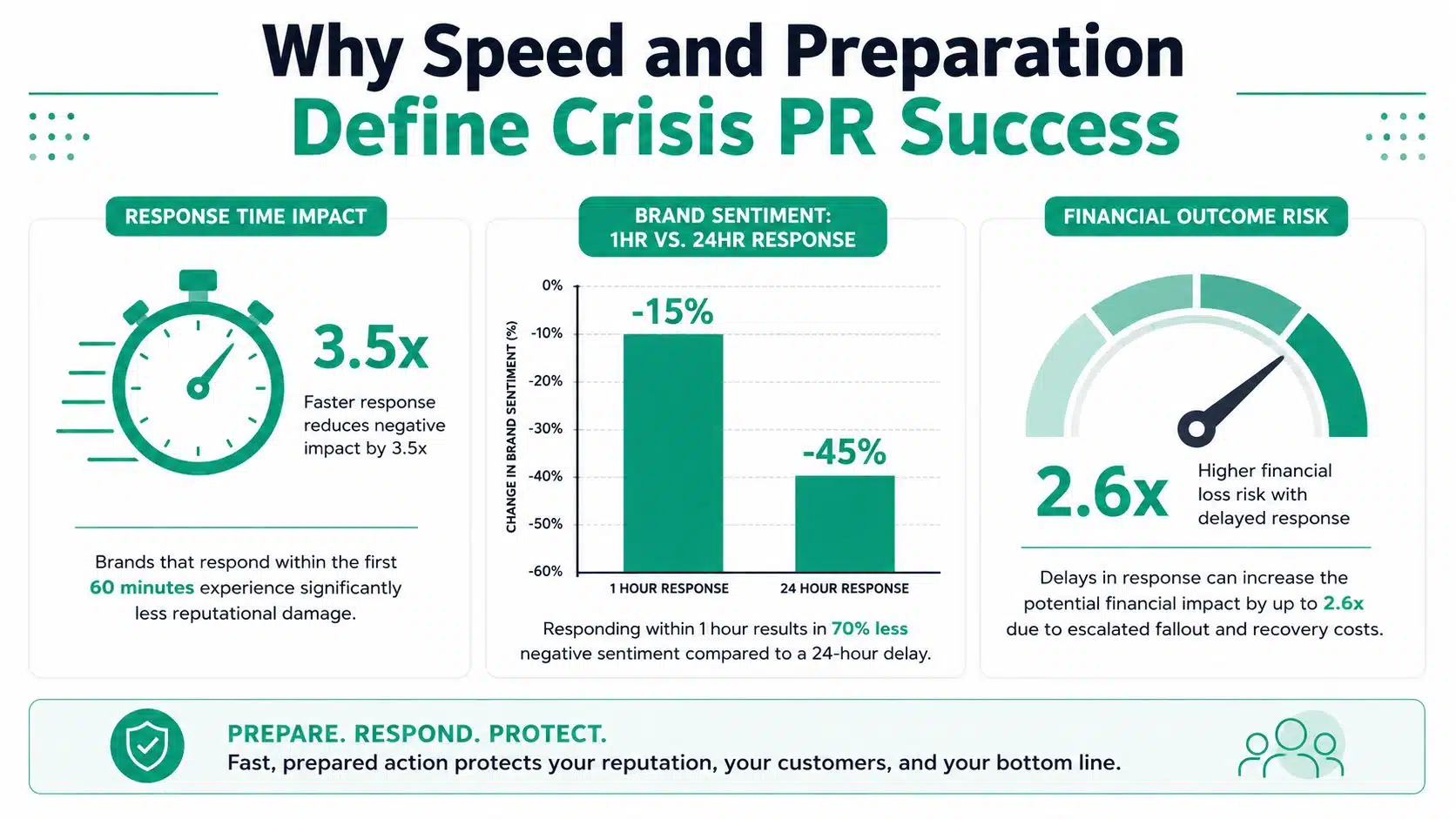
Speed only works when the team knows what to do with it. A plan that waits for a perfect investigation usually loses the first narrative round, and by then employees, customers, and journalists are already filling in the blanks. A better way to think about crisis management PR is as a sequence: monitor, decide, acknowledge, update, and prove. If you want a concise external reference on the mechanics, the essential crisis management tips from Carlos Alba Media map well to that logic.
The historical shift is simple. Old crisis playbooks were built for slower media cycles, where a statement could wait until morning. Modern crises move through social platforms, online news, and private group chats at the same time, which is why response time, approval chains, and holding statements now sit at the center of serious PR work.
Why Speed and Preparation Define Crisis PR Success
A crisis response loses value fast once the issue is public. Every hour without a clear direction raises the risk of conflicting internal updates, media speculation, and operational confusion, and that is why crisis management PR has to sit alongside incident response and business continuity. The question is whether the team can move before the story hardens.
Speed changes the shape of the outcome
A fast response does not resolve the incident on its own, but it keeps the organization in control of the first version of events. As the data in the introduction shows, delay gives the company more certainty but less control, and that trade-off shows up in sentiment, reach, and cost. The practical problem is simple: if your team waits until every detail is verified, someone else fills the gap for you.
The older playbook assumed a brand could hold back until the internal review was complete. That approach fits a slower news cycle, not a crisis that spreads through social feeds, online news, and private group chats at the same time. A better standard is to say what you know, state what you do not know, and give the next update time in plain language.
Practical rule: Issue an early holding statement with partial facts, then update in controlled increments instead of trying to produce one perfect statement.
Speed also depends on whether the team knows how fast it can act without creating new errors. The essential crisis management tips from Carlos Alba Media line up with that reality, because response speed only helps when it is tied to approval paths, message ownership, and a clear update cadence. In practice, that means the first statement should be usable, reviewable, and ready to refine, not trapped in endless internal debate.
Preparation is the part that reduces panic
Prepared teams do not spend the first hour asking who can approve a statement or where the holding language lives. They already know who owns the decision, which channels get updated first, and how quickly the legal or leadership review can happen without freezing the response. That separation between a practiced workflow and improvised damage control is what makes crisis management PR workable under pressure.
Preparation also affects how quickly a brand can protect trust once the incident is visible. A crisis response framework should connect to broader reputation work, and a practical overview of that connection is covered in this guide to online reputation management strategies. The point is not to polish the message for appearance’s sake. It is to keep the organization consistent enough that employees, customers, and reporters are not getting three different versions of the same event.
A useful planning mindset is to assume the incident will be public before the internal discussion is finished. Then build around that reality. The brands that handle this well are the ones that practice message approval, monitor reaction as it develops, and keep response assets ready before the problem becomes the only thing people are talking about.
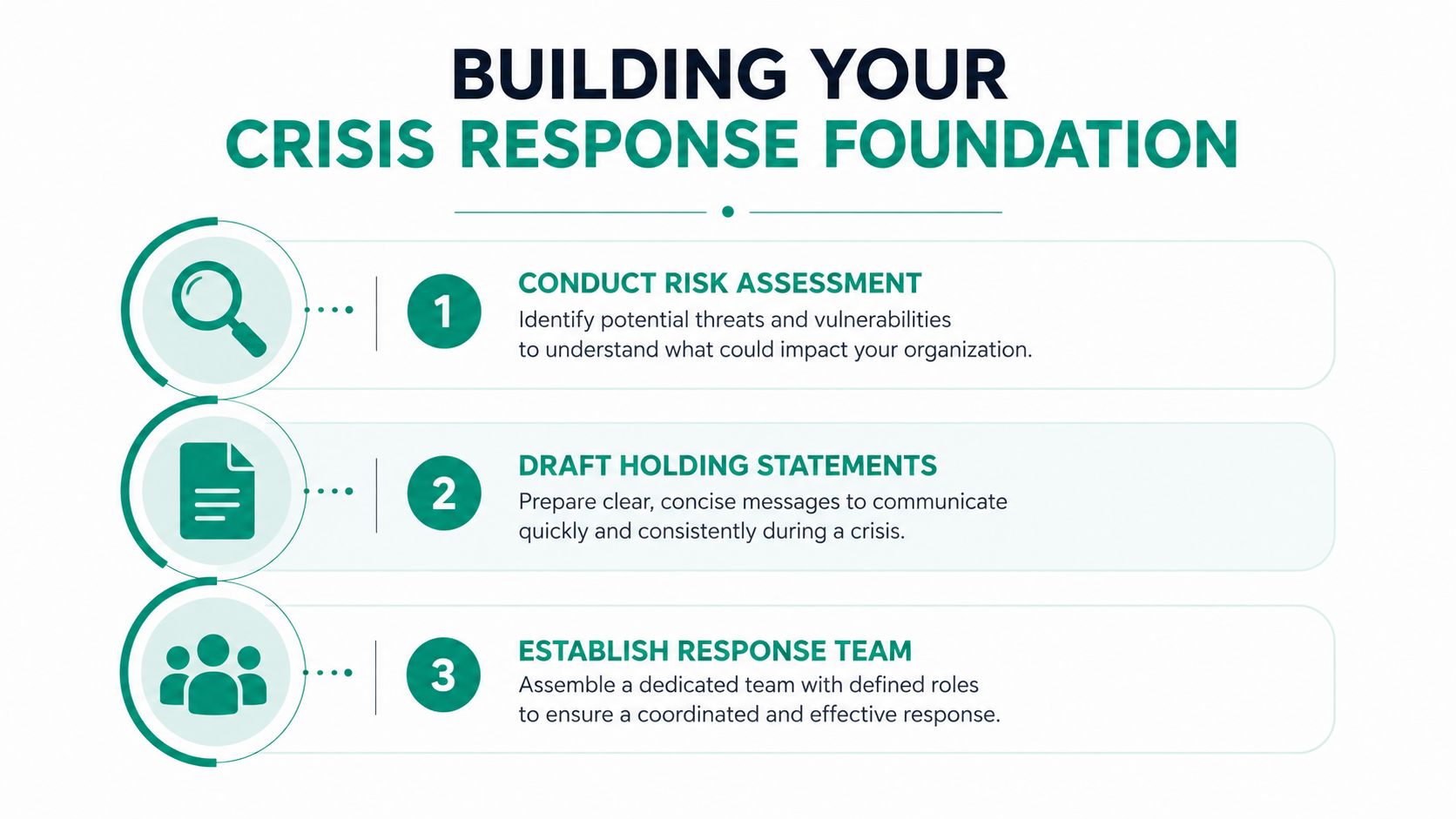
Building Your Crisis Response Foundation
Most crisis failures start before the crisis. The team didn’t train, the approval chain was fuzzy, or the holding statement had never been written. Preparation sounds dull until the first message has to go out in real time.
Start with risk, not with templates
A crisis plan should begin with scenario mapping. Look at the incidents most likely to affect your business: Cyber issues, product failures, employee misconduct, service outages, safety concerns, and reputation attacks. The goal isn’t to predict everything. The goal is to identify the categories where speed and clarity will matter most.
From there, document the triggers that matter to your team. Who gets notified when the issue hits social media, when a customer escalates to the press, or when a regulator asks for comment? If the answer depends on memory, the plan isn’t ready.
Build roles that hold under pressure
A good response team is small enough to move and clear enough to trust. One person should own decision authority, one should handle fact gathering, one should manage approvals, and one should coordinate external messaging. If everyone can edit everything, nothing stays consistent.
The second layer is the paperwork that keeps the team from improvising. Draft holding statements for likely scenarios. Pre-approve spokesperson guidance. Keep a list of channels that need updates, including website banners, social posts, customer service scripts, and internal notes. If the issue touches public trust, your internal audience should never learn about it from the news.
A practical benchmark for plan quality is whether the team can answer these questions without searching through folders:
- What gets escalated first: Define the incident types that trigger a formal review.
- Who approves the first statement: Name the decision-maker, not the department.
- What gets documented if you stand down: Record why the team chose not to escalate and who signed off.
- Where the latest version lives: Keep a single source of truth so nobody sends an outdated draft.
The best crisis plans are short enough to use under pressure and specific enough to stop debate.
Treat drills as part of the system
A plan that sits in a shared drive doesn’t count as readiness. Teams need to rehearse the process, not just read it. That includes timing the first alert, testing who responds on weekends, and checking whether the spokesperson can deliver the approved language without sounding scripted.
For organizations that are also working on digital trust, the operational overlap is real. A solid plan supports reputation work across search, social, and customer service, which is why a resource like online reputation management often pairs naturally with crisis planning. The point is not to merge every discipline; it’s to keep the response from splintering when the pressure starts.
Deciding When to Activate Your Crisis Plan
Not every complaint needs a war room. A noisy thread, a handful of angry customers, or a single unverified post can still be a routine service issue. If the team escalates everything, the plan loses force, and the company burns time on false alarms.
The better question is whether the issue has crossed from inconvenience into organizational risk. That threshold can show up as public media pickup, a pattern of complaints that points to a systemic failure, or stakeholder concern that could affect revenue, operations, or safety. The key is to make that judgment before the response becomes performative.
Use a decision gate, not a panic reflex
Activation should be owned by a named decision-maker, usually a crisis lead or senior communications lead with legal and operational input. The decision needs context, not hype. What matters is whether the facts show a broader threat to trust, not whether the comment volume feels uncomfortable.
If the team chooses not to escalate, document three things. First, what you saw. Second, why the issue stayed below crisis level. Third, when you’ll review it again. That record protects the organization from memory drift and stops people from relitigating the same call later.
Restraint can protect the brand
Fast-moving social platforms create a specific problem. Early claims often change, but the pressure to react never does. If a company launches a full-scale crisis response too early, it can create contradictory statements, overexpose a small issue, and make the brand look more guilty than the evidence supports. Restraint isn’t silence. It’s disciplined evaluation.
Practical rule: if the facts are incomplete, say what’s confirmed, monitor the situation, and avoid overcommitting to a theory.
That approach matches the guidance that organizations should first determine whether they’re facing a full crisis before activating damage control. It also reflects the trade-off for small and mid-sized businesses, where a false alarm can waste scarce time and create more confusion than the original complaint.
The hard part is social pressure. Employees may want an immediate answer, customers may demand an apology, and journalists may ask for comment before the team is ready. Still, the worst move is pretending every spike deserves the same response. A selective, evidence-based trigger keeps crisis management PR credible because the organization only treats real crises like real crises.
Executing Rapid Response with Clear Messaging
Once the decision to activate is made, speed needs structure. A team that moves fast without a cadence usually produces rushed drafts, mixed approvals, and statements that answer the wrong question. A response timeline fixes that, because it tells everyone when to draft, when to clear, and when to stop adding detail.
The 15-20-60-90 model gives the team a working rhythm. Regroup’s version says to acknowledge the crisis within 15 minutes, share more detailed information by 60 minutes, and be ready for a press conference or further media engagement by 90 minutes. That timeline works because it forces the team to communicate before speculation becomes the default, while still leaving room to verify the facts that matter.
Match the message to what people feel
The CDC’s crisis communication guidance stays practical for a reason. Don’t over-reassure; acknowledge uncertainty, acknowledge people’s fears, and give people things to do (CDC). Those rules matter more than polished language because anxious people look for honesty and direction, not theatrics.
A holding statement should therefore do four things. Confirm the issue. Say what’s being investigated. Explain what happens next. Give the audience a place to look for updates. Anything more detailed than that can drift into speculation, and in the first response window, speculation creates more work for everyone involved.
A spokesperson brief should sound like this in structure, not in canned language:
- Confirmed fact: State what the company knows for certain.
- Unknown area: Say what still needs verification.
- Next update: Name the next communication point.
- Action for stakeholders: Tell people what to do right now.
That format keeps the spokesperson from trying to sound omniscient. It also gives legal and operations teams a cleaner boundary, because the message says enough to be credible without inventing certainty.
Build one source of truth
Message consistency breaks when updates are scattered across email, social, website banners, and customer service notes. The fix is a single approved message hub that everyone works from. One owner updates the facts, one approver signs off, and every channel pulls from the same language. If the team has to rewrite the same update three different ways, the response is already drifting.
The same principle applies to social media. If the crisis is visible there, the response should be visible there too, but not casually rewritten by each platform manager. That discipline matches broader principles of reputation management in social media, where consistency across posts, replies, and pinned updates shapes whether people think the company is in control.
For teams that handle multiple channels at once, the omni-channel marketing playbook can help frame the coordination problem, even though crisis response has its own tighter rules.
The goal isn’t to sound perfect. It’s to sound aligned. When the public sees the company, the website, and the spokesperson saying the same thing, trust holds longer, and the message does less damage while the facts are still being checked.
Coordinating Media and Stakeholder Communications
A crisis can split into multiple conversations at once. Journalists want a statement, customers want service updates, employees want reassurance, and investors want to know whether the situation affects the business. If those audiences hear different versions of the story, the response starts to look unstable.
Frame the story differently without changing the facts
The message can shift by audience, but the facts cannot. Media needs a clean summary with a clear timeline. Employees need to know what to say and what not to speculate on. Customers need to know how the issue affects them. Partners need to know whether delivery, contracts, or support are at risk.
One-sided messaging often falls short. In victim-crisis scenarios, a two-sided message outperformed a one-sided message in experimental research at CUHK. In practice, that means acknowledgment plus corrective information beats denial plus polish. If the company only talks about one side of the problem, the audience assumes the other side is being hidden.
The same study also found that adding five or six coordinated crisis communication tactics produced significant reputation improvement in some cases, while reputation management strategies alone were not better than the base response in other cases CUHK. That is a warning against clutter. More tactics are not automatically better. The response needs coordination, not a pile-on.
Keep internal communication from becoming its own crisis
Employees are often the fastest source of inconsistency. If they hear fragments from friends, social media, or the press before the company speaks internally, they start filling gaps themselves. That creates rumor pressure and can make the company look disorganized even when the external statement is solid.
The fix is simple to describe and harder to execute well. Internal updates should go out quickly, in plain language, with clear guidance about what has been confirmed and what should not be shared yet. Managers need talking points, not improvisation. That keeps the company from issuing one public message and twenty private variations.
Media readiness still needs human judgment
Reporters usually ask the same practical questions. What happened? Who is affected? What is the company doing now? When will there be another update? If the spokesperson can answer those questions without drifting into blame or speculation, the tone stays grounded.
A useful standard is to tie every external statement to one of three purposes: acknowledgment, correction, or next-step update. That limits the temptation to overexplain. It also keeps crisis management PR from turning into a defensive essay when a short, direct response would do the job better.
Match each audience to the right channel
The message itself is only half the job. The other half is sending it where each group is already looking. If the incident affects service, customers need a public update, a support script, and a place to check status. If employees are hearing rumors, internal channels need to move first, or at least at the same time. If investors or partners are exposed to risk, they need a direct line of communication before they start guessing.
Channel discipline matters because one channel often gets ahead of the others. Social posts may go live while the website still says nothing, or support agents may know the answer before frontline staff does. That gap creates avoidable friction. The omni-channel marketing playbook is useful here as a coordination model, even though crisis response has tighter rules and less room for experimentation.
Keep the response aligned as facts change
Crisis communication fails when teams treat the first statement as a finish line. Facts change, legal review slows, operations may uncover a wider scope, and the audience notices every mismatch. The answer is not to speak constantly. It is to update on a set cadence and make the change visible across every audience that matters.
That cadence should be deliberate. If the company has no new facts, say so and give the next expected update window. If a correction is needed, correct it in the same places the original message appeared. If the issue has spread to new stakeholders, add them to the communication plan before they feel ignored.
For mid-sized brands, that discipline is what keeps a crisis from becoming a trust problem that lasts longer than the incident itself. A tighter message hub, a clear owner for updates, and channel-specific versioning help the response stay credible and support online reputation repair once the immediate noise starts to fade.
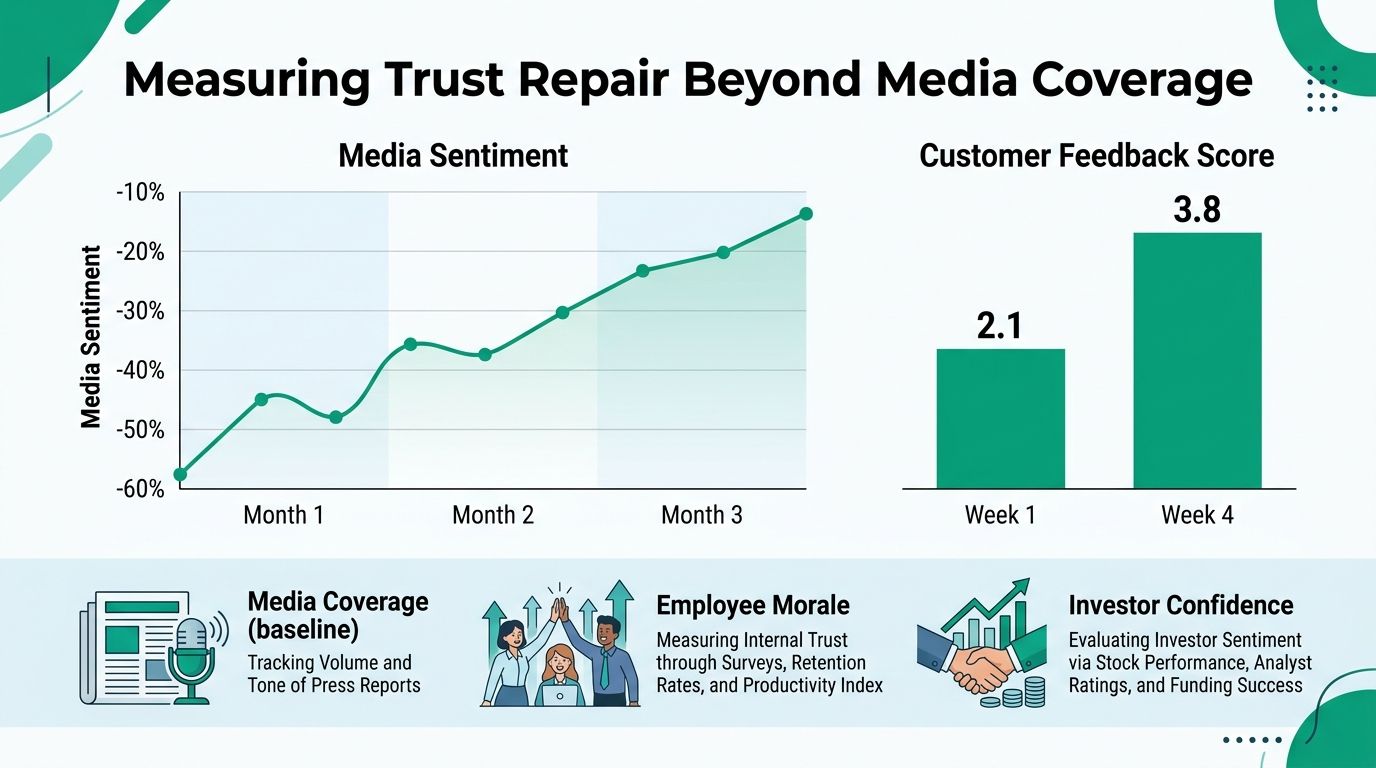
Measuring Trust Repair Beyond Media Coverage
Press coverage ends before trust repair does. A crisis can vanish from the news while customers still hesitate, employees stay skeptical, and partners wait to see whether the fix is real. Recovery measurement has to go past mentions and headlines.
Track who changed their mind
The Institute for Public Relations advises teams to monitor coverage, sentiment trends, feedback from customers, employees, investors, and partners, plus broader recovery metrics after the initial reaction settles. That framework works because media visibility and actual confidence are not the same thing.
Start with share of voice, message pull-through, complaint recurrence, web traffic to the crisis page, and stakeholder follow-up rates. Then look at the tone of customer service tickets, employee feedback, partner questions, and investor calls. If the same concern keeps coming back, the issue is not repaired yet.
Don’t let external noise hide internal damage
External sentiment often moves faster than internal sentiment. In the early weeks, employees may tell you more about whether the organization recovered because they see how leadership behaves after the press cycle ends. Customers can be quieter in public and still decide not to buy again.
A clean media bounce does not equal a resolved crisis. A team can win headlines and still lose trust if corrective action never shows up in daily operations. A team can win headlines and still lose trust if corrective action never shows up in daily operations. The measurement has to reflect that gap, and the work of online reputation repair has to connect what people read with what they experience.
A practical scorecard usually has three layers:
- Visibility layer: what coverage said, where it appeared, and how often the core message showed up.
- Trust layer: whether stakeholders accepted the explanation and stopped repeating the same objections.
- Behavior layer: whether complaints recurred, support contacts dropped, and follow-up questions became more specific rather than more suspicious.
Useful test: if the same people keep asking the same question, the response has not landed.
Different businesses need different success markers. A local service company may care most about customer follow-up and complaint recurrence. A B2B firm may watch partner confidence and account retention discussions. A consumer brand may need to track both internal morale and public sentiment for longer than the first media wave.
Conducting Post-Crisis Review and Continuous Improvement
A crisis review should read like an operating memo. It should capture what the team learned while the details are still fresh and make sure the next incident starts from a better place. That means less storytelling and more documentation, and more attention to what changed in the business after the pressure eased.
Review the response against the actual timeline
Start with a simple report. When did the issue begin? When did the team notice it? When did the first alert go out? When did the company speak publicly? When did the next update happen? That sequence shows whether the plan worked or whether people were improvising under pressure.
Then review the content itself. Did the holding statement stay accurate as new facts emerged? Did the spokesperson use the same language as the website and customer service teams? Did legal review create a useful safeguard or a bottleneck? Those questions point directly to process changes, and they show where speed broke down because the team had no clear decision path.
Turn findings into named actions
A post-crisis review only matters if it changes the system. Write down the corrective measures, assign an owner, and set a review date. Update the templates that failed, retire the ones that were too vague, and change the approval chain if it slowed the response.
Use a short checklist for the follow-through:
- Update the scenario list: Add any incident type the team missed.
- Revise the holding statements: Rewrite any language that sounded vague or defensive.
- Reassign ownership: Fix roles if someone had to improvise outside their lane.
- Schedule the next drill: Test the new version before the next real event.
The Institute for Public Relations guidance also stresses delivering promised information, keeping stakeholders updated on corrective measures, and analyzing the crisis effort for lessons to integrate back into the system. The point is simple. The organization does not just respond; it learns, and the learning has to be visible in the next decision cycle. Institute for Public Relations
The strongest crisis teams treat recovery as part of the crisis itself. They keep talking after the headline fades, they show the fix in visible ways, and they keep the plan current. That is how crisis management PR turns one bad event into a more durable operating system.