
A lot of agencies hit the same wall at roughly the same moment. The client list gets better, the retainers get larger, and one enterprise account turns a workable SEO process into a daily scramble. Rankings live in one tool, crawl findings in another, task tracking in a project board, and reporting in a spreadsheet someone is afraid to touch.
That setup can survive a small site. It breaks fast when a client has thousands of URLs, multiple stakeholders, regional teams, and developers shipping changes every week. At that point, enterprise SEO agency software stops being a nice upgrade. It becomes the system that keeps the work coherent.
The Scaling Limit of Spreadsheets and Point Tools
An agency can manage a mid-sized SEO program with a patchwork stack for longer than it should. A rank tracker handles visibility checks. A crawler runs scheduled audits. Someone exports data into slides before the monthly meeting. For a while, it feels efficient enough.
Then an enterprise client arrives with country folders, legacy templates, product pages generated from a feed, and a dev team that deploys unceremoniously on Friday evening.
On Monday, rankings dip in one market. Crawl reports show indexable pages increasing in another. Analytics flags a drop in organic landings on pages that still appear to rank. The account manager asks whether this is a technical issue, a content issue, or a reporting lag. Nobody can answer quickly because the data lives in separate systems with separate update cycles.
That’s where most agencies feel the cost of point tools. The problem isn’t only tool overlap. The problem is operational delay.
What breaks first
The first failure usually isn’t strategy. It’s coordination.
- Data consistency slips: Different teams work from different exports, so the technical lead and the client services lead may discuss the same issue with different numbers on screen.
- Prioritization slows down: A raw crawl report can show thousands of issues, but it won’t tell an agency which ones affect revenue-driving sections first.
- Client communication gets messy: Manual reporting turns every monthly review into a reconstruction project instead of a decision-making session.
- Ownership becomes unclear: If no platform ties findings to tasks, fixes get discussed more often than they get shipped.
A large SEO account rarely fails because the agency missed one keyword. It fails because the team couldn’t connect diagnosis, prioritization, and execution fast enough.
Spreadsheets make this worse because they look organized. They provide rows, tabs, color coding, and comments. What they don’t provide is a reliable operating view of a moving website.
Why does enterprise complexity change the software question
Enterprise SEO work involves dependencies. A change in faceted navigation affects crawling. A template revision affects internal linking. A localization decision affects indexation, cannibalization, and reporting at the same time.
When agencies try to manage those relationships with disconnected tools, they spend too much time stitching evidence together. The software should do the joining for them. That’s the practical role of enterprise SEO agency software. It isn’t just another dashboard. It’s the control layer for complex search operations.
Defining the Enterprise SEO Operating System
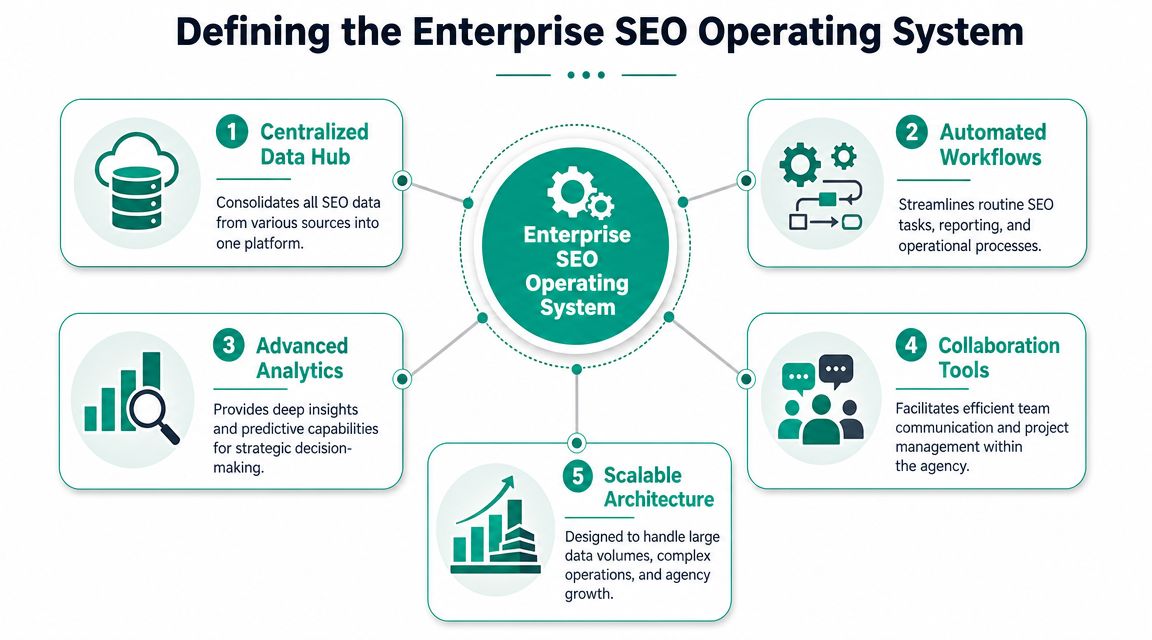
The cleanest way to think about enterprise SEO agency software is this. It’s an operating system for search visibility, not a single-purpose SEO tool.
A standard SEO tool answers one question at a time. Where do we rank? What errors did the crawler find? Which backlinks changed? An enterprise platform connects those answers so the agency can run the account as one system.
More like ERP than a rank tracker
In practice, the closest analogy is an ERP platform. Finance teams don’t want separate systems that never reconcile. Enterprise SEO teams don’t either. They need one place where crawl data, ranking data, workflow states, forecasting, and stakeholder reporting can support the same decision.
That shift in buyer behavior isn’t theoretical. An industry summary says the enterprise SEO platforms market was valued at $4.38 billion in 2024 and is projected to reach $12.5 billion by 2032, implying a 14% CAGR according to GTM 80/20’s enterprise SEO statistics roundup. That level of market growth tells agencies something useful. Enterprise buyers increasingly expect platform-supported delivery, not manual consulting alone.
For teams that need a broader strategic foundation, this guide to enterprise SEO and scalable success is a useful companion to the software question.
What the platform actually does
Value comes from consolidation and control.
| Operating need | What the platform handles |
|---|---|
| Unified diagnosis | Brings crawl findings, visibility data, and page-level performance into one view |
| Workflow control | Assigns fixes, tracks status, and reduces handoff gaps between SEO, content, and dev teams |
| Client accountability | Produces repeatable dashboards and reporting tied to actual work completed |
| Decision support | Helps teams move from issue lists to priority lists |
| Scale management | Supports large sites, multiple markets, and repeated reporting cycles without rebuilding the process each month |
A proper platform also changes the agency’s internal behavior. Analysts stop spending their best hours gathering exports. Account leads stop translating five tools into one client story. Technical teams can trace causes faster because the evidence is already connected.
Practical rule: If your team still needs a manual spreadsheet to explain what the platform should already connect, the software isn’t functioning as an operating system.
That’s the distinction that matters. Enterprise SEO agency software isn’t defined by having more features. It’s defined by whether the system reduces complexity instead of adding another place to check.
Core Capabilities That Power Agency Growth
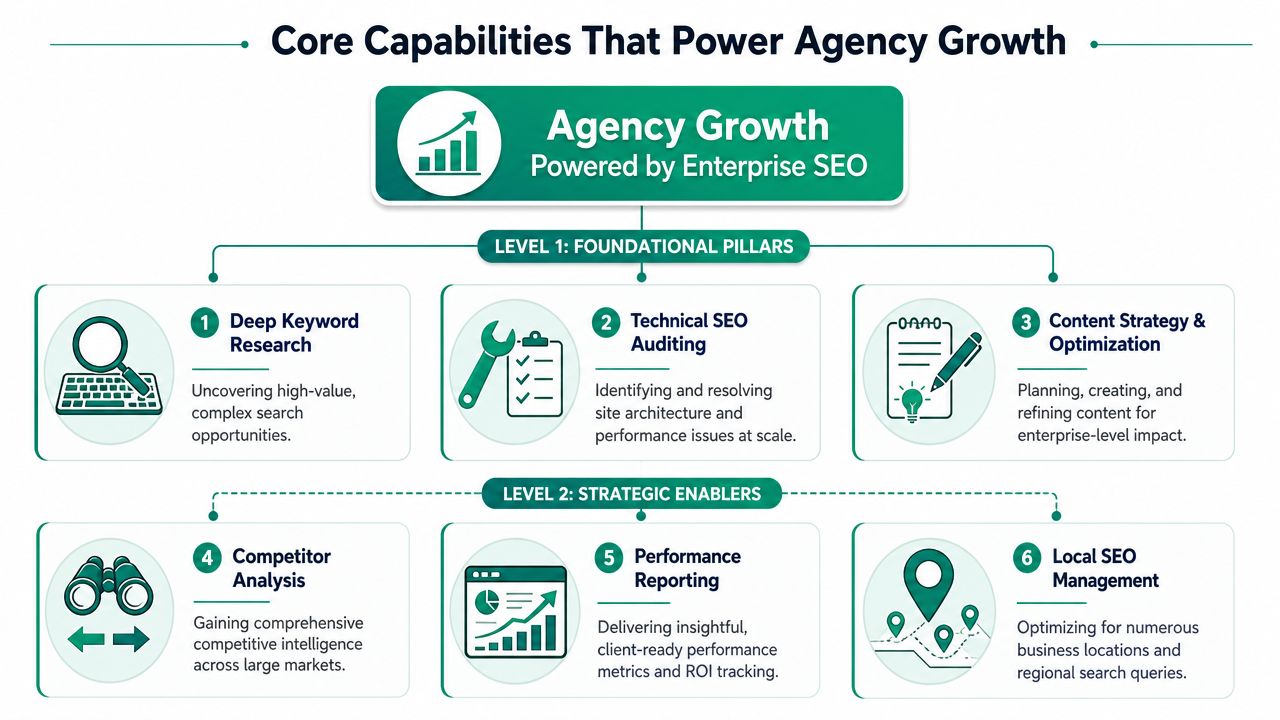
A serious enterprise platform should support the work an agency performs. That means diagnosis, measurement, planning, coordination, and forecasting. If one of those layers is weak, the agency ends up rebuilding it manually.
Technical diagnostics that go beyond crawl errors
Enterprise SEO software earns its keep first on the technical side. Large sites don’t suffer from one obvious issue. They suffer from patterns across templates, sections, and bot behavior.
Neutral industry guidance states that enterprise SEO software is most valuable when it combines crawl analysis, log-file analysis, rank tracking, and forecasting in one system, because that shows how search engines interact with large sites instead of relying on surface-level keyword reports, as explained in OVRDRV’s overview of enterprise SEO tools.
That combination matters because each input covers a different blind spot:
- Crawl analysis: Shows what the site structure exposes
- Log-file analysis: Shows what search engines request
- Rank tracking: Shows where visibility changes appear
- Forecasting: Helps agencies model likely impact before asking for engineering effort
A crawler alone can tell you that pages exist. Logs tell you whether bots care.
Performance measurement that matches enterprise reality
Basic rank tracking isn’t enough once an account spans multiple devices, result types, and regions. Agencies need performance measurement that supports segmentation, not just snapshots.
The useful questions are operational:
- Which page groups lost visibility?
- Did the drop happen in one market or all of them?
- Did the issue affect mobile results, local results, or classic organic listings?
- Which templates recovered after release, and which didn’t?
Many platforms still underperform in this area. They collect data but don’t help teams isolate the pattern quickly.
A stronger setup lets the agency map rankings to page type, geography, and business priority. That turns reporting into management.
For a deeper view of the strategic side, this enterprise SEO strategies resource complements the platform selection process.
Content intelligence and prioritization
Content work at the enterprise level isn’t just brief creation and optimization scoring. Agencies need to understand where content decay is happening, where internal linking is weak, and where multiple pages compete for the same intent.
The platform should support content decisions in context:
| Capability area | What agencies need from it |
|---|---|
| Topic analysis | Identify gaps across sections, not just individual keywords |
| Page evaluation | Surface underperforming templates and stale content groups |
| Internal linking review | Find pages that matter but remain structurally isolated |
| Competitive comparison | Show where rivals own the topic cluster or SERP feature set |
| Forecasting support | Estimate the likely value of updating, consolidating, or expanding content |
The trade-off is straightforward. Some tools are excellent at technical depth and weak on content workflow. Others are comfortable for editorial teams but shallow on diagnostics. Agencies usually need one primary system and then selective specialist tools around it.
Workflow and collaboration controls
Growth doesn’t come from finding more issues. It comes from getting more of the right issues fixed.
That requires collaboration features that many SEO buyers underweight during procurement. User roles, task routing, change tracking, annotations, and custom dashboards sound administrative. They’re not. They decide whether the platform becomes daily infrastructure or an expensive reporting layer.
Agencies scale when the software helps specialists work together, not when it gives each specialist another isolated interface.
When evaluating enterprise SEO agency software, ask a blunt question. Does the platform improve throughput, or does it just improve visibility into the backlog? Those are very different outcomes.
A Practical Checklist for Selecting Your Platform
Most software demos go wrong for the same reason. The vendor shows polished dashboards, the agency asks about features, and nobody checks whether the system can survive a real enterprise account.

A better buying process starts with scenarios, not menus. Bring actual requirements from a current or recent client. Use those to test fit.
Questions that expose operational fit
Independent enterprise SEO guidance points to crawl-budget optimization and indexation control at scale as core software requirements for technically complex sites, and it also highlights international rank tracking across countries, languages, and regions in Sure Oak’s enterprise SEO guidance. Those two areas alone reveal whether a platform is built for enterprise work or just positioned that way.
During a demo, ask questions like these:
- Can the crawler be customized by section? Agencies need to isolate templates, directories, parameters, and page classes without running broad, noisy audits every time.
- How does the platform handle indexation analysis? You want evidence tied to canonical behavior, exclusions, duplication signals, and crawl patterns.
- What happens in international SEO setups? Region and language segmentation should be native, not improvised through naming conventions.
- Can it support migrations and consolidations? A platform should let teams benchmark pre-launch states and monitor post-launch impact without rebuilding the setup.
- What can be automated safely? Reporting, alerts, and recurring diagnostics should reduce labor, but teams still need control over thresholds and recipients.
- How usable are permissions and roles? Enterprise accounts often involve internal specialists, client stakeholders, and external developers. Access control matters.
What to test live
Don’t accept a polished walkthrough. Ask the vendor to perform specific actions in the meeting.
| Demo test | What you’re checking |
|---|---|
| Segment a large site by template or directory | Whether the platform supports practical diagnosis |
| Compare visibility across markets | Whether international reporting is truly built in |
| Trace an indexation issue to impacted URLs | Whether findings are actionable |
| Create a task from a technical finding | Whether collaboration is native or bolted on |
| Build a client-facing dashboard | Whether reporting can be customized without extra manual work |
One more thing deserves attention. Product direction matters. If the roadmap is frozen around classic rankings and old reporting models, the software may age poorly in a changing search environment.
A vendor discussion can be easier when the team already shares a baseline on enterprise tooling. This short video is useful for aligning the evaluation conversation.
Red flags agencies should take seriously
Some warning signs show up early:
- Reporting-first positioning: If the platform talks mostly about dashboards, the data model may be shallow.
- Weak implementation answers: Vague responses on setup, governance, and onboarding usually become agency labor later.
- No clear path for large-site diagnosis: Enterprise software should handle complexity directly, not ask your analysts to export and patch the gaps elsewhere.
The right platform won't answer every need alone. It should, however, handle the center of the work without forcing your agency back into spreadsheet management.
Integrating the Platform into Your Agency's Workflow
Buying the software is the easy part. Getting the agency to use it consistently is where value is either built or lost.
That pressure is real because enterprise budgets create expectations. A 2026 industry roundup reports that 45% of enterprise-level companies spend more than $20,000 per month on SEO, according to StudioHawk's enterprise SEO statistics roundup. When a client invests at that level, the agency needs a delivery model that is structured, visible, and repeatable.
Start with one pilot account
A full agency rollout sounds efficient. It usually isn't.
Begin with one account that has enough complexity to test the platform properly, but not so much political sensitivity that every setup change becomes a debate. The goal is to pressure-test workflows, dashboard design, and reporting logic before standardizing them across more clients.
A practical rollout often follows this sequence:
- Configure the account model around business units, markets, templates, and key page groups.
- Set user roles for technical SEO, content strategy, account management, and leadership.
- Define alert logic so the platform flags meaningful changes, not every fluctuation.
- Map outputs into existing meetings such as weekly standups, client reviews, and release checks.
Build different views for different jobs
One dashboard never works for everyone.
Technical specialists need crawl states, indexation patterns, and anomaly alerts. Content teams need topic clusters, underperforming pages, and internal linking gaps. Account leads need client-ready summaries tied to priorities and progress.
The platform should reflect the agency's operating model. If every team looks at the same dashboard, at least one team is wasting time.
A simple internal framework helps:
| Role | Primary view |
|---|---|
| Technical SEO | Crawl health, indexation, logs, release monitoring |
| Content strategist | Content gaps, decay signals, template opportunities |
| Account manager | Priorities, progress, business impact, upcoming risks |
| Agency leadership | Account health, delivery consistency, resource pressure |
Train for interpretation, not button clicks
Software adoption fails when training stays too shallow. Teams don’t need a tour of every menu. They need pattern recognition.
Teach people how to answer questions such as:
- Is this drop isolated or systemic?
- Which issue belongs with SEO, content, or development?
- What deserves escalation this week, and what can wait?
- How should this finding be framed to a client stakeholder?
That kind of training turns the platform into a working system instead of a reference library.
Agencies can also blend platform data with existing service lines. For example, a firm like Ascendly Marketing can use platform outputs to support SEO delivery alongside website, content, and reporting workflows where those services intersect.
Make reporting part of delivery, not a monthly recap
The strongest implementation pattern is simple. The same platform that identifies the issue should track the fix and support the client conversation. Once those activities split apart, the agency starts duplicating work again.
That means monthly reporting should show more than results. It should show what was found, what was fixed, what remains in queue, and why the queue is ordered that way. Clients usually respond well to that structure because it gives them traceability, not just charts.
Measuring Software ROI and Future-Proofing Value
A platform doesn’t justify itself because the interface is cleaner. It justifies itself when the agency can connect software use to better execution, stronger client communication, and more durable search visibility.
That measurement has to go beyond rankings. Rankings matter, but they are only one signal inside a larger operating picture.
What agencies should actually measure
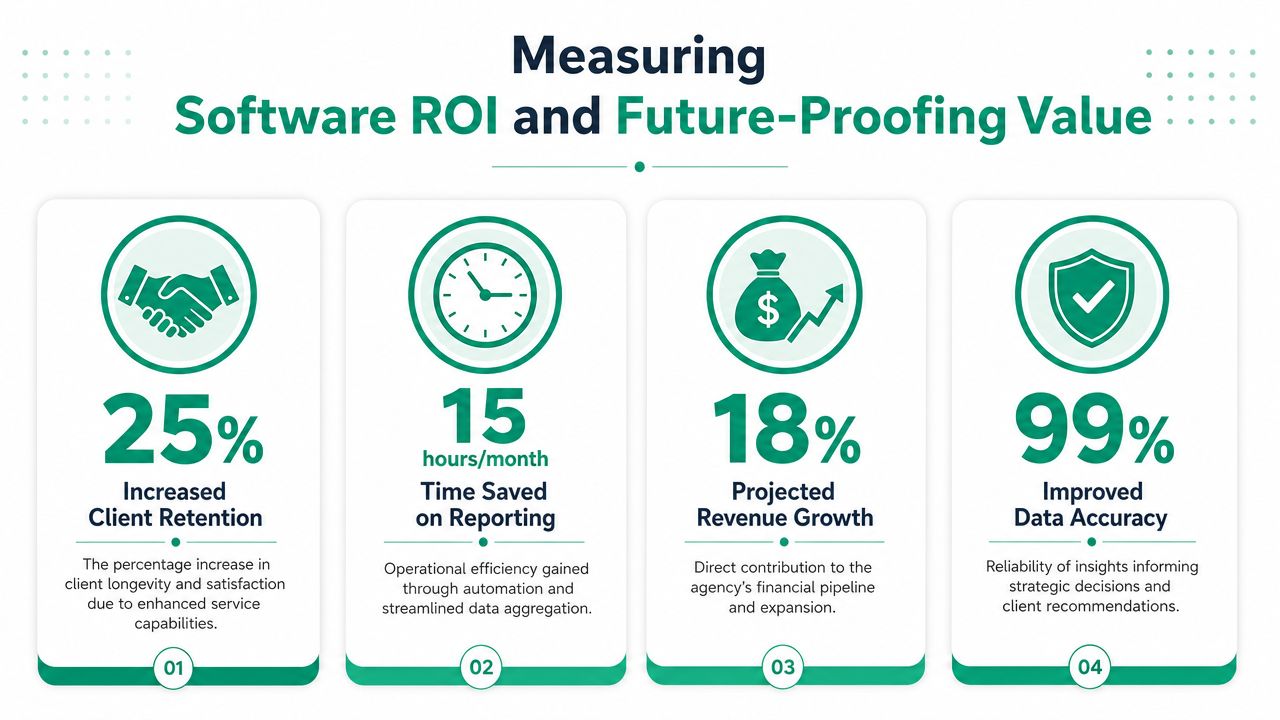
The strongest ROI models combine operational and client-facing metrics.
On the agency side, look at whether the platform reduced time spent on repetitive reporting, shortened diagnosis cycles, and improved task follow-through. On the client side, track whether priority pages regained discoverability, whether content work aligned more tightly to business pages, and whether the agency can explain the change with more confidence and less lag.
A useful scorecard looks like this:
| Measurement area | What to review |
|---|---|
| Operational efficiency | Reporting effort, investigation time, workflow handoff speed |
| Delivery quality | Rate of issue resolution, clarity of prioritization, release monitoring consistency |
| Client confidence | Reporting quality, meeting usefulness, visibility into work completed |
| Search performance | Qualified organic traffic trends, page-group recovery, conversion-aligned page performance |
This enterprise SEO analytics guide is a helpful reference when building those measurement models.
The platform should support business cases, not just charts
If a technical team finds a crawl issue but can’t show why it matters to a client, the software has only solved half the problem. Enterprise SEO agency software should help translate findings into business language.
That usually means tying platform outputs to page groups that matter commercially. Category pages. Service pages. High-intent comparison pages. Key regional landing pages. Once reporting follows those structures, the conversation gets sharper.
A good ROI model answers two questions at once. Did the platform help the team work better, and did that better work improve outcomes the client cares about?
Future-proofing for AI search visibility
A second layer of ROI is readiness. Search behavior is shifting, and enterprise buyers are already asking about visibility beyond classic blue-link rankings. Recent guidance notes that enterprise SEO buyers are increasingly asking about visibility on AI-driven platforms, and that teams now need reporting that tracks content performance across search engines plus AI-led discovery surfaces, as discussed in iPullRank’s overview of enterprise SEO agencies.
That changes the software brief.
Agencies should look for platforms that can support:
- Entity and topic coverage analysis: Not just keyword position tracking
- Faster experimentation: So teams can test content structure and retrieval patterns quickly
- Multi-surface reporting: To monitor visibility wherever discovery happens
- Cross-functional visibility: Because AI-search readiness affects content, technical SEO, and brand authority at the same time
Traditional ranking dashboards won’t disappear. They just won’t be enough on their own.
A Sample Vendor-Agnostic Agency Tech Stack
No single platform handles every agency’s needs perfectly. Most mature teams end up with a layered stack. The enterprise platform sits in the middle; then specialist tools support edge cases, collaboration tools keep work moving, and reporting tools shape the client view.
That stack should be designed by function, not by brand loyalty.
How the layers fit together
The core platform should handle the daily operating burden. It becomes the place where agencies diagnose technical issues, monitor visibility, track priorities, and standardize reporting. Around that, specialist tools can go deeper where the central platform is thinner.
A practical setup often looks like this.
| Stack Layer | Component Function | Example Tool Types |
|---|---|---|
| Core Platform | Central system for crawl monitoring, rank tracking, forecasting, workflow support, and account-wide reporting | Enterprise SEO suites |
| Specialist Point Tools | Deep analysis for edge cases such as advanced log review, digital PR tracking, content planning, or migration QA | Log analyzers, content intelligence platforms, backlink tools |
| Project Management and Collaboration | Task routing, due dates, approvals, communication, and implementation tracking | Asana, Jira, Slack, ClickUp |
| Client Reporting | Executive summaries, blended dashboards, and stakeholder-facing reporting views | Looker Studio, BI dashboards, presentation tools |
| Data Integration Layer | Pulls platform outputs into wider marketing or analytics environments when custom reporting is needed | APIs, connectors, warehouse tools |
All-in-one versus modular
There isn’t one correct answer here. Some agencies benefit from a strong all-in-one platform because it reduces operational friction. Others prefer a modular stack because their technical team wants deeper diagnostics or their content team already runs a separate planning system.
The trade-off usually comes down to this:
- All-in-one systems reduce handoff pain and standardize process
- Modular stacks give specialists more depth but increase management overhead
Agencies should choose the version they can run consistently. A theoretically perfect stack isn’t useful if nobody maintains it.
What belongs in the center
The center of the stack should always do four things well:
- Surface technical and visibility issues early
- Support prioritization across large sites and multiple stakeholders
- Track work from diagnosis to reporting
- Adapt as search reporting expands beyond traditional rankings
When that middle layer is weak, the rest of the stack turns into compensating controls. Analysts export more files, managers hold more status meetings, and client reports become harder to trust.
A stable operating core makes every surrounding tool more useful.
Ascendly Marketing offers SEO and digital growth services for businesses that need structured execution across visibility, content, paid media, and web performance. If you’re evaluating enterprise SEO agency software and want help aligning technology with delivery workflows, reporting, and client goals, Ascendly is one option to review.