

TL;DR:
- Enterprise SEO applies to large, complex websites regardless of company size, focusing on scalability and governance.
- Key pillars include technical SEO, content scaling, cross-team coordination, and ROI-driven measurement.
- Treat SEO as infrastructure for sustainable growth, automating processes and establishing governance early.
Enterprise SEO carries a reputation for being the exclusive territory of Fortune 500 companies and global retail giants. That reputation is bad, and it’s costing ambitious SMBs real money. Enterprise SEO is a structured, scalable approach to search optimization for large or complex web properties, and its core principles apply to any business that wants to grow without breaking its own systems. Whether you manage 500 pages or 500,000, understanding how enterprise SEO works gives you a serious competitive edge. This guide breaks down the definition, the core pillars, the most common pitfalls, and the practical lessons your team can start applying today.
Table of Contents
- Defining enterprise SEO: What sets it apart?
- Core pillars of successful enterprise SEO
- Enterprise SEO challenges: Pitfalls and advanced realities
- Applying enterprise SEO lessons to SMB growth
- Perspective: Why treating SEO as infrastructure changes everything
- Supercharge your SEO with Ascendly Marketing
- Frequently asked questions
Key Takeaways
| Point | Details |
|---|---|
| Enterprise SEO definition | Enterprise SEO is structured for scaling visibility and revenue across large, complex websites with thousands to millions of pages. |
| Core strategies | Scaling technical SEO, content automation, and governance is essential for sustainable growth at any size. |
| SMB applications | Small businesses can adopt scalable enterprise practices now to support future growth and avoid missteps. |
| Risk management | Planning for migrations, index management, and new search technologies prevents costly setbacks. |
| Infrastructure mindset | Treating SEO as infrastructure—not just a campaign—prepares organizations for future change. |
Defining enterprise SEO: What sets it apart?
Most people assume enterprise SEO just means “SEO for big companies.” The reality is more specific and more useful than that. Enterprise SEO applies SEO principles to large, complex websites with thousands to millions of pages, requiring scalable strategies, governance, and cross-team coordination to improve search visibility, market share, and revenue. The scale changes everything about how you plan, execute, and measure.
Traditional SEO for a small business might involve one person managing keyword research, on-page updates, and link building. Enterprise SEO requires coordinated workflows across marketing, IT, legal, and content teams. A single technical decision, like changing URL structures, can affect millions of pages and months of organic traffic. The stakes are categorically different.
Here’s a quick comparison to make the distinction concrete:
| Factor | Traditional (SMB) SEO | Enterprise SEO |
|---|---|---|
| Page count | Hundreds to low thousands | 10,000 to millions |
| Team size | 1 to 3 people | Cross-functional teams |
| Risk level | Moderate | High (one mistake = major traffic loss) |
| Automation need | Low to moderate | Critical |
| Governance | Informal | Structured (RACI, CoE) |
Sites with 10,000 or more pages are typically considered enterprise-level, though complexity matters as much as raw page count. An e-commerce store with deep faceted navigation or a SaaS platform with user-generated content can hit enterprise-level SEO complexity well before reaching that threshold.
The business case is clear. Well-run enterprise SEO directly impacts market share and revenue at a scale that no paid channel can match long-term. For SMBs investing in SEO for small business, understanding these principles early builds a foundation that scales with you. And when content marketing for growth is layered on top of solid technical SEO, the compounding effect becomes one of your most powerful business assets.

The key takeaway: enterprise SEO is not about company size. It’s about the complexity and scale of your web presence and the systems you need to manage it effectively.
Core pillars of successful enterprise SEO
Understanding the definition sets the stage. Now let’s look at what actually makes enterprise SEO function at scale. There are five core pillars every team needs to understand:
- Technical SEO at scale — Crawl budget optimization, canonicalization, and indexation management become mission-critical when you have thousands of pages. Search engines have limited resources to crawl your site, so wasting that budget on low-value pages is a direct loss.
- Content scaling — Producing and updating content across a massive site requires automation tools, editorial workflows, and often multilingual or localization strategies.
- SEO governance — Who owns what? How are decisions made? Governance models define accountability and prevent costly mistakes.
- Cross-team coordination — IT, legal, content, and marketing must operate from a shared playbook. Siloed teams are one of the top causes of enterprise SEO failure.
- Measurement and reporting — ROI-aligned reporting that ties organic search performance to business outcomes, not just rankings.
Key mechanics like crawl budget optimization and international SEO governance are what separate teams that scale from teams that stall. The role of SEO specialists becomes increasingly strategic as complexity grows, shifting from tactical execution to systems design.
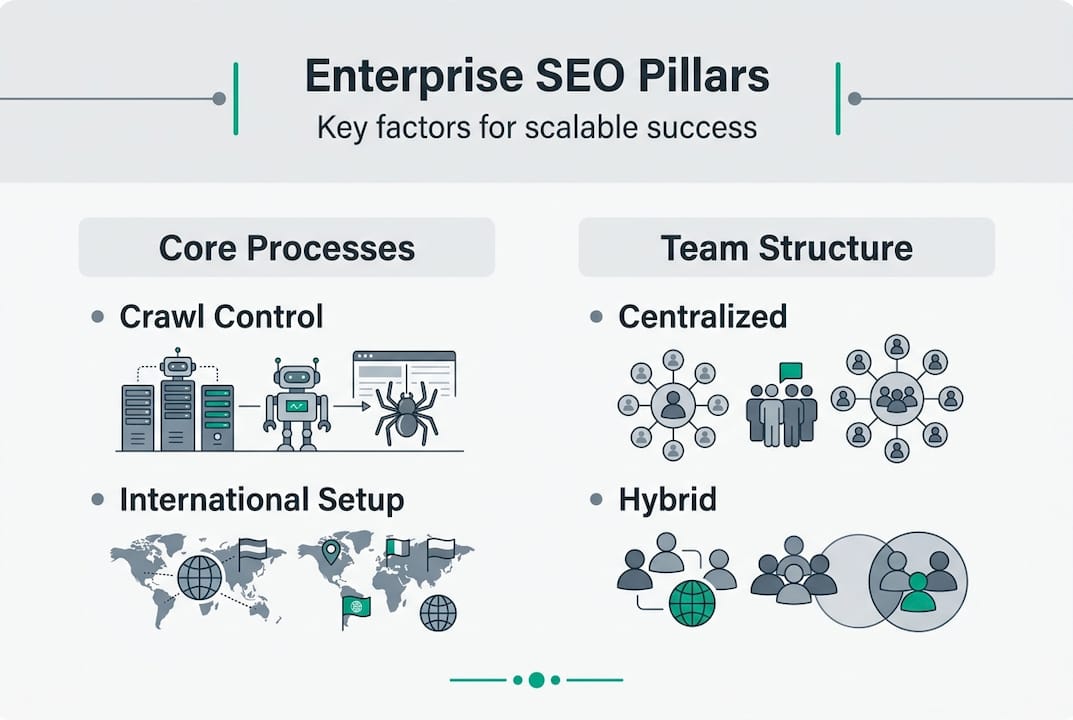
Governance models deserve special attention because they’re often misunderstood. Here’s how the three main SEO governance models compare:
| Model | Structure | Best for |
|---|---|---|
| Centralized | One team owns all SEO decisions | Consistency, brand control |
| Decentralized | Each business unit handles its own SEO | Agility, regional flexibility |
| Hybrid | Central standards, local execution | Most large organizations |
For teams exploring enterprise-level marketing strategies, the hybrid model tends to offer the best balance between control and speed.
Pro Tip: You don’t need to be a large enterprise to adopt governance practices. Even a simple RACI matrix (Responsible, Accountable, Consulted, Informed) for SEO decisions can prevent the kind of miscommunication that causes duplicate content, broken redirects, and unindexed pages.
Enterprise SEO challenges: Pitfalls and advanced realities
Knowing the pillars is one thing. Knowing where teams fall apart is what separates good strategy from great execution. Enterprise SEO has a specific set of failure modes that can quietly drain traffic and revenue for months before anyone notices.
The most common preventable issues include:
- Index bloat — Programmatic content generation without governance creates thousands of low-quality pages that dilute crawl budget and rankings.
- Site migrations without planning — Unplanned migrations drop traffic by 15 to 30% on average, a figure that’s entirely preventable with proper redirect mapping and pre-launch audits.
- Siloed teams — When IT and marketing don’t communicate, you get duplicate pages, broken canonical tags, and content that never gets indexed.
- Crawl budget exhaustion — Low-value pages consuming crawl budget means your best content gets crawled less frequently, slowing your ability to rank for new keywords.
- Ignoring entity salience — AI-driven search increasingly rewards sites that demonstrate topical authority and entity relationships, not just keyword density.
Understanding SEO in website redesign is especially critical here. Redesigns are one of the highest-risk moments in any site’s life, and teams that treat them as purely design projects routinely lose 20 to 40% of their organic traffic post-launch.
“Enterprise SEO is built to bleed when internal processes fail. The external risks like algorithm updates and AI search shifts are real, but they amplify internal failures, not cause them.” — Preventing SEO failures
For teams managing product catalogs or service directories, e-commerce SEO best practices address many of these same challenges at a scale that’s directly relevant to growing SMBs. The lesson is consistent: technical debt in SEO compounds fast, and the cost of fixing it later is always higher than preventing it now.
Applying enterprise SEO lessons to SMB growth
Here’s where things get genuinely useful for your business. You don’t need a 50-person SEO team to benefit from enterprise thinking. The smartest SMBs borrow the frameworks and apply them at their current scale, so they’re ready when growth demands more.
Four enterprise tactics that translate directly to SMB growth:
- Adopt hybrid governance early — Define who owns SEO decisions before your site gets complex. A simple approval workflow for new page creation or URL changes prevents the kind of structural problems that cost enterprise teams months to fix.
- Automate what you can — Use tools to handle meta tag generation, internal linking suggestions, and crawl monitoring. Scalable SEO staffing is one option, but automation extends your team’s capacity without proportional cost increases.
- Prioritize crawl efficiency — Even on smaller sites, keeping your crawl budget focused on high-value pages improves indexation speed and ranking consistency. Audit and noindex thin or duplicate pages regularly.
- Build ROI-aligned reporting — Tie your SEO metrics to business outcomes from day one. Rankings are vanity. Leads, revenue, and conversion rates are what justify continued investment.
Enterprise governance strategies can be adopted scalably by smaller teams focused on automation and crawl efficiency, and the payoff is a site that grows without accumulating technical debt. The step-by-step SMB marketing guide from Ascendly walks through how to build these systems in a practical sequence. And if you want to understand how strategy drives results, the data behind SMB marketing strategy shows a 331% higher success rate for businesses with a documented plan.
Pro Tip: Start your governance practice with one simple rule: no new page gets published without an assigned owner, a target keyword, and a defined internal link. That single habit prevents most of the structural SEO problems that plague growing sites.
Perspective: Why treating SEO as infrastructure changes everything
Most businesses treat SEO like a campaign. They run it for a quarter, measure it against a short-term goal, and pull back when results aren’t immediate. That mindset is the single biggest reason SEO underperforms for otherwise capable teams.
At Ascendly Marketing, we’ve seen this pattern repeatedly since 2013. The businesses that win long-term treat SEO the way they treat their CRM or their accounting system: as infrastructure that runs continuously, improves incrementally, and protects the business from disruption. Success in enterprise SEO hinges on treating it as infrastructure, with workflows and centers of excellence, not campaigns. The same principle applies at every scale.
When you build SEO into your operational workflows, two things happen. First, your execution becomes consistent regardless of team turnover or algorithm updates. Second, you build a compounding asset that grows in value over time. For teams investing in B2B SEO expertise, this infrastructure mindset is what separates sustainable growth from short-term traffic spikes. In 2026 and beyond, with AI reshaping how search works, businesses with strong SEO infrastructure will adapt. The ones running campaigns will scramble.
Supercharge your SEO with Ascendly Marketing
Enterprise SEO strategies are not reserved for companies with massive budgets or hundred-person marketing teams. The frameworks, governance models, and technical practices covered in this guide are within reach for any ambitious SMB ready to build for scale.

Ascendly Marketing helps businesses implement scalable SEO foundations, from technical audits and governance planning to content strategy and ROI reporting. Explore our full range of digital marketing services to see how we approach growth systematically. If you’re newer to organic search, our organic SEO guide is a strong starting point. And for a broader view of how digital channels work together, the SMB digital marketing guide covers the full picture in practical terms.
Frequently Asked Questions
What qualifies a website as needing enterprise SEO?
Websites with over 10,000 pages, complex technical architecture, or multiple teams managing content typically require enterprise SEO to maintain governance and scale results effectively. Complexity matters as much as page count.
Can small businesses benefit from enterprise SEO strategies?
Absolutely. Governance and automation practices from enterprise SEO can be adopted at any scale, helping SMBs build clean site architecture and avoid the technical debt that slows growth later.
What are the biggest risks in enterprise SEO?
The highest-impact risks include site migrations without planning, index bloat from ungoverned programmatic content, siloed teams producing duplicate or unindexed pages, and slow adaptation to AI-driven search behavior.
How is SEO governance managed at the enterprise level?
Large organizations use centralized, decentralized, or hybrid models supported by RACI matrices and approval workflows, often coordinated through a dedicated SEO Center of Excellence that sets standards across all teams.