

TL;DR:
- Engaging content captures attention and prompts reactions like sharing, commenting, or purchasing. Creating it relies on a system of audience research, clear structure, and measurement, not talent. Building emotional connection and matching content format to platforms significantly boosts engagement and loyalty.
Engaging content is defined as any piece of writing, video, or visual that holds attention long enough to prompt a reaction, whether that reaction is a share, a comment, a click, or a purchase. Knowing how to create engaging content is not about raw talent. It is about applying a repeatable system built on audience research, psychological hooks, clear structure, and consistent measurement. Successful creators treat engagement as a production system problem, not a creative lottery. The benchmarks for 2026 are specific: headlines between 10 and 20 words, average sentence length around 14 words, and image text kept under 20% of the visual area. Get those fundamentals right, and the rest follows.
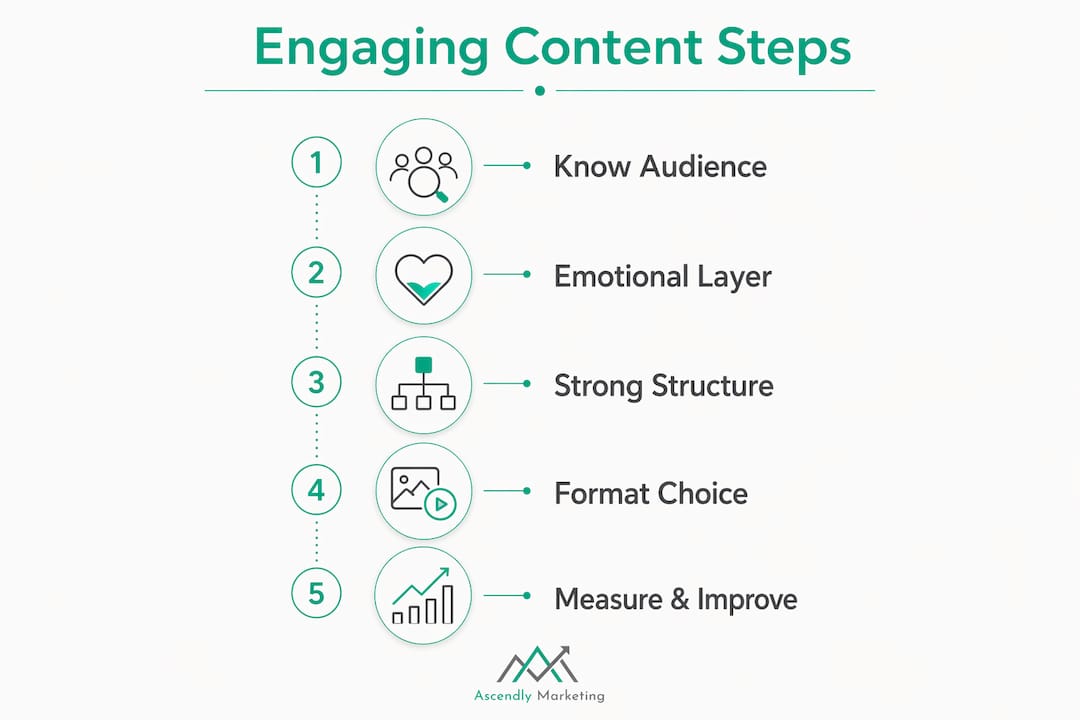
How to create engaging content by knowing your audience first
The most common reason content fails is that it speaks to no one in particular. Generic content produces generic results. The fix starts with building audience personas grounded in real data, not assumptions.
Effective persona research pulls from three sources:
- Community language: Read comments, Reddit threads, and Facebook groups where your audience talks freely. The exact words they use to describe their problems are the words your content should mirror.
- Search behavior: Use Google Search Console or keyword research tools to find what questions your audience types, not what you think they type.
- Competitor content gaps: Audience language and competitor gaps reveal unmet needs and fresh angles your competitors have missed. Look for topics with high search volume and thin, low-quality coverage.
- Direct feedback: Surveys and one-on-one interviews surface emotional context that data alone cannot capture.
Once you know what your audience wants, layer in emotional resonance. Human storytelling creates deeper connections than any data point alone. A case study about a real customer’s struggle outperforms a list of product features every time. People connect with people, not with brands.
Pro Tip: Search for your topic on Reddit or Quora before writing a single word. The top-voted answers tell you exactly what your audience finds most useful and what language they use to ask for it.

Emotional resonance is the layer that separates forgettable content from content that gets shared. Pair your data with a human story, and you give readers a reason to care beyond the information itself.
What does a strong content structure actually look like?
Structure is the difference between a reader who stays and one who bounces after the first paragraph. Strong structure is not accidental. It is designed.
Start with the hook. Optimal headlines in 2026 run 10–20 words, roughly 138–150 characters. That length gives you enough room to make a specific promise without losing the reader’s attention before they even click. A headline like “Seven Proven Ways to Double Your Email Open Rate in 30 Days” outperforms “Email Marketing Tips” because it is specific, benefit-driven, and time-bound.
After the hook, your content needs a clear promise. Tell the reader exactly what they will get by the end. Frameworks like the MESSAGE model (Message, Emotion, Story, Structure, Audience, Goal, Execution) help you plan that promise before you write a single body paragraph. The model forces you to answer: who is this for, what do they need, and what should they do next?
Readability standards for 2026 are clear:
- Keep average sentence length at roughly 14 words for clarity without sacrificing flow.
- Use subheadings every 200–300 words so readers can scan and find what they need.
- Keep paragraphs to 3–5 sentences maximum.
- Use numbered lists for sequential steps and bullet lists for non-sequential items.
- End each major section with a takeaway or transition that pulls the reader forward.
| Format element | 2026 standard | Why it matters |
|---|---|---|
| Headline length | 10–20 words | Balances clarity and curiosity |
| Sentence length | ~14 words average | Maintains readability and flow |
| Paragraph length | 3–5 sentences | Prevents visual fatigue |
| Image text overlay | Under 20% of image area | Keeps visuals clean and readable |
Pro Tip: Write your headline last. After you finish the draft, you know exactly what the content delivers. That clarity produces a more accurate, more compelling headline than anything you write before you start.
Platform matters too. A long-form article structure works on a blog. A carousel works on Instagram. A thread works on X. Match your structure to where your audience actually reads. You can find content format ideas for social media that align with platform-specific engagement patterns.
Writing and editing techniques that make content captivating
Clear writing is not about using simple words. It is about removing every word that does not earn its place. The goal is a draft that reads the way a confident, knowledgeable person talks.
The most effective editing techniques include:
- Read aloud: Reading your draft aloud exposes stiff transitions, filler phrases, and sentences that run too long. If you stumble reading it, your reader will stumble too.
- One idea per paragraph: Each paragraph should make one point, support it, and move on. Stacking multiple ideas in one paragraph forces the reader to do extra work.
- Active voice: “The team launched the campaign” is clearer than “The campaign was launched by the team.” Active voice keeps sentences short and direct.
- Concrete language: Replace “a significant improvement” with “a 40% increase.” Replace “many customers” with “three out of four customers.” Specificity builds credibility.
- Cut filler transitions: Phrases like “it goes without saying” and “as we all know” add words without adding meaning. Delete them.
Storytelling is the most underused writing technique in content marketing. A single concrete example, told as a brief narrative, does more to illustrate a point than three paragraphs of explanation. Use the structure: situation, complication, resolution. That three-part arc holds attention because the human brain is wired to follow narrative tension toward a payoff.
Balancing technical precision with accessible language is a skill that separates good writers from great ones. Write for a reader who is intelligent but not yet an expert in your specific topic. Explain jargon the first time you use it. Never assume shared knowledge that your audience may not have.
How do multimedia and format choices affect engagement?
Visual content is not decoration. It is a core part of how readers process and retain information. The wrong visual choice actively hurts engagement.
Text on images should stay under 20% of the image area to keep visuals clean in crowded social feeds. That rule applies to Instagram posts, Facebook ads, and LinkedIn graphics alike. When text dominates an image, the visual loses its stopping power. The image becomes a slide, not a hook.
Captions and subtitles are not optional for video content. A large share of social video is watched without sound, particularly on mobile. Subtitles keep viewers watching. Captions also improve accessibility, which expands your potential audience.
Repurposing content across formats multiplies the reach of a single idea. A long-form blog post becomes a LinkedIn article summary, a short video script, an email newsletter section, and a carousel. Each format reaches a different segment of your audience without requiring you to generate a new idea from scratch. For a practical look at social media engagement strategies across formats, the principles of consistency and platform fit apply across industries.
Pro Tip: When repurposing, always adapt the format to the platform’s native behavior. Do not paste a blog intro into an Instagram caption. Rewrite it to match how people read on that platform.
Responding to comments and direct messages promptly turns passive followers into active participants. Engagement is a two-way exchange. When you reply, you signal to the algorithm and to your audience that there is a real person behind the content. That signal compounds over time into community loyalty.
How do you measure and improve content engagement over time?
Measurement without a clear question produces noise, not insight. Before you check any metric, define what behavior you are trying to understand.
The metrics that matter most for content engagement are:
- Watch time and scroll depth: These show whether readers actually consume your content or bounce after the first screen.
- Shares and saves: Shares signal that readers found the content worth spreading. Saves signal that readers found it worth returning to. Both are stronger signals than likes.
- Comments: Comments reveal emotional response. A post with 50 comments generated more genuine engagement than a post with 500 likes and no replies.
- Click-through rate: On email and search, click-through rate tells you whether your headline and preview text are doing their job.
- Return visitors: A growing share of return visitors indicates that your content builds loyalty, not just traffic.
Run small tests before scaling. Change one variable at a time: the headline format, the opening sentence, the call to action placement, or the visual style. Changing multiple variables at once makes it impossible to know what drove the result. Use your content marketing strategy as the framework for deciding which tests to prioritize based on your goals.
Analytics feedback should feed directly back into your content planning. If a particular topic generates three times the average comments, create a follow-up piece. If a specific headline format consistently outperforms others, make it your default template. Iteration is how good content becomes great content over time.
Key Takeaways
Creating captivating content requires a repeatable system built on audience research, clear structure, conversational writing, smart format choices, and consistent measurement.
| Point | Details |
|---|---|
| Audience research drives relevance | Use community language, search data, and competitor gaps to find what your audience actually needs. |
| Structure determines whether readers stay | Apply headline length standards (10–20 words) and keep sentences around 14 words for maximum readability. |
| Editing is where engagement is built | Read aloud, cut filler, use active voice, and keep one idea per paragraph to sharpen every draft. |
| Visuals follow clear rules | Keep image text under 20% of the visual area and always add captions to video content. |
| Measurement drives improvement | Track shares, comments, scroll depth, and click-through rate, then test one variable at a time. |
What I have learned about content that actually works
After years of building content programs for brands across industries, the single biggest mistake I see is treating content creation as an inspiration problem. Creators wait for a great idea instead of building a system that produces great ideas on schedule.
The second mistake is underestimating the emotional layer. AI-generated content can replicate research but rarely captures the emotional depth that makes a reader stop and think. The posts and articles that generate real community response almost always contain a human moment: a failure, a counterintuitive lesson, or a story that makes the reader feel seen. That layer cannot be templated. It has to be written by someone who genuinely understands the audience.
The third mistake is publishing and disappearing. Responding promptly to audience interactions is not a nice-to-have. It is the mechanism that converts a piece of content into a community. The brands I have seen build durable audiences all share one habit: they show up in the comments.
My practical recommendation is to treat every piece of content as a hypothesis. Publish it, measure the response, extract one lesson, and apply it to the next piece. That cycle, repeated consistently, produces better results than any single viral post ever will.
— Ascendly Marketing
Content strategy support from Ascendly Marketing
Knowing the principles is one thing. Executing them consistently across every channel, format, and audience segment is another challenge entirely.

Ascendly Marketing has worked with businesses since 2013 to build content programs that generate real traffic, real leads, and real revenue. The team includes SEO specialists, content creators, and social media managers who apply the same frameworks covered in this article at scale. Whether you need a full digital marketing strategy or targeted support with content creation and distribution, Ascendly Marketing builds programs around your specific goals. You can also explore content marketing examples that show what results-driven content looks like in practice. Contact Ascendly Marketing to discuss what a structured content engagement program looks like for your business.
FAQ
What makes content engaging to readers?
Engaging content combines a specific promise, emotional resonance, and clear structure. It speaks directly to a defined audience using their own language and delivers on its headline’s promise without filler.
How long should a headline be for maximum engagement?
Headlines between 10 and 20 words, or roughly 138–150 characters, balance clarity and curiosity for maximum reader attention in 2026.
What is the best sentence length for readable content?
An average sentence length of about 14 words maintains readability without sacrificing flow. Sentences that run longer tend to lose readers before reaching the main point.
How do you measure whether content is actually engaging?
Track shares, saves, comments, scroll depth, and click-through rate. These behavioral signals reveal whether readers consumed and valued your content, not just whether they landed on the page.
Does responding to comments really improve engagement?
Yes. Promptly responding to comments and messages builds community and signals to platform algorithms that your content generates genuine interaction, which increases its organic reach over time.