

A lot of small businesses keep working on the same problem from the wrong end. They rewrite headlines, change button colors, and swap ad images, yet the underlying issue is simpler: the same message is going to people with different needs.
That approach wastes budget. It also lowers response.
Audience segmentation campaigns have been shown to generate 101% more clicks compared to non-segmented campaigns, according to Salesgenie’s customer segmentation analysis. That number changes the conversation. Audience segmentation isn’t a cosmetic marketing tactic. It’s the difference between sending one broad message and sending a relevant one.
Stop Shouting into the Void; Start Segmenting
Most low-performing marketing has the same flaw. The business knows what it wants to say, but it hasn’t sorted customers into groups that care for different reasons.
Audience segmentation means dividing your market into smaller groups based on shared traits, actions, or buying patterns. Then you match the message, offer, timing, and channel to that group. A first-time buyer shouldn’t get the same email as a repeat customer. A business owner comparing vendors shouldn’t see the same ad as someone ready to book today.
What changes when you segment
Without segmentation, marketing acts like a loudspeaker. With segmentation, it starts acting like a conversation.
That shift affects almost every channel:
- Email gets sharper because repeat buyers, inactive leads, and new subscribers each receive different messages
- Ads waste less spend because you stop paying to show the same creative to everyone
- Sales follow-up improves because the team can prioritize people based on fit and behavior
- Website content becomes more useful because different visitors see different paths
Practical rule: If two customer groups buy for different reasons, they need different messaging.
A busy owner doesn’t need more complexity. You need fewer mismatches. That’s why segmentation belongs with other smart marketing strategies that improve efficiency before you increase spend.
A plain-English example
Take a local HVAC company. One part of its audience needs emergency repair. Another group wants annual maintenance. A third is comparing replacement systems and financing options.
If that company sends one generic promotion to all three groups, recipients largely ignore it. If it separates those groups and tailors the message, each campaign becomes easier to understand and easier to act on.
That’s the practical value of audience segmentation. It helps you stop broadcasting and start matching real demand.
The Five Lenses for Viewing Your Audience
You can look at the same customer from several angles. One lens shows who they are. Another shows what they do. A third shows what they care about. Used together, these lenses make your decisions cleaner.
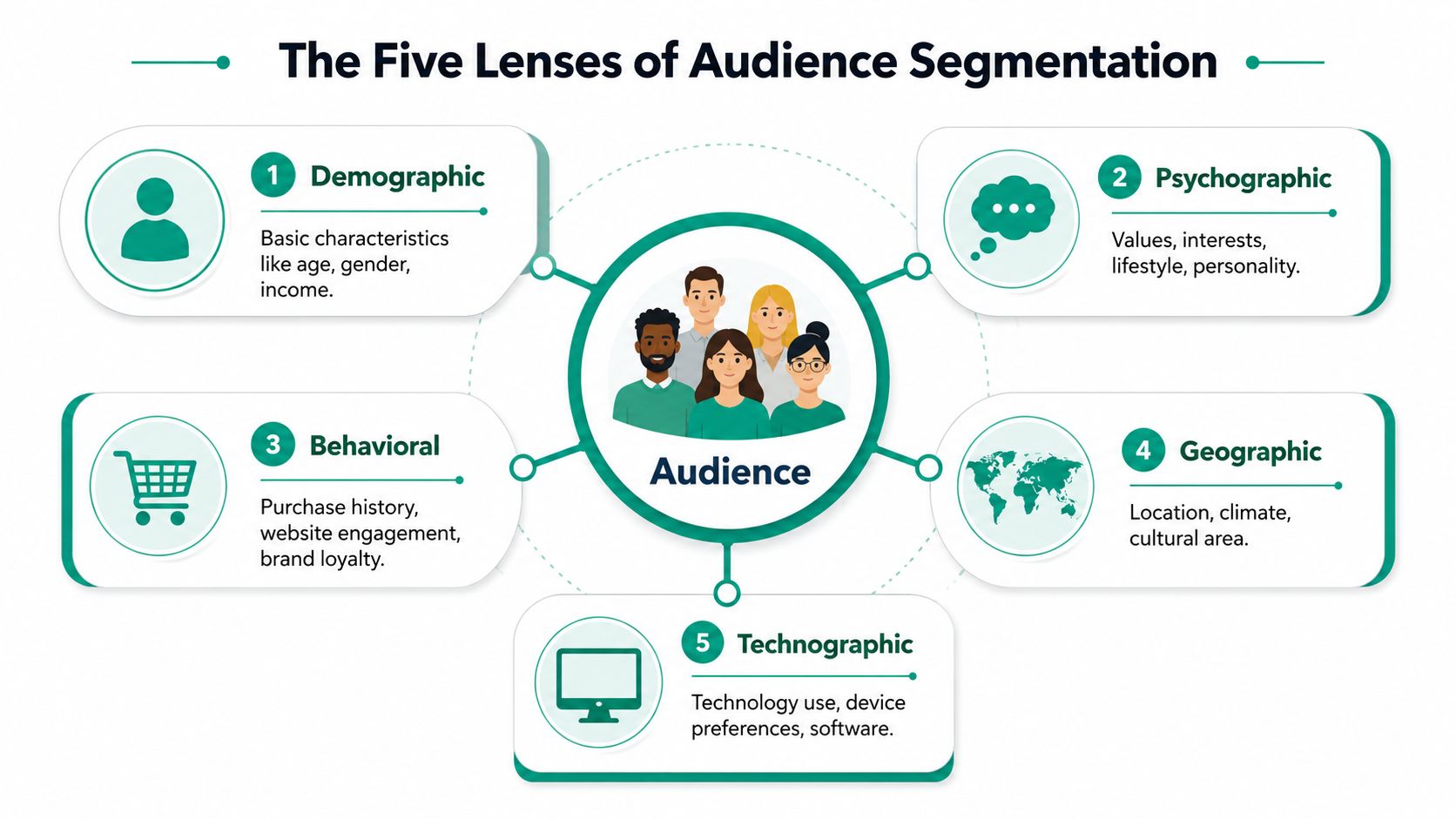
The five lenses
Demographic segmentation looks at basic traits such as age, income range, family status, or job role. This lens helps when different life stages or roles shape demand. A bookkeeping service, for example, may speak differently to a solo consultant than to a household hiring tax help.
Psychographic segmentation focuses on attitudes, preferences, values, and motivations. Two customers with similar income can still buy for different reasons. One wants convenience. Another wants status. A third wants simplicity and low risk.
Behavioral segmentation tracks actions. This includes pages visited, products viewed, content downloaded, emails opened, carts abandoned, and purchase frequency. When readers ask, “What should I segment first?” I usually point here because actions are often clearer than assumptions.
Two lenses that matter even more in practice
Geographic segmentation uses location. For local service businesses, geography often shapes both demand and logistics. Neighborhood, service area, climate, and commute patterns can all affect how and when buyers respond.
Technographic segmentation groups people by the devices, platforms, and software they use. If your audience browses on mobile but checks out on desktop, that matters. If you’re a B2B company selling to teams on specific software stacks, that matters even more.
Different lenses answer different questions. Demographics tell you who someone is. Behavior shows what they’ve done. Geography tells you where to act. Technographics show how they interact.
A separate but closely related B2B lens is firmographic segmentation. That means company size, industry, business model, or department. If you want a clean overview of how targeting differs from segmentation, this audience targeting guide for SMBs gives useful context.
Audience Segmentation Types Compared
| Segmentation Type | What It Is | Example Data Points | Question It Answers |
|---|---|---|---|
| Demographic | Personal background traits | Age range, household status, income band, role | Who is this customer? |
| Psychographic | Motivations and preferences | Interests, values, buying priorities, lifestyle | Why might they buy? |
| Behavioral | Observable actions | Product views, repeat visits, email clicks, abandoned carts | What are they doing? |
| Geographic | Location-based grouping | City, ZIP area, service radius, region | Where should you target them? |
| Technographic | Technology usage | Mobile vs desktop, browser, software used, platform preference | How do they interact with you? |
How to choose the right lens first
Don’t try to use every lens at once.
Start with the one tied closest to revenue:
- For e-commerce, begin with behavioral and transactional data
- For B2B lead generation, start with firmographic and behavioral signals
- For local service businesses, begin with geography and recent activity
- For long sales cycles, mix motivations with intent signals from content consumption
When teams get stuck, the issue usually isn’t lack of data. It’s trying to answer five business questions with one customer label.
Connecting Segments to Your Bank Account
Segmentation matters because it changes where money goes and what comes back.
A generic campaign spreads budget across people who aren’t equally ready, equally valuable, or equally interested. A segmented campaign puts more spend behind the groups most likely to respond. That one operational change improves how your sales pipeline fills and how your marketing budget performs over time.
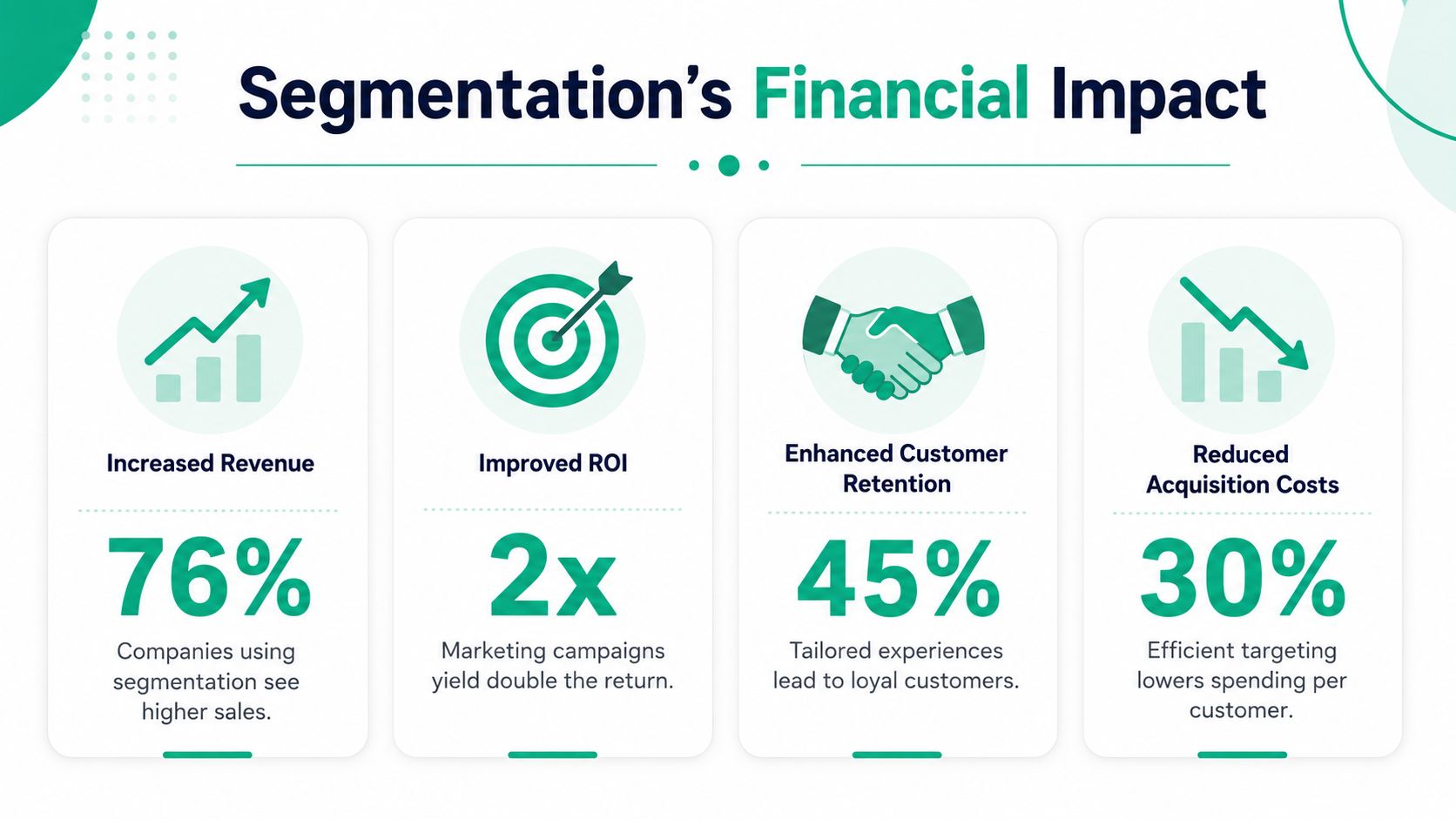
Why revenue changes
Segmented, targeted, and triggered marketing campaigns generate 77% of total marketing ROI, based on Aerospike’s analysis of real-time audience segmentation. That statement explains why broad campaigns often underperform. The return doesn’t come evenly from every message. It comes disproportionately from the messages matched to the right audience and the right timing.
A simple example makes this easier to see. A B2B software company may have one segment comparing vendors, another asking for pricing, and another downloading educational content. If all three groups receive the same offer, the campaign blurs intent. If each group gets the next logical message, the budget works harder because the message fits the stage.
Better fit improves more than clicks
Financial impact shows up in several places at once:
- Conversion efficiency improves because relevant offers create less friction
- Sales teams spend time better because higher-fit leads reach them sooner
- Customer value rises when repeat buyers receive offers based on actual need
- Waste drops when weak segments stop consuming the same budget as strong ones
Personalization earns its keep. It doesn’t need to be flashy. It just needs to match context. A useful read on that connection is this piece on why personalized marketing drives SMB engagement and sales.
The fastest way to lower marketing efficiency is to treat every lead as if they have the same urgency, budget, and buying reason.
What owners should measure
If you run a smaller company, skip vanity metrics first. Track outcomes by segment:
- Lead quality by segment
- Conversion rate by segment
- Average order pattern by segment
- Repeat purchase behavior by segment
- Sales cycle length by segment
Those numbers show whether your segmentation model is helping the business make money, not just produce reports.
A Practical Framework for Building Your Segments
Most SMBs don’t need a data science team to start. They need a clear process and a short list of useful data sources.
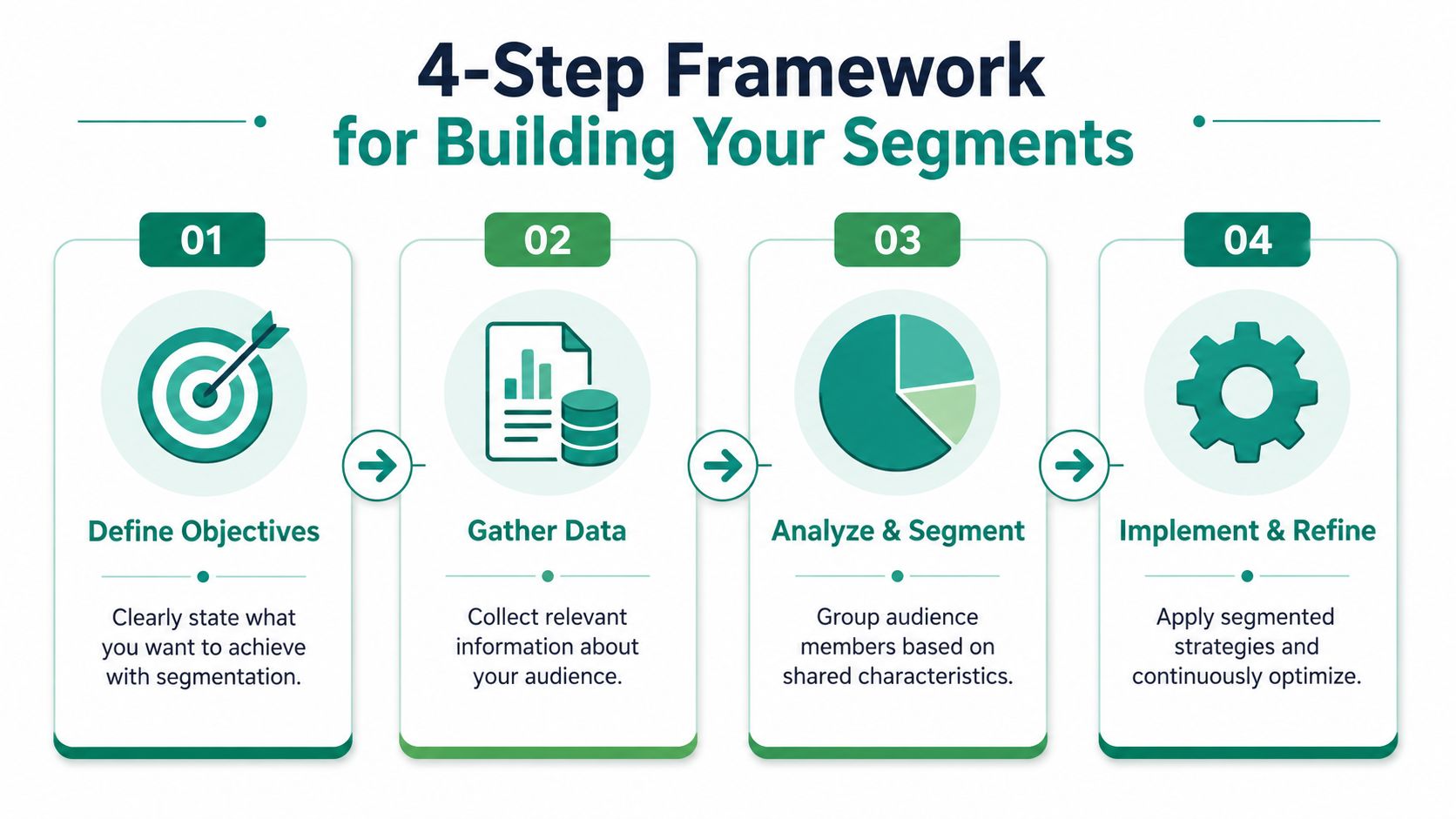
Step 1: Define the business objective
Start with one commercial goal. Don’t begin with “let’s segment our audience.” Begin with a practical problem such as low repeat purchases, weak lead quality, or too many abandoned carts.
That goal shapes the segment model. If you want more repeat orders, transactional and behavioral data will matter most. If you need better B2B lead quality, firmographic and engagement signals should lead.
A useful input here is your persona work. If your team needs a reset on that foundation, this guide to buyer persona development helps clarify what belongs in a segment versus what belongs in a profile.
Step 2: Gather the right data
Pull from systems you already have before you add new tools. Common sources include Google Analytics, your CRM, e-commerce platform, email platform, customer surveys, support tickets, and point-of-sale data.
Keep the data practical:
- Behavioral signals such as repeat visits, product views, downloads, and cart events
- Transactional records such as recency, frequency, and categories purchased
- Customer attributes such as role, company type, location, or account size
- Motivational clues from surveys, sales notes, and on-site search terms
If messaging apps are part of your sales process, segmenting that channel matters too. This overview of WhatsApp customer segmentation shows how teams can separate contacts based on behavior and buying stage instead of sending the same message to everyone.
A short visual can help if you’re mapping this for your team:
Step 3: Analyze and build the groups
At the beginning, simple rules work fine. You can create segments such as repeat buyers, first-time buyers, high-intent visitors, inactive customers, or leads from specific industries.
As your data gets cleaner, clustering becomes useful. Organizations using predictive clustering algorithms on behavioral data achieve 34% higher segment homogeneity and a 27% improvement in Customer Lifetime Value compared to traditional demographic-only segmentation, according to Count’s audience segmentation analysis. In plain language, that means data-driven grouping produces cleaner segments and stronger long-term value than relying only on labels like age or income.
Step 4: Activate and refine
A segment has no value until you use it. Push the groups into your email platform, ad audiences, CRM workflows, or on-site personalization tools. Then test one message per segment against one generic control.
Field note: Good segments are distinct enough to act on and simple enough to maintain.
Review results regularly. If two segments respond the same way, merge them. If one segment contains people with very different buying patterns, split it. The process isn’t complicated, but it does require discipline.
Audience Segmentation in Action for Your Business
Theory gets clearer when you can see where it fits. These three examples are small on purpose. They mirror the kinds of decisions SMBs make every week.
B2B company with uneven lead quality
A manufacturing supplier was generating inquiries, but the sales team said too many leads weren’t a fit. The company had been running the same message to operations managers, procurement teams, and small owner-operators.
The fix wasn’t more leads. It was better sorting.
The team created segments using company type, buying role, and on-site behavior. Visitors reading specification pages received technical follow-up. Pricing-page visitors saw consultation offers. Smaller firms received messaging focused on flexibility and turnaround, while larger accounts saw risk reduction and process stability.
That changed how sales conversations started. Reps spent less time requalifying. Marketing stopped treating all form fills as equal.
E-commerce store with misleading “high-value” assumptions
An online retailer had been targeting “high-income” shoppers with premium product messaging. Results were mixed because the label didn’t describe how people bought.
Recent retail intelligence shows that “high-income” demographics often split their baskets between premium and discount formats, which means segmentation needs to go beyond income and use cross-purchase and basket behavior to identify real buyer profiles, as noted in this audience segmentation techniques roundup.
What basket behavior reveals
The retailer shifted from demographic assumptions to transactional patterns:
- Premium-only buyers received early access and curated bundles
- Mixed-basket shoppers saw value framing, pairings, and practical recommendations
- Discount-led buyers received timing-based offers and replenishment reminders
Buyers don’t organize themselves by the labels a business prefers. They organize themselves through repeated behavior.
That move improved relevance because the store stopped guessing from surface traits and started responding to actual purchase patterns.
Local service business with broad service-area marketing
A home services company had one campaign covering its full metro area. Response varied a lot, but the ads, landing pages, and offers were identical across locations.
The business reorganized by neighborhood clusters, service type, and urgency. High-intent visitors who checked emergency pages were separated from homeowners browsing seasonal maintenance. Certain areas received messages built around faster scheduling, while others saw preventive service content tied to recurring needs.
The biggest change was operational, not creative. The business aligned campaign groups with the way technicians were dispatched and the kinds of jobs each area produced. That made the marketing easier to measure because each segment mapped to a real business condition.
From Plan to Profit: Activating Your Segments
Once your segments are built, the work shifts to operations. You need tools that can hold the data, move it between systems, and trigger the right response.
For most SMBs, that stack includes a CRM, an email platform, website analytics, and an ad platform. E-commerce brands may add Shopify or WooCommerce data. B2B teams often pull in form activity, pipeline stage, and sales notes. Local service companies usually need location data and service history close at hand.
What to track every month
Pick a short KPI set and keep it tied to revenue:
- Segment conversion rate to see which groups buy
- Lead-to-sale quality to spot which campaigns create useful demand
- Repeat purchase or retention patterns to identify durable customer groups
- Message response by segment across email, ads, and landing pages
Then test activation, not just targeting. A segment can be right while the message is wrong.
Why real-time updates matter
Static segments age quickly. A visitor can move from casual browser to ready buyer in one session. A cart abandoner can become a customer within minutes. If your systems update too slowly, your messaging trails behind the buyer.
Campaigns using real-time segment updates every five minutes achieve 52% higher click-through rates and 38% greater engagement than campaigns using daily static segments, as noted earlier in Count’s benchmark analysis. The gain comes from timing. The message reaches people while their behavior still reflects current intent.
Build a usable rhythm
Keep the process light and repeatable:
- Review segment performance inside your CRM and analytics tools
- Adjust membership rules when behavior changes
- Test one offer or message per segment
- Feed results back into your next campaign setup
Audience segmentation works best when it’s treated like an operating habit. Not a one-time setup. Not a report that sits in a dashboard.
If your team wants a clearer segmentation strategy, stronger targeting, or a better link between marketing activity and revenue, Ascendly Marketing can help you build the system and put it to work.