
You publish a thoughtful update on your company’s LinkedIn page. The copy is clean. The design looks polished. An hour later, the post has two likes, and one came from someone on your team.
That result usually doesn’t mean the post was bad. It means the post was dropped into LinkedIn without a system behind it.
A working LinkedIn content strategy isn’t a list of post ideas. It’s an operating model. You decide who the content is for, what role each post plays, who inside the company helps distribute it, and which posts deserve paid support. When those pieces connect, LinkedIn stops being a place where you announce things and starts being a place where buyers notice patterns, remember your point of view, and start conversations.
From Crickets to Conversations on LinkedIn
A lot of B2B teams treat LinkedIn like a press release feed. They post product updates, team photos from events, and company milestones, then wait for traction that rarely comes. The issue isn’t effort. The issue is that buyers don’t open LinkedIn hoping to read brand announcements.
They open it to learn something useful, react to an opinion, or join a conversation already moving.
That gap matters because LinkedIn isn’t a side channel in B2B. It drives real pipeline attention. LinkedIn generates approximately 80% of all B2B social media leads, 97% of B2B marketers use it for content marketing, and 40% rate it as their most effective channel for high-quality leads, according to Forbes Advisor’s content marketing statistics roundup.
What usually goes wrong
The weak pattern looks familiar:
- The company page does all the talking while employees stay quiet
- Every post sounds promotional even when the topic is useful
- The format never changes so the feed feels flat
- Nobody manages the first hour after publishing, so discussion dies early
A better pattern starts with one shift. Stop asking, “What should we post this week?” Ask, “What conversation do we want to be part of with the people who buy from us?”
Buyers respond to relevance before they respond to polish.
When a cybersecurity SaaS company posts, “We just launched a new feature,” that’s easy to ignore. When the same company posts, “Three security review questions enterprise buyers ask before a pilot gets approved,” a different audience pays attention. Now the post is attached to a job, a risk, and a buying moment.
What a real system changes
A real strategy does four jobs at once:
| Focus | What it does on LinkedIn |
|---|---|
| Audience fit | Targets people by role, pressure, and buying trigger |
| Content structure | Keeps posts tied to clear themes instead of random ideas |
| Distribution | Extends reach through employees and paid support |
| Measurement | Tracks business signals, not vanity metrics |
Once those pieces are in place, content becomes easier to create because every post has a purpose. You stop guessing. Your team knows why a founder post differs from a product post, why some ideas belong on employee profiles instead of the company page, and why certain posts get budget behind them.
Building Your Strategic Foundation
Most LinkedIn strategies break before the writing starts. Teams jump into content production with a loose persona, a few broad themes, and no clear link between audience pain and the post they'll publish next Tuesday.
The fix is simple. Build around audience mapping and content pillars first.
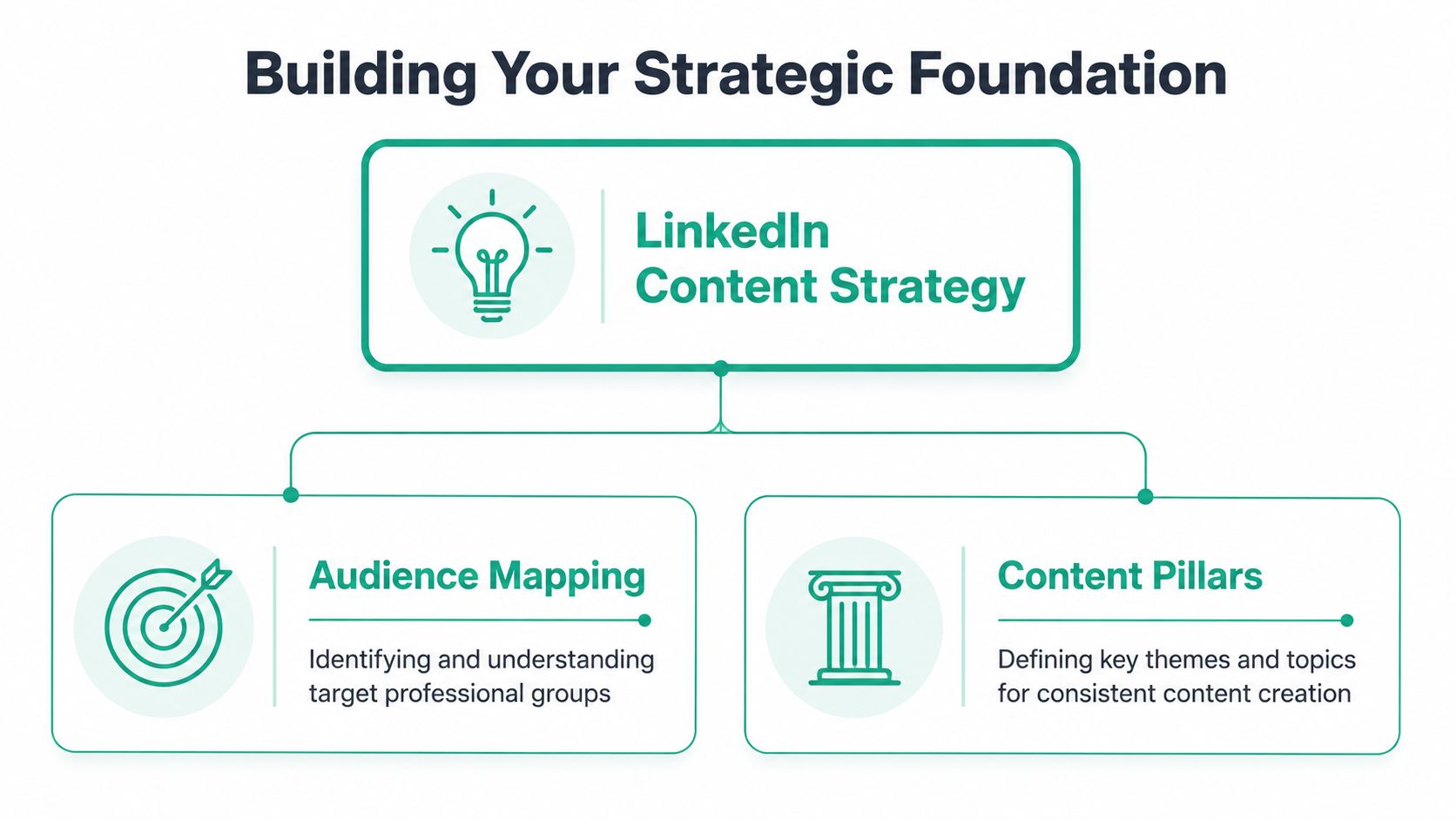
Start with roles, not a generic persona
"Mid-market decision-maker" is too vague to guide content. A stronger map lists the actual roles involved in a sale, then ties each one to a specific concern.
Take a B2B SaaS company selling workflow software:
- CTO cares about integrations, security review friction, and implementation complexity
- CFO wants a credible business case, lower waste, and fewer hidden costs
- Project Manager needs adoption, ease of use, and less resistance from the team
That structure produces clearer content fast. The CTO doesn't need another generic productivity tip. The CFO won't engage with a feature tour unless it connects to a business outcome. The Project Manager responds to stories about rollout friction because that problem lands on their desk.
If you need a stronger starting point for this work, a practical buyer persona development process helps turn broad audiences into role-based messaging inputs.
Build content pillars that match buying pressure
Once the audience map is clear, define 3 to 5 content pillars. More than that gets messy. Fewer than that usually makes the feed repetitive.
For the same SaaS company, the pillars could look like this:
-
Operational pain points
Posts about handoff failures, duplicate work, slow approvals, and reporting confusion. -
Decision support
Content for buyers comparing options, building internal consensus, or preparing for vendor review. -
Product education
Use cases, setup lessons, FAQs, and examples that make the product easier to understand. -
Customer reality
Behind-the-scenes implementation lessons, objections heard in sales calls, and what users struggle with before adoption sticks. -
Company point of view
Posts from leaders on how the market is changing, what clients are asking for, and where common advice falls short.
Assign a job to each pillar
Not every pillar exists to generate leads directly. Some create familiarity. Some remove friction. Some open the door for conversation.
A simple working model looks like this:
| Pillar | Primary purpose | Best home |
|---|---|---|
| Operational pain points | Start discussion | Employee profiles and company page |
| Decision support | Help active buyers | Company page, founder profile |
| Product education | Reduce confusion | Company page |
| Customer reality | Build trust | Founders, sales leaders, customer success |
| Company point of view | Differentiate | Executives and subject experts |
Practical rule: If a pillar can’t be tied to a buyer question, objection, or trigger, it’s too vague to keep.
Many teams clean up wasted effort when they realize half their planned content is internal news dressed up as thought leadership. Keep internal updates, but don’t let them dominate the calendar. A strategic LinkedIn presence is built around the buyer’s world, not your publishing convenience.
Creating Content That Connects and Converts
A team builds solid content pillars, posts consistently for a month, and still gets little traction. The problem usually is not effort. It is a mismatch. The topic may be right, but the format, voice, or distribution path does not fit the job the post needs to do.
Good LinkedIn content works as a system. The company page publishes the clearest version of the message. Leaders and subject matter experts add context from the field. Employees extend reach with posts and comments that sound like real people. Paid amplification then goes behind the posts that already proved they can hold attention. If those pieces are disconnected, even strong ideas stall.

Match the format to the job
Start with intent, not format preference.
- Text posts work best for a sharp opinion, a lesson from the field, or a direct take on a problem buyers are trying to solve.
- Document carousels are better for teaching. Use them for step-by-step processes, comparisons, frameworks, and objection handling.
- Video earns its place when tone, delivery, or credibility matter. A product lead explaining a rollout mistake often carries more weight on video than in copy alone.
- Polls and questions can start useful conversations, but only when the question helps surface a real buyer concern.
The trade-off is straightforward. Production value helps only after the idea is clear. B2B marketing teams often spend too much time polishing design and too little time sharpening the point. A plain text post with a specific point of view will often outperform a polished asset that says nothing memorable.
Build a content mix that earns attention
Many company feeds underperform because they promote too early and teach too little. Content mix frameworks help fix that by forcing discipline across the week.
The 3-2-1 rule
LinkedIn’s own framework recommends three pieces of industry-related content, two pieces of “proud” content, and one piece promoting your brand or solutions in a weekly mix, as described in LinkedIn’s B2B content marketing guide.
This model fits company pages well. It gives the brand room to show momentum without turning the feed into a string of announcements.
The 4-1-1 rule
The 4-1-1 rule suggests that for every six pieces of content, four should be relevant industry content from others, one should be a soft promotional post, and one should be a hard promotional post. That mix can also support stronger engagement for carousel posts, according to this LinkedIn post on best practices.
This approach works well for employee advocacy and executive posting because it is easy to explain and easy to repeat. Sales leaders know they do not need to pitch every time they post. Employees know they can add value by interpreting industry trends, sharing customer-facing lessons, and occasionally tying those insights back to the company.
A simple split looks like this:
| Situation | Better fit |
|---|---|
| Company page with mixed audiences | 3-2-1 |
| Founder, sales, and employee advocacy content | 4-1-1 |
| Heavy launch period | 4-1-1, so promotion does not flood the feed |
If your team is still building consistency, map this mix into a weekly LinkedIn content calendar process so each audience, format, and owner has a clear role.
Write for conversation, then conversion
Authority matters. Forced authority does not.
A lot of weak LinkedIn content sounds like it was approved by six people and written by none of them. Buyers respond better to posts that show how work happens in practice. That is why implementation friction, sales objections, trade-offs, and lessons learned often drive better discussions than generic advice.
Expandi's analysis of LinkedIn content strategy makes a similar point. Relatable, relevant posts often outperform content that tries too hard to signal expertise.
That does not mean posting casually for the sake of it. It means showing your thinking in a way that helps a buyer make a decision.
Use this filter before publishing:
-
Share friction, not just conclusions
Post about the objection that kept slowing deals down, the onboarding step customers kept missing, or the internal assumption that turned out to be wrong. -
Use specific scenes from real work
"A CFO asked how long procurement would delay rollout" carries more weight than "buyers care about ROI." -
Give employees room to interpret
Provide message guidance, examples, and guardrails. Do not hand people scripts that erase their voice. -
Choose posts for paid support after they prove organic traction
If a founder post gets strong saves, comments, and qualified profile visits, that is often a better candidate for paid amplification than a brand-new campaign asset.
That last point is where many LinkedIn strategies break apart. Teams treat organic, advocacy, and paid as separate programs with separate calendars. A stronger model is to let organic posts test the message, let employees add credibility and reach, then put budget behind the angles buyers already responded to. That approach lowers creative guesswork and gives paid campaigns stronger starting material.
A quick example shows the difference.
Weak post
"We're proud to be a leading provider helping businesses streamline collaboration."
Stronger post
"One buyer told us their team used three separate tools to approve the same project. The actual issue was not missing software. It was unclear ownership between finance, ops, and legal. Here is the workflow change that fixed the bottleneck before any platform decision."
That kind of post does more than fill the calendar. It gives sales a conversation starter, gives employees something useful to share, and gives marketing a signal about which pain points deserve more reach.
A quick visual example helps if your team is still deciding which formats to prioritize.
Establishing Your Publishing Rhythm
Many teams don't need more ideas. They need a publishing rhythm they can maintain without turning LinkedIn into a weekly scramble.
The cleanest baseline is three posts per week minimum. That cadence comes from the same 4-1-1 best-practices source noted earlier and works because it gives enough repetition for learning without forcing daily production. It also leaves room for employee comments, resharing, and real-time response.

Build the week before it starts
A useful workflow looks like this:
-
Batch topics once a week
Pull ideas from sales calls, customer success notes, product questions, and current objections. -
Draft in groups
Write all founder posts together, then all company page posts, then employee-ready versions. -
Schedule only the base layer
Put your core posts into a calendar, but leave room for reactive commentary when industry news gives you a strong opening.
A structured content calendar process keeps this manageable, especially when marketing is coordinating with leadership and sales.
Treat publishing like an event, not a button click
Posting and disappearing wastes reach. LinkedIn rewards discussion that starts quickly.
LinkedIn's algorithm prioritizes content that generates meaningful discussion quickly, and responding to comments within the first hour signals value and increases visibility and reach according to this LinkedIn marketing guide.
That first hour changes how your team should work.
Workflow note: If nobody can monitor the post after it goes live, don't publish it yet.
A simple first-hour checklist works well:
-
Fifteen minutes before publishing
Warm up the account. Leave thoughtful comments on a few relevant posts and make sure the author is available to reply once their post is live. -
At publish time
Tag sparingly, check formatting on mobile, and confirm the call to action fits the post. Most posts don't need a hard CTA. -
Within the first hour
Reply to every real comment. Ask follow-up questions. Pull other team members into the thread only when they add something useful.
Protect consistency from burnout
The wrong rhythm is daily posting with no staying power. The right rhythm is a pace your team can hold for months.
If a founder can only support one strong post a week, build around that. If sales leaders are active commenters but weak original writers, use them in distribution instead of forcing them into content creation. A practical LinkedIn content strategy respects the limits of the people who have to execute it.
Amplifying Your Reach Beyond Organic
Organic posting gives you signal. It rarely gives you full distribution.
Relying on the algorithm alone leaves too much on the table, especially in B2B where trust often travels through people before it reaches a company page. The stronger approach combines organic content, employee advocacy, and paid amplification into one system.
Employee advocacy is distribution with credibility
A post from a company page can build presence. A post from a founder, salesperson, solutions engineer, or customer success leader often carries more weight because it arrives as a person speaking from real work.
That doesn't mean you should pressure employees to copy and paste corporate messaging. Forced advocacy creates thin engagement and obvious sameness.
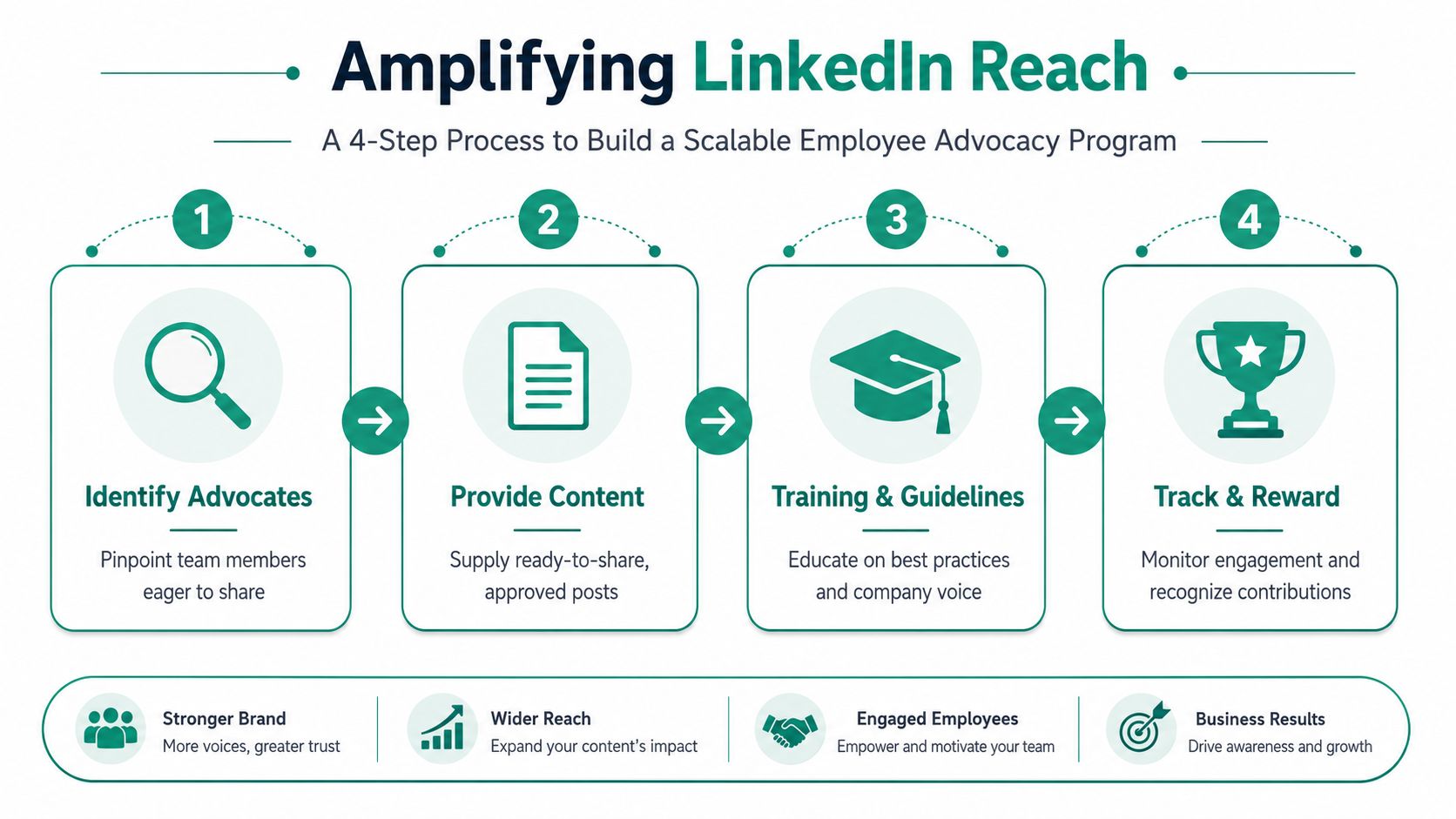
A scalable system is lighter:
-
Identify natural participants
Start with people who already comment, post, or engage with industry conversations. -
Give them adaptable source material
Provide a short brief, a few sample hooks, and the core point. Let them rewrite in their own voice. -
Support the comments layer
Ask employees to add context in the comments on company posts, not just reshare them. -
Recognize useful participation
Reward consistency and relevance, not volume.
The 4-1-1 mix finds practical application beyond the company page. If your team shares four pieces of outside industry content, one soft promotional post, and one hard promotional post, the feed stays useful. It doesn't turn into a distributed brochure.
A smart place to deepen this part of the system is a focused B2B lead generation strategy on LinkedIn, where content and outreach work together instead of operating in separate lanes.
Paid amplification should follow proof, not guesswork
A lot of teams "boost" the wrong content. They pay to extend a post that underperformed organically because someone internal liked the message. That's backwards.
Use paid support after a post has already shown signs of relevance. The post doesn't need to go viral. It just needs to prove that the audience understood it, interacted with it, or clicked through to learn more.
Here is a simple decision filter:
| Organic signal | Paid decision |
|---|---|
| Strong comments from the right audience | Worth testing with budget |
| Good click activity to a relevant page | Worth extending |
| Only likes from employees | Don’t amplify yet |
| High impressions with weak response | Rewrite the angle first |
Build one system, not three separate tactics
The best LinkedIn programs don't separate content, advocacy, and paid media into different discussions.
They work like this:
- The company page publishes a solid post tied to a pillar.
- Employees and executives add perspective, either with their own versions or useful comments.
- Marketing watches for signs that the message fits.
- The best-performing post gets targeted paid support.
That sequence compounds attention around a proven idea. It also saves budget because you're not gambling on weak creative. You're extending content that already showed some evidence of market fit.
Measuring What Matters and Optimizing Your Approach
To measure business impact, look beyond vanity metrics like likes.
A LinkedIn program earns its budget when it helps create pipeline, shortens trust-building, or improves response from the accounts you want to reach. That means the scorecard has to match the job each post is doing. A thought-leadership post from a founder should not be judged by the same standard as a demo-driven offer from the company page. An employee post that sparks the right buyer comments can be more valuable than a company post with broader reach and weaker intent.
Measure content by business role
Start by assigning each post a role before it goes live. This sounds simple, but it fixes a common reporting problem. Teams publish a mix of brand, demand, and executive content, then evaluate all of it with one flat set of numbers.
Use a tighter model:
- Awareness posts should earn comments from relevant buyers, profile visits, saves, and repeat engagement from the same audience over time.
- Consideration posts should drive qualified clicks into pages that continue the conversation, such as case studies, webinars, or category education.
- Decision-stage posts should support form fills, demo requests, booked meetings, or another clear buying action.
- Employee and executive posts should be reviewed for trust signals, including comments from target accounts, connection growth with the right people, and engagement that creates sales conversations.
Format matters too, but only in context. As noted earlier, different formats tend to produce different behaviors. A text post may generate stronger discussion. A short video may hold attention but produce fewer site visits. A document post may get more saves from buyers who want to return later. Keep the formats that help the system work. That means content from the company page, employee advocacy, and paid amplification should be reviewed together, not in separate reports.
Run a monthly review with three questions
A useful review meeting does not need a complicated dashboard. It needs clean inputs and a decision.
Pull these four inputs into one view:
- Post-level performance across comments, saves, shares, click behavior, and who engaged
- Traffic quality from LinkedIn into key site pages, not just visit volume
- Lead signals tied to offers, contact forms, demo paths, or sales conversations
- Distribution performance across company posts, employee participation, executive activity, and any paid support
Then ask:
-
What created qualified response?
Look for patterns in message, audience, author, and format. -
What attracted attention but weak intent?
These posts may still be useful for reach, but they should not shape your conversion strategy. -
What should change next month?
Adjust one variable at a time. The hook, the CTA, the author, the target audience, or the paid follow-up.
The review should end with one decision per pillar: keep, fix, or cut.
Optimize the system, not just individual posts
LinkedIn strategy grows more operational in these instances: If a company page post drives qualified clicks, but employee reposts add no meaningful reach, the issue is not the content pillar. The issue is the advocacy layer. If employee posts earn strong discussion but nothing moves into pipeline, the gap may be the destination page or CTA. If an organically strong post falls flat once promoted, the audience targeting or offer may be off.
That is why optimization should happen across the full system:
- Content pillar. Is the topic attracting the right audience?
- Author or distribution source. Does this idea work better from the brand, a subject matter expert, or a sales leader?
- Employee advocacy. Are employees adding perspective, or just reposting without context?
- Paid amplification. Are you promoting proven messages to the right audience segment?
- Conversion path. Does the click lead somewhere worth the buyer's time?
Small changes produce cleaner learning. Keep the pillar steady long enough to see a pattern, then change one variable at a time. Teams that rewrite everything every month usually create noise, not insight.
If your team needs help turning scattered posting into a working system, Ascendly Marketing can help you build the strategy, content workflow, distribution plan, and reporting structure that make LinkedIn a measurable growth channel.