

You launch a new website. The design is clean. The photos look polished. Ads start running on Google, Facebook, or LinkedIn. Then almost nothing happens. A few clicks come in, but the right people don’t stay, don’t reply, and don’t buy.
That problem usually gets blamed on the channel. Teams say the ads need work, the website needs more traffic, or the email list is weak. Sometimes those things are true. More often, the underlying issue sits underneath all of them. The message isn’t landing.
Messaging in marketing isn’t a tagline exercise. It’s the working explanation for why someone should care, why they should care now, and why they should choose you instead of delaying the decision or choosing someone else. When that explanation is vague, every tactic above it starts to feel expensive and disappointing.
Why Your Marketing Feels Invisible
A common pattern shows up in small and mid-sized businesses. The owner knows the offer is good. The team knows customers get results. Yet the homepage opens with broad language like “advanced solutions” or “quality service,” and the ads repeat the same phrases. Buyers see it, but they don’t feel spoken to.

That’s why some companies look active in the market but remain forgettable. Visibility and recognition aren’t the same thing. A brand can show up everywhere and still fail to create relevance. If you’re sorting out that difference, this breakdown of brand visibility for small businesses is a useful companion.
The product is not the message
Your product or service is the what. Messaging is the why this matters to this person right now.
A payroll software company doesn’t sell dashboards. It sells fewer manual errors, cleaner approvals, and less time spent fixing avoidable problems. A local coffee roaster doesn’t sell beans. It sells a better daily ritual, fresher flavor, and a reason to choose one shop over another.
Buyers don’t sort through your business the way you do. They don’t review your service list, admire your process, and infer your value. They skim. They compare. They ask one silent question the entire time.
Why should I care enough to keep reading?
If your message doesn’t answer that question quickly, the rest of the campaign won’t rescue it.
Why channels get blamed first
Channels are easy to point at because they’re visible. Messaging problems are harder to see because they spread everywhere.
When the message is weak, the homepage headline underperforms, paid ads attract the wrong clicks, sales calls start with too much explanation, and email follow-ups sound generic. Teams then “optimize” each asset one by one without fixing the shared root issue.
That creates a strange kind of busy. Lots of output. Very little traction.
Good marketing doesn’t start with more content. It starts with a sharper point of view about the buyer, the problem, and the promised outcome.
Once that point of view is clear, the website, ads, emails, SMS, and sales scripts stop feeling like separate projects. They become different expressions of the same argument.
The Core Components of Powerful Marketing Messaging
A strong message isn’t one clever sentence. It’s a small system. Each part supports the others, and if one piece is missing, the whole thing gets weaker.
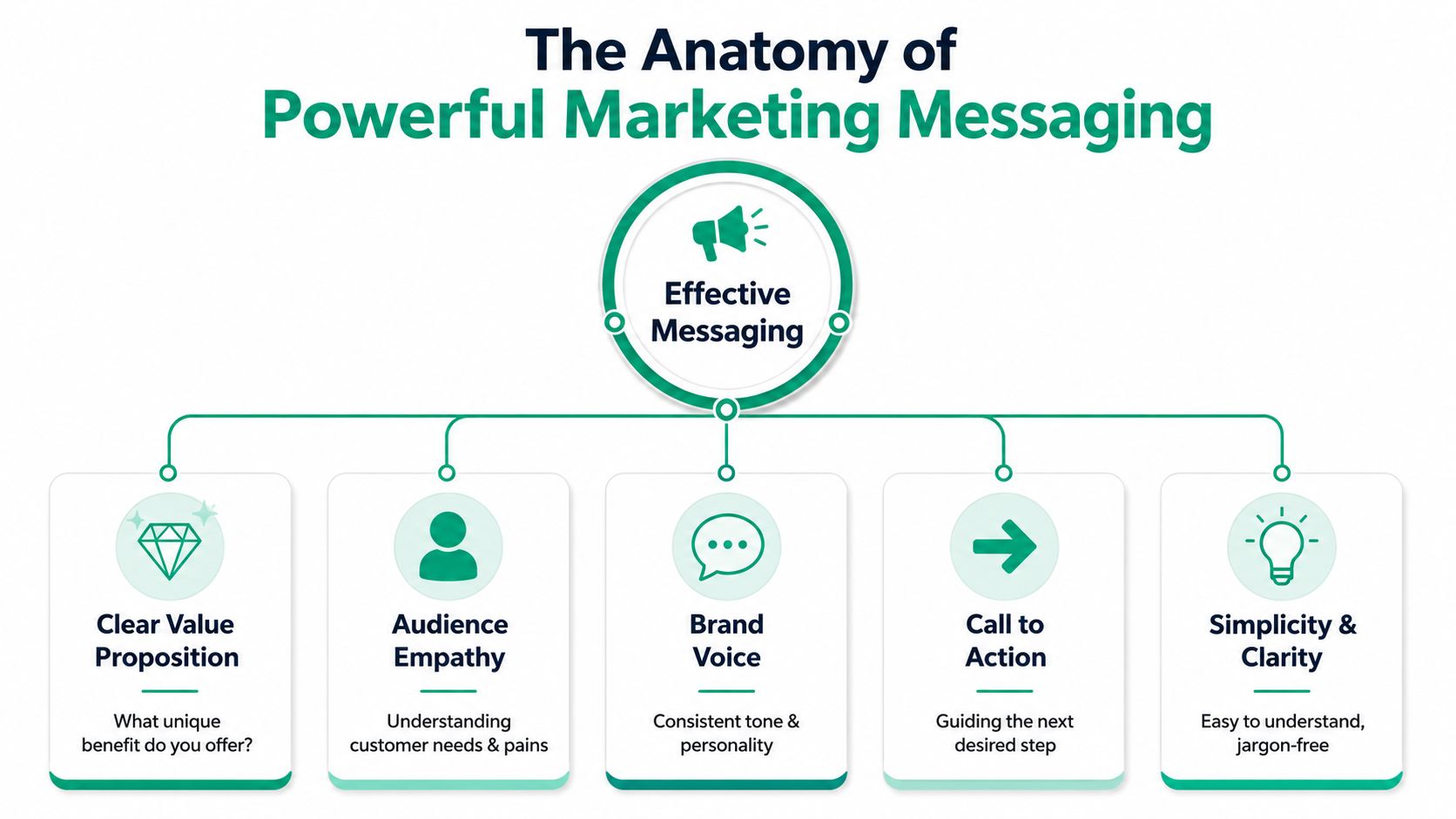
The easiest way to think about it is this. Your message needs a central claim, supporting arguments, a recognizable voice, evidence, and a next step. Without that structure, marketing turns into a pile of disconnected copy.
Start with one clear primary message
The best messaging architecture begins with a primary message. That means one clear sentence that explains what you do and why it matters. From there, you build three to four message pillars, and each pillar should address a specific customer need, highlight a unique strength, and be backed by at least three concrete proof points such as customer success metrics, testimonials, case studies, or product capabilities. The framework also calls for testing message changes against conversion rates and deal velocity so you can confirm the message works with real buyers, not just internal opinions, as outlined in Product Marketing Alliance’s guide to messaging.
That single sentence does a lot of work. It keeps your homepage focused. It keeps your sales deck from wandering. It gives your ad copy a stable center.
A weak version sounds like this:
- Weak example: We provide advanced workflow solutions for modern teams.
A stronger version sounds like this:
- Stronger example: We help operations teams replace scattered spreadsheets with one workflow system that cuts approval chaos and makes work easier to track.
The second one is less flashy. It’s also more useful.
A quick visual can help if your team is building this for the first time.
The five parts buyers actually respond to
Here are the working parts I look for when reviewing messaging in marketing.
Value proposition
This is the core promise. Not the feature list. Not the company description. The promise tells the buyer what improves if they choose you.Audience empathy
You need language that reflects the buyer’s problem the way they experience it. If they say “our handoffs are messy,” don’t replace that with polished internal terminology.Differentiators
Buyers compare options fast. Give them a reason to remember your approach. Faster onboarding, clearer reporting, deeper customization, easier setup. Pick what is real and useful.Brand voice
Voice isn’t decoration. It shapes trust. A legal firm shouldn’t sound like a meme account. A direct-to-consumer beverage brand shouldn’t read like a compliance memo.Proof points and CTA
Claims without evidence feel thin. Evidence without direction stalls action. You need both.
Think like a lawyer, not a poet
Strong messaging works like a legal argument. You make one main claim, then support it with evidence that holds up under scrutiny.
Here’s a simple version of that structure:
| Part | Job |
|---|---|
| Primary message | States what you do and why it matters |
| Pillar 1 | Covers one core customer need |
| Pillar 2 | Covers another meaningful benefit |
| Pillar 3 | Shows a distinct advantage or use case |
| Proof points | Back each pillar with real evidence |
| CTA | Tells the buyer what to do next |
If your marketing sounds polished but still doesn't convert, check the proof layer. Many teams have a decent promise and weak support. Others have plenty of evidence but no clear claim tying it together.
That mismatch creates confusion fast.
From Guesswork to Strategy With a Messaging Framework
Most bad messaging doesn't come from bad writers. It comes from an unstructured process. One person writes the homepage. Another writes paid ads. Sales writes its own pitch. Product adds feature copy later. Soon the company has five versions of the same story, and none of them line up.
A framework fixes that.
Build a messaging matrix before you write campaigns
The simplest working tool is a message matrix. It forces clarity before copy starts moving into a website, ad set, email sequence, or SMS flow.
Use one row per message pillar. Then map each pillar to the audience segment, the talking points, and the proof behind it.
| Message Pillar (Core Theme/Benefit) | Audience Segment | Key Talking Points (1-2 sentences) | Proof Points (Metrics, Testimonials, Case Study Link) |
|---|---|---|---|
| Faster team coordination | Operations managers | Replace scattered updates with one visible workflow | Customer quote, internal product capability, case study link |
| Cleaner reporting | Executive buyers | See project status without chasing multiple teams | Dashboard screenshots, reporting features, testimonial |
| Easier adoption | Department heads | Roll out a tool people will actually use | Onboarding notes, support resources, customer feedback |
The table doesn't need to be elegant. It needs to be useful. If your team can open it and answer "what do we say to this audience and what supports that claim," you've already made the hard part easier.
Why structure beats ad hoc copywriting
There's a reason random copy rounds rarely solve messaging problems. Ad hoc writing tends to chase surface-level improvements. A stronger verb here. A shorter headline there. Those changes can help, but they don't create alignment.
A framework does three things at once:
-
It reduces internal opinion battles
Teams stop arguing from taste and start reviewing whether a message matches buyer priorities. -
It gives sales and marketing the same language
That lowers friction in handoffs and follow-up conversations. -
It makes testing possible
You can isolate one message pillar against another instead of changing everything at once.
That last point matters. Messages that combine high memorability, genuine value that matches desired outcomes, and 100% deliverability can increase market share by approximately 3x when validated through Ideal Customer Profile preference testing, according to LinkedIn's messaging strategy analysis. The same analysis says focused, sharp messaging almost always beats exhaustive messaging.
That finding matches what happens in practice. Buyers don't reward completeness. They reward relevance.
Practical rule: If your message tries to say everything, it usually says nothing clearly enough to win.
Focus first, then expand carefully
Many businesses make the same mistake when building messaging in marketing. They try to fit every service, use case, and audience into the first message draft.
Don't do that.
A better sequence looks like this:
-
Choose one primary buyer first
Pick the audience most tied to revenue, fit, or urgency. -
Name one painful problem clearly
Use the language buyers use in calls, emails, reviews, and demos. -
Tie your promise to a desired outcome
Not "better platform." Something concrete and buyer-centered. -
Attach proof before launch
If a pillar has no support, it isn't ready.
That process turns messaging from a creative guess into a business asset. It also gives you a source document that can be updated as the market changes, instead of rewriting everything from scratch each quarter.
Tailoring Your Message for Different Audiences
One message won't carry the entire customer journey. The buyer who has never thought seriously about the problem needs a different message from the buyer comparing vendors this week.
That doesn't mean your brand should sound inconsistent. It means the same core message needs different angles, depending on what the audience already knows and what decision they're trying to make.
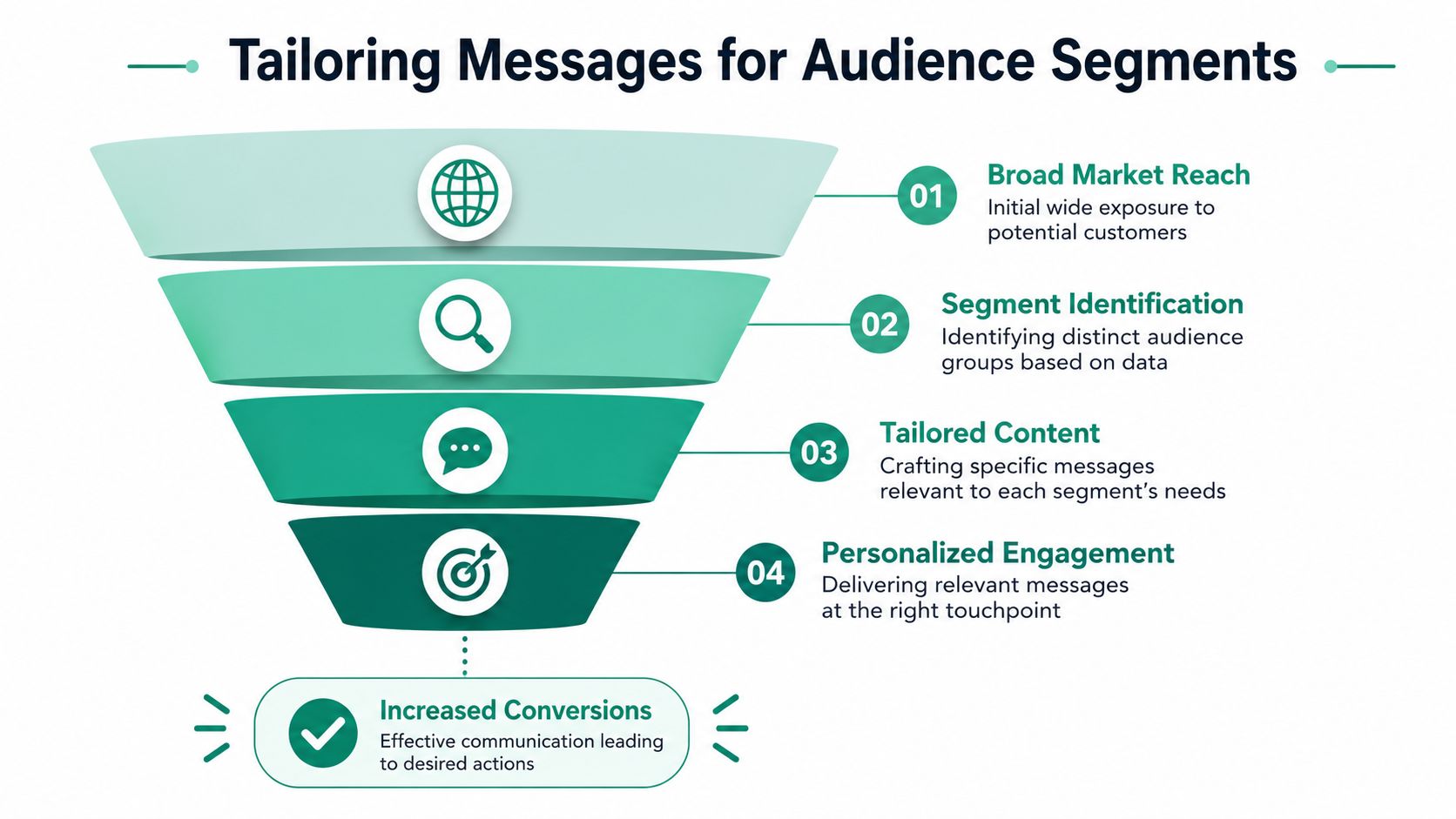
A clear understanding of audience segments helps here. If you haven't mapped them yet, this guide to buyer persona development is a practical place to start.
Match the message to awareness stage
The five awareness stages are still one of the most useful planning tools in messaging in marketing.
| Awareness stage | What the buyer needs from you |
|---|---|
| Unaware | A reason to notice the problem |
| Problem aware | Language that names the pain clearly |
| Solution aware | A framework for what a good solution should do |
| Product aware | Reasons your option is worth shortlisting |
| Most aware | A direct, low-friction reason to act now |
A common mistake is repetition. They deliver one angle over and over, even as the buyer moves closer to decision. Recent research found that 54% of consumers abandon brands due to inconsistent or repetitive messaging across awareness stages, which is why stage-specific persuasion matters, as discussed in Sergio Felix’s breakdown of messaging angles.
Use different persuasion angles on purpose
A few examples make this easier to apply.
Problem-aware buyers usually respond to storytelling and clear recognition of the issue. They want to feel understood before they want a pitch.
Solution-aware buyers need benefits explained in plain English. They already know the category exists. Now they’re deciding what kind of approach makes sense.
Product-aware buyers can handle sharper persuasion. This is where urgency, FOMO, social proof, or feature comparison can work, because they’re already evaluating options.
Most aware buyers don’t need a long education sequence. They need friction removed. Pricing clarity, an easy demo path, or direct next steps matter more than brand theater.
When teams ignore these shifts, every stage gets the same treatment. The result feels repetitive to buyers and wasteful to the company.
A homepage headline, a retargeting ad, and a sales follow-up shouldn’t sound identical. They should sound related.
Don’t treat every audience as culturally identical
There’s another gap that gets ignored too often. Underserved audiences don’t just need the same message translated word for word. They often need a different framing, different examples, and simpler language choices.
Research on underserved U.S. audiences found that 68% report marketing messages fail to resonate because of language or cultural misalignment, and that hybrid channel strategies combining print, out-of-home placements, and digital are 3x more effective for reaching underserved communities than relying only on mainstream digital channels, according to RDW Group’s analysis of communications for vulnerable and underserved communities.
That has direct implications for messaging in marketing.
A few working adjustments:
Translate for meaning, not just words
Literal translation often keeps the sentence structure but loses the buyer’s reality.Remove jargon aggressively
Technical phrasing excludes people fast, especially in healthcare, finance, education, and public service contexts.Adapt channels with the message
If a community responds better to local print, community spaces, or multilingual materials, the channel plan has to reflect that.
This isn’t a side issue. It’s part of building a message people can effectively use.
Marketing Messaging Examples in Action
Theory gets easier when you can see the same framework used in two very different businesses. The words change. The logic doesn’t.
Example one with B2B project management software
Say a B2B SaaS company sells project management software to operations leaders.
The homepage shouldn’t open with “all-in-one collaboration for modern teams.” That phrase says almost nothing. A better hero message would be direct: your team can track work, approvals, and handoffs in one place without chasing updates across spreadsheets and chat.
Below that, the pillars could support three buyer concerns:
- visibility for managers
- fewer handoff errors for teams
- clearer reporting for leadership
On a website, the copy can be slightly broader because the buyer is exploring. The call to action might be “See how the workflow works.”
A paid social ad needs a narrower angle. One ad could target operations managers with a line like: Still managing approvals in spreadsheets? Put every handoff in one system your team can follow. The CTA becomes “Book a demo” or “See the platform.”
An email nurture sequence should slow down and sequence the proof. The first email names the common workflow mess. The second shows how the platform centralizes updates. The third answers rollout concerns. Same core message, different pressure level.
Example two with a local coffee brand
Now switch to a direct-to-consumer coffee company selling small-batch roasted beans.
The homepage hero can lead with freshness and taste. Something like: Fresh-roasted coffee delivered with flavor that doesn’t sit on a warehouse shelf. That’s a consumer message, so the sensory and routine aspects can do more work.
A Facebook or Instagram ad should tighten the angle further. If the audience already buys specialty coffee, the ad can focus on roast timing, flavor notes, or subscription convenience. If the audience is broader, the message should stay simpler: coffee that tastes fresher because it’s roasted in small batches and shipped fast.
The email sequence changes again. Welcome emails can introduce the roast style, brewing tips, and the easiest first purchase. Cart abandonment emails should drop the brand story and focus on removing hesitation. What roast fits your taste? How much coffee do you need? When will it ship?
Same structure, different surface language
Here’s the key point. These two businesses shouldn’t sound alike. One buyer is trying to reduce operational friction at work. The other is choosing a better everyday product. Different context. Different vocabulary. Different emotional tone.
Still, both examples use the same backbone:
| Channel | SaaS message style | Coffee brand message style |
|---|---|---|
| Homepage | Problem plus operational outcome | Product experience plus freshness |
| Paid ad | Sharp pain point and direct CTA | Taste, convenience, or routine angle |
| Sequenced education and proof | Taste guidance and purchase confidence |
That consistency is what makes messaging scalable. You aren't inventing a new identity for every channel. You're adapting one tested argument to the context in front of you.
A Practical Checklist for Launching Your New Message
A better message won't help much if it stays in a strategy doc. Launch is where teams usually lose momentum. They update the homepage but forget the sales deck. They rewrite ad copy but leave old nurture emails running. They change the tagline and assume the work is done.
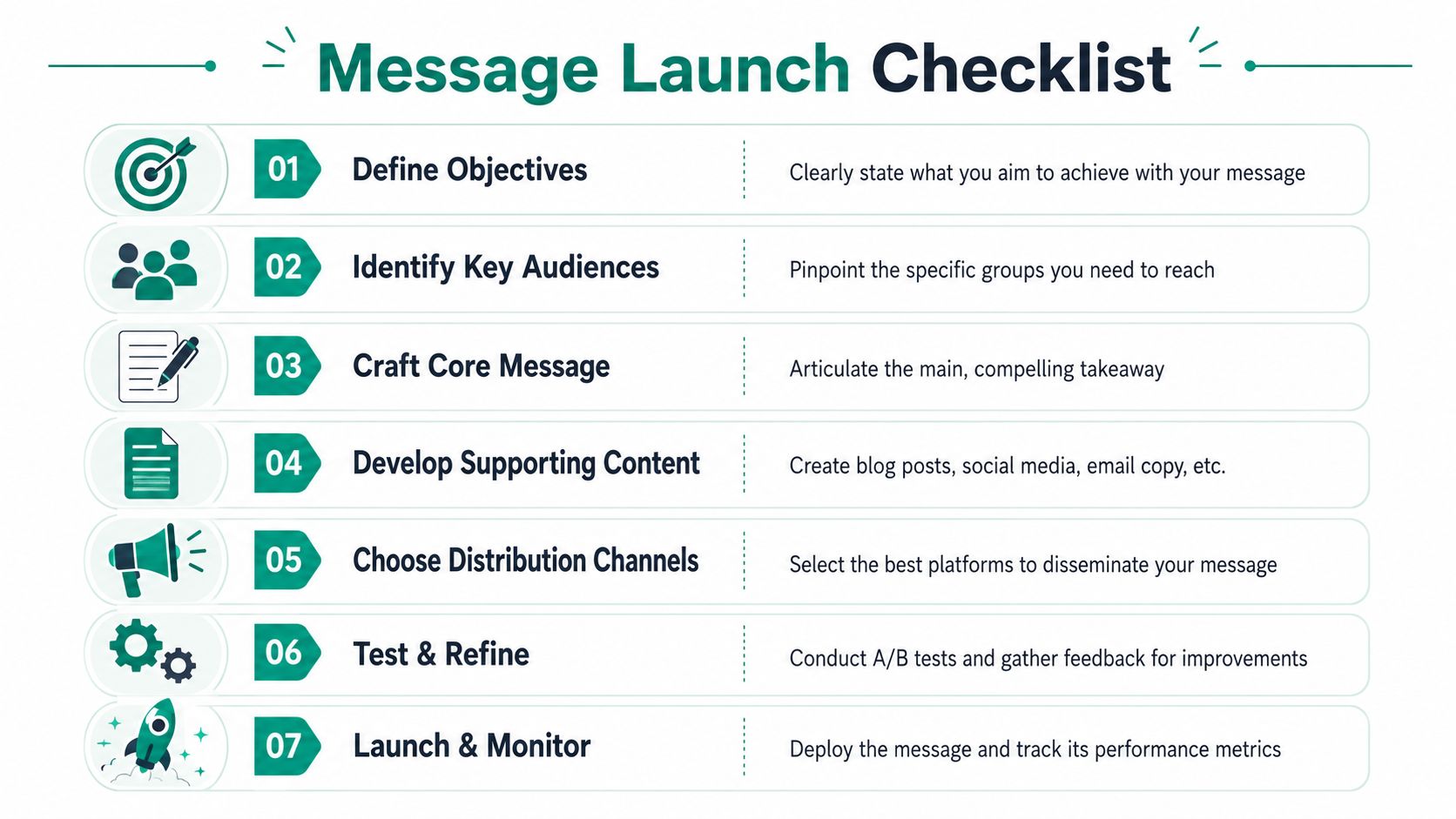
A cleaner rollout starts with a checklist and a clear owner for each step.
Align the people first
Before any public launch, get the internal language right.
-
Brief sales and service teams
Give them the primary message, the pillars, the approved phrasing, and the terms to avoid. -
Update internal docs
Refresh pitch decks, onboarding notes, sales scripts, proposal templates, and FAQ responses. -
Test for comprehension
Ask team members to explain the message back in their own words. If each version sounds different, the rollout isn't ready.
Update the highest-impact assets first
Don't try to fix every line of copy in one day. Prioritize what buyers see first and what affects conversion most.
-
Homepage hero and core service pages
These shape first impression and clarity. -
Paid search and paid social copy
These need to match the new promise and audience angle. -
Email sequences and forms
Confirmation emails, nurture flows, and contact forms should reflect the same language. -
Sales follow-up material
Demo invites, proposal intros, and one-pagers often lag behind the website.
If your team is pairing message changes with performance improvements, a practical review of conversion rate optimization strategies can help connect the copy work to page behavior.
Measure from day one
Don't launch and wait for a vague sense that things feel better. Track the places where messaging should change behavior.
- Conversion rates on key landing pages
- Lead quality feedback from sales calls and form submissions
- Deal velocity if your sales cycle supports that view
- Engagement signals on ads, emails, and SMS campaigns
- Message preference in tests where one pillar is compared against another
SMS can be especially useful when speed and visibility matter. Open rates for SMS consistently hit 90 to 98%, 80% of messages are read within five minutes, average response rates are around 45% compared to roughly 6% for email, and well-optimized programs see conversion rates from 21 to 30%, according to Sakari's SMS marketing statistics roundup. Separate reporting also notes 98% open rates for SMS, making it a strong channel when immediate attention matters, as covered in G2's SMS marketing statistics.
Use that kind of channel only when the message is ready. Fast delivery doesn't fix weak positioning. It just exposes weak positioning faster.
If your business needs sharper messaging, cleaner positioning, and a practical way to connect strategy with real conversion work, Ascendly Marketing can help build and deploy a message that fits your audience, your channels, and your growth goals.