

TL;DR:
- Backlinks are external links from other sites that act as endorsements, boosting search engines’ trust in your pages. They are essential in SEO, with Google prioritizing links from authoritative, relevant sources to improve rankings. Building diversified, high-quality backlinks through original content, guest posting, and digital PR helps small businesses increase organic visibility and leverage AI-driven search benefits.
Backlinks are defined as inbound links from external websites that point to your pages, and they function as editorial votes of confidence in the eyes of search engines. The role of backlinks in SEO is to signal trustworthiness and relevance, helping Google decide which pages deserve top rankings. Backlinks remain one of the top three Google ranking factors in 2026, largely because they represent deliberate editorial choices that are hard to fake. For small and medium-sized business owners, understanding how backlinks work is not optional. It is one of the clearest paths to organic visibility in a competitive search environment.
How do backlinks affect SEO rankings?
Backlinks influence rankings through a mechanism Google calls PageRank, which treats each inbound link as a vote that passes authority, or “link equity,” from one page to another. The more authoritative the linking page, the more equity it transfers. The number one ranking result has 3.8 times more backlinks than pages ranked 2 through 10. That gap is not a coincidence. It reflects how deeply link authority is baked into Google’s algorithm.

Referring domains matter more than raw link count. Google treats referring domain diversity as a stronger ranking signal than total backlink volume. Getting 50 links from 50 different websites carries far more weight than getting 50 links from the same domain. Each unique domain acts as a separate endorsement, and search engines count those endorsements independently.
The dofollow versus nofollow distinction still matters, but less rigidly than it once did. Dofollow links pass PageRank directly, while nofollow links are treated as hints rather than hard signals. Importantly, a 2026 Semrush study found that nofollow links can still influence rankings, especially within AI-driven search systems that evaluate broader trust patterns.
Backlinks’ durability as a top ranking factor comes from being deliberate editorial actions. That makes them far more resistant to manipulation than on-page content signals alone.
Backlinks also extend beyond traditional search. Generative AI models consider backlink profiles as trustworthiness markers when surfacing content in AI-powered answers. If your site lacks a credible link profile, it is less likely to appear in AI-generated search results, regardless of content quality. For SMBs investing in AI-driven SEO strategies, this makes backlink building more urgent, not less.
What types of backlinks actually move the needle?
Not all backlinks carry equal weight. The three most common types are organic editorial links, guest post links, and digital PR links. Each has a different risk profile and SEO value.
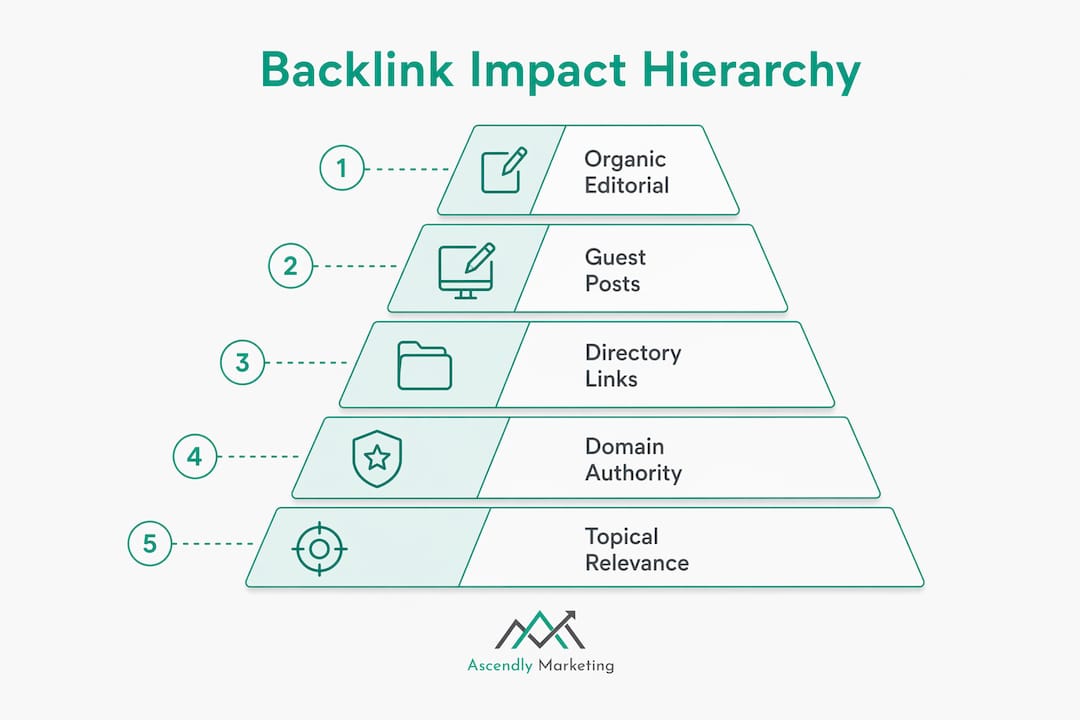
Organic editorial links are earned when another site references your content without any outreach. These are the most valuable because they reflect genuine endorsement. Guest post links come from articles you write for other publications. They are effective when placed on relevant, authoritative sites, but they carry risk if used at scale on low-quality sites. Digital PR links are earned through press coverage, data studies, or expert commentary. These tend to come from high-authority news and industry sites, making them among the most powerful links available.
Quality factors determine how much any backlink is worth.
| Quality factor | Why it matters |
|---|---|
| Domain authority | Higher authority sites pass more link equity |
| Topical relevance | Niche-relevant links outperform generic high-authority links |
| Source page traffic | Links from pages with real traffic pass stronger SEO signals |
| Anchor text | Descriptive, contextual anchor text reinforces topical relevance |
| Editorial context | Links embedded in relevant body content carry more weight |
Topical relevance is about 4 times more impactful than raw domain authority when the linking site operates in your niche. A link from a mid-authority site in your exact industry will outperform a link from a high-authority site with no topical connection. This is one of the most underappreciated facts in link building for SMBs.
Links from pages with measurable organic traffic pass more SEO equity than links from pages that nobody visits. A backlink from a page ranking for real search terms is worth far more than one buried on a page with zero traffic.
Pro Tip: Before pursuing any backlink, check the source page’s organic traffic using a backlink analysis tool. A link from a page with no traffic is unlikely to move your rankings.
Anchor text also shapes how search engines interpret a link. Exact-match anchor text can help, but overusing it triggers spam filters. Natural, varied anchor text that describes the linked content contextually is the safest and most effective approach.
What link building strategies work for small businesses?
Effective link building for SMBs starts with targeting niche-relevant, authoritative domains rather than chasing volume. One strong link from a respected industry publication beats 20 links from generic directories. The goal is to build a profile that looks like a naturally earned reputation, because that is exactly what Google rewards.
Here are the most effective link-building steps for SMBs in 2026:
- Create original research or proprietary data. Studies, surveys, and unique datasets attract editorial links from journalists and bloggers who need credible sources to cite.
- Pursue guest posting on relevant industry sites. Write for publications your customers actually read. Focus on sites with real audiences and editorial standards.
- Use digital PR to earn press mentions. Pitch expert commentary, local business stories, or data-driven angles to journalists. Coverage from news sites generates high-authority links at scale.
- Build relationships with niche bloggers and content creators. Genuine relationships lead to natural mentions over time, which are among the most durable links you can earn.
- Audit competitor backlink profiles. Identify sites linking to competitors and reach out with a stronger content offer. This is one of the fastest ways to find qualified link targets.
- Diversify your referring domains continuously. Avoid concentrating links from a single source. Diminishing returns set in quickly when multiple links come from the same domain.
Reciprocal linking, where two sites agree to link to each other, carries real risk if done at scale. Reciprocal link strategies can work in moderation when the exchange is genuinely relevant, but systematic link swapping triggers Google’s spam detection.
Pro Tip: Search engines detect unnatural link velocity, anchor text ratios, and domain clustering. Build links gradually and vary your anchor text to avoid triggering algorithmic penalties.
Quality content and backlinks reinforce each other. Pages that earn links tend to rank higher, which attracts more links organically. Publishing content worth citing is the most sustainable link-building strategy available to any SMB.
How do you measure backlink impact and monitor link health?
Measuring the impact of backlinks requires tracking the right metrics, not just counting links. The key metrics to watch are referring domains, link growth velocity, domain rating of linking sites, and the organic traffic of source pages.
Referring domain count is the single most important metric. A growing number of unique domains linking to your site signals expanding authority. Link growth velocity matters too. A sudden spike in links can look unnatural and trigger a manual review. Steady, gradual growth is the pattern Google trusts.
Backlink analysis tools give you visibility into your full link profile. Tools like Ahrefs, Semrush, and Moz provide counts of referring domains, domain authority scores, and anchor text breakdowns. Regular audits using these tools help you spot toxic or spammy links before they damage your rankings.
Best practices for monitoring your link profile:
- Run a full backlink audit every quarter. Identify links from low-quality, irrelevant, or penalized domains and disavow them if necessary.
- Track new and lost referring domains monthly. Losing links from authoritative sites is a warning sign worth investigating.
- Monitor anchor text distribution. An unnatural concentration of exact-match anchor text is a red flag for search engines.
- Check the traffic of your top linking pages. Links from pages losing organic traffic may be losing their SEO value too.
- Compare your referring domain count to competitors. A significant gap signals where you need to focus acquisition efforts.
95% of all indexed web pages have zero backlinks. That statistic means even a modest, well-targeted link-building effort puts your site ahead of the vast majority of competing pages. The bar is lower than most SMB owners assume.
Key Takeaways
Backlinks remain a top three Google ranking factor because they represent genuine editorial endorsements that signal trust, topical relevance, and authority to both traditional and AI-powered search engines.
| Point | Details |
|---|---|
| Quality beats quantity | One relevant, authoritative link outperforms dozens from low-traffic or off-topic sites. |
| Referring domain diversity | Links from many unique domains signal broader authority than many links from one source. |
| Topical relevance wins | A niche-relevant backlink is about 4 times more impactful than a generic high-authority one. |
| Monitor your link profile | Quarterly audits catch toxic links before they trigger algorithmic or manual penalties. |
| AI search amplifies backlink value | Generative AI models use backlink profiles as trust signals, extending their impact beyond traditional rankings. |
What I’ve learned after years of building backlinks for SMBs
The biggest mistake I see SMB owners make is treating backlinks as a numbers game. They chase volume, buy link packages, or spin up guest posts on irrelevant sites, then wonder why their rankings stagnate or drop. The truth is that Google has gotten very good at identifying link patterns that look manufactured. A hundred low-quality links can actively hurt a site that ten strong ones would have lifted.
What actually works is earning links through content that deserves to be cited. Original research, expert commentary, and genuinely useful resources attract links without any manipulation. That approach takes longer, but the results compound. A page that earns links organically keeps earning them, while a page propped up by purchased links collapses the moment Google updates its spam filters.
The other shift I’ve watched closely is how backlinks now feed into AI search visibility. Generative AI systems are not just looking at your content. They are looking at who vouches for it. A strong backlink profile from credible, relevant sources tells these systems that your content is worth surfacing. For SMBs trying to show up in AI-generated answers, 2026 SEO trends make it clear that backlinks and content quality are inseparable.
My advice: stop thinking about backlinks as a separate tactic and start treating them as the natural result of doing everything else well. Publish content worth citing. Build real relationships in your industry. Earn coverage through digital PR. The links will follow, and they will be the kind that last.
— Ascendly Marketing
How Ascendly Marketing supports your backlink strategy
Building a credible backlink profile takes time, expertise, and a clear plan. Ascendly Marketing has helped SMBs across industries build link profiles that drive real organic growth since 2013.

Ascendly Marketing’s digital marketing services include SEO strategy, link building, digital PR, and content creation, all coordinated to build authority that compounds over time. The team brings experience from big brands and tech companies, applying that expertise to the specific challenges SMBs face in competitive search markets. If you want a link-building strategy built around your niche, your goals, and the latest search signals, Ascendly Marketing is ready to help you get there.
FAQ
What are backlinks in SEO?
Backlinks are inbound links from external websites pointing to your pages. Search engines treat them as editorial endorsements that signal trust and authority.
Why do backlinks matter for small business rankings?
Backlinks are one of Google’s top three ranking factors. The number one result has 3.8 times more backlinks than pages ranked 2 through 10, making link acquisition a direct path to higher visibility.
How many backlinks does a small business website need?
There is no fixed number. Referring domain diversity matters more than total link count. Consistent growth from niche-relevant, authoritative domains produces stronger results than chasing a specific volume target.
What is the difference between dofollow and nofollow backlinks?
Dofollow links pass PageRank and contribute directly to SEO equity. Nofollow links are treated as hints by Google and can still influence rankings, particularly in AI-driven search systems.
How do I check my backlink profile?
Backlink analysis tools like Ahrefs, Semrush, and Moz let you audit referring domains, anchor text distribution, and domain authority scores. Running a quarterly audit helps you identify and address toxic or low-quality links before they affect rankings.