

A strong webinar program can influence pipeline long before a prospect talks to sales.
The teams that get revenue from webinars do not treat them as isolated events. They build a system around attendance, engagement, and follow-up, because registration volume by itself is a weak success metric. I have seen webinars with a full signup list produce little sales movement, and smaller sessions generate qualified meetings because the topic, reminder flow, and post-event handoff were built for buying intent.
That is the shift that matters. A webinar marketing strategy works best when it is designed to move people from interest to action. That means choosing topics tied to real buying problems, using multi-channel reminders to raise show-up rates, and tracking outcomes such as influenced pipeline, sales conversations, and opportunity creation.
Many B2B teams still run webinars like a single campaign. They publish a landing page, send a few email blasts, host the session, and post the recording. Then attendance dips, engagement is uneven, and revenue impact is hard to prove.
The format is rarely the problem. The missing piece is the operating system behind it: a clear offer, a 21-day promotion window, a Show-Up Maximizer sequence with email plus SMS and micro-commitments, and a post-webinar process that helps sales act on intent while it is still warm.
Why Webinars are Your New Revenue Engine
Analysts and webinar platforms have reported a consistent pattern for years. Webinar programs that run regularly tend to produce stronger conversion quality and lower acquisition costs than one-off events or lighter content offers.
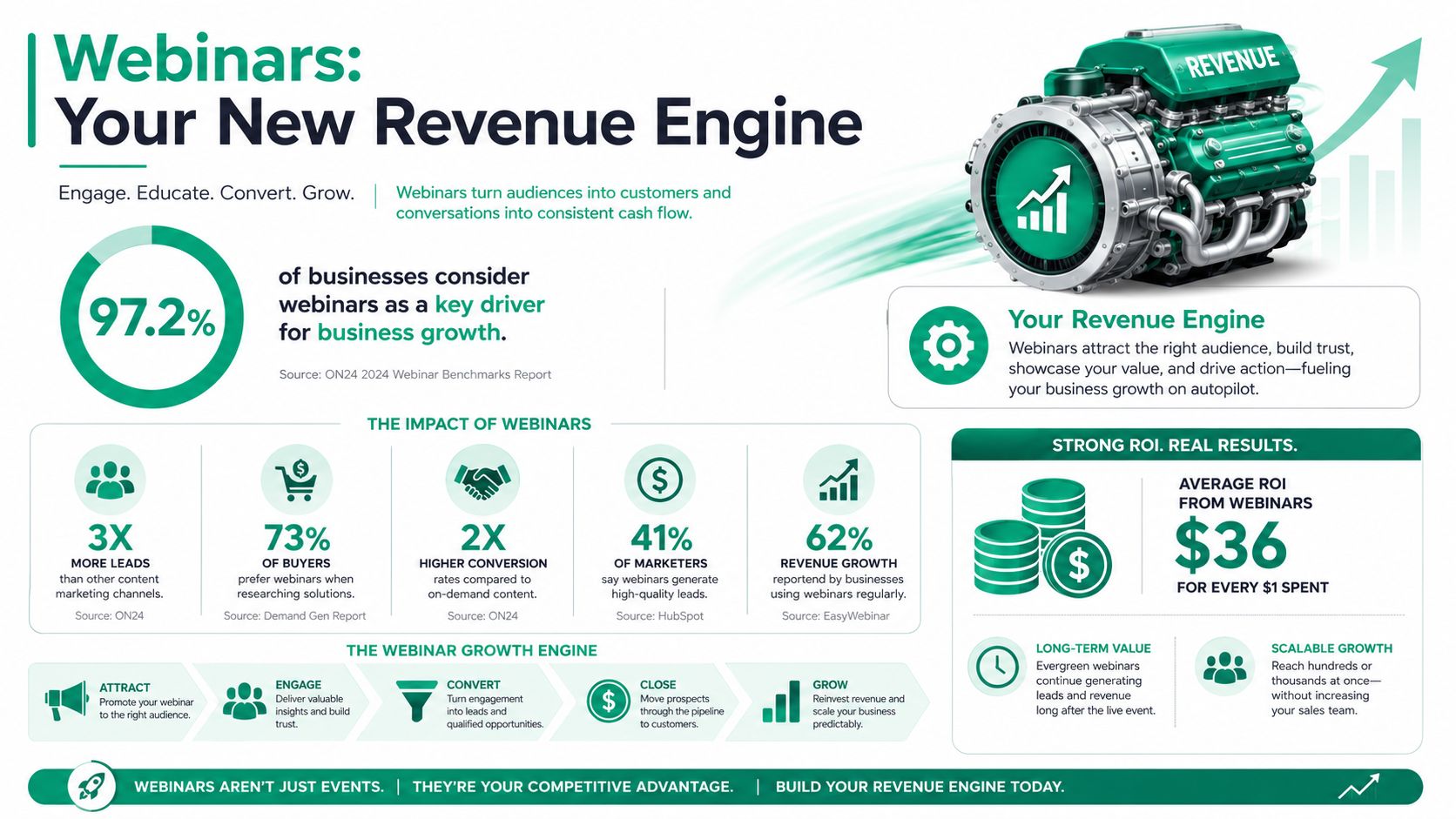
That tracks with what happens in real pipelines. A guide download signals curiosity. A webinar registration signals intent. A live attendee who stays through the core teaching, answers a poll, and clicks the next-step CTA is giving your team a much clearer buying signal.
What the numbers actually say
As noted earlier, industry research points in the same direction. Companies that make webinars a repeatable part of demand generation often see better efficiency than teams that treat them as occasional campaigns. The practical takeaway is simple. Registration volume is not the headline metric. Revenue contribution is.
| Metric | What it means in practice |
|---|---|
| Webinars are treated as a high-priority channel by many B2B teams | The format is proven enough to deserve process, budget, and sales alignment |
| Frequent webinar programs often see lower customer acquisition costs | Consistency usually beats sporadic launches because each event improves audience quality, promotion performance, and follow-up execution |
| Webinar leads often convert better than low-intent content leads | Buyers who commit time to a live session are usually further along than someone who grabbed a checklist |
I use one rule here. If the topic does not map to a sales conversation your reps already have, the webinar might get registrations and still miss pipeline.
Why this format produces revenue
Webinars compress several buying steps into one session. Prospects hear how you define the problem, judge whether your team understands the stakes, compare your approach with other options, and surface objections in Q&A while attention is still close.
That matters in longer sales cycles.
For B2B teams, webinars are especially effective when the offer needs explanation, trust, or internal buy-in from more than one stakeholder. For firms selling advice or complex financial services, educational sessions can support strategies for growing your RIA because they create a setting where expertise and process are visible, not just claimed. The same principle applies to software, agencies, and consulting offers with nuanced buying criteria.
There is a trade-off. Webinars ask for more commitment than a blog post or guide, so the registration page and promise have to work harder. That is why strong teams pair the event with focused conversion assets such as B2B lead generation landing pages and then measure what happens after the session, not just who filled out the form.
The revenue case gets stronger when attendance is engineered, not left to chance. A webinar becomes a real pipeline channel when the reminder flow includes more than email, attendance is treated as a conversion point, and post-event follow-up is built around intent signals. That is how you raise show-up rates, create qualified conversations, and prove pipeline influence instead of reporting a large registration count that never turns into sales.
Blueprint Your Webinar Before You Build
Most weak webinars fail before the first slide is written. The topic is broad, the audience is vague, and the CTA has no clear relationship to what the audience came to learn.

Start with the business outcome. If you’re in B2B, the webinar usually needs to create qualified conversations, accelerate open opportunities, or support a complex sale. If you’re in e-commerce, the same format can educate buyers, handle objections live, and move them toward a product collection or launch page. Different goal, different build.
Write the brief before the deck
Use a one-page planning brief. Keep it blunt.
Primary business goal
Decide whether this webinar exists to create new leads, influence active deals, support retention, or drive direct product consideration.Audience definition
Name the buyer by role, problem, awareness level, and urgency. “Small business owners” is too broad. “Operations leaders trying to reduce manual reporting” is usable.One core promise
Pick one result the audience will understand immediately. If the title and registration copy try to solve five problems, response drops.Next step after the webinar
Choose a single action. Book a call. Request a demo. Download a toolkit. Watch an on-demand product walkthrough. One webinar can support more than one path in your CRM, but the attendee-facing CTA should stay simple.
Match content to the buyer’s stage
A common mistake is building thought leadership content when the business needs sales-qualified action. The reverse happens too. Teams pitch too early to an audience that still needs context.
Use this decision frame:
| If your goal is… | Build the webinar around… | Avoid… |
|---|---|---|
| B2B lead generation | A problem, framework, and decision criteria | Product-heavy slides in the opening |
| E-commerce product consideration | Use cases, product fit, and objections | Abstract industry commentary |
| Pipeline acceleration | Specific blockers in the buying process | Generic education with no commercial relevance |
For firms in regulated or advisory spaces, audience intent tends to be more nuanced. That’s why practical planning resources such as strategies for growing your RIA can sharpen your angle before promotion starts. The same principle applies across industries. The webinar has to meet the buyer where the decision is getting stuck.
Build the registration page around fit, not hype
Your landing page should qualify as much as it converts. Clear promise, clear agenda, clear speaker relevance, clear next step. If the page overpromises or hides who the session is really for, you’ll attract the wrong registrants and pay for it in poor attendance quality.
Teams refining webinar registration pages can borrow strong ideas from B2B lead generation landing page strategy. The page doesn’t need clever wording. It needs message match between ad, email, title, agenda, and CTA.
The fastest way to weaken a webinar is to choose a broad topic because it “appeals to everyone.” Broad topics usually attract curiosity, not buying intent.
Once the blueprint is tight, the content gets easier. You know who it’s for, what problem it solves, what proof to include, and what action the audience should take next.
The 21-Day High-Conversion Promotion Cycle
Teams often either under-promote webinars or overdo it with repetitive reminders that feel like spam. The fix is cadence, not volume.
A high-performing webinar marketing strategy follows a 21-day promotional cycle where Days 1 to 7 focus on awareness, Days 8 to 14 reinforce value, and Days 15 to 21 drive urgency. B2B audiences show peak attendance when webinars are scheduled between 10:00 AM and 11:30 AM or 1:00 PM to 3:00 PM, with 11:00 AM cited as the optimal time, and multi-touch campaigns across social media, partner networks, and advertising outperform single-channel efforts according to this webinar strategy breakdown.
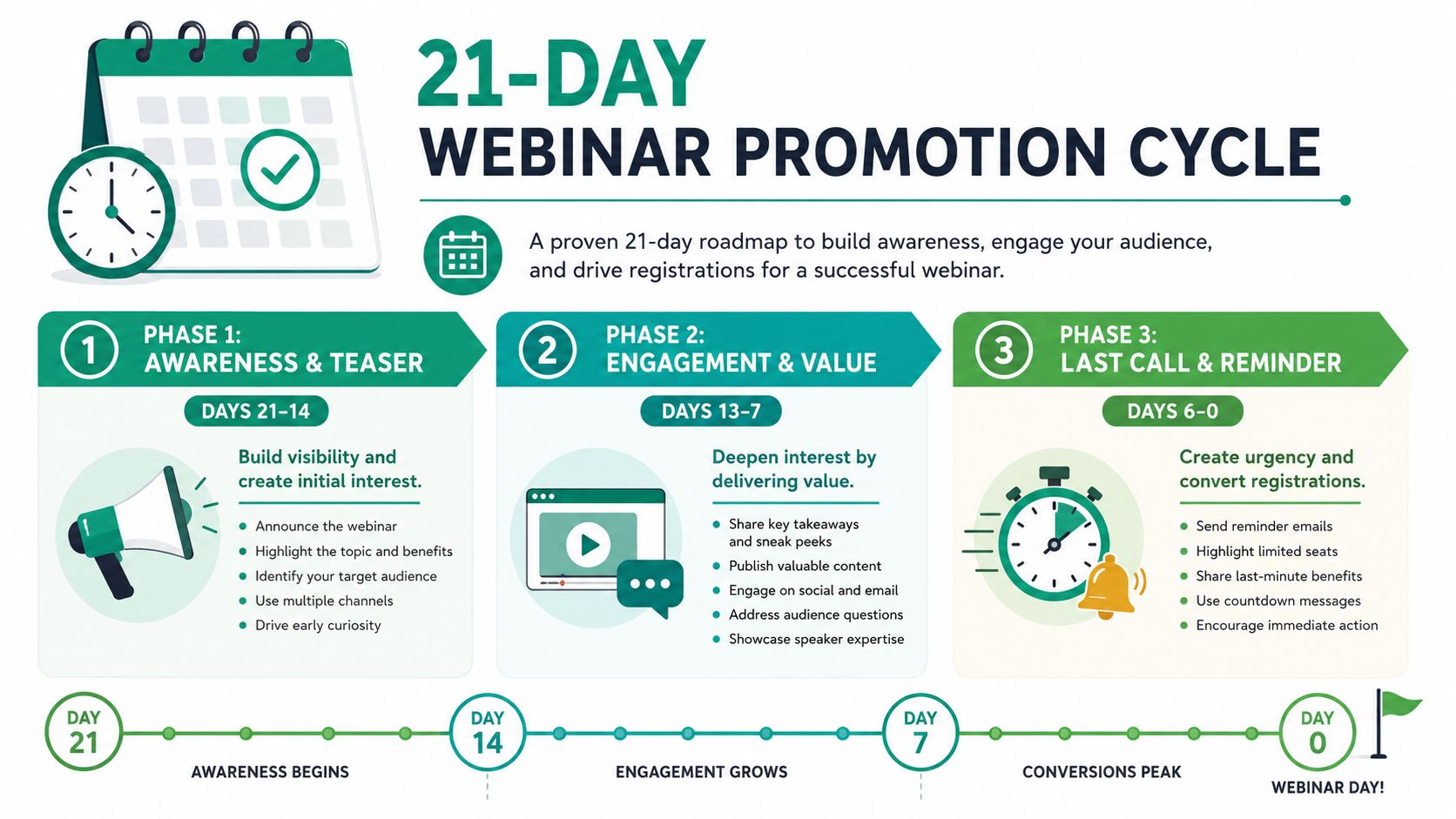
Days 1 to 7 build awareness
At this stage, don’t try to close the registration with dense copy. You’re introducing the problem, the angle, and the reason to care now.
Use short assets:
Email announcement
Lead with the problem and the outcome. Skip the speaker bio wall.Social teaser
Pull one sharp insight or question from the webinar concept.Partner mention
If you have associations, vendors, or co-marketing relationships, ask for early reach now rather than in the final week.
Sample email structure:
- Problem your audience already feels
- What they’ll learn in plain terms
- Why this speaker or team can teach it
- Registration CTA
This is also the phase where paid support can help if the topic already has a clear audience and commercial path. Paid promotion won’t rescue a weak topic. It will just spread the weakness faster.
Days 8 to 14 reinforce value
Many teams often go quiet, which is a mistake. Registrations don’t stay warm on their own.
Use content that reduces uncertainty:
| Asset | What it should do |
|---|---|
| Speaker video | Show credibility and tone |
| Agenda post | Make the session feel concrete |
| Short clip or insight graphic | Prove the webinar will teach something specific |
| Sales enablement note | Give reps language to invite open opportunities |
This middle stretch isn’t about saying “register now” louder. It’s about answering the silent questions in the prospect’s head. Is this relevant? Is it too basic? Is it just a pitch? Is the presenter worth listening to?
If attendance quality matters, promotion has to pre-frame the session. The buyer should know the problem, the angle, and the level of depth before they register.
Days 15 to 21 create urgency
Now you push for action. Reminders become important, but they need context.
Use these messages:
One week out
Re-state the business problem and what attendees will leave with.Day before
Focus on timing, agenda, and direct benefit.Twenty-four hours before and one hour before
Keep it operational. Clear subject line. Clear join path. No extra copy.
A lot of marketers make the final reminder too promotional. At this point, clarity beats persuasion.
What works better than a single-channel push
Email still carries most webinar programs, but email alone leaves gaps. A prospect may intend to attend and still miss the message. Partner distribution reaches adjacent trust networks. Paid retargeting brings back visitors who clicked but didn’t register. Social gives your speakers and internal advocates something easy to share.
A practical mix looks like this:
- Email for core conversion
- LinkedIn organic for repeated visibility
- Retargeting ads for page visitors
- Partner sends for borrowed reach
- Sales outreach for open deals and target accounts
That mix doesn’t need to be large. It needs to be coordinated.
Timing choices that improve the odds
If you’re targeting B2B audiences, the timing window matters because your webinar competes with meetings, deadlines, and internal fire drills. Scheduling inside the stronger attendance windows is a simple win. I also prefer choosing one standard webinar slot for a program because the audience learns your rhythm over time.
Consistency reduces friction. Your team gets better at launching. Your audience gets used to the format. Your CRM data becomes easier to compare across sessions.
The Show-Up Maximizer System
Registration totals can make a campaign look healthy while revenue stays flat. The reason is obvious once you look at attendance. A registered name isn’t a live buyer interaction.

Industry show-up rates average 20 to 30%, yet a multi-channel Show-Up Maximizer system using SMS, WhatsApp, and Voice AI can lift attendance to 45 to 60% by creating micro-commitments such as calendar invites and worksheets. The same source notes a 98% open rate for SMS and WhatsApp in this context, which is why passive email-only reminders underperform in comparison according to this Show-Up Maximizer framework.
Stop treating attendance like a reminder problem
Many organizers think attendance drops because they didn’t send enough reminder emails. That’s usually the wrong diagnosis.
People miss webinars because they never fully committed in the first place. They registered with light intent. Then inbox pressure, meetings, and competing priorities took over. Email reminders can help, but they don’t create commitment by themselves.
The better model is anticipation.
Build micro-commitments after registration
The thank-you page is one of the most underused assets in a webinar marketing strategy. Don’t waste it on a generic confirmation message.
Use it to ask for one small action:
- Add the calendar invite
- Download a worksheet
- Submit a question in advance
- Choose a reminder channel
- Reply to a confirmation email with a specific challenge
Each action increases the chance the webinar becomes a real appointment rather than a vague intention.
Field note: The more effort someone invests before the webinar starts, the less likely they are to skip it.
Use more than email
Email still belongs in the sequence. It just shouldn’t carry the entire attendance goal.
A practical reminder stack often includes:
| Channel | Best use |
|---|---|
| Confirmation, agenda, join link | |
| SMS or WhatsApp | High-visibility reminders close to the event |
| Calendar invite | Locks the time block |
| Sales or CS outreach | Personal nudge for target accounts and active opportunities |
If your nurture system already supports segmented follow-up, extend that logic here. Teams working on stronger automated communication flows can apply the same principles found in email marketing for lead generation. The point isn’t more automation for its own sake. The point is sequencing the right message through the right channel at the right moment.
What passive reminders get wrong
A passive reminder says, “Your webinar starts tomorrow.”
A stronger reminder says, “Bring this worksheet. You’ll use it during the session.” That changes the role of the attendee. They’re no longer a passive viewer. They’re preparing to participate.
That difference affects show-up quality too. The same person who downloads the worksheet, adds the event to their calendar, and sends in a question is more likely to stay engaged once the webinar begins.
Delivering a High-Impact Live Experience
The live session is where weak planning gets exposed fast. If the presenter rambles, the slides are dense, and the opening takes too long to reach the point, chat goes quiet and attention drops. If the host keeps the room moving, uses interaction well, and handles the Q&A with confidence, trust builds quickly.
I like to run a webinar as if I’m directing a live broadcast, not presenting a deck. That mindset changes everything. You stop asking, “Did we cover all the slides?” and start asking, “Is the audience still with us?”
The opening decides the session
The first few minutes carry more weight than often realized. Start with the problem, who the webinar is for, and what the audience will leave with. Then prove quickly that this won’t be a long commercial.
A simple live flow works well:
- Brief welcome and logistics
- Direct statement of the problem
- What attendees will learn
- Quick audience interaction through poll or chat
- Core teaching
That early interaction matters. Once people type in chat or answer a poll, they shift from watching to participating.
Keep the room active
A webinar should feel like a guided conversation, even when one speaker holds the floor most of the time.
Use a mix of:
- Polls to surface priorities or segment the audience in real time
- Chat prompts to collect quick reactions
- Q&A markers where the host signals when questions will be answered
- Offer transitions that connect naturally to the topic being taught
If you work in settings where community and remote participation shape the experience, there are useful operational lessons in practical steps for online ministry. The context is different, but the live delivery principles hold up. Clear run-of-show, active hosting, audience acknowledgment, and a calm backup plan all make the session feel intentional.
A live webinar loses momentum when the speaker sounds like they’re reading slides. It gains momentum when the speaker responds to the room.
Present like a guide, not a narrator
Most presenters don’t need to become performers. They need to become clearer.
That means shorter slides, stronger transitions, and fewer detours. Put detail in your spoken explanation, not in paragraphs on the screen. If you have a moderator, use them. A moderator can watch chat, collect questions, reset pacing, and keep the presenter from disappearing into the deck.
Rehearsal also changes quality more than people expect. Even one full dry run will surface awkward transitions, technical issues, timing problems, and slide clutter that seemed invisible during preparation.
End with a controlled handoff
The final CTA shouldn’t feel bolted on. If the webinar taught a real problem well, the next step should feel like a continuation.
Good examples include:
- booking a strategy call tied to the exact challenge discussed
- accessing a gated recording or workbook
- requesting a customized demo based on use case
- joining a follow-up session for deeper implementation
A weak ending says, “Contact us if you want to learn more.” A stronger ending says, “If you’re dealing with this exact issue, here’s the next practical step.”
The Post-Webinar Revenue Loop
The money usually isn’t made during the webinar. It’s made in the follow-up. Yet, too often, teams default to one generic email with a replay link and call the follow-up done.
That wastes the strongest signal your audience just gave you.
The most valuable webinar ROI metric isn’t total lead volume. It’s the number of existing pipeline opportunities influenced where at least one stakeholder attended, measured by comparing stage progression rates for influenced versus non-influenced deals according to this webinar ROI metric framework.
Split attendees and no-shows immediately
Attendees and absentees are not the same audience. They shouldn’t receive the same message.
Attendees gave you time and attention. They need a follow-up that acknowledges what happened live and points them to a relevant next step.
No-shows need a different path. They showed intent by registering, but they didn’t get the experience. That means your job is to recreate enough of the value to pull them back in.
A simple post-event split looks like this:
| Segment | Follow-up angle |
|---|---|
| Attendees | Thanks, recap, next step tied to engagement |
| No-shows | Replay, key takeaway, reason to re-engage |
| High-engagement attendees | Direct outreach from sales or customer success |
| Existing open opportunities | CRM flag and pipeline influence tracking |
Use behavior, not just attendance status
Attendance tells you who showed up. Engagement tells you what to do next.
If someone asked a detailed question, answered polls, stayed through the offer, or clicked the CTA, that record should shape the next message and the next sales action. Generic nurture ignores the best data you have.
Marketing automation earns its keep. A solid workflow can route engaged attendees into sales follow-up, send replay and summary content to no-shows, and push behavior data into the CRM for opportunity influence reporting. Teams building those flows often start with a cleaner automation structure like the one outlined in marketing automation for B2B.
Webinar follow-up shouldn’t ask, “Did they register?” It should ask, “What did they do, and what does that behavior suggest?”
Turn one event into an ongoing revenue asset
The recording shouldn’t just sit in a resource library. Gate it. Segment access. Pair it with a worksheet, summary, or short email sequence. Use clips in outbound outreach. Pull Q&A themes into future content. Build remarketing audiences from people who registered but didn’t attend, and from people who watched on demand but didn’t convert.
A strong webinar marketing strategy creates a loop:
- Live event generates engagement data
- Follow-up converts engagement into conversations
- Sales feedback improves the next topic and angle
- On-demand assets continue producing qualified interest
That’s how webinars stop being isolated campaigns and start influencing pipeline in a way leadership can see.
Measure What Matters and Scale Your Program
A webinar program becomes scalable when the team stops arguing about whether a session “felt good” and starts reading the same dashboard.
Well-executed webinars achieve a 63% conversion rate of attendees into qualified leads, and landing page conversion rates can reach up to 51%. The most useful KPIs include registration rate, attendance rate, sustained viewing duration, and conversion data, while platforms should provide real-time analytics for play rate and CTA click-through rate according to these webinar KPI benchmarks.
Build a dashboard around behavior and business impact
Not every metric deserves equal weight. A large registration count can hide weak attendance. Strong attendance can hide weak watch time. Solid watch time can still produce little business value if the CTA and follow-up are poorly matched.
Track performance in layers.
Acquisition layer
- Registration rate tells you whether the topic, offer, and page are connecting
- Landing page conversion shows whether your messaging and form experience are doing their job
Engagement layer
- Attendance rate shows whether promotion and reminder systems are working
- Sustained viewing duration shows whether the content held attention
- Play rate and CTA click-through rate reveal what happened inside the experience
Revenue layer
- Qualified lead conversion
- Pipeline influenced
- Stage progression for influenced opportunities
- Closed revenue tied to webinar engagement
The mistake is stopping at the first layer because it’s easier to report.
Use a monthly review that forces hard decisions
I prefer a review structure that compares webinars side by side, not one at a time. Patterns appear faster that way.
Ask these questions every month:
| Question | What the answer usually reveals |
|---|---|
| Which topics drove the strongest registration rate? | Message-market fit |
| Which sessions held viewing time longest? | Content quality and presenter strength |
| Which webinars produced the most qualified action? | CTA alignment and audience quality |
| Which influenced active pipeline? | Sales relevance |
That process makes planning sharper. You stop choosing topics based on internal enthusiasm and start choosing them based on buyer response.
Repurpose with discipline
One webinar can produce a lot of useful material, but only if someone edits it for purpose. Don’t dump the full recording everywhere and call it repurposing.
Pull out:
- Short clips for social and paid retargeting
- Q&A excerpts for email follow-up
- A blog article built around one core argument
- Sales snippets that answer common objections
- On-demand gated content for later-stage leads
Each asset should serve a different stage or channel. The replay is not the only output.
Scale the program by standardizing what shouldn’t change
Creative variation matters in topic, angle, and examples. Operational variation usually creates chaos.
Standardize these pieces:
- Your planning brief
- Promotion calendar
- Reminder workflow
- Run-of-show template
- Post-webinar segmentation logic
- Reporting dashboard
Once those are fixed, the team can spend more energy improving the parts buyers notice. Topic selection, speaker quality, storytelling, follow-up relevance.
A webinar marketing strategy becomes durable when every session teaches the next one how to perform better. That’s the true compounding effect. Not more webinars for the sake of volume, but a cleaner system that keeps improving conversion quality, attendance quality, and pipeline impact.
If your team wants a webinar marketing strategy tied to qualified leads, pipeline influence, and cleaner conversion paths, Ascendly Marketing can help you build the landing pages, promotion systems, automation, and reporting structure that turn webinars into a dependable growth channel.