

Most small business owners pour money into driving more traffic before their website can actually convert visitors into leads. That’s a costly mistake. Lead generation is the process of attracting and converting strangers into potential customers by capturing their interest and contact information through inbound and outbound strategies. Get this right, and you build a predictable pipeline. Get it wrong, and you’re essentially filling a leaky bucket. This guide walks you through every stage of the lead generation process, the channels that deliver real results in 2026, and a practical framework for building a system that fits your business.
Table of Contents
- Understanding lead generation: The basics explained
- Key stages of the lead generation process
- Top lead generation channels for SMBs in 2026
- Framework: Building your custom SMB lead generation system
- Advanced methods: Lead qualification, AI, and maximizing results
- How we help SMBs power growth with lead generation
- Frequently asked questions
Key Takeaways
| Point | Details |
|---|---|
| Lead generation fundamentals | Effective lead generation means attracting the right prospects and collecting information to move them into your sales funnel. |
| Best channels for SMBs | SEO and nurturing-focused campaigns consistently deliver the lowest costs and highest close rates. |
| Optimize the whole funnel | A systematic approach—attract, capture, nurture, qualify, convert—prevents lost leads and wasted ad spend. |
| Use automation & AI | Automation, nurturing routines, and AI lead scoring drive more qualified leads and reduce manual workload. |
Understanding lead generation: The basics explained
A “lead” is simply a person who has shown interest in what you sell. They might have filled out a contact form, downloaded a free guide, or clicked on your ad. The goal of lead generation is to collect enough information about that person to start a real sales conversation.
There are two broad approaches every SMB should understand:
- Inbound lead generation pulls people toward you through content, SEO, and social media. A potential customer finds your blog post, reads it, and signs up for your newsletter. You earned their attention.
- Outbound lead generation pushes your message out to a targeted audience through cold email, paid ads, or direct mail. You initiate the contact.
- Referral-based generation sits somewhere in between. A happy client recommends you, and a warm lead lands in your inbox.
- Event-based generation uses webinars, trade shows, or local networking to capture interest in real time.
The biggest misconception among SMBs is that more traffic automatically means more sales. It doesn’t. If your landing page is confusing or your follow-up is slow, traffic is wasted spend. Understanding the lead generation basics before scaling your budget is the single most important step you can take.
“Lead generation is the process of attracting and converting strangers into potential customers by capturing their interest and contact information through inbound and outbound strategies.” — HubSpot
Inbound methods typically cost less over time and build brand trust. Outbound methods can generate results faster but require more budget and precision targeting. Most successful SMBs use both.
Key stages of the lead generation process
Lead generation isn’t a single action. It’s a sequence of connected steps, and skipping any one of them causes leads to fall through the cracks. Here’s how the lead generation funnel breaks down for a typical SMB:
- Attract — Drive awareness through SEO, content marketing, social media posts, or paid ads. This is where strangers first encounter your brand.
- Capture — Convert that attention into a lead using forms, landing pages, pop-ups, or gated content like a free checklist or webinar registration.
- Nurture — Stay in front of captured leads with email sequences, retargeting ads, or helpful content until they’re ready to buy.
- Qualify — Determine which leads are worth your sales team’s time. Marketing-qualified leads (MQLs) show interest; sales-qualified leads (SQLs) are ready to talk price.
- Convert — Hand off qualified leads to your sales process and close the deal.
The key stages include Attract, Capture, Nurture, Qualify, and Convert, and each one requires a different tool or tactic.
| Stage | Inbound approach | Outbound approach |
|---|---|---|
| Attract | Blog posts, SEO, social content | Paid ads, cold email, direct mail |
| Capture | Landing pages, lead magnets | Ad forms, event sign-ups |
| Nurture | Email drips, retargeting | Follow-up calls, LinkedIn outreach |
| Qualify | Lead scoring, behavior tracking | Sales discovery calls |
| Convert | CRM handoff, demo booking | Proposal, close call |
Many SMBs invest heavily in the Attract stage and then ignore Nurture entirely. That’s where most of the money gets lost. Explore B2B lead generation tactics and converting B2B leads to see how each stage connects in practice.

Top lead generation channels for SMBs in 2026
Not every channel works equally well for every business. Your budget, team size, and sales cycle all influence which channels deserve your attention first.
Here’s how the major channels stack up on cost per lead (CPL) and impact:
| Channel | Avg. CPL | Best for | Adoption rate |
|---|---|---|---|
| SEO | $31 | Long-term organic growth | High |
| Email marketing | $53 | Nurturing and retention | 34% of SMBs |
| Webinars | $72 | B2B, high-ticket services | Growing |
| Social media | Varies | Brand awareness, retargeting | Facebook 70%, Instagram 60% |
| PPC/paid ads | Varies | Fast results, specific offers | Medium |
| Cold outreach | Low upfront | B2B prospecting | Common |
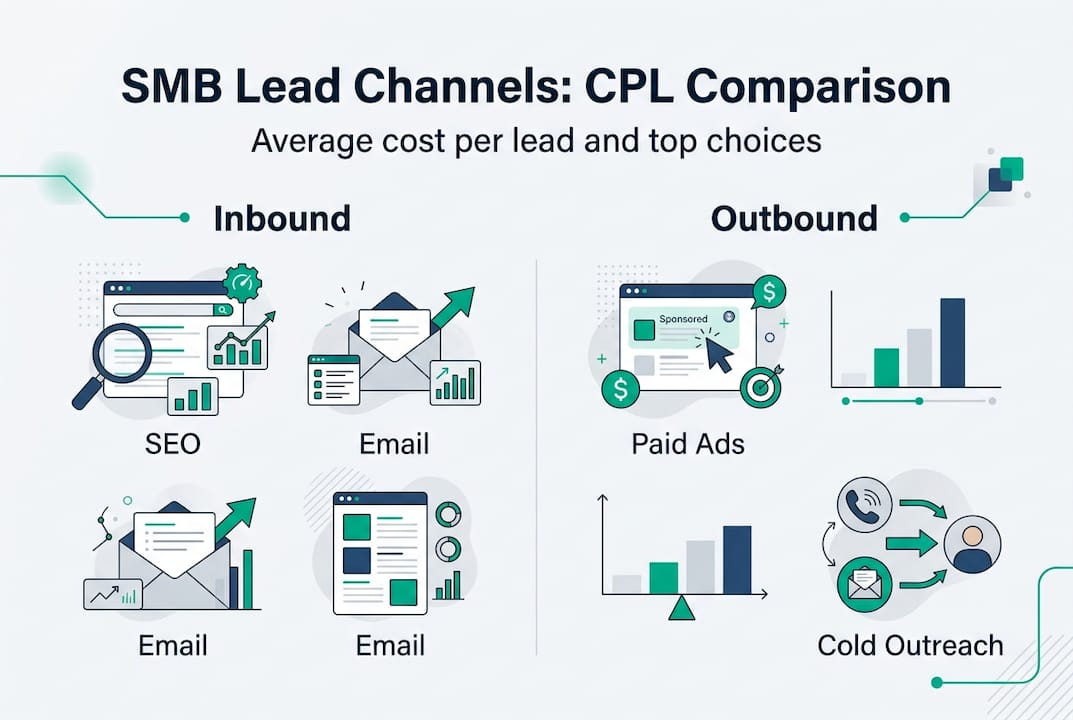
According to SMB benchmarks, inbound CPL runs 39 to 62 percent lower than outbound, and inbound close rates hit 14.6 percent versus just 1.7 percent for outbound. Those numbers matter when you’re working with a limited budget.
For lead generation strategies that fit SMB realities, the most effective methodologies include SEO, content marketing, email drip campaign examples, social media, PPC, cold outreach, webinars, and referral partnerships.
Here’s a quick breakdown of what works per channel:
- SEO: Targets buyers already searching for your solution. Slow to build, but SEO lead generation delivers the lowest CPL at $31 and compounds over time.
- Email: Best for nurturing leads already in your funnel. Personalized sequences outperform broadcast blasts every time.
- Social media: Facebook and Instagram dominate SMB adoption. Use them for retargeting warm audiences, not just brand awareness.
- PPC: Great for testing offers fast. Set tight geographic and demographic targeting to avoid wasted spend.
- Webinars: Higher CPL at $72, but the leads are warmer and more educated about your offer.
- Cold outreach: Works best in B2B when you have a clear ideal customer profile and a compelling reason to reach out.
Pro Tip: Don’t try to run every channel at once. Pick two channels that match your budget and audience, master them, then expand. Spreading thin across six channels produces mediocre results on all of them.
Framework: Building your custom SMB lead generation system
Knowing the channels is one thing. Putting them together into a repeatable system is where most SMBs struggle. Here’s a practical approach to building yours:
- Set a realistic lead target. For most SMBs, starting with 50 to 100 leads per week is manageable and measurable. Don’t aim for volume before you can handle the follow-up.
- Pick two primary channels. Choose based on where your ideal customers spend time and what your team can consistently execute.
- Build your capture assets. Create at least one strong landing page with a clear offer, a simple form, and a compelling reason to submit contact details.
- Set up a nurturing sequence. Even a three-email welcome sequence is better than silence. Map out what happens after someone fills out your form.
- Connect a CRM. Tools like HubSpot, Zoho, or Pipedrive keep leads organized and prevent them from getting lost in someone’s inbox.
- Review and adjust monthly. Track CPL, conversion rate, and lead quality. Cut what isn’t working and double down on what is.
For B2B businesses, blend digital channels like LinkedIn outreach and content marketing with offline tactics like referral programs and local partnerships. For B2C, social media retargeting and email sequences tend to drive faster results. Explore lead generation systems built specifically for SMBs if you want a done-for-you starting point.
Pro Tip: Use your CRM to set automatic follow-up reminders. A lead that doesn’t hear from you within 24 hours is a lead that’s already talking to your competitor.
Advanced methods: Lead qualification, AI, and maximizing results
Once your basic system is running, these advanced tactics separate businesses that scale from those that plateau.
Lead scoring assigns point values to lead behaviors, like opening emails, visiting your pricing page, or downloading a resource. When a lead crosses a threshold, your CRM flags them as sales-ready. This stops your sales team from wasting time on people who aren’t ready to buy.
AI lead qualifying tools can boost qualified leads by 35 to 50 percent by analyzing behavioral patterns and predicting purchase intent faster than any manual process. That’s not a small improvement. That’s a fundamental shift in how efficiently your pipeline runs.
For high-value clients, account-based marketing (ABM) focuses your entire team on a short list of ideal target accounts. ABM campaigns deliver close rates of 20 to 30 percent, compared to the 1.7 percent typical of outbound spray-and-pray tactics. Pair ABM with strong B2B SEO strategies to make sure those target accounts find you organically too.
Here are the telltale signs you’re losing leads right now:
- No follow-up email after a form submission
- Sales team contacts leads days later instead of within the hour
- No lead scoring, so every lead gets the same treatment
- Landing pages with no clear call to action
- No CRM, so leads live in spreadsheets or email threads
Nearly 79% of leads are lost without a proper nurturing sequence in place. That’s not a traffic problem. That’s a system problem.
Fix your conversion process before you scale your traffic. More visitors hitting a broken funnel just means more wasted budget. Audit your current capture and nurture steps first, then invest in driving more volume.
How we help SMBs power growth with lead generation
Building a lead generation system from scratch takes time, testing, and the right expertise. That’s exactly where Ascendly Marketing comes in.
Since 2013, we’ve helped small and medium-sized businesses build lead generation systems grounded in the same frameworks covered in this guide. Whether you need PPC advertising solutions to generate fast, targeted leads or organic SEO strategies to build a sustainable inbound pipeline, our team designs strategies around your specific goals and budget. We don’t believe in one-size-fits-all. We believe in systems that work for your business, your audience, and your sales cycle. Book a free consultation with our team and let’s assess where your lead funnel stands today.
Frequently asked questions
What is the most cost-effective lead generation method for SMBs?
SEO delivers the lowest cost per lead for SMBs at around $31 per lead, making it significantly cheaper than email at $53 or webinars at $72.
How fast should SMBs follow up with new leads?
You should follow up within minutes of a lead coming in. Speed-to-lead is critical because delays of even a few hours dramatically reduce your chances of converting that lead.
Why do most leads get lost in the funnel?
Nearly 79 percent of leads are lost when businesses skip nurturing sequences after the initial capture. Without consistent follow-up, leads go cold fast.
Do AI tools really improve lead quality?
AI-powered lead scoring boosts qualified leads by 35 to 50 percent by identifying high-intent prospects faster and more accurately than manual review alone.