

TL;DR:
- Effective content marketing requires a clear strategy aligned with business goals and audience needs.
- A strong content strategy includes defining goals, building personas, creating pillar and cluster content, and measuring revenue impact.
- Consistent execution and adaptation, focusing on revenue metrics over vanity metrics, drive sustainable growth.
Most small and medium-sized businesses treat content marketing like a social media chore: post something on Tuesday, write a blog when time allows, and hope Google notices. That approach doesn’t build a business. Content marketing generates 3x more leads than paid ads at 62% lower cost, but only when it’s driven by a real strategy. The difference between SMBs that grow predictably and those that spin their wheels comes down to one thing: whether content is guided by clear goals, audience insight, and a measurable plan, or just happening by accident.
Table of Contents
- Why content strategy matters for SMB success
- Key pillars of an effective content strategy
- How content strategy drives tangible business results
- Common mistakes and how to avoid them
- Steps to build your SMB content strategy
- What most SMBs miss about content strategy
- Take your content strategy to the next level
- Frequently asked questions
Key Takeaways
| Point | Details |
|---|---|
| Strategy drives ROI | Content strategy generates significantly more leads at lower cost for SMBs than ad spend alone. |
| Framework matters | Using proven pillars, data-driven personas, and pillar-cluster models leads to scalable and sustainable content results. |
| Focus on revenue | SMBs should track revenue and leads, not just vanity metrics, for true growth. |
| Repurpose and distribute | Repurposing high-performing content and promoting it across multiple channels boosts reach without extra budget. |
Why content strategy matters for SMB success
Let’s clear up a common mix-up. Content strategy and content marketing are not the same thing. Content marketing is what you produce and publish. Content strategy is the plan that decides what to produce, for whom, when, and why. Without the strategy layer, content marketing is just guesswork dressed up as effort.
For SMBs, this distinction is especially important. You don’t have the budget or the team size to absorb wasted effort. Every blog post, video, or email needs to serve a purpose that connects back to your business goals. When it doesn’t, you’re spending time and money on content that generates traffic but no revenue.
The content marketing benefits for SMBs are real, but they require structure to materialize. A well-built content strategy typically serves four core objectives:
- Brand awareness: Getting your name in front of the right audience before they’re ready to buy
- Lead generation: Attracting people who have a problem you can solve
- Trust building: Demonstrating expertise so prospects choose you over competitors
- SEO growth: Creating content that earns rankings and organic traffic over time
“Content marketing, when executed strategically, consistently outperforms paid channels on cost-per-lead while compounding in value over time.” This is why top-performing SMBs treat content as a long-term asset, not a short-term campaign.
The businesses that see the biggest returns aren’t necessarily producing the most content. They’re producing the right content, for the right audience, at the right stage of the buying journey. That’s strategy in action.
Key pillars of an effective content strategy
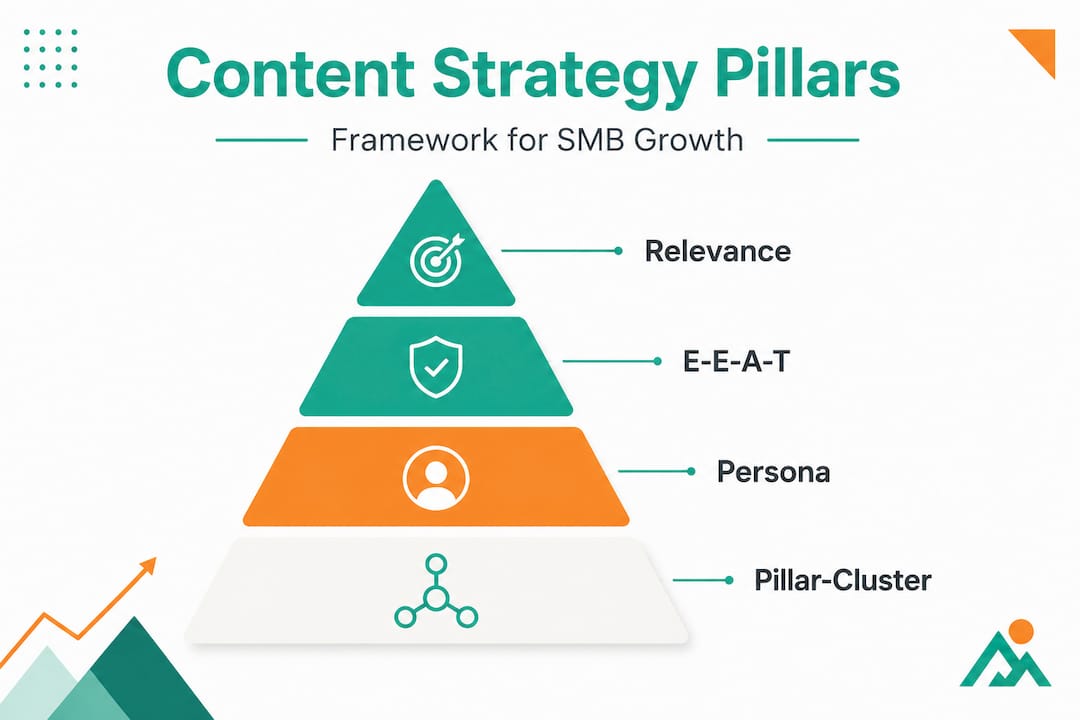
Once you understand why strategy matters, the next question is: what does a strong content strategy actually look like? There are several foundational pillars that separate businesses with a real plan from those just winging it.
E-E-A-T (Experience, Expertise, Authoritativeness, Trust) is the framework Google uses to evaluate content quality, and it’s also a useful internal standard. Every piece of content you create should reflect genuine experience, demonstrate subject-matter expertise, and build trust with your audience. In 2026, generic AI-generated content floods every niche. The businesses that win are those that bring a real human perspective to their content, even when using AI tools to support production. As one content strategy analysis puts it, prioritizing E-E-A-T alongside multichannel distribution (used by roughly 50% of top performers) is what separates strategic content from noise.
Data-driven audience personas are the foundation of relevance. If you don’t know exactly who you’re writing for, what keeps them up at night, and what questions they’re typing into Google, you’re guessing. Build personas from real data: customer interviews, search query reports, CRM data, and support ticket themes.

The pillar-cluster model is a proven approach to content architecture. A pillar page covers a broad topic in depth. Cluster pages cover related subtopics and link back to the pillar. This structure signals topical authority to search engines and guides readers through a logical content journey. You can see this approach in action through content strategy examples from businesses that have used it to dominate organic search in their niche.
Here’s how ad-hoc content compares to a strategic content approach:
| Element | Ad-hoc content | Strategic content |
|---|---|---|
| Goal | Publish something | Drive specific business outcomes |
| Audience | General or assumed | Research-backed personas |
| Topics | Random or trend-chasing | Pillar-cluster mapped to buyer journey |
| Distribution | One channel, one time | Multichannel, repurposed formats |
| Measurement | Page views, likes | Revenue, leads, retention |
| AI use | Replace human voice | Scale production, humans add nuance |
To build your core content strategy from scratch, follow these steps:
- Define your primary business goal for content (leads, sales, brand awareness)
- Build two to three detailed audience personas from real data
- Map your pillar topics to the problems your personas face
- Plan your cluster content around the questions each persona asks
- Choose two to three distribution channels where your audience actually spends time
- Set a publishing cadence you can sustain consistently
- Establish revenue-focused KPIs (key performance indicators) before you publish anything
Pro Tip: Identify your top three performing blog posts or pages and update them every six months with new data, examples, and internal links. Refreshing evergreen content often drives more traffic than creating something brand new, and it costs a fraction of the effort.
A strong content marketing strategy guide will walk you through each of these steps in detail, but the key insight is this: the strategy must come before the content, not after.
How content strategy drives tangible business results
Strategy pillars are only valuable if they translate into numbers that matter. The good news is that well-executed content strategy has a documented track record of delivering real ROI for SMBs.
The B2B median content marketing ROI sits at 287%, and top-performing SMEs regularly see 3 to 4x returns after 12 months of consistent strategic content. That’s not a typo. But notice the qualifier: 12 months. Content strategy is not a quick-win channel. It’s a compounding asset.
Here’s what measurable success looks like across different business types:
| Business type | Primary content goal | Typical result at 12 months |
|---|---|---|
| B2B service firm | Lead generation | 40-60% increase in qualified inquiries |
| E-commerce SMB | Organic traffic and sales | 2-3x organic revenue growth |
| Local service business | Brand visibility and trust | Top 3 local search rankings |
| SaaS startup | Trial signups | 50-80% lower cost per acquisition |
These results don’t happen by accident. They come from businesses that commit to a strategy and measure the right things. The measurable outcomes you should be tracking include:
- Qualified lead volume: Not just form fills, but leads that match your ideal customer profile
- Sales pipeline contribution: How much revenue can be traced back to content touchpoints
- Customer retention rates: Content that educates existing customers reduces churn
- Organic search rankings: Positions for high-intent keywords that your buyers actually use
- Time on site and return visits: Signals that your content is genuinely useful
You can find real SEO case studies that show how SMBs have used content strategy to move the needle on these exact metrics. The pattern is consistent: businesses that align content with buyer intent and track revenue attribution outperform those chasing traffic alone.
Pro Tip: Set up revenue attribution in your CRM from day one. Tag every lead with the content piece that first brought them to your site. After six months, you’ll have clear data on which content types and topics actually drive sales, not just clicks.
Pairing content strategy with SMB lead gen strategies creates a compounding effect: organic content fills the top of your funnel, while targeted lead generation tactics convert that traffic into customers.
Common mistakes and how to avoid them
Even businesses that understand the value of content strategy fall into predictable traps. Knowing these mistakes in advance saves you months of wasted effort.
Choosing channels before defining strategy. This is the most common error. A business decides to “do LinkedIn” or “start a podcast” before they’ve defined their audience, goals, or content pillars. The channel should follow the strategy, never lead it. Ask where your audience actually spends time, then go there with a clear message.
Skipping audience research. Personas built on assumptions rather than data produce content that sounds right internally but misses the mark externally. Real audience research means talking to customers, analyzing search data, and reviewing competitor content gaps.
Tracking vanity metrics. Page views and social media followers feel good but rarely correlate with revenue. As research on content in the AI age makes clear, measuring revenue attribution over vanity metrics is the dividing line between content programs that grow businesses and those that just grow spreadsheets.
“Measure revenue, not just clicks. The businesses winning with content in 2026 are those that can trace every dollar back to a content touchpoint.”
Ignoring repurposing and distribution. Creating a blog post and publishing it once is the least efficient content approach possible. A single well-researched article can become a LinkedIn carousel, a short-form video script, an email newsletter, a podcast talking point, and a social media thread. Multichannel distribution multiplies the value of every piece you create.
Giving up before the compounding kicks in. Content strategy takes time. Most SMBs abandon their plan at month three or four, right before the organic momentum would have started building. Commit to at least 12 months before evaluating whether the strategy is working.
A step-by-step digital marketing approach helps you avoid these pitfalls by building the right foundation before you scale production.
Steps to build your SMB content strategy
Now let’s put everything together into a practical roadmap you can start using this week.
-
Set specific, measurable goals. “Get more traffic” is not a goal. “Generate 50 qualified leads per month through organic content within 12 months” is. Goals drive every decision that follows.
-
Build your audience personas. Interview five to ten current customers. Ask what problems they were trying to solve, what content helped them make a decision, and what questions they had before buying. Use this data to build two to three detailed personas.
-
Map your content pillars. Choose three to five broad topics that sit at the intersection of your audience’s biggest problems and your business’s expertise. These become your pillar pages.
-
Create your cluster content plan. For each pillar, identify ten to fifteen subtopics. These become your blog posts, videos, and guides. Use keyword research tools to validate that people are actually searching for these topics.
-
Build a realistic content calendar. Consistency beats volume. One high-quality piece per week outperforms five rushed pieces. Plan three months ahead so you’re never scrambling for ideas.
-
Launch and distribute. Publish your content and actively distribute it across the channels where your audience lives. Don’t rely on Google alone to send traffic.
-
Measure, learn, and optimize. After 90 days, review which content is generating leads and revenue. Double down on what works. Cut or revise what doesn’t. This iterative cycle is what separates growing content programs from stagnant ones.
Following a content strategy for SMBs that incorporates pillar-cluster with data-driven personas and multichannel promotion gives you the best foundation for sustainable organic growth. The key word is sustainable: this approach builds an asset that keeps working for you long after the initial effort.
What most SMBs miss about content strategy
Here’s something most content guides won’t tell you: copying a strategy template from a case study rarely works. Not because the framework is wrong, but because the audience, niche, and competitive landscape are different for every business. The SMB that grew 300% using long-form SEO content in the finance space is not a blueprint you can paste onto a local home services company.
The businesses we’ve seen succeed with content share one trait: they adapted the framework to their specific audience rather than following a generic playbook. That means doing the uncomfortable work of real audience research, testing content formats that feel unfamiliar, and being willing to kill tactics that aren’t generating revenue.
The “post more” instinct is also a trap. We’ve watched businesses publish five articles a week and see zero growth, while a competitor publishes one deeply researched piece per month and steadily climbs the rankings. Volume without distribution and ROI tracking is just noise. The businesses pulling ahead in 2026 are using a barbell approach: AI tools to handle research, formatting, and first drafts at scale, while real human expertise shapes the insights, opinions, and trust signals that readers and search engines actually value.
The real-life content marketing stories that stand out all have one thing in common: the business measured revenue, not just clicks. In 2026, that’s the line between content leaders and everyone else still wondering why their blog isn’t growing their business.
Take your content strategy to the next level
Building a content strategy that actually drives revenue takes more than a good plan on paper. It takes consistent execution, ongoing optimization, and the ability to connect every content decision back to business outcomes.

At Ascendly Marketing, we’ve helped SMBs move from scattered content efforts to focused strategies that generate real leads and measurable growth since 2013. Our team covers the full spectrum of digital marketing services, from content creation and SEO to paid media and analytics, so your content doesn’t just exist but performs. If you’re ready to stop guessing and start growing, explore our SMB digital strategy solutions and see what a structured approach can do for your business.
Frequently asked questions
What is the difference between content strategy and content marketing?
Content strategy sets the goals, audience framework, and measurement plan. Content marketing is the actual execution of that plan through content creation and distribution.
How long does it take to see results from a content strategy?
Most SMBs see significant lead growth and ROI after 6 to 12 months of consistent strategic content, with top SMEs seeing 3 to 4x returns after the 12-month mark.
Which metrics should I track to measure content strategy success?
Track revenue, qualified leads, and customer retention rather than clicks or impressions, since measuring revenue attribution over vanity metrics is what separates high-performing content programs from average ones.
How can SMBs create content with limited resources?
Repurpose top-performing content across formats and channels, and use a barbell strategy: AI for scale, with human expertise handling the nuance and trust-building that AI alone cannot deliver.