

TL;DR:
- A structured marketing plan aligns efforts, improves accountability, and connects tactics to measurable goals.
- Most SMBs waste budgets on unfocused activities due to lack of clear objectives and responsibility.
- Simple, actionable plans with defined owners and regular reviews outperform complex, neglected strategies.
Most small and medium-sized business owners invest real money in marketing but never see returns that justify the spend. The reason is almost always the same: they’re running tactics without a strategy. Posting on social media, running a few ads, maybe sending an email blast here and there, but none of it connects to a clear goal or a measurable outcome. A structured marketing plan changes that completely. It turns scattered effort into focused momentum. This guide walks you through every step so you can build a plan that actually drives growth, not just activity.
Table of Contents
- Why do you need a marketing plan
- What to prepare before you start
- Building your marketing plan: The key steps
- Choosing the right digital marketing tactics
- Measuring results and optimizing your plan
- What most SMBs get wrong about marketing plans (and how to fix it)
- Ready for results? Take the next step
- Frequently asked questions
Key Takeaways
| Point | Details |
|---|---|
| Start with clear goals | Define measurable business objectives before assembling your plan. |
| Align budget with growth | Allocate 7-8% of revenue to marketing, with a focus on digital channels. |
| Choose the right tactics | Select marketing channels and techniques that match your goals and audience. |
| Measure and optimize | Track key metrics and update your plan quarterly for continual improvement. |
| Keep it simple and actionable | The best marketing plans are clear, focused, and actually used. |
Why do you need a marketing plan?
Running marketing without a plan is like driving to a city you’ve never visited without a map. You might eventually get there, but you’ll waste fuel, make wrong turns, and arrive exhausted. For SMBs operating on tight margins and limited staff, that kind of waste isn’t just frustrating. It can be fatal to the business.
Here’s what operating without a clear plan typically looks like in practice:
- Budget drain with no clear attribution: You spend money on ads or a redesigned website but have no way to connect those costs to revenue generated.
- Unfocused campaigns: Marketing messages that try to speak to everyone end up resonating with no one, reducing response rates and click-through performance.
- Inconsistent output: Without a content calendar or assigned responsibilities, marketing becomes reactive. You post when someone remembers to, not when your audience is primed to engage.
- No benchmarks: Without defined goals and metrics, you can’t evaluate what’s working or make confident decisions about where to shift budget.
A marketing plan solves all of these problems by creating a shared document that aligns your team, your budget, and your tactics around specific business outcomes. It creates accountability. It gives you a baseline to compare results against. It tells you when something is working and when it needs to change.
“A goal without a plan is just a wish.” This is especially true in marketing, where the difference between businesses that scale and those that stall is often a clear, written strategy with defined milestones.
Research from the Small Business Administration shows that SMB marketing budgets should sit at 7 to 8% of revenue for most established businesses, with growth-stage companies allocating up to 12 to 20%. Of that total, 50 to 70% should go toward digital channels. These aren’t arbitrary numbers. They reflect what SMB marketing success actually requires in a competitive online environment. Without a plan, most businesses either overspend on the wrong channels or underspend everywhere and expect outsized results.
What to prepare before you start
Before you write a single word of your marketing plan, you need to gather the right raw materials. Jumping into planning without this groundwork produces a document that looks organized but doesn’t reflect your actual business situation.
Here’s what you need to collect before you start building:
- Current business goals: Revenue targets, customer acquisition goals, market expansion plans, or product launch timelines
- Customer personas: Detailed profiles of your ideal buyers, including demographics, pain points, buying triggers, and preferred channels
- Past campaign data: What has worked before, what hasn’t, which channels drove leads, and what your cost per acquisition has been
- Available resources: Your internal team’s skills, software tools you already pay for, and time available to dedicate to marketing execution
- Budget overview: Total revenue and a realistic percentage you can allocate to marketing
| What to gather | Why it matters |
|---|---|
| Business revenue and targets | Sets realistic budget ceilings and growth expectations |
| Customer personas | Shapes messaging, channel selection, and offer structure |
| Historical campaign performance | Prevents repeating costly mistakes and reveals quick wins |
| Team skills and bandwidth | Determines what you can do in-house vs. outsource |
| Tool inventory | Avoids duplicate software spend and identifies gaps |
| Budget range | Ensures your tactics are financially realistic |
Pro Tip: Use the SBA’s guideline of 7 to 8% of revenue as your starting benchmark for marketing spend. If you’re in an aggressive growth phase, plan for up to 12 to 20%. This gives you a defensible number to bring to internal budget conversations before you start allocating to specific tactics.
Setting measurable objectives before you select any tactic is critical. “Get more leads” is not a goal. “Generate 80 inbound leads per month from organic search by Q3” is. Your objectives should follow the SMART framework: Specific, Measurable, Achievable, Relevant, and Time-bound. Once those are in place, your digital marketing preparation becomes far more focused and efficient.
Building your marketing plan: The key steps
With your foundational information gathered, you’re ready to assemble the actual plan. Here is the step-by-step structure that works for most SMBs, from early-stage to established businesses scaling for growth.
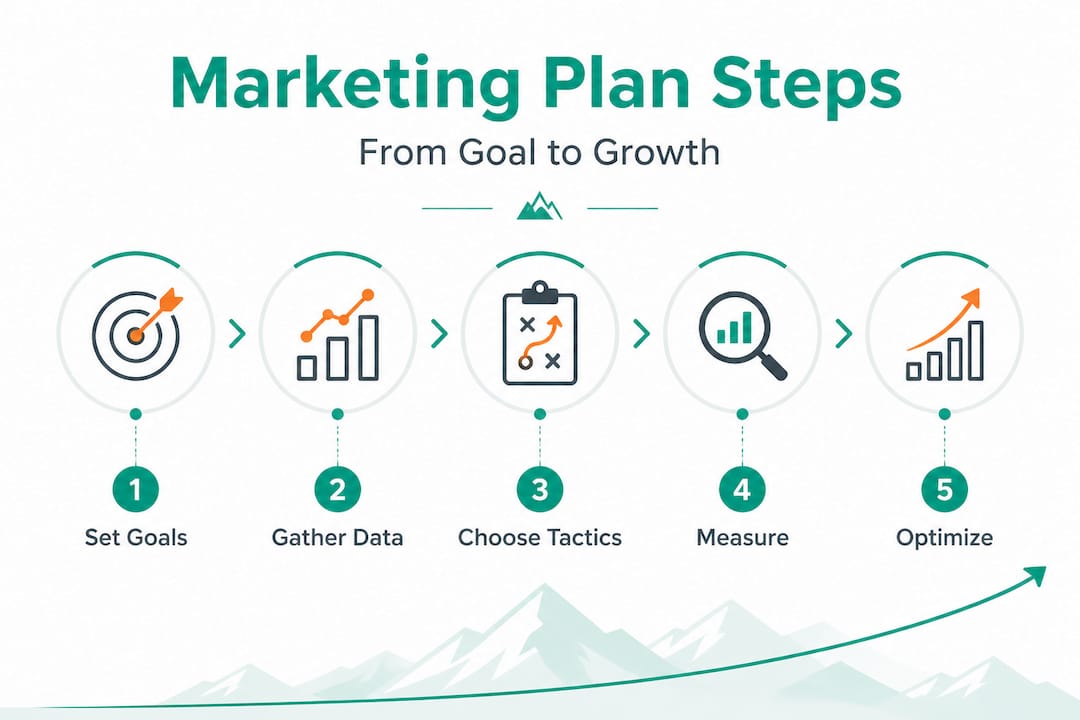
- Set your goals. Start with two to four primary objectives tied directly to business outcomes. Revenue, leads, brand awareness, or customer retention. Rank them by priority.
- Analyze your audience and market. Confirm your customer personas with real data wherever possible. Review your competitors’ positioning, pricing, and marketing channels to identify gaps you can fill.
- Define your unique selling proposition (USP). Your USP is the one clear reason your ideal customer should choose you over any alternative. It should inform every piece of messaging you create.
- Select your channels. Match channels to where your audience spends time and where your goals require presence. Don’t try to be everywhere. Be effective where it counts.
- Allocate your budget. Per the SBA, SMB budget allocation should sit at 7 to 8% of revenue, with up to 50 to 70% directed to digital. Break this down by channel based on your goals.
- Create a content and campaign calendar. Map out what you’re publishing, promoting, or launching and when. Tie each piece to a goal and a channel.
- Assign responsibilities. Every action item needs an owner. Without this, tasks fall through the cracks.
- Set up tracking. Define the metrics you’ll monitor and the tools you’ll use before you launch. Measurement is not optional.
| Tactic type | Example | Best for | Typical outcome |
|---|---|---|---|
| Traditional | Direct mail, print ads, radio | Local brand awareness | Broader reach, harder to measure |
| Digital SEO | Blog content, on-page optimization | Long-term organic traffic | Lower cost per lead over time |
| Digital PPC | Google Ads, Meta Ads | Immediate lead generation | Fast results, requires ongoing spend |
| Email marketing | Newsletters, nurture sequences | Retention and conversion | High ROI for existing audiences |
| Social media | Organic posts, Stories, Reels | Brand engagement and awareness | Community building, indirect conversions |
Pro Tip: Keep your plan to one clear page or a simple, structured document. If it takes more than 30 minutes to read, it’s too complex to execute. The consulting plan process we use at Ascendly Marketing is designed to produce a focused, action-oriented plan rather than a dense strategy document that nobody reads twice. Exploring digital marketing strategies that match your business size and goals will also sharpen your channel decisions significantly.

Choosing the right digital marketing tactics
Choosing your digital tactics is where a lot of SMBs make costly mistakes. They hear that a competitor is doing TikTok, so they start posting there. Someone reads that SEO is important, so they write a few blogs. These decisions aren’t wrong, but they’re not connected to a goal. That’s the problem.
Here is a breakdown of the major digital tactics, what each one does, and when it’s the right choice:
- Search engine optimization (SEO): Builds long-term organic visibility for search queries your buyers are already using. Best for businesses investing in 12-plus months of consistent growth.
- Pay-per-click advertising (PPC): Drives immediate traffic through paid placements on Google, Meta, or LinkedIn. Best when you need fast results and have a budget to sustain it.
- Email marketing: Nurtures leads through your funnel and retains existing customers. Consistently delivers the highest ROI of any digital channel when the list is clean and segmented.
- Content marketing: Builds trust and authority by answering your audience’s questions before they’re ready to buy. Content marketing examples show how businesses use articles, videos, and case studies to generate leads organically.
- Social media marketing: Builds community, sustains brand presence, and can drive direct conversions through paid social formats.
- Retargeting: Re-engages visitors who didn’t convert the first time. Very cost-effective because you’re only spending on people who have already shown interest.
- Search engine marketing (SEM): Combines organic and paid search engine marketing strategies for maximum search visibility, particularly useful in competitive industries.
Match every tactic to a stage of your buyer’s journey. Awareness tactics (social, content, SEO) pull people in. Consideration tactics (email, retargeting, webinars) keep them engaged. Conversion tactics (PPC, landing pages, limited-time offers) close the deal. Understanding the full range of digital marketing types makes it easier to build a balanced mix.
Pro Tip: Because digital channels offer real-time reporting and precise attribution, the SBA recommends directing 50 to 70% of your budget to digital. Start with the channels that map directly to your primary goal, then layer in supporting tactics as budget and capacity allow.
Measuring results and optimizing your plan
A marketing plan without measurement is just a set of intentions. The businesses that win long-term are the ones that treat their marketing data as seriously as their financial statements.
The core metrics every SMB should track include:
- Return on investment (ROI): Total revenue generated divided by total marketing spend. This is your north star metric.
- Cost per lead (CPL): How much you spend to generate each new lead. Track this by channel to identify your most efficient sources.
- Conversion rate: The percentage of leads that become paying customers. Low conversion often signals a messaging or nurturing problem, not a traffic problem.
- Customer acquisition cost (CAC): The total cost to acquire one new customer. Compare this to lifetime customer value to assess long-term profitability.
- Channel performance: Which platforms are driving traffic, leads, and revenue? This is where you make budget reallocation decisions.
Reliable tools for tracking these metrics include Google Analytics 4, Google Search Console, Meta Ads Manager, HubSpot, Semrush, and basic UTM parameters in your campaign URLs. Most of these have free or low-cost tiers that work well for SMBs. For understanding and measuring marketing ROI in a way that directly informs your budget decisions, building a simple reporting dashboard makes a significant difference.
Best practice is to review performance monthly for in-flight adjustments and quarterly for strategic shifts. Monthly reviews catch quick wins and early problems. Quarterly reviews let you evaluate channel mix, budget allocation, and goal progress with enough data to make informed changes.
Pro Tip: Once you have three to six months of data, use your channel performance numbers to justify shifting more budget to your highest-performing digital channels. The SBA budget guideline is a starting point, not a ceiling. Strong-performing channels deserve a bigger share of the budget, and your data makes that case objectively.
What most SMBs get wrong about marketing plans (and how to fix it)
Here’s something we’ve seen consistently across more than a decade of working with small businesses: most marketing plans fail not because they’re strategically wrong, but because they’re never actually implemented.
The process goes like this. A business owner or marketing manager spends two weeks building a detailed, polished plan. It covers every channel, maps every persona, and projects revenue impact by quarter. Then it gets emailed around, everyone nods, and it sits in a folder while the same ad-hoc marketing behavior continues as before. The plan becomes what we call shelfware.
The reason this happens is almost always overcomplication paired with unclear ownership. When a plan has 12 priorities and no designated owners, nobody takes responsibility. When the document is 40 pages long, nobody reads it after the first week. When the review cycle is annual, the plan is irrelevant before it’s ever tested.
What actually works is the opposite of that. The best small business marketing strategy we’ve seen in practice is a one-page plan with three to four clear goals, named owners for each tactic, a 90-day action horizon, and a monthly check-in to review progress. It’s less impressive to present in a boardroom. But it gets done.
The uncomfortable truth is that a simple plan with strong execution will always beat a sophisticated plan with weak follow-through. Adaptability matters more than completeness. Quarterly reviews matter more than a perfect initial document. And a leader who holds the team accountable to the plan matters more than any tool or template.
Build the simplest version of your plan that answers these three questions: What are we trying to achieve? What are we doing to get there? How will we know if it’s working? If your plan can answer those clearly, you’re already ahead of most of your competitors.
Ready for results? Take the next step
Building a marketing plan is the right move. Executing it with the right team makes all the difference.

At Ascendly Marketing, we work with small and medium-sized businesses to turn strategic plans into measurable growth. From setting your goals and defining your audience to launching campaigns and tracking results, our team of SEO specialists, content creators, and paid media experts handles the full picture. Whether you’re starting from scratch or need to sharpen an existing strategy, explore our digital marketing services to see what’s possible. If you’re ready for a focused roadmap built around your specific business goals, our small business digital marketing approach is designed exactly for where you are right now.
Frequently Asked Questions
How much should a small business spend on marketing?
The SBA recommends 7 to 8% of revenue for most established SMBs, and up to 12 to 20% for businesses in an aggressive growth phase. Start with the lower range and scale up as you validate which channels are producing returns.
What are the essential components of a marketing plan?
A complete marketing plan includes clearly defined goals, target audience analysis, a set budget, selected tactics, a content and campaign calendar, defined KPIs, and a structured review process to track and adjust results over time.
How often should I update my marketing plan?
Review your marketing plan every month for in-campaign adjustments, and conduct a full strategic review quarterly. Update it immediately if major changes occur in your business model, budget, or market conditions.
What percentage of my marketing budget should go to digital?
Current SMB best practices, supported by SBA budget guidelines, recommend directing 50 to 70% of your total marketing budget to digital channels due to their measurability, targeting precision, and lower cost per acquisition compared to most traditional formats.
Do I need a formal document, or is an outline enough?
A simple but detailed outline with clear goals, assigned ownership, and defined metrics is usually more effective than a lengthy formal document. Focus on clarity and action steps rather than completeness for its own sake.