

TL;DR:
- Data-driven marketing helps small businesses target audiences and improve return on investment.
- Small SMBs can leverage existing data, qualitative feedback, and industry insights effectively.
- Focus on a few key metrics and combine data insights with local knowledge for best results.
Most small business owners assume analytics dashboards, A/B testing, and data-driven campaigns are tools reserved for companies with multimillion-dollar budgets and dedicated data science teams. That assumption is costing you sales. The reality is that you already have data sitting in your Google Analytics account, your social media insights, and your customer emails. You just need to know how to use it. This guide breaks down exactly what data-driven marketing is, why it works for businesses your size, and how to start applying it today without getting lost in spreadsheets or expensive software.
Table of Contents
- What is data-driven marketing and why does it matter?
- Core advantages for SMBs: Better results with less risk
- From confusion to action: Making data work for any SMB
- Real-world examples: SMBs winning with data
- A smarter approach: Data isn’t everything—local nuance matters too
- Ready to apply data-driven strategies? Get expert help for SMB growth
- Frequently asked questions
Key Takeaways
| Point | Details |
|---|---|
| Start with small data | You don’t need complex analytics to improve your marketing—basic website and sales data can drive meaningful results. |
| Blend data and intuition | Combining data-driven tactics with local storytelling creates the most effective SMB marketing campaigns. |
| Action beats analysis paralysis | Pick a few key metrics to track, make small improvements, and iterate—overthinking slows progress. |
| Learn from real-world examples | Success stories from SMBs prove measurable gains even with limited data resources. |
| Seek expert support when needed | Professional marketers can help tailor strategies and make the most of your available data. |
What is data-driven marketing and why does it matter?
Data-driven marketing means making decisions based on real information rather than gut instinct. Instead of running an ad because it “feels right,” you look at what your audience actually responds to, where your website traffic comes from, and which messages have led to real sales in the past. Then you put your budget behind what works.
For small and medium-sized businesses (SMBs), this approach is particularly powerful because you cannot afford to waste money. A large corporation can absorb a campaign that flops. You probably cannot. Data removes much of that guesswork, pointing your resources toward the channels and messages most likely to produce results.
Here is what data-driven marketing actually does for you:
- Better targeting: You learn who your real customers are, not who you think they are. Age, location, device, buying time, and content preferences all become visible.
- Efficient budget use: You stop spending on tactics that do not convert and reinvest in those that do.
- Measurable ROI: Every dollar you spend can be tracked back to a specific result, whether that is a lead, a sale, or a repeat purchase.
- Faster learning: When a campaign underperforms, data tells you why so you can correct it quickly instead of waiting weeks for anecdotal feedback.
- Smarter content creation: Knowing which topics, formats, and headlines drive the most engagement means your content team stops guessing and starts producing.
The most common misconception is that you need massive datasets to benefit. That is simply not true. As research on small business data strategies confirms, SMBs can aggregate smaller data sets, borrow industry-level insights, and use qualitative customer feedback to drive meaningful marketing decisions. You do not need a data warehouse. You need a clear question and the right tools to answer it.
If you are just getting started, a solid digital marketing guide can help you understand the broader landscape before narrowing down to analytics.
Key insight: Data-driven marketing is not about having the most data. It is about asking the right questions with the data you already have.
The shift in thinking is simple. Traditional marketing says, “Let’s try this.” Data-driven marketing says, “The numbers suggest this will work, so let’s do it.” That difference in approach separates businesses that grow predictably from those that grow by accident.
Core advantages for SMBs: Better results with less risk
Once you accept that you do not need enterprise-level tools to benefit from analytics, the next question is: what specific advantages does this approach give you? The answer is straightforward. Data-driven marketing reduces your financial risk while increasing your chances of hitting your revenue targets.
Here is how to start building that foundation in a structured way:
- Audit your current data sources. Pull reports from Google Analytics, your email platform, and your social channels. You already have information about traffic, open rates, and engagement sitting unused.
- Identify your highest-converting channel. Look at where your actual paying customers came from. Was it organic search, a specific social platform, or direct referrals? Start there.
- Set a baseline. Record your current numbers for website visits, lead volume, and conversion rate. This becomes your benchmark for measuring improvement.
- Run one small test. Change a single variable in your next campaign, such as the subject line of an email or the headline of a landing page. Measure the difference.
- Scale what works. Once you have evidence that a tactic converts, allocate more of your budget to it and reduce spend on what is not performing.
This approach mirrors what small business marketing strategies consistently recommend: start small, prove the concept, then scale with confidence.
Comparison: Data-driven vs. traditional marketing for SMBs
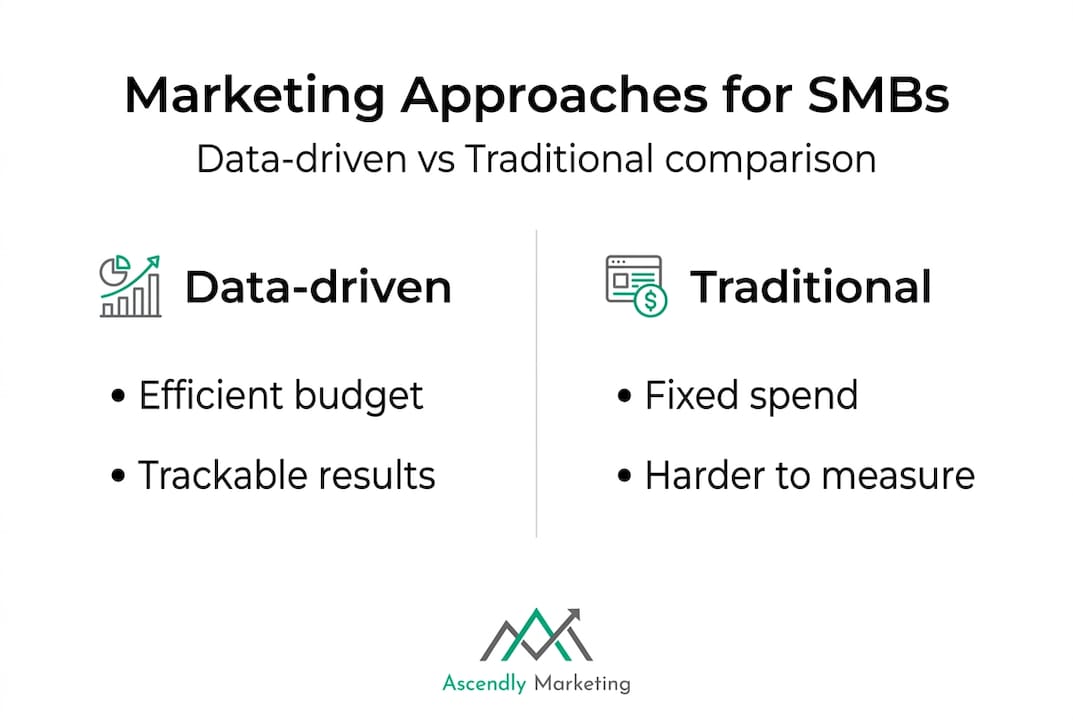
| Factor | Data-driven marketing | Traditional marketing |
|---|---|---|
| Budget efficiency | High (spend follows results) | Variable (often intuition-based) |
| Targeting precision | Specific audience segments | Broad, general audiences |
| Measurability | Direct tracking and attribution | Difficult to measure precisely |
| Speed to optimize | Fast (real-time adjustments) | Slow (long campaign cycles) |
| Emotional resonance | Can feel impersonal if misused | Strong local and human trust |
| Best use for SMBs | Digital campaigns, paid ads, SEO | Local events, referrals, print |
Notice the last row. Traditional marketing is not dead for SMBs. Research on marketing approaches for business shows that a hybrid model is often the best choice: use data-driven tactics for precision and ROI, and keep traditional methods for building emotional trust and local community presence. The two approaches strengthen each other when used together.
Businesses using structured strategies see dramatically better outcomes. According to research highlighted in marketing success strategies, SMBs with a documented marketing plan have significantly higher success rates than those running campaigns ad hoc.
Pro Tip: Instead of tracking every metric available, track micro-conversions, which are the small actions that lead up to a sale, such as email signups, video views, or product page visits. These reveal hidden ROI and tell you where prospects are getting stuck before they buy.
From confusion to action: Making data work for any SMB
The most common reason SMBs stay stuck in guesswork is not a lack of data. It is not knowing which data matters. When you log into Google Analytics for the first time and see 47 different reports, it is easy to close the tab and go back to doing what you have always done. The fix is to simplify.
You do not need all the data. You need the right data. Research confirms that small businesses can be data-driven by aggregating smaller data samples, borrowing insights from similar businesses in their industry, and incorporating qualitative feedback from customers directly. That last point is underused and incredibly valuable.
Here is a practical data table to help you match business goals with the right metrics:
| Business goal | Key metric to track | Tool to use |
|---|---|---|
| Increase website traffic | Organic sessions, traffic source | Google Analytics |
| Generate more leads | Form submissions, click-through rate | HubSpot, Google Ads |
| Improve email performance | Open rate, click-to-open rate | Mailchimp, Klaviyo |
| Boost social engagement | Reach, shares, saves | Native platform insights |
| Increase sales conversions | Conversion rate, revenue per visitor | Shopify, Google Analytics |
Use this table as a filter. Pick the goal most relevant to your business right now, track only that metric, and ignore the rest until you have made progress.
Here are the core actions you can take immediately:
- Talk to your customers directly. Surveys and one-on-one conversations generate qualitative data that no analytics tool captures. Ask them what almost stopped them from buying and what made them choose you.
- Borrow industry benchmarks. If you do not have enough of your own data yet, look at published industry averages for email open rates, conversion rates, or ad costs. Use those as targets while you build your own baseline.
- Use free tools first. Google Analytics, Google Search Console, and your social media native insights are all free and provide substantial data for most SMBs.
- Review your data on a fixed schedule. Pick one day per week or per month to review your key metrics. Consistency beats intensity.
For a structured approach to putting this all together, our step-by-step SMB marketing guide walks through each phase in plain language. If you want to go further, AI for SMB marketing explores how newer tools can automate parts of the data analysis process so you spend less time in dashboards and more time on strategy.
Pro Tip: Limit yourself to three key metrics when starting: website sessions, lead conversion rate, and cost per acquisition. These three numbers tell you whether people are finding you, whether they are interested, and whether you are spending efficiently.
Real-world examples: SMBs winning with data
Theory is useful. But what does data-driven marketing actually look like for businesses your size? Here are realistic examples drawn from common SMB scenarios across retail, services, and local businesses.
A local retail shop noticed through Google Analytics that 70% of its website traffic came from mobile users, but mobile visitors converted at half the rate of desktop users. The owner dug deeper and found that the checkout process on mobile had too many steps. After simplifying the mobile checkout to three clicks, mobile conversion rates doubled within 60 days. No expensive tools. No data science team. Just pay attention to what the numbers were saying.

A service-based business, specifically a small HVAC company, used customer review data and call tracking to identify that most new customers mentioned “fast response” as the reason they chose the company. The marketing team shifted its ad copy to lead with response time guarantees. Cost per lead dropped by 30% within one quarter because the message matched what buyers actually cared about.
A local restaurant used social media insights to discover that posts featuring behind-the-scenes kitchen content generated three times more shares than promotional posts. The owner shifted from posting “come try our specials” content to “here is how we make our signature dish” content. Foot traffic increased, and the restaurant built a genuine following based on trust rather than discounts.
These examples share a common pattern:
- Identify a gap between expected and actual performance
- Look at the available data to find the specific cause
- Make one targeted change based on that insight
- Measure the result and build on it
As noted in guidance on leveraging limited data, you do not need large data sets to generate actionable insights. Small business owners who borrow insights from competitors and comparable businesses in their industry can accelerate this learning curve dramatically.
“The businesses that grow the fastest are not always the ones with the most data. They are the ones who act consistently on the data they already have.”
You can review documented outcomes in our SMB marketing case studies and explore how real-world social media examples demonstrate what this looks like across different industries and platforms.
A smarter approach: Data isn’t everything—local nuance matters too
Here is something the analytics industry does not say loudly enough: data can mislead you if you use it without context. Numbers tell you what is happening. They rarely tell you why. And for local SMBs especially, the “why” lives in human relationships, neighborhood culture, and community trust.
We have seen businesses obsess over their click-through rates while ignoring the fact that their front-line staff was creating terrible customer experiences. The data showed great ad performance. The business was still losing customers. No dashboard captures that.
The most effective SMBs we work with use data as a compass, not a command. They let the numbers point them in a direction, then apply local knowledge, customer relationships, and genuine brand personality to execute. A marketing campaign informed by analytics but delivered with human warmth outperforms a technically perfect campaign that feels cold and generic every single time.
There is also the trap of paralysis by analysis. When you track too many metrics, you spend more time reviewing data than acting on it. The goal is a small set of reliable numbers that tell you clearly whether things are moving in the right direction. Everything else is noise.
For SMBs thinking about scaling this approach strategically, choosing a digital agency that understands both the data side and the human side of marketing is essential. The combination of precision and personality is where real growth lives.
Ready to apply data-driven strategies? Get expert help for SMB growth
If this article made you realize there is untapped potential in the data you already have, that is exactly the right reaction.
At Ascendly Marketing, we work specifically with small and medium-sized businesses to build data-driven marketing strategies that are practical, budget-conscious, and built for real growth. From setting up proper tracking and identifying your highest-value channels to running campaigns that actually convert, our team brings the analytical depth and creative execution your business needs. Explore our full range of digital marketing services or start with a tailored small business marketing strategy session. Let’s turn your data into your competitive advantage.
Frequently Asked Questions
Do small businesses need large amounts of data to benefit from data-driven marketing?
No. As research on SMB data strategies confirms, SMBs can achieve meaningful results by aggregating small data sets, borrowing industry insights, and incorporating qualitative customer feedback into their decisions.
What’s the difference between data-driven and traditional marketing for SMBs?
Data-driven marketing uses analytics to guide decisions with measurable precision, while traditional marketing relies more on intuition and local trust. Research on marketing approaches consistently shows that a hybrid of both methods delivers the strongest results for most SMBs.
How can SMBs get started with data-driven marketing?
Begin by tracking three key metrics: website sessions, lead conversion rate, and cost per acquisition. Use free tools like Google Analytics and start small before expanding your data collection as your confidence grows.
Does data-driven marketing work for local businesses, not just online brands?
Yes. Even brick-and-mortar businesses can use call tracking, foot traffic data, and local search metrics to make smarter decisions. A hybrid marketing model that combines local trust with digital precision works particularly well for community-based SMBs.