

TL;DR:
- Most small and medium-sized businesses assume programmatic advertising is exclusive to Fortune 500 brands, but automation now makes it accessible for all. Programmatic replaces manual ad buying with software algorithms that target specific audiences across multiple channels in milliseconds, enhancing efficiency and scale. SMBs should focus on strategic campaign setup, ongoing oversight, and selecting appropriate deal types like PMP or guaranteed deals to maximize results and protect their brand.
Most small and medium-sized business owners assume programmatic advertising belongs in the budget of Fortune 500 brands. That assumption is costing them real money. Nearly 9 in 10 digital display ad dollars are now transacted programmatically worldwide, which means if your competitors are running display ads, they are almost certainly using this technology. The good news is that automation has made programmatic tools genuinely accessible to businesses of every size, and understanding how it works could be the single biggest upgrade to your digital marketing strategy this year.
Table of Contents
- What is programmatic advertising?
- How does real-time bidding and programmatic buying work?
- Types of programmatic deals: RTB, PMP, direct, and more
- Why does programmatic dominate digital ad spending?
- How SMBs can harness programmatic for marketing results
- Most expert guides miss this in programmatic advertising
- Ready to elevate your digital advertising?
- Frequently asked questions
Key Takeaways
| Point | Details |
|---|---|
| Automated ad buying | Programmatic advertising automates buying and selling digital ads for better precision and scale. |
| Multiple deal types | SMBs can choose from RTB, private marketplaces, and programmatic direct depending on control needs. |
| Budget-friendly for SMBs | Modern platforms allow flexible budgets, making programmatic accessible to small and medium-sized businesses. |
| Measurement is critical | Successful programmatic campaigns require setting clear goals and ongoing monitoring for brand safety and efficiency. |
What is programmatic advertising?
Programmatic advertising sounds technical, but the core idea is straightforward. Instead of a human picking ad placements and negotiating rates with publishers one by one, software handles the entire process automatically. Programmatic advertising automates the buying and selling of digital ad inventory using software and algorithms, matching your message to the right audience across thousands of websites in milliseconds.
Think about the old way of buying ads. A marketing manager would call a sales rep at a publisher, negotiate pricing, sign an insertion order, and wait for a campaign to go live. That process could take weeks and involved significant guesswork about whether the right audience would actually see the ads.
Programmatic flips that model entirely. You define your audience, set your budget, and establish your bid rules inside a platform. The software then goes out and buys the most relevant impressions available at any given moment, across thousands of publishers simultaneously. That kind of scale and precision simply was not possible through manual buying.
“Programmatic is not a single tactic. It is an infrastructure for buying digital media more intelligently, at scale, with real audience data guiding every decision.”
Programmatic works across a wide range of digital channels today, including display banners, video, connected TV, mobile apps, and even digital out-of-home billboards. For SMBs looking to get more from their paid advertising guide, understanding programmatic is no longer optional. It is the foundation of how digital media is transacted.
Key channels where programmatic operates:
- Display advertising on websites and apps
- Pre-roll and mid-roll video on streaming platforms
- Connected TV and over-the-top content
- Native advertising within editorial content
- Digital out-of-home screens in retail and transit
How does real-time bidding and programmatic buying work?
The technology behind programmatic can seem like a black box, but once you break it down step by step, the logic is clear and compelling.
Here is how a single ad impression gets bought and served in under 100 milliseconds:
- A user loads a webpage. That page contains ad slots that are connected to a supply-side platform (SSP), which is the software publishers use to sell their inventory.
- The SSP sends a bid request. The request includes anonymized data about the user (location, browsing behavior, device type) and the placement details.
- The bid request goes to an ad exchange. In common open-market setups, programmatic trades occur in ad exchanges where impressions are auctioned in real time, usually via real-time bidding (RTB).
- Demand-side platforms (DSPs) evaluate the impression. DSPs are the software advertisers use to bid on inventory. They assess whether the impression matches your targeting criteria and calculate a bid.
- The highest bid wins. The winning ad is instantly served to the user. The whole process takes roughly 100 milliseconds, faster than the blink of an eye.
| Platform | Role | Who uses it |
|---|---|---|
| DSP (Demand-Side Platform) | Buys ad inventory on behalf of advertisers | Marketers, agencies |
| SSP (Supply-Side Platform) | Sells publisher ad inventory | Publishers, media owners |
| Ad Exchange | Marketplace connecting buyers and sellers | Both parties |
| DMP (Data Management Platform) | Stores and activates audience data | Advertisers, agencies |
| Ad Server | Delivers and tracks ads | Both parties |
This ecosystem creates enormous efficiency. Rather than buying a slot on a specific website and hoping the right people show up, you are buying access to specific audiences wherever they happen to be browsing. If your ideal customer is a 45-year-old small business owner in the Midwest who recently searched for accounting software, programmatic can find that person and serve your ad to them across multiple sites throughout the day.
Pro Tip: When you are starting out with programmatic, focus your DSP targeting on first-party audience data (your existing customer emails or website visitors) before layering in third-party behavioral segments. Your own data will always outperform rented audience segments on conversion rates.
For SMBs comparing PPC marketing examples or exploring paid search engine optimization, programmatic display adds a complementary layer that reaches potential customers beyond search intent, building brand awareness while they browse.
Types of programmatic deals: RTB, PMP, direct, and more
Not all programmatic buying is created equal. Programmatic is broader than RTB: it can be transacted through multiple buying methods such as open-exchange RTB, private marketplaces, preferred deals, and programmatic guaranteed/direct. Each method offers a different balance of control, transparency, and cost certainty.
| Deal type | How it works | Control level | Best for |
|---|---|---|---|
| Open RTB | Real-time auction, anyone can bid | Low | Scale and reach |
| Private Marketplace (PMP) | Invite-only auction with select publishers | Medium | Brand safety |
| Preferred Deal | Fixed price, non-guaranteed inventory | Medium-High | Premium placements |
| Programmatic Guaranteed | Reserved inventory at fixed price | High | Predictable spend |
Open RTB is the most common entry point for SMBs. You bid on available inventory in real time across a broad marketplace. Costs are typically lowest here, and scale is highest. The trade-off is less control over exactly where your ads appear.

Private Marketplace (PMP) deals are invitation-only auctions. A publisher opens select inventory to a curated group of advertisers. You get better transparency and brand safety without losing the efficiency of real-time bidding. This is a strong middle-ground option for SMBs that care about where their brand is seen.
Preferred deals let you negotiate a fixed price with a publisher for a specific placement, but inventory is not guaranteed. You get priority access without committing to a guaranteed buy.
Programmatic Guaranteed is the closest equivalent to traditional direct buying, but done programmatically. Inventory, pricing, and timing are all locked in advance. This approach eliminates uncertainty and is ideal if you have a major campaign launch or seasonal promotion that needs reliable delivery.
Pro Tip: If brand safety is a concern (and it should be for most SMBs), start with PMP deals on curated publisher lists rather than broad open-exchange buying. You pay a slight premium, but avoid the risk of your logo appearing next to content that conflicts with your brand values.
Exploring the types of online advertising available today shows that programmatic is not a replacement for other channels. It is a transaction layer that makes many of those channels smarter.
Why does programmatic dominate digital ad spending?
The numbers make the case clearly. Programmatic will account for nearly 9 in 10 digital display ad dollars worldwide in 2025. That is not a trend. That is a market reality.
9 in 10 digital display dollars. If you are still buying media manually, you are operating outside the mainstream of how digital advertising actually works today.
The reasons for programmatic’s dominance come down to three structural advantages:
Efficiency. Automated buying eliminates the overhead of manual negotiations. Your budget goes toward impressions rather than administrative work, and the technology optimizes placement in real time based on performance data.
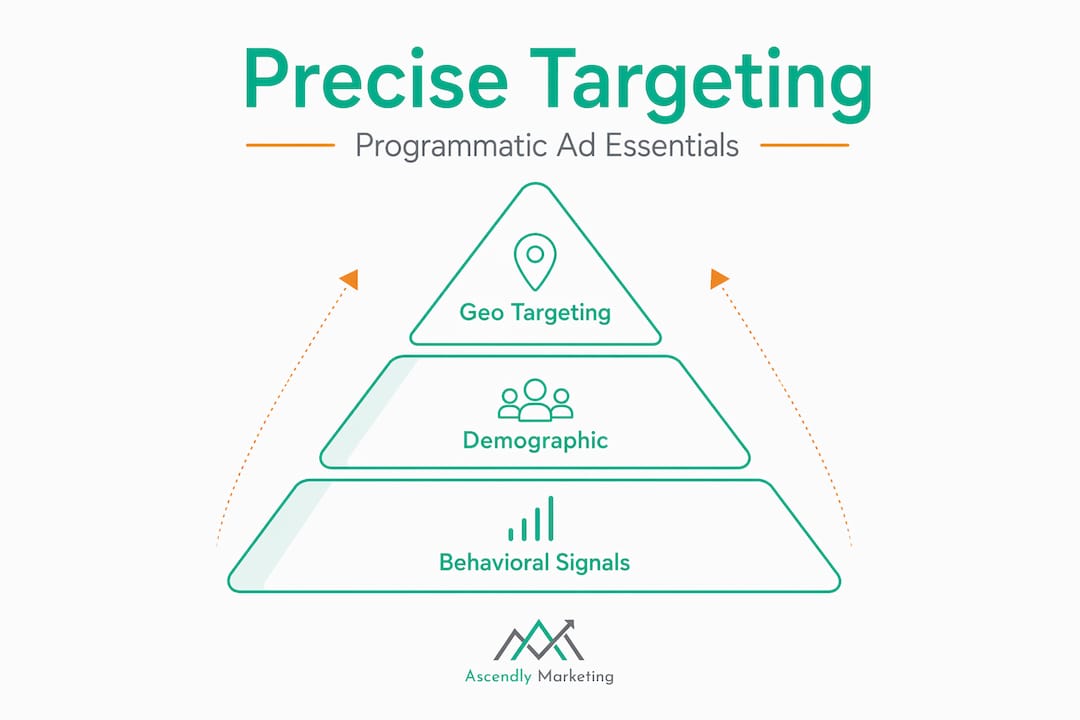
Precision targeting. Programmatic platforms can layer multiple targeting signals simultaneously, including geography, device type, browsing behavior, purchase intent, contextual page content, and more. That level of granularity is impossible to replicate with manual insertion orders.
Scale. A single programmatic campaign can reach inventory across thousands of publishers without requiring individual relationships with each one. For an SMB with limited sales contacts, this is a game-changing advantage.
Key benefits of programmatic for SMBs:
- Access to premium inventory without direct publisher relationships
- Real-time budget control and campaign optimization
- Granular audience targeting based on actual behavior
- Transparent reporting on where ads are served and how they perform
- Flexible minimum spend thresholds that fit smaller budgets
That said, benefits come with real responsibilities. Online advertising growth creates more competition for quality inventory, which means SMBs need to be strategic. Brand safety controls prevent your ads from appearing alongside harmful content. Privacy-aware targeting ensures compliance with evolving regulations like state-level consumer privacy laws. And proper measurement setup makes sure you can actually attribute results to your campaigns.
Getting those details right matters more than which DSP you choose. Solid PPC optimization tips for paid search apply equally here: structure matters, and sloppy setup wastes money fast.
How SMBs can harness programmatic for marketing results
Knowing why programmatic is powerful is useful. Knowing how to actually deploy it for your business is what changes your results.
The practical challenge for SMBs is not selecting the right technology stack. It is configuring campaigns with adequate guardrails around measurement, brand safety, and privacy-aware targeting. Here is a practical roadmap to follow:
-
Define your audience before touching the platform. Write out exactly who you are trying to reach: demographics, interests, job roles, browsing behaviors, or purchase signals. The more specific you are going in, the better your targeting configuration will be.
-
Set up conversion tracking first. Install your tracking pixels and verify they are firing correctly before spending a single dollar. Without clean measurement, you are flying blind. This step alone prevents enormous waste.
-
Start with retargeting. Your website visitors are your warmest audience. Build a retargeting segment from your first-party data and run your initial programmatic campaign to that group. It is lower risk, typically higher converting, and gives you real performance data quickly.
-
Choose your deal type based on risk tolerance. Open RTB is fine for retargeting at scale. For prospecting campaigns targeting new audiences, consider a PMP deal to maintain brand safety while still accessing solid inventory.
-
Set exclusion lists from day one. Block categories of content that conflict with your brand: news, political content, adult content, and any verticals that feel misaligned with your positioning. This is a five-minute setup step that protects your brand indefinitely.
-
Review performance weekly, not monthly. Programmatic moves fast. Budget pacing, bid adjustments, and creative rotation should be reviewed at least weekly in the early weeks of a campaign.
-
Test one variable at a time. Change one targeting parameter, creative, or deal type per test cycle. Testing everything at once makes it impossible to know what actually drove the improvement.
Pro Tip: Set a strict daily budget cap when launching a new programmatic campaign. Algorithms can spend aggressively while learning, and an uncapped daily budget on a new campaign can exhaust a monthly budget in days. Cap first, then scale once performance data confirms efficiency.
Following a structured set of paid advertising steps gives you a reliable foundation whether you are running programmatic display, paid search, or social campaigns.
Most expert guides miss this in programmatic advertising
Here is the honest truth that most articles about programmatic advertising avoid: the technology is the easy part.
DSPs are sophisticated, user-friendly platforms. Setting up an audience segment takes minutes. The hard part is maintaining discipline and oversight once campaigns are live. Automation has a way of creating false confidence. You set it up, it is running, results look reasonable, so you move on to the next priority. That is exactly when waste starts compounding.
In our experience working with SMBs across industries, the businesses that get the most from programmatic are not the ones with the biggest budgets or the fanciest data management tools. They are the ones that treat programmatic campaigns like an ongoing conversation rather than a set-and-forget system. They review placement reports to see which sites actually drove conversions. They rotate creative on a regular schedule so ad fatigue does not silently kill performance. They check brand safety logs to confirm ads are not appearing in unexpected contexts.
SMB advertising growth does not come from adopting every new ad technology. It comes from getting the fundamentals right and executing them consistently. Programmatic is a force multiplier for good strategy, but it amplifies poor strategy just as quickly.
Start small. Spend $500 to $1,000 in a controlled test before committing a major budget. Learn what your actual CPMs (cost per thousand impressions), click-through rates, and conversion rates look like in your market. Then scale what works, cut what does not, and resist the pressure to automate away your judgment entirely. That combination of smart technology and active human oversight is what separates SMBs that win with programmatic from those that waste their ad budgets on impressions that never convert.
Ready to elevate your digital advertising?
Programmatic advertising is no longer a luxury reserved for enterprise brands with massive media teams. It is accessible, scalable, and increasingly essential for any SMB that wants to compete for attention online.
At Ascendly Marketing, we help SMBs design and manage PPC advertising services that include programmatic display, paid search, and integrated digital campaigns built around measurable outcomes. Our team brings experience managing real campaigns across diverse industries, and we know how to configure the guardrails that protect your budget while driving real results. Explore our full range of digital marketing services, or start with our digital marketing guide for SMBs to understand where programmatic fits in your broader strategy. Let us help you turn advertising technology into actual business growth.
Frequently asked questions
Is programmatic advertising suitable for small businesses?
Yes, automation allows even small businesses to access high-quality ad inventory and precise targeting with manageable budgets. Programmatic is the dominant method for digital ad buying, making its tools and benefits widely available regardless of business size.
What’s the difference between programmatic and traditional ad buying?
Programmatic automates placements and targeting through real-time auctions, while traditional buying relies on manual negotiation and signed insertion orders. Programmatic automates ad buying using software and algorithms, which eliminates the delays and guesswork of manual methods.
Do I need a large budget to use programmatic advertising?
No, programmatic platforms allow you to set budgets and bids at almost any level, making it accessible to businesses of various sizes. You set targeting, budgets, and bid rules, which gives you full control over how much you spend and when.
How can I ensure brand safety with programmatic ads?
Choose curated buying methods like private marketplaces or programmatic guaranteed deals, and set up exclusion lists and measurement safeguards from day one. For better control and fewer surprises, select curated or more certain buying methods such as PMP or programmatic guaranteed deals to protect your brand across all placements.