

Paid advertising should be one of the most predictable growth tools in your business arsenal. Yet most small and medium-sized business owners find themselves burning through budget with little to show for it. Clicks come in, but leads don’t. Sales stay flat. The problem usually isn’t the platform or even the product. It’s the absence of a repeatable, structured process. This guide walks you through every stage of a proven paid advertising process, from setting up the right foundation to optimizing campaigns based on real data, so you can stop guessing and start growing.
Table of Contents
- What you need before you start paid advertising
- Step-by-step paid advertising process for SMBs
- Tracking, analytics, and measuring paid ad ROI
- Troubleshooting, optimizing, and avoiding common pitfalls
- Why a process leads to scalable paid advertising wins
- Get expert help refining your paid advertising process
- Frequently asked questions
Key Takeaways
| Point | Details |
|---|---|
| Preparation matters | Clear goals and the right tools prevent wasted budget. |
| Follow a repeatable process | A stepwise approach delivers better and more scalable ad results. |
| Measure and optimize | Tracking data and adjusting campaigns maximizes paid ad ROI. |
| Avoid common mistakes | Watch for wasted spend and always base changes on analytics. |
What you need before you start paid advertising
Preparation is the step most business owners skip, and it’s the reason so many campaigns fail before they even launch. Before you spend a single dollar on ads, you need to get clear on who you’re targeting, what you want to achieve, and how you’ll measure success.
Start by building customer personas. A persona is a detailed profile of your ideal buyer: their age, job, pain points, goals, and where they spend time online. Without this, you’re writing ads for everyone, which means you’re writing them for no one.
Next, define your campaign goals. Are you trying to drive website traffic, collect leads, generate direct sales, or build brand awareness? Each goal shapes your entire campaign structure, from the platform you choose to the metrics you track. Paid advertising strategies that align with measurable goals consistently improve campaign ROI.
Here’s a quick look at which platforms suit which goals:
| Platform | Best for | Typical cost model |
|---|---|---|
| Google Ads | High-intent search traffic | Cost per click (CPC) |
| Facebook/Instagram | Awareness and retargeting | CPM or CPC |
| LinkedIn Ads | B2B lead generation | Cost per lead (CPL) |
| YouTube Ads | Brand awareness, video content | Cost per view (CPV) |
Before launch, make sure you have these essentials in place:
- Tracking pixels installed on your website (Google Tag Manager makes this easier)
- Analytics platforms configured (Google Analytics 4 is the current standard)
- Conversion goals defined so the platform knows what success looks like
- A realistic budget with a clear KPI target attached to it
- Landing pages that match your ad message and have a clear call to action
Pro Tip: Don’t send paid traffic to your homepage. Build or use a dedicated landing page for each campaign. Relevance between ad and landing page is one of the biggest factors in conversion rate.
Step-by-step paid advertising process for SMBs
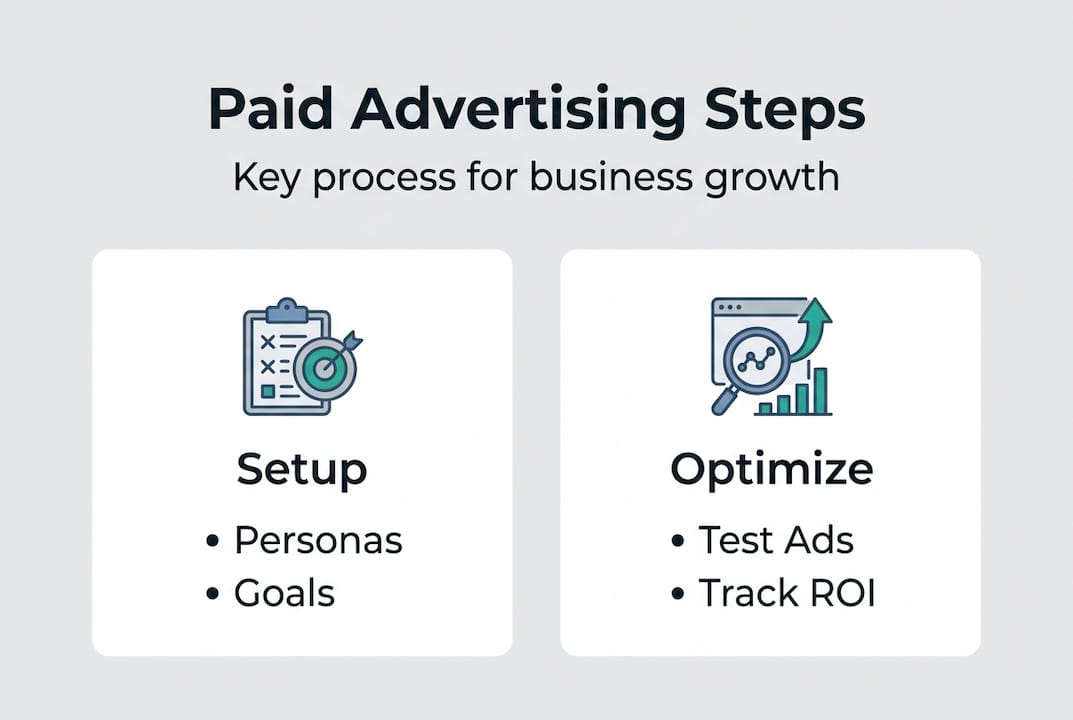
With your prep complete, you’re ready to begin the step-by-step process that ensures every dollar works harder. A structured approach to campaign setup and optimization consistently drives better ROI for small businesses.
-
Research your audience, competition, and keywords. Use tools like Google Keyword Planner, SEMrush, or SpyFu to find what your audience searches for and what your competitors bid on. This shapes your entire strategy.
-
Structure your campaigns and ad groups. Group related keywords and audiences into tight, focused ad groups. One theme per ad group keeps your quality scores high and your messaging sharp.
-
Write compelling ad copy and design creatives. Your headline has about three seconds to earn a click. Lead with the benefit, speak to the pain point, and include a clear call to action. For display and social ads, visuals carry as much weight as the words.
-
Set targeting and budgets. Define geographic targeting, device preferences, and audience segments. Start with a conservative daily budget you can sustain for at least two to four weeks of testing.
-
Launch and monitor closely in the first days. The first 72 hours reveal a lot. Watch for runaway spend on irrelevant queries, low click-through rates, or landing page issues that kill conversions.
-
Optimize continuously with data. This is where the real work happens. Refer to your PPC campaign optimization process regularly: pause weak keywords, test new copy, adjust bids, and refine targeting based on what the data tells you.
Here’s a comparison of two common SMB campaign approaches:
| Approach | Setup time | Learning curve | Best for |
|---|---|---|---|
| Search (Google Ads) | Medium | Moderate | Active buyers ready to purchase |
| Social (Facebook/Instagram) | Fast | Lower | Awareness and nurturing cold audiences |
For a deeper look at converting that traffic into real customers, the lead generation guide covers the full funnel from click to close.
Pro Tip: Never run just one version of an ad. Always create at least two variations so you can split test headlines, images, or calls to action from day one.
Tracking, analytics, and measuring paid ad ROI
Executing campaigns is only half the battle. Real success depends on what you measure and improve. Without solid tracking, you’re flying blind, and that’s where budgets disappear.

Start with the basics. Install your tracking pixels correctly and verify they fire on the right pages. A pixel that misfires on your thank-you page will report zero conversions even when your campaign is working perfectly.
Here are the core metrics every SMB should monitor:
- CTR (click-through rate): Measures how compelling your ad is. A low CTR usually signals weak copy or poor audience targeting.
- CPC (cost per click): Tells you how competitive your keywords or placements are. High CPC isn’t always bad if conversions follow.
- CPL (cost per lead): The true cost of acquiring one interested prospect. This is the number to benchmark and improve over time.
- CPA (cost per acquisition): What you pay for each actual customer. Compare this to your average customer value to know if the campaign is profitable.
- ROAS (return on ad spend): Calculated as revenue divided by ad spend. A ROAS of 3x means you earn three dollars for every dollar spent.
Key insight: Measuring marketing ROI is not just about proving value to stakeholders. It’s the feedback loop that tells you exactly where to put more money and where to cut.
Set up conversion goals inside Google Analytics 4 and your ad platforms so every form fill, phone call, and purchase is captured automatically. Review your data weekly, not monthly. Trends shift fast in paid advertising, and a week of unchecked overspend can wipe out a month of gains.
Troubleshooting, optimizing, and avoiding common pitfalls
Once you’ve launched and started tracking results, it’s time to focus on troubleshooting and maximizing your investment. Even well-structured campaigns run into problems, and knowing how to spot and fix them quickly separates profitable advertisers from frustrated ones.
The most common issues SMBs face include:
- Broad match keywords eating budget: Irrelevant clicks drain spend fast. Use negative keywords aggressively to filter out searches that don’t match your offer.
- Weak landing pages: An ad can win the click, but a confusing or slow landing page loses the lead. Test page speed, clarity, and your call-to-action placement.
- Making changes too quickly: Platforms need data to optimize. Changing bids, budgets, or targeting every two days resets the learning phase and costs you time and money.
- Ignoring audience segmentation: Treating all visitors the same misses the opportunity to retarget warm prospects with different messaging than cold audiences.
- Copying competitors blindly: What works for a larger brand with a bigger budget won’t always translate to your campaign context.
Pro Tip: Before pausing a campaign for poor performance, check whether the landing page, not the ad, is the real problem. Run a quick heatmap test using a tool like Hotjar to see where visitors drop off.
“The businesses that win with paid advertising are not the ones with the biggest budgets. They’re the ones who treat every campaign as a learning opportunity and apply those lessons systematically.”
Ad optimization tips confirm that continuous learning and iteration are what separate campaigns that scale from ones that stall. Build a simple optimization log: note every change you make, when you made it, and what result followed. This habit alone will sharpen your decision-making faster than any course or tool.
Why a process leads to scalable paid advertising wins
Here’s something most marketing advice won’t tell you: the platform you choose matters far less than the discipline you bring to managing it. We’ve seen businesses spend tens of thousands on Google Ads with zero return, and we’ve seen others generate consistent leads on a few hundred dollars a month. The difference is almost always process.
One-off campaigns feel like action, but they produce noise. You spend, you wait, you shrug, and you move on. A process, by contrast, creates a feedback loop. Each campaign teaches you something. Each optimization compounds on the last. Over time, you’re not just running ads. You’re building institutional knowledge about what your specific audience responds to.
This is especially true for SMBs, where every dollar counts. Digital marketing growth for small businesses rarely comes from one lucky campaign. It comes from stacking small wins through disciplined iteration. The businesses that stick to a process, review their data honestly, and make incremental improvements are the ones that eventually scale their ad spend with confidence because they know their numbers.
Don’t treat paid advertising as a gamble. Treat it as a system you build, test, and refine over time.
Get expert help refining your paid advertising process
Building a paid advertising process from scratch takes time, testing, and a lot of trial and error. If you’d rather skip the costly learning curve and get results faster, working with specialists makes a measurable difference.
Ascendly Marketing has been helping small and medium-sized businesses build profitable paid ad campaigns since 2013. Our team provides expert PPC support tailored to your goals, budget, and audience, so you’re not guessing what works. From initial setup to ongoing optimization, we handle the process so you can focus on running your business. Explore our full range of digital marketing services and find out how a structured, data-driven approach can turn your ad spend into real, measurable growth.
Frequently asked questions
What is the typical paid advertising process for small businesses?
A stepwise process starts with audience research and goal setting, moves through campaign setup and creative development, and continues with ongoing tracking and optimization to improve results over time.
How much should I budget for paid advertising as a small business?
Start with a test budget you can sustain for at least four weeks, then scale only after tracking proven ROI from that initial spend. Budget size matters less than your ability to measure and adjust.
How long does it take to see results from paid ads?
Clicks and impressions start immediately, but meaningful conversions typically require two to four weeks of learning and optimization before you can draw reliable conclusions.
Which platform works best for paid advertising?
It depends on your audience. Google Ads works best for capturing high-intent buyers, Facebook and Instagram for awareness and retargeting, and LinkedIn for B2B lead generation.
How do I measure the success of my paid campaigns?
Use tracking tools to monitor leads, sales, and calculate ROI consistently. Make decisions based on data patterns, not single-day results or gut feelings.