

TL;DR:
- Performance marketing is a results-based strategy where small businesses pay only for measurable actions like sales or leads, reducing financial risk. It leverages digital channels such as search, social media, and affiliate marketing, emphasizing tracking, testing, and attribution accuracy for scalable growth. Successful SMBs focus on defining clear funnels, continuous testing, and blending platform data with first-party insights to drive sustainable ROI.
Most small business owners have been burned at least once by a digital ad campaign that ate through budget and delivered nothing but vague “impressions” and “reach” numbers. The good news? There’s a smarter way to spend. Performance marketing is a results-driven digital marketing strategy where you pay only for specific, measurable actions such as sales, leads, clicks, or installs, not just for exposure. This guide breaks down exactly what performance marketing is, how its core channels and payment models work, which metrics actually matter, and how real SMBs are using it to generate serious, verifiable returns.
Table of Contents
- What is performance marketing? Core principles explained
- How does performance marketing work? Channels and methodologies
- Key KPIs and models: What you actually pay for
- Why performance marketing drives real SMB growth: Case studies and ROI
- Performance marketing in 2026: Trends, pitfalls, and expert nuances
- What most SMBs get wrong (and right) about performance marketing
- Need help unlocking growth with performance marketing?
- Frequently asked questions
Key Takeaways
| Point | Details |
|---|---|
| Results-based approach | With performance marketing, you only pay for actions that drive business results, not for exposure. |
| Data-driven optimization | Success hinges on continuously tracking, measuring, and improving based on real outcomes. |
| Ideal for growth | Small businesses can see high ROI by focusing spend on trackable channels tied to revenue. |
| Blend with branding | Combining performance and brand strategies ensures sustainable growth, not just quick wins. |
What is performance marketing? Core principles explained
At its core, performance marketing flips the traditional advertising model on its head. Instead of paying upfront for ad space and hoping someone notices, you pay only when something measurable happens. A customer clicks your ad. A lead fills out your form. A sale goes through. That accountability is what makes it so attractive to businesses watching every dollar.
The performance marketing basics are straightforward: define a trackable action, run campaigns designed to drive that action, and pay based on results. This model transfers much of the financial risk from the advertiser to the channel or platform, because spend is directly tied to outcomes.
How performance marketing differs from traditional and brand marketing
| Factor | Traditional marketing | Brand marketing | Performance marketing |
|---|---|---|---|
| Payment basis | Ad placement/time | Impressions, reach | Clicks, leads, sales |
| Measurability | Low to medium | Medium | High |
| Risk level | High upfront | Medium | Lower, tied to outcomes |
| Time horizon | Short to medium | Long-term | Short to medium |
| Primary goal | Awareness/reach | Trust, loyalty | Conversions, revenue |
This contrast matters because many SMBs fall into one of two traps: they either spend on traditional ads with no clear way to measure results, or they skip marketing entirely because it feels too risky. Performance marketing offers a middle path.
“Pure performance marketing can create a ‘hamster wheel’ dependency, where short-term wins feel good but long-term brand equity quietly erodes. Experts consistently recommend a hybrid approach that combines trackable performance tactics with brand-building for sustainable growth.”
Performance marketing works best when you have a clearly defined end action that can be tracked digitally. Think ecommerce sales, lead form submissions, phone call bookings, or app downloads. It’s less effective for goals like building emotional brand affinity or targeting audiences who are nowhere near a buying decision. For a broader look at where performance fits within your overall strategy, the digital marketing guide for SMBs is a practical starting point.
Key benefits for SMBs specifically include:
- Measurable ROI: You can trace every dollar to a specific outcome
- Lower financial risk: You’re not paying for eyeballs that never convert
- Budget flexibility: You can scale up when something works and pause what doesn’t
- Faster feedback loops: Real-time data lets you adjust campaigns within days, not quarters
- Channel diversity: You can run performance campaigns across search, social, and affiliate simultaneously
How does performance marketing work? Channels and methodologies
Performance marketing isn’t one channel. It’s a methodology applied across several digital channels, each with its own strengths depending on your audience and goals.
Main channels used in performance marketing:
- Search (SEM/PPC): Ads shown on search engines when users type relevant queries. You pay per click (CPC). This channel is powerful because it captures intent. Someone searching “emergency plumber near me” is ready to act.
- Social media ads: Paid placements on platforms like Meta, LinkedIn, TikTok, or Pinterest. These work well for visually compelling products and audience targeting by demographics, interests, or behaviors.
- Affiliate marketing: Partners promote your product and earn a commission for each verified sale or lead. Low upfront risk, but requires careful vetting of affiliate partners.
- Programmatic advertising: Automated buying of display or video ads based on audience data. Algorithms match your ad to users most likely to convert, often in real time.
The performance marketing playbook makes clear that effective campaigns follow a repeatable process: set specific goals, select the right channels, implement tracking infrastructure (like pixels and UTM parameters), and then optimize using real-time data, A/B testing, and machine learning.
Tracking is where most beginners slip up. Without a properly installed pixel or conversion tracking setup, you’re flying blind. A pixel is a small snippet of code placed on your website that records user behavior, like which page they landed on, whether they added an item to their cart, and whether they completed a purchase. This data flows back into your ad platform and tells it which users and ad variations are actually converting.

For deeper guidance on building out your paid campaigns with this foundation in mind, the paid advertising strategies resource walks through the setup in practical terms.
One often-overlooked step is planning digital campaigns in a structured way before you spend a single dollar. Campaigns built around clear funnels and audience segments consistently outperform those launched reactively. The step-by-step digital marketing guide is another resource that helps SMBs lay this groundwork correctly.
Pro Tip: Before launching any performance campaign, map your KPIs directly to your revenue goals. If your average customer is worth $500 and converts 10% of the time from a lead, your maximum acceptable cost per lead is $50. Start there, not with what the platform suggests as a default bid.
Key KPIs and models: What you actually pay for
Understanding payment models is crucial because different models favor different business types and objectives. The most common metrics in performance marketing include CPC, CPA, CPL, ROAS, CTR, and CVR.
Performance marketing payment models explained
| Model | Full name | What you pay for | Best for |
|---|---|---|---|
| CPC | Cost per click | Each click on your ad | Traffic, awareness, retargeting |
| CPA | Cost per acquisition | Each completed sale or conversion | Ecommerce, high-ticket services |
| CPL | Cost per lead | Each qualified lead submitted | B2B, service businesses |
| ROAS | Return on ad spend | Revenue generated per ad dollar | Ecommerce scaling |
| CPM | Cost per thousand impressions | Every 1,000 ad views | Brand reach (less common in pure performance) |
Key KPIs to monitor:
- Click-through rate (CTR): Percentage of people who saw your ad and clicked. A low CTR signals a weak headline or irrelevant audience.
- Conversion rate (CVR): Percentage of clicks that become the desired action. Low CVR often points to a landing page problem, not an ad problem.
- Cost per acquisition (CPA): Total spend divided by total conversions. The north star metric for most SMBs.
- Return on ad spend (ROAS): Revenue divided by ad spend. A ROAS of 4x means for every $1 spent, you earned $4 in revenue.
- Lifetime value (LTV): Not a standard performance metric, but critical for knowing how aggressive you can afford to be on CPA.
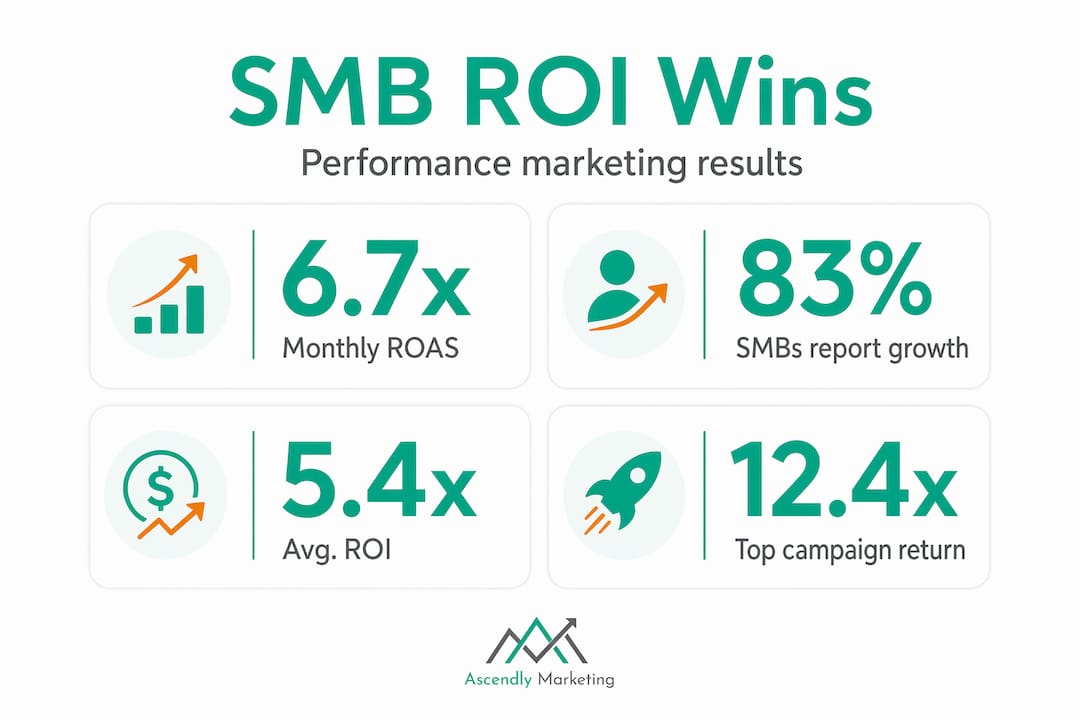
Real SMBs are generating impressive returns. Case studies show ecommerce brands hitting 6.7x ROAS within just 30 days of launching optimized campaigns. Understanding your own numbers and targets before you begin is what makes those outcomes achievable rather than accidental.
For a clear breakdown of how to calculate your own marketing ROI before and after campaigns, the guide on calculating marketing ROI walks through the math in plain language. Pairing that with conversion rate optimization strategies can dramatically lower your CPA without increasing ad spend.
Why performance marketing drives real SMB growth: Case studies and ROI
The numbers don’t lie. Real businesses using structured performance marketing frameworks are seeing transformational results. A small nutrition clinic scaled to 5.4x ROI with 320% revenue growth after implementing a CRM-integrated campaign. An ecommerce brand hit 6.7x ROAS in 30 days. A skincare company grew from 1.4x to 12.4x ROAS over a 90-day optimization period.
These aren’t outliers. They’re the result of applying the same repeatable principles consistently.
Three essential ingredients for repeatable success in performance marketing:
- A defined, trackable funnel. Every campaign needs a start point (ad impression) and a measurable end point (sale, lead, booking). Without this, you can’t learn from your data or improve.
- A testing culture. The brands seeing the highest ROAS are running A/B tests constantly: on ad creative, landing page copy, offer structure, and audience segments. One headline change can double conversion rates.
- Attribution clarity. You need to know which channel or ad actually drove the conversion, not just which one was last clicked. Multi-touch attribution models help, but even a simple first-touch vs. last-touch comparison reveals important patterns.
“Analytics is not a reporting function. It’s a decision-making engine. The SMBs winning with performance marketing treat every campaign as a source of learning, not just revenue.” This insight reflects what analytics-driven ROI consistently demonstrates across industries.
You can explore real results from SMB campaigns in the Ascendly Marketing case studies section, where outcomes are broken down by channel and industry. For a detailed look at the analytics layer behind these results, the guide on marketing analytics for SMBs is worth your time.
Pro Tip: Don’t rely solely on platform-reported conversions. Use your own analytics (like Google Analytics 4 with proper event tracking) alongside platform data to cross-reference results. Privacy changes have made platform attribution less reliable, and blending sources gives you a more accurate picture.
Performance marketing in 2026: Trends, pitfalls, and expert nuances
Performance marketing in 2026 is more complex than it was five years ago, mostly because of privacy. The phaseout of third-party cookies, iOS privacy updates, and tighter data regulations have introduced significant measurement gaps. Platform-only metrics are no longer enough.
The new standard is blended measurement. That means combining:
- Platform analytics (Meta Ads Manager, Google Ads)
- First-party data from your own CRM and website
- Experiments like geo-lift tests and holdout groups to validate causality
- Marketing mix modeling for larger budgets to understand channel-level contribution
Measurement imperfections from privacy changes require consistent calibration and multi-method validation. SMBs with trackable digital funnels still benefit enormously, but those relying on single-platform attribution are almost certainly over or undercounting the impact of specific channels.
Common pitfalls to avoid:
- Optimizing for cheap clicks rather than quality conversions
- Ignoring brand marketing entirely in favor of short-term performance wins
- Scaling budgets before validating that a campaign is truly profitable at a smaller scale
- Using vanity metrics (impressions, reach, follower counts) as a proxy for performance
“Performance marketing is not just a set of channels. It’s a management system built on experimentation, accountability, and continuous optimization.” This framing matters because it shifts the mindset from “set and forget” to iterative growth.
The sustainability risk is real. Businesses that invest only in performance channels and nothing in brand equity become fragile. When ad costs rise (and they will), they have no organic demand or brand loyalty to fall back on. The data-driven marketing strategies that work long-term always integrate both layers. Tracking how your efforts are performing over time using tools covered in measuring website success helps you course-correct before problems compound.
What most SMBs get wrong (and right) about performance marketing
Here’s the uncomfortable truth we’ve seen across hundreds of campaigns: most SMBs who struggle with performance marketing aren’t failing because of their ad budget. They’re failing because they’re optimizing the wrong thing.
Chasing the cheapest possible CPC or CPL sounds smart on paper. But cheap leads from the wrong audience waste your sales team’s time and inflate your real cost-to-close. We’ve seen businesses cut their CPL in half by narrowing targeting, even though it raised the platform’s reported cost. The leads converted at three times the rate.
The “hamster wheel” trap is real. We’ve watched businesses build impressive short-term revenue on paid channels, only to watch it collapse the moment they paused campaigns. No search visibility. No organic traffic. No repeat customers who sought them out intentionally. Performance marketing without brand investment is renting customers, not earning them.
The SMBs who do this well think differently. They treat their ad campaigns as a testing ground for their offer and messaging, not just as a traffic tap. When they find a message that converts well in paid ads, they carry it into their organic content, their email sequences, their sales conversations. The ad becomes a learning vehicle.
Explore real examples of this combined approach in our case studies to see how the numbers bear out in practice.
The most contrarian insight we’d offer: your product-to-market fit and your offer structure matter more than your ad creative. We’ve seen average ads with an outstanding offer crush beautifully designed campaigns built around a weak one. Spend as much time improving what you’re selling and how you frame it as you do optimizing your bids.
Pro Tip: Review your campaign data weekly, but make major strategic decisions monthly. Short-term fluctuations create panic and lead to reactive changes that undo good setups. Build in patience alongside your rigor.
Need help unlocking growth with performance marketing?
Understanding performance marketing is one thing. Executing it profitably across multiple channels while managing a business is another challenge entirely.

At Ascendly Marketing, we’ve been building performance-driven campaigns for SMBs since 2013. Our team specializes in designing strategies that combine paid advertising, analytics, and growth planning to generate measurable outcomes for real businesses. Whether you’re starting from scratch or looking to scale what’s already working, our digital marketing services are built to deliver results you can see in your revenue, not just your dashboard. If you’re ready to build a strategy that works for your specific business model, our small business marketing strategy consulting is a great place to start the conversation.
Frequently asked questions
What actions are typically tracked and paid for in performance marketing?
Advertisers pay for specific conversions such as sales, leads, clicks, or app installs, rather than for ad views or impressions that don’t guarantee any business outcome.
How is success measured in performance marketing?
Success is measured using KPIs like CPC, CPA, CPL, ROAS, CTR, and conversion rates, each of which ties your ad spend directly to a specific, revenue-relevant business goal.
Is performance marketing suitable for every business?
It works best for businesses with trackable digital funnels, like ecommerce stores or lead-gen service businesses, but is less effective for campaigns focused purely on building brand awareness without a measurable end action.
Can small businesses see significant ROI from performance marketing?
Absolutely. SMB case studies show returns ranging from 5.4x ROI to 12.4x ROAS, though results depend heavily on how well the funnel, targeting, and offer are structured before spending begins.