

TL;DR:
- Buyers often bypass stages or revisit earlier ones, making the funnel non-linear.
- Dark funnel sources significantly influence purchase decisions outside tracked channels.
- Clear lead handoff criteria and stage-specific content improve funnel efficiency and conversion.
Most small business owners assume their customers follow a tidy path: they see an ad, visit a website, and buy. Reality is far messier. Buyers circle back, skip stages, and vanish without warning. The result? Wasted ad spend, frustrated sales teams, and growth that stalls despite solid marketing effort. This guide breaks down the marketing funnel in plain terms, explains why leads leak at predictable points, and gives you practical strategies to fix those leaks. Whether you’re new to the concept or looking to sharpen your approach, you’ll walk away with a clear framework you can apply immediately.
Table of Contents
- What is a marketing funnel? The essential concept explained
- Mapping the funnel: From awareness to loyal customer
- Beyond the basics: Non-linear buyer journeys and the dark funnel
- Making your marketing funnel work for your business
- Our perspective: Why the marketing funnel still matters, even when buyers break the rules
- Need help building your perfect marketing funnel?
- Frequently asked questions
Key Takeaways
| Point | Details |
|---|---|
| Funnels define buyer journeys | A marketing funnel maps how strangers become loyal customers. |
| Journeys are not always linear | Buyers frequently loop, skip, or enter at different funnel stages. |
| Leaks and dark funnel exist | Missing alignment and untracked research cause valuable leads to fall through. |
| Optimization is ongoing | Regularly updating funnel strategies reduces leaks and boosts conversions. |
| SMB success needs flexibility | Adapting the funnel to real buyer behavior is essential for small business growth. |
What is a marketing funnel? The essential concept explained
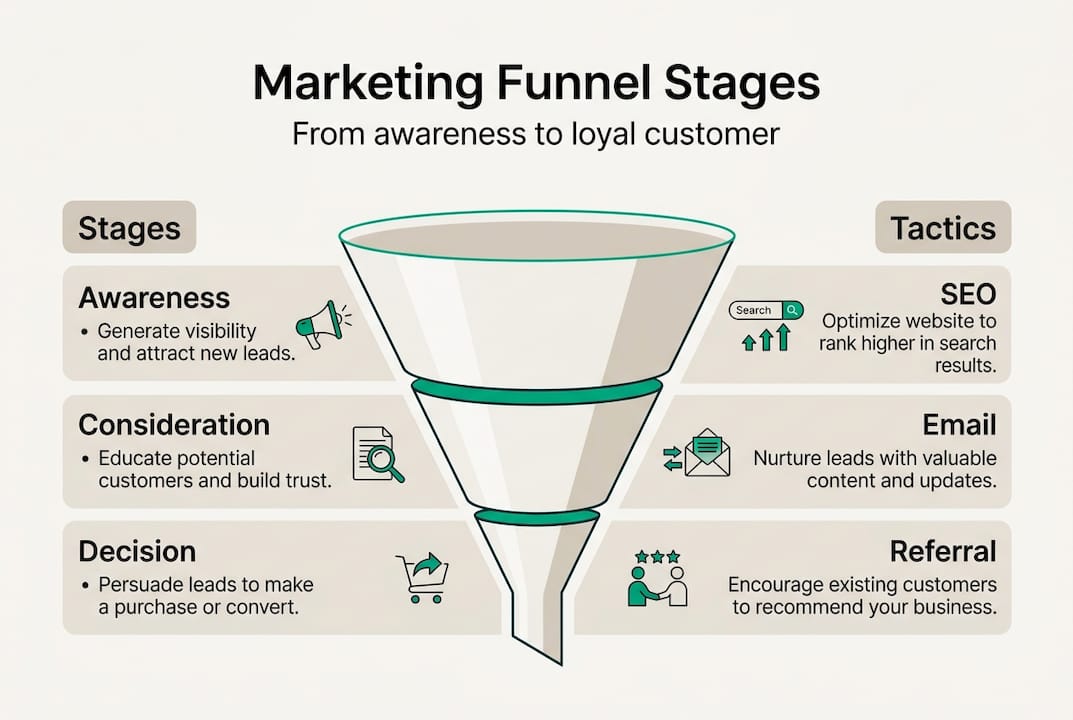
A marketing funnel is a model that maps the journey a potential customer takes from first hearing about your business to becoming a loyal buyer. Think of it like an actual funnel: wide at the top, narrow at the bottom. Many people enter awareness, but only a fraction reach the purchase stage. The funnel helps you visualize where people are dropping off so you can address the problem.
For digital marketing for SMBs, the funnel is the backbone of any growth strategy. It forces you to think about the customer experience as a sequence of steps rather than a single event.
Here are the four core stages most SMBs work with:
- Awareness: The prospect discovers your brand through search, social media, ads, or word of mouth.
- Consideration: They compare you against alternatives, read reviews, and evaluate whether you’re the right fit.
- Decision: They’re ready to buy and just need the right nudge, offer, or conversation.
- Retention: The sale is done, but the relationship continues. Repeat customers and referrals come from this stage.
| Funnel stage | Primary goal | Typical tactics |
|---|---|---|
| Awareness | Reach new audiences | SEO, paid ads, social content |
| Consideration | Build trust and educate | Blog posts, email nurture, case studies |
| Decision | Convert leads to buyers | Free trials, demos, strong CTAs |
| Retention | Increase lifetime value | Loyalty programs, follow-up emails |
Here’s the critical thing most guides skip: funnels are not linear, and leads frequently enter at different stages or loop back through earlier ones. A prospect might find a detailed blog post and jump straight to requesting a quote, bypassing awareness tactics entirely. The funnel is a conceptual map, not a guaranteed customer blueprint.
Pro Tip: Audit your funnel entry points every quarter. If most of your leads arrive mid-funnel through referrals or word of mouth, you need different content to meet them there, not top-of-funnel ads.
Mapping the funnel: From awareness to loyal customer
Knowing the stages is one thing. Seeing how they play out in a real business is another. Let’s walk through each stage with a practical tactic you can apply.
- Awareness: Publish SEO-optimized content that answers the questions your ideal customer is already searching. A local accounting firm, for example, might rank for “how to track business expenses” to pull in small business owners early in their research.
- Consideration: Send a targeted email sequence to new subscribers. Share case studies, comparisons, and behind-the-scenes content. This is where the benefits of content marketing become most visible since consistent, relevant content builds the trust that moves people forward.
- Decision: Make conversion easy. Reduce friction with clear pricing pages, strong testimonials, and a simple call-to-action. If you offer services, a free consultation or discovery call removes the commitment barrier.
- Retention: Don’t treat the sale as the finish line. Follow up, ask for feedback, and create reasons to return. Referral incentives, loyalty discounts, and regular newsletters all work here.
One of the most damaging leaks in the funnel happens between the marketing team and the sales team. In lead generation terms, this is the transition from a Marketing Qualified Lead (MQL) to a Sales Qualified Lead (SQL). An MQL is someone marketing has identified as a likely buyer. An SQL is someone sales has vetted and is ready to pursue. Leads frequently leak at exactly this handoff, often because marketing and sales disagree on what “ready” actually means.
Research consistently shows that misaligned MQL-to-SQL definitions cause significant lead waste. When marketing passes leads too early and sales dismisses them as unqualified, real revenue opportunities disappear into the gap.
Looking at content marketing examples from successful SMBs shows a common pattern: businesses that create stage-specific content, like comparison guides for consideration and ROI calculators for decision, see tighter funnel performance because the content does the qualifying work before any human handoff.

Pro Tip: Sit down with your sales and marketing teams and write a shared, specific definition of an MQL and an SQL. Agreement on criteria reduces friction and prevents good leads from being abandoned.
Beyond the basics: Non-linear buyer journeys and the dark funnel
The classic funnel model is a useful tool, but it was built for a simpler era. Today’s buyers research across dozens of touchpoints before ever contacting a business. Buyer journeys frequently loop, start mid-funnel, and are shaped by sources you can never track.
This brings us to the dark funnel. The dark funnel describes all the research and influence that happens outside your tracked channels. You can’t see it in your analytics, but it’s shaping purchase decisions right now.
Dark funnel examples include:
- Peer recommendations shared in private Slack groups or LinkedIn DMs
- Podcast mentions where your brand gets discussed, but no link is ever clicked
- Reddit threads where buyers compare your product against competitors
- Word-of-mouth conversations at industry events or in online communities
- Saved content that people revisit later without generating a new tracked session
Here’s a comparison of how the two funnel models differ:
| Characteristic | Linear funnel | Non-linear funnel |
|---|---|---|
| Path | Predictable, stage-by-stage | Looping, skipping, reversing |
| Tracking | Mostly visible | Partly invisible (dark funnel) |
| Content strategy | Stage-specific content | Content for all entry points |
| Lead source clarity | High | Low to moderate |
| SMB implication | Easy to model | Requires flexibility |
Understanding digital buyer journeys reveals just how much of the research phase happens before a prospect ever engages with your brand directly. This means your reputation, social proof, and content that exists “out there” on third-party platforms matter as much as your owned channels.
For SMBs, the practical response to this is straightforward. First, invest in brand visibility on the channels where your audience talks, not just where you can track clicks. Second, ask new customers how they actually heard about you, not just what your analytics show. Third, explore B2B marketing best practices that address demand generation holistically, covering both the visible and invisible parts of the journey.
Making your marketing funnel work for your business
Theory is useful. Action is better. Here are the highest-impact steps you can take to improve your funnel performance right now.
- Audit every stage for drop-off points. Use your analytics to identify where traffic or leads are declining. High traffic but low conversions on a product page signal a decision-stage problem. High bounce rates on blog posts signal a consideration-stage mismatch.
- Create content for every stage. Most SMBs over-invest in awareness content and neglect the middle and bottom of the funnel. Build comparison guides, case studies, and FAQ pages that serve buyers who are already close to a decision.
- Define your lead handoff criteria clearly. Document exactly what qualifies a lead to move from one stage to the next. Ambiguity here is expensive. For B2B lead generation tips, this is often the single highest-leverage fix available.
- Use automation to stay consistent. Manual follow-up breaks down under volume. Marketing automation tools allow you to trigger emails, retargeting ads, and notifications based on specific lead behaviors, keeping the funnel moving without constant human intervention.
- Measure retention, not just acquisition. Funnel optimization that stops at the sale misses half the opportunity. Track repeat purchase rates, referrals, and customer lifetime value as actively as you track new leads.
B2B businesses face additional complexity here. B2B buying committees typically include six to ten decision makers, each of whom may be at a different funnel stage simultaneously. Your content and outreach need to speak to the CFO’s budget concerns, the operations manager’s workflow worries, and the end user’s day-to-day frustrations, all at once. A well-structured B2B marketing strategy accounts for this by creating persona-specific content and sequences.
Pro Tip: Map your top three buyer personas to specific funnel stages and assign at least one piece of content to each combination. This simple exercise often reveals major content gaps that explain why leads stall.
Our perspective: Why the marketing funnel still matters, even when buyers break the rules
We’ve worked with SMBs across dozens of industries since 2013, and here’s what we’ve observed: the businesses that dismiss the funnel as “outdated” struggle most with lead quality and revenue predictability. The ones that use it as a flexible diagnostic tool consistently outperform.
The funnel isn’t meant to predict exactly what every buyer will do. It’s meant to give your team a shared language for identifying problems and taking action. When you say “we’re losing people at the consideration stage,” everyone knows where to focus. Without that framework, you’re just guessing.
What we push back on is rigid, linear thinking. Treating every buyer as if they enter at awareness and exit at purchase causes SMBs to miss the prospects who arrive already convinced, or the ones who need six months of nurturing before they’re ready. The value of content at every funnel stage is that it meets buyers wherever they actually are, not wherever your model assumes they should be.
The practical move is to keep the funnel as your map while staying responsive to what your data and your customers actually tell you.
Need help building your perfect marketing funnel?
Understanding the marketing funnel is one thing. Building one that consistently generates and converts leads for your specific business is another challenge entirely.

Ascendly Marketing has helped SMBs design, implement, and optimize marketing funnels since 2013. From strategy to execution, our team covers every stage: content, SEO, paid ads, and automation. If you want a funnel that actually reduces leak points and drives real revenue, explore our digital marketing services or review how we approach digital strategies for small businesses. Book a free consultation, and we’ll show you exactly where your current funnel is losing leads.
Frequently Asked Questions
Why do leads fall out of the marketing funnel?
Leads most commonly exit at key handoff points, particularly the MQL-to-SQL transition, where misalignment between marketing and sales or lack of timely follow-up causes qualified prospects to go cold.
How do B2B funnels differ from B2C funnels?
B2B funnels involve buying committees of 6 to 10 decision-makers, longer sales cycles, and significant purchase influence from dark funnel sources that never appear in your analytics.
What is the dark funnel in marketing?
The dark funnel covers all buyer research outside tracked channels, including private community discussions, podcast mentions, and word-of-mouth conversations that shape decisions before a prospect ever contacts you.
How can SMBs optimize their marketing funnels?
SMBs can reduce leaks by documenting clear handoff criteria, creating stage-specific content for every part of the funnel, and using automation to maintain consistent follow-up without relying on manual effort alone.