

TL;DR:
- E-commerce SEO focuses on high-intent product and category pages for sustainable traffic growth.
- It involves ongoing keyword research, technical optimization, and structured data implementation.
- Investing in e-commerce SEO yields long-term ROI, with traffic and revenue continuing after initial efforts.
Paid ads keep getting more expensive, and the returns keep shrinking. If you’re running an online store and relying mostly on Google Ads or social media spend to drive sales, you already feel the squeeze. The good news is that SEO ROI compounds steeply over time, reaching 2.6x at the 12-month mark, making organic search one of the most cost-effective growth channels available to small and medium-sized businesses. This guide breaks down exactly what e-commerce SEO is, why it works differently from standard SEO, and how your store can start building sustainable traffic that doesn’t disappear the moment you pause a campaign.
Table of Contents
- Defining e-commerce SEO and how it works
- Core components: What powers e-commerce SEO success
- Advanced and emerging trends in e-commerce SEO
- E-commerce SEO for SMBs: Practical strategies and quick wins
- Our take: Why traditional SEO isn’t enough for e-commerce brands
- How Ascendly Marketing accelerates e-commerce SEO growth
- Frequently asked questions
Key Takeaways
| Point | Details |
|---|---|
| SEO builds lasting growth | E-commerce SEO brings a steady stream of potential customers to your store without rising ad costs. |
| SMB-friendly first steps | Start by auditing your site, fixing technical issues, and optimizing product and category pages. |
| Advanced tactics matter | Modern e-commerce SEO includes semantic search, structured data, and AI-driven enhancements. |
| Track real business impact | Focus on organic revenue and customer acquisition cost for clear ROI, not just rankings. |
Defining e-commerce SEO and how it works
E-commerce SEO is not the same thing as general website SEO. It’s a specialized practice built around the way online shoppers search and buy. According to Search Engine Land, e-commerce SEO optimizes product pages, category pages, site structure, and content to improve discoverability in search engines, attracting high-intent organic traffic that drives sales without paid ads.
That last part matters: high-intent. Someone searching “buy waterproof hiking boots size 10” is ready to purchase. E-commerce SEO is designed to put your product in front of that person at exactly the right moment, for free.
Here’s why this matters so much for SMBs specifically. Paid ads give you traffic while the budget runs. The moment you stop spending, the traffic stops too. Organic search traffic, on the other hand, builds like an asset. A well-optimized product page can rank and drive sales for months or years without additional investment. The cost per acquisition drops steadily over time.
The core activities that make up e-commerce SEO best practices include:
- Keyword research focused on what buyers actually type when they’re ready to purchase
- On-page optimization of product titles, descriptions, and meta tags
- Site structure improvements that make it easy for search engines to crawl and index your catalog
- Technical fixes like improving page speed, fixing broken links, and setting up proper redirects
- Content creation that answers buyer questions and supports product discovery
“The biggest mistake SMBs make is treating SEO like a one-time task. E-commerce SEO is an ongoing investment in a channel that pays you back more over time, not less.”
Working with an experienced SEO company in Dallas or wherever your business is based can accelerate this process significantly, especially if your catalog is large or your technical setup needs work. The goal is always the same: build a store that search engines trust and shoppers find naturally.
Core components: What powers e-commerce SEO success
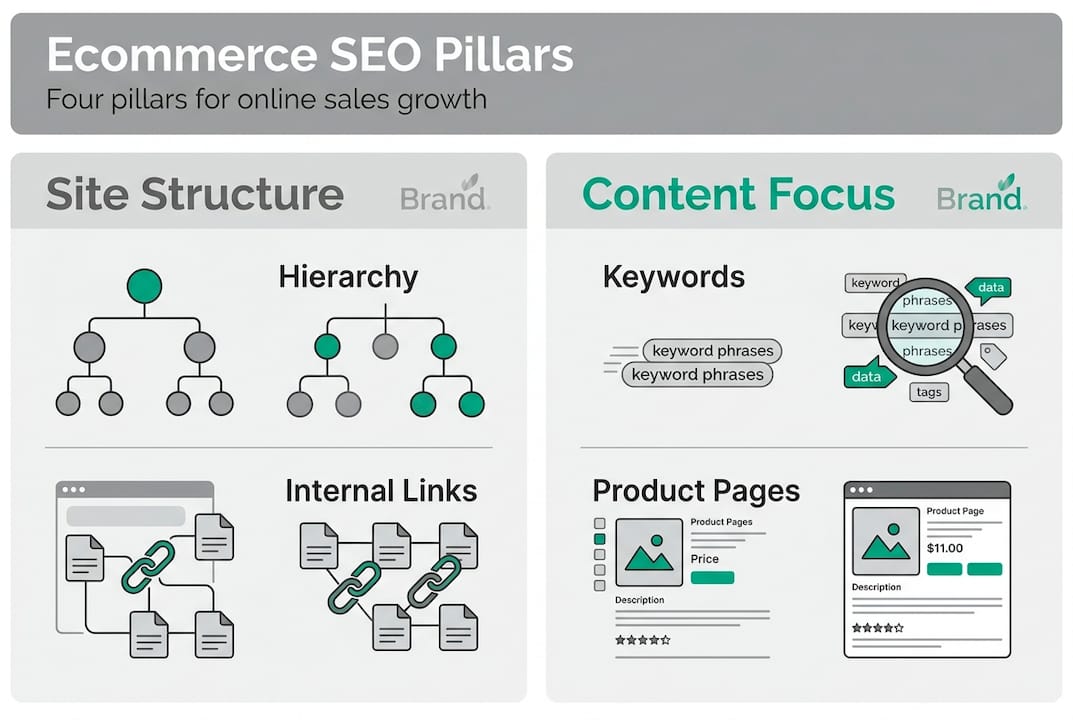
Now that you understand the concept, let’s look at what actually makes e-commerce SEO work. There are four major pillars, and each one plays a distinct role in your store’s visibility.
1. Keyword research with buyer intent
Not all keywords are equal. E-commerce SEO prioritizes transactional and commercial intent keywords. “Best running shoes for flat feet” signals a buyer comparing options. “Buy running shoes online” signals someone ready to check out. Mapping these keywords to the right pages, categories for broader terms, and product pages for specific ones is the foundation of the entire strategy.
2. Product and category page optimization
Every product page needs a unique title tag, a compelling meta description, and a detailed product description that naturally includes target keywords. Category pages need their own optimized content too. Thin or duplicate content across hundreds of product pages is one of the most common reasons e-commerce sites underperform in search.
3. Technical SEO for online stores
This is where e-commerce sites face unique challenges. Core Web Vitals, mobile-first indexing, and structured data like Product and BreadcrumbList schema are all critical. Robots.txt and canonical tags help manage crawl budget, which matters a lot when you have thousands of URLs generated by filters and sorting options.

4. Site hierarchy and internal linking
A clear, logical site structure helps both users and search engines. Products should be reachable within three clicks from the homepage. Internal links from blog content to product pages pass authority and guide shoppers deeper into your catalog. Understanding the role of SEO in website redesign is especially important if you’re planning to rebuild your store.
Here’s a quick comparison to make the differences clear:
| Feature | Basic SEO | E-commerce SEO |
|---|---|---|
| Primary focus | Blog and service pages | Product and category pages |
| Keyword intent | Informational | Transactional and commercial |
| Structured data | Basic schema | Product, Review, BreadcrumbList |
| Crawl management | Simple sitemap | Robots.txt, canonicals, faceted navigation |
| Conversion goal | Leads or awareness | Direct product sales |
Pro Tip: Check your Core Web Vitals in Google Search Console every month. A slow-loading product page doesn’t just hurt rankings. It directly reduces conversions, so fixing speed issues pays off twice. Knowing how to increase e-commerce sales starts with making sure your site loads fast and works flawlessly on mobile.
Advanced and emerging trends in e-commerce SEO
Once your fundamentals are solid, there’s a whole next level of tactics that separate good e-commerce SEO from great e-commerce SEO. These are the areas shaping the future of organic search for online stores.
Semantic SEO and entity optimization
Search engines no longer just match keywords. They try to understand the meaning and context behind a search. Using customer reviews, Q&A sections, and entity mentions (brand names, product attributes, use cases) helps search engines build a richer picture of what your products are and who they’re for. This is called semantic SEO, and it’s becoming more important every year.
AI-assisted content creation
AI tools can help you scale product descriptions and category content faster. But here’s the catch: raw AI output often lacks the depth, accuracy, and trust signals that Google’s E-E-A-T guidelines (Experience, Expertise, Authoritativeness, Trustworthiness) reward. Always have a human editor review and enrich AI-generated content before publishing. A strong content marketing strategy for e-commerce pairs AI efficiency with genuine human expertise.
GEO and AEO: Optimizing for AI-driven search
Generative Engine Optimization (GEO) and Answer Engine Optimization (AEO) are emerging practices focused on getting your content cited by AI-powered search tools like Google’s AI Overviews. GEO enhances traditional SEO by using structured content, citations, and direct answers that AI systems can pull and quote. For e-commerce, this means writing clear, factual product content that answers specific buyer questions.
Key advanced tactics worth implementing now:
- Mine your internal site search data regularly to find what shoppers can’t find on your site
- Track revenue per page instead of just sessions or rankings
- Add Q&A sections to product pages to capture voice search and featured snippet opportunities
- Use structured data markup to enable rich results like star ratings and price displays in search
Statistic to know: SEO ROI compounds to 2.6x at the 12-month mark, which means the brands investing in advanced tactics today are building a compounding advantage their competitors will struggle to close.
Pro Tip: Set up a monthly review of your site’s internal search queries. The terms shoppers type when they can’t find something are often your best keyword opportunities hiding in plain sight.
E-commerce SEO for SMBs: Practical strategies and quick wins
Strategy is only useful if you can act on it. Here’s a practical, prioritized plan for SMBs starting or improving their e-commerce SEO in 2026.
Step-by-step starting plan:
- Run a technical audit. Use a tool like Screaming Frog or Semrush to crawl your site. Fix broken links, duplicate content, missing meta tags, and slow pages first.
- Optimize your top category pages. Add unique introductory copy, target your primary commercial keywords, and make sure each page has a clear title tag and meta description.
- Improve your best product pages. Write detailed, original descriptions. Add customer reviews. Include structured data markup for Product and Review schema.
- Build top-funnel content. Buying guides, comparison posts, and how-to articles attract shoppers earlier in their journey and funnel them toward your products.
- Track organic revenue and customer acquisition cost. Tracking organic revenue and CAC versus paid channels is the clearest way to prove the value of your SEO investment to stakeholders.
Here’s how organic SEO compares to paid ads for SMB e-commerce:
| Factor | Paid ads | Organic SEO |
|---|---|---|
| Cost over time | Increases | Decreases per acquisition |
| Traffic when paused | Stops immediately | Continues |
| Trust signals | Lower (labeled “Ad”) | Higher (organic results) |
| Time to results | Immediate | 3 to 6 months |
| Long-term ROI | Flat or declining | Compounding |
Quick wins you can implement this week: update your meta titles to include the product name and a key benefit, compress all product images to improve load time, and add at least five customer reviews to your top ten product pages. These small changes have an outsized impact on both rankings and conversions. Understanding the benefits of content marketing alongside SEO helps you build a full organic strategy that works at every stage of the buyer journey.
Pro Tip: Focus your first 90 days on long-tail keywords. Phrases like “organic cotton baby onesies 6 to 12 months” have lower competition and higher purchase intent than broad terms, making them far easier to rank for quickly.
Our take: Why traditional SEO isn’t enough for e-commerce brands
Here’s something most SEO guides won’t tell you: following a standard SEO checklist will not cut it for e-commerce in 2026. The gap between traditional SEO and what e-commerce actually requires keeps widening, and many SMBs are still using playbooks built for service businesses or blogs.
Modern e-commerce SEO demands semantic signals, rich snippet optimization, and a genuine focus on customer experience. It’s not enough to stuff keywords into a product title and call it done. Search engines now evaluate trust, depth, and relevance at a much more sophisticated level.
The rise of AI-driven search makes this even more urgent. GEO and AEO differ from traditional SEO in that AI systems optimize for citations and direct answers rather than just clicks. Brands that invest in depth, accuracy, and structured content will get cited by AI tools. Brands that don’t will become invisible.
Our honest advice: stop measuring success by keyword rankings alone. Track revenue per page, organic customer acquisition cost, and assisted conversions. These are the metrics that connect SEO to real business outcomes. If you want a deeper look at how all of this fits into a broader growth strategy, our guide on digital marketing for SMBs is a good place to start.
How Ascendly Marketing accelerates e-commerce SEO growth
If reading this has made you realize your store has untapped organic potential, you’re not alone. Most SMBs we work with are leaving significant revenue on the table simply because their e-commerce SEO hasn’t been built with the right foundation.

At Ascendly Marketing, we offer expert-led e-commerce SEO built specifically for small and medium-sized businesses. From technical audits and on-page optimization to content strategy and structured data implementation, our team handles the full picture. Explore our SEO service agency solutions, learn what organic SEO can do for your store long-term, or browse our full range of digital marketing services to find the right fit. Reach out today for a free site evaluation and let’s build something that grows.
Frequently Asked Questions
What makes e-commerce SEO different from regular SEO?
E-commerce SEO targets product and category pages, focusing on transactional keywords, structured data, and high-intent buyers instead of just general website content.
How long does it take for e-commerce SEO to show results?
E-commerce SEO typically takes 3 to 6 months to see notable growth, with ROI compounding to 2.6x after 12 months of consistent effort.
Do small stores really need SEO, or is it just for big brands?
SEO is especially valuable for small stores because it helps them attract targeted, high-intent shoppers at a much lower cost than paid advertising, even on a limited budget.
What are the first SEO actions for a new e-commerce site?
Start with a technical audit covering crawl, speed, and schema, then optimize your top category and product pages, and create content that answers common buyer questions.