

TL;DR:
- Branding forms the foundation of effective marketing by defining identity, building trust, and differentiating businesses.
- Consistent branding can increase revenue by up to 23% and supports long-term business success.
- Small businesses should focus on clarity, consistency, and storytelling rather than expensive rebrands or logo obsession.
Most business owners think branding means picking a logo and choosing brand colors. That’s the starting point, not the strategy. Brand identity actually serves as the foundation of marketing for SMBs by defining identity, building trust, differentiating from competitors, and enabling customer loyalty and premium pricing. When you treat branding as a commercial framework rather than a design exercise, everything in your marketing gets sharper, more consistent, and more effective. This article walks through how branding drives real marketing results, what the research says, and exactly how you can apply it without a big budget.
Table of Contents
- Branding as the foundation of effective marketing
- How strong branding amplifies marketing results
- Branding strategies for small and medium businesses
- Common misconceptions and nuanced perspectives
- A fresh look: Why branding is your SMB’s best moat
- Connect branding and strategy for real growth
- Frequently asked questions
Key Takeaways
| Point | Details |
|---|---|
| Branding is foundational | Strong branding sets the tone and direction for all effective marketing activities. |
| Consistency boosts results | Consistent branding can raise SMB revenue by over 20% and foster long-term trust. |
| Budget-friendly tactics work | SMBs can achieve big branding impact using clear messaging, content, and partnerships—not just design. |
| Branding outlasts trends | A disciplined brand strategy delivers sustained advantage beyond quick-win tactics. |
Branding as the foundation of effective marketing
Here’s the thing most marketing advice skips: before any campaign, ad, or post can work, your audience needs to know what you stand for. That’s branding. It’s not just your visual identity. It’s your company’s values, voice, and the promise you make to customers every time they interact with you.
Strong branding does several things for your marketing at once:
- Defines your identity: It tells customers who you are, what you believe, and why you exist beyond making a profit.
- Builds trust: Consistent messaging and visuals signal reliability. People buy from businesses they recognize and trust.
- Differentiates you: In crowded markets, branding is what separates you from the competitor offering the same service at a similar price.
- Enables premium pricing: A well-positioned brand can charge more because customers perceive higher value.
- Creates loyal customers: People don’t just come back for products. They come back for brands they connect with.
Think of branding as a commercial framework, not a design project. Your online branding guide should answer the question: “Why should someone choose us?” If you can’t answer that clearly, your marketing campaigns are working harder than they need to.
“A brand is the set of expectations, memories, stories, and relationships that, taken together, account for a consumer’s decision to choose one product or service over another.” — Seth Godin
Pro Tip: Write a one-sentence brand statement that captures your value, audience, and differentiator. Use it as a filter for every piece of content, ad, and campaign you create. If it doesn’t align, cut it.
For SMBs, digital branding for SMBs is especially critical because you’re often competing against larger companies with bigger ad budgets. A clear, consistent brand levels the playing field by building recognition and trust faster than any single campaign can.
Branding isn’t a one-time task. It’s an ongoing discipline that shapes how every marketing dollar performs. When your brand is clear, your ads get better click-through rates, your emails get opened more, and your social content builds a real following.
How strong branding amplifies marketing results
Let’s talk numbers. Because branding isn’t just a feel-good strategy. It has a measurable, documented impact on revenue and growth.
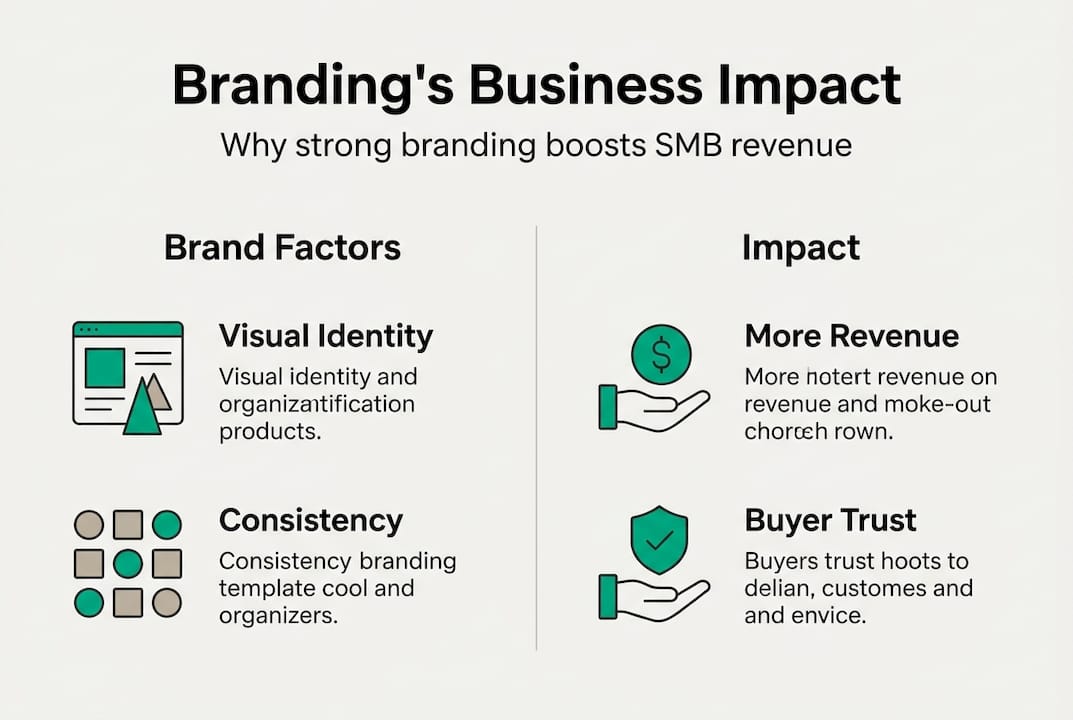
Consistent branding increases revenue by 20 to 23%, and 91 to 93% of executives link long-term branding to sustained business success. That’s not a small edge. That’s a structural advantage.
Here’s a breakdown of what the data tells us:
| Branding factor | Business impact |
|---|---|
| Consistent visual identity | Up to 23% revenue increase |
| Long-term brand investment | Linked to success by 91%+ of executives |
| Brand trust | Key driver of repeat purchases and referrals |
| Brand differentiation | Supports premium pricing and reduced price sensitivity |
These numbers reflect something important: branding compounds over time. Unlike a paid ad that stops working the moment you stop funding it, a strong brand keeps generating returns. Customers remember you. They refer you. They come back without needing to be retargeted.
Here’s what consistent branding does for your marketing specifically:
- Improves ad performance: Familiar brands get higher click-through and conversion rates because trust is already established.
- Reduces customer acquisition cost: When people already know and trust your brand, you spend less convincing them to buy.
- Strengthens word-of-mouth: People recommend brands they feel connected to, not just products they used once.
- Supports content marketing: A clear brand voice makes content creation faster, more consistent, and more effective.
The short-term vs. long-term tension is real for SMBs. It’s tempting to focus entirely on immediate sales through promotions or discounts. But businesses that invest in brand equity alongside performance marketing consistently outperform those that don’t. The brand does the heavy lifting over time, making every future campaign cheaper and more effective.

Branding strategies for small and medium businesses
Budget is the most common objection we hear from SMB owners when branding comes up. The good news: SMBs with limited budgets succeed through clarity, consistency, and low-cost tactics like content and partnerships. You don’t need a six-figure rebrand to build a powerful brand.
Here’s a practical comparison of what works versus what wastes money:
| Common mistake | Smarter approach |
|---|---|
| Obsessing over logo design | Defining your brand values and voice first |
| Full rebrand when growth stalls | Refreshing messaging and consistency |
| Chasing design trends | Building a timeless, recognizable visual system |
| Skipping brand guidelines | Creating a simple one-page brand style guide |
So where do you start? Follow these steps:
- Clarify your brand position: Define who you serve, what problem you solve, and what makes you different. Write it down in plain language.
- Develop a consistent voice: Decide how you sound. Friendly? Expert? Direct? Use that tone across every channel.
- Build low-cost digital assets: A clean website, consistent social profiles, and a content calendar are all you need to start.
- Use storytelling: Share customer success stories, behind-the-scenes content, and your origin story. Stories build emotional connection faster than any ad.
- Form strategic partnerships: Co-create content with complementary businesses. It expands your reach without increasing your ad spend.
Pro Tip: Before you spend on ads, make sure your brand is consistent across your website, social profiles, and email signature. Inconsistency kills trust silently. Customers notice even when they don’t say anything.
Once your brand foundation is solid, layering in content marketing strategies and SEO strategies for SMBs becomes dramatically more effective. Your content has a clear voice. Your SEO reflects a coherent brand story. And your digital marketing steps build on a foundation that actually holds.
Common misconceptions and nuanced perspectives
Let’s clear up the most persistent myths about branding, because they cost SMBs real money and time.
Myth 1: Branding is just your logo.
Your logo is one element of your brand. Branding is the entire commercial framework that includes your reputation, your customer experience, your values, and how people feel after interacting with you. A beautiful logo attached to a confusing or inconsistent experience does nothing for growth.
Myth 2: Branding is only for big companies.
Small businesses actually benefit more from strong branding because they can’t outspend competitors on advertising. A clear brand identity is a force multiplier for limited marketing budgets.
Myth 3: You need a rebrand to fix marketing problems.
Most of the time, the issue isn’t the brand itself. It’s an inconsistency in how the brand is applied. Before investing in a full rebrand, audit whether your current brand is being used consistently across all channels.
There’s also a real debate in marketing circles worth knowing about. Byron Sharp’s research emphasizes mental availability (how easily your brand comes to mind) over deep emotional connection. Rita McGrath’s work focuses more on competitive advantage and differentiation. Both perspectives have merit.
The risk of chasing short-term sales at the expense of brand equity is well-documented. Businesses that constantly discount or run promotions train customers to wait for deals rather than buying at full price.
Here’s what both schools of thought agree on:
- Consistency builds recognition, and recognition builds trust.
- Brand equity takes time to build but pays off compoundingly.
- Digital branding explained for SMBs always starts with clarity of purpose, not aesthetics.
- Innovation is more credible when it comes from a brand customers already trust.
For SMBs, the practical takeaway is this: don’t get lost in the academic debate. Focus on being recognizable, consistent, and trustworthy. That alone puts you ahead of most competitors.
A fresh look: Why branding is your SMB’s best moat
Here’s an uncomfortable truth most marketing agencies won’t tell you: tactics expire. SEO algorithms change. Ad costs rise. Social platforms shift. What doesn’t expire is a brand that customers genuinely trust and recognize.
We’ve seen this pattern repeatedly. SMBs that invest in brand discipline, not just campaign execution, build something that protects them from market volatility. When a competitor undercuts your price or a platform changes its algorithm, a strong brand keeps customers coming back anyway.
Branding acts as a permission system for innovation. When your audience trusts your brand, they give you room to try new things, launch new products, and enter new markets. Without that trust, every new move requires starting from scratch.
The SMBs that struggle most are the ones treating branding as a one-time task. Set it and forget it. But the businesses that grow consistently treat their brand like a living asset. They invest in building online brands the same way they invest in operations: with intention, consistency, and a long-term view.
Brand discipline isn’t glamorous. It’s showing up the same way every day, across every channel. But that consistency is exactly what creates the moat that keeps competitors out.
Connect branding and strategy for real growth
Understanding branding’s role is one thing. Executing it consistently across SEO, content, social media, and paid advertising is another challenge entirely.
That’s where Ascendly Marketing comes in. Since 2013, we’ve helped SMBs translate brand clarity into measurable marketing results. Our integrated approach connects your brand strategy directly to execution across all digital marketing services, from SEO and content to paid ads and web design. If you’re ready to stop running disconnected campaigns and start building something that compounds, explore our SMB marketing guide or book a consultation to see how we approach brand-driven growth for businesses like yours.
Frequently Asked Questions
How does branding impact small business marketing?
Branding gives structure and credibility to every marketing effort, directly boosting revenue, building customer trust, and helping SMBs stand out even without large advertising budgets.
Is branding only about a logo or visual identity?
Branding is a strategic business framework built around values, reputation, and customer experience. Visuals like logos and colors are just one small part of it.
How can I improve branding with a small budget?
Focus on clarity and consistency first. Low-cost tactics like storytelling, content creation, and strategic partnerships deliver strong brand-building results without expensive design overhauls.
Does branding really help with long-term business growth?
Absolutely. Research shows 91 to 93% of executives believe long-term brand investment is essential for sustainable business growth, and consistent branding can increase revenue by 20 to 23%.