

How AI Web Design in Dallas Is Rewriting User Intent for Modern Brands
In a crowded digital landscape, most websites still rely on static assumptions about user behavior. Pages are built, optimized once, and then left to perform indefinitely with minor tweaks. This outdated approach ignores a critical reality. User intent is fluid, contextual, and often unpredictable. That is where AI web design in Dallas is creating a fundamental shift. Instead of designing for a fixed audience, we design for evolving micro-moments.
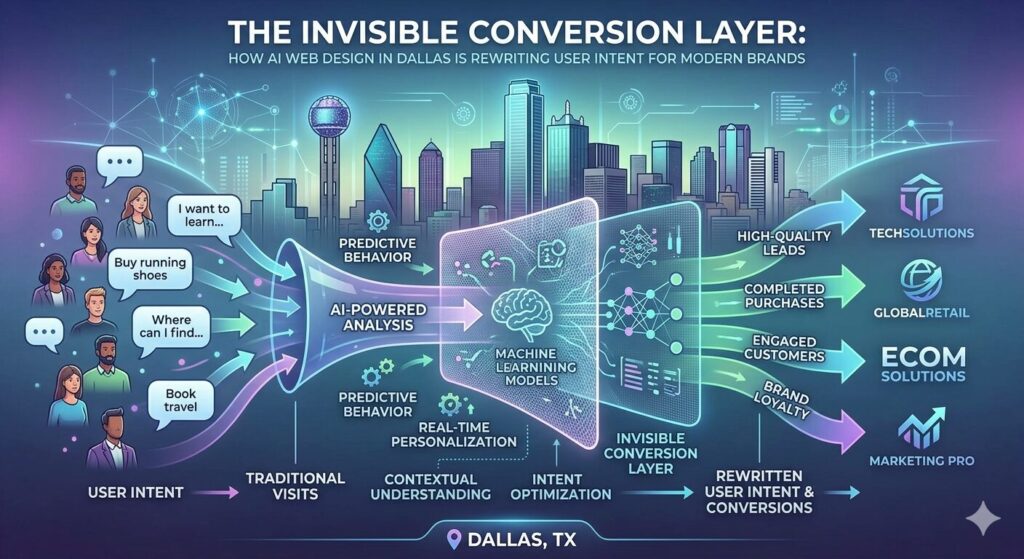
At Ascendly Marketing, we approach AI-driven web design not as a trend but as an operational framework that continuously reshapes how a website understands and responds to its visitors. The result is what we call the invisible conversion layer, a system that adapts in real time to maximize engagement and outcomes.
Moving Beyond Static UX Into Adaptive Experiences
Traditional UX design follows predefined user journeys. While this works in theory, it often fails in practice because real users rarely follow linear paths. AI changes this paradigm entirely.
We build websites that learn from user interactions as they happen. This includes:
• Behavioral pattern recognition
• Session-based personalization
• Real-time layout adjustments
• Dynamic content prioritization
Instead of forcing users into a rigid funnel, the website reshapes itself based on signals such as scroll depth, click patterns, dwell time, and navigation hesitation.
This means two users landing on the same page may experience entirely different versions of it, each optimized for their intent.
The Rise of Predictive Interface Architecture
One of the most underutilized capabilities in web design is prediction. AI allows us to anticipate what a user is likely to do next and prepare the interface accordingly.
We implement predictive models that:
• Preload relevant content before it is requested
• Adjust call to action placement based on likelihood to convert
• Modify navigation structures dynamically
• Surface high intent information earlier in the session
This creates a frictionless experience where users feel like the website understands them without any explicit input.
In a competitive market like Dallas, where businesses fight for attention and retention, predictive interfaces create a measurable advantage.
Designing for Micro Intent Instead of Macro Personas
Most marketing strategies rely on personas. While useful, personas are broad generalizations. AI enables us to go deeper by focusing on micro intent.
Micro intent refers to the immediate goal of a user within a specific moment. For example:
• A user comparing pricing vs a user ready to book
• A visitor researching vs one looking for contact details
• A returning customer vs a first time explorer
We design systems that identify these micro intents within seconds and adapt accordingly. This may involve:
• Changing headline messaging
• Reordering sections of a page
• Highlighting different trust signals
• Adjusting visual hierarchy
This level of precision dramatically improves conversion rates because users are not treated as part of a generic segment.
AI Driven Content Structuring for Search and Humans
SEO and user experience are often treated as separate disciplines. With AI, they become tightly integrated.
We build content systems that:
• Analyze search intent in real time
• Adjust keyword emphasis dynamically
• Optimize readability based on engagement signals
• Restructure content blocks for better flow
Instead of writing one version of a page, we create modular content that can be reassembled based on what the user needs and what search engines prioritize.
This ensures that websites remain competitive in rankings while delivering highly relevant experiences to users.
The Role of Data Feedback Loops in Continuous Optimization
A key advantage of AI web design is that optimization never stops. Every interaction becomes data, and every piece of data improves performance.
We establish feedback loops that:
• Continuously test variations without manual A B setups
• Identify underperforming elements instantly
• Scale winning design patterns across the site
• Eliminate guesswork in decision making
This creates a self-improving system where the website evolves alongside user behavior.
For businesses in Dallas looking to scale efficiently, this approach reduces reliance on periodic redesigns and instead enables ongoing refinement.
Hyper Personalization Without Compromising Speed
One common concern with advanced personalization is performance. Slow websites lose users quickly. AI solves this by optimizing delivery mechanisms alongside experience.
We ensure that:
• Personalization logic runs efficiently in the background
• Content is served through optimized frameworks
• Loading sequences are intelligently prioritized
• Core Web Vitals remain strong
This balance between intelligence and speed is critical. A smart website that loads slowly will still fail.
Emotional Intelligence in Web Design
AI is not just about data. It is also about understanding human behavior on a deeper level.
We integrate sentiment analysis and behavioral cues to detect:
• Frustration signals such as rapid clicks or repeated actions
• Engagement signals like long scroll sessions
• Decision hesitation patterns
Based on this, the website can respond in subtle but powerful ways:
• Simplifying the interface
• Offering assistance prompts
• Highlighting reassurance elements
This creates an experience that feels intuitive and supportive rather than mechanical.
Local Market Intelligence for Dallas Businesses
AI web design becomes even more powerful when combined with local insights. Dallas is a diverse and competitive market with unique user behaviors.
We incorporate:
• Location based personalization
• Regional search trend analysis
• Local competitor benchmarking
• Industry specific user behavior modeling
This ensures that websites are not just globally optimized but locally dominant.
Future Proofing Through Autonomous Design Systems
The future of web design is not manual. It is autonomous.
We are moving toward systems that:
• Generate layout variations automatically
• Adapt branding elements based on audience response
• Evolve navigation structures without developer intervention
• Continuously align with business goals through data inputs
At Ascendly Marketing, we are already building frameworks that support this level of automation while maintaining brand consistency and strategic control.
Why This Matters Now
The shift to AI web design is not optional. It is inevitable. Businesses that continue to rely on static websites will find themselves at a disadvantage as competitors adopt adaptive systems.
The gap will not be incremental. It will be exponential.
Websites will no longer be digital brochures. They will become intelligent platforms that actively participate in conversion, engagement, and growth.
Closing Perspective
AI web design in Dallas is not about adding complexity. It is about removing friction at every level of the user experience.
By focusing on micro intent, predictive behavior, and continuous optimization, we create websites that do more than attract visitors. They understand them.
At Ascendly Marketing, we believe the most effective websites are the ones users do not have to think about. They simply work, adapt, and convert.
That is the invisible conversion layer, and it is redefining what modern web design can achieve.